
Article page checkbox is not checked in page info.
Rules on political groups in the European Parliament
Rules on political groups in the European Parliament
Kamil Baraník, Members' Research Service
Summary
Members of the European Parliament may form political groups; these are organised by political affiliation, not by nationality. Since the first direct elections in 1979, the number of political groups has fluctuated between seven and ten. Following the 2024 elections, the number, size and composition of political groups is likely to continue to fluctuate, with the possible dissolution of some political groups and the creation of new ones.
A minimum of 23 Members, elected in at least one quarter (currently seven) of the EU's Member States, is required to form a political group. Those Members who do not belong to any political group are known as 'non‑attached' Members (non‑inscrits, known as NI).
Although the political groups play a prominent role in Parliament, individual Members and/or several Members acting together also have many rights, including in relation to the exercise of oversight over other EU institutions, such as the European Commission. However, belonging to a political group is of particular relevance when it comes to the allocation of key positions in Parliament's political and organisational structures, such as committee and delegation chairs and rapporteurships on important dossiers. Moreover, political groups receive higher funding for their collective staff and parliamentary activities than non‑attached Members.
Political group funding, however, is distinct from funding granted to European political parties and foundations, which, if they comply with the registration requirements, may apply for funding from the European Parliament.
This briefing updates the previous edition of June 2019, by Laura Tilindyte, which itself updated an earlier edition of June 2015, by Eva‑Maria Poptcheva
Evolution and role of political groups
Members of the European Parliament (MEPs) sit in political groups. These are organised by political affiliation, not nationality. This is a legacy of the European Coal and Steel Community (ECSC) Common Assembly – the precursor to the European Parliament– which, as early as 1953, recognised three trans‑national political groups (Christian democrats, socialists and liberals) in its internal rules of procedure. Several years later, the Assembly abandoned seating by alphabetical seating order in favour of seating by political affiliation, making it a genuine transnational parliament organised along ideological lines.1
Political groups – which are to be distinguished from European political parties (see below) – are central to the work of the European Parliament. Through the creation of political blocs, groups make a significant contribution to the Parliament's operational capability by preventing fragmentation and facilitating the decision‑making process. Political groups are essential to building majorities in Parliament, and in organising, coordinating and supporting the activities of their Members. The vast majority of the total 214 national political parties represented in the outgoing (2019‑2024) Parliament were linked with a political group (see Table 1).
|
1979‑1984 |
1984‑1989 |
1989‑1994 |
1994‑1999 |
1999‑2004 |
2004‑2009 |
2009‑2014 |
2014‑2019 |
1.7.2019 |
1.4.2024 |
|
|---|---|---|---|---|---|---|---|---|---|---|
| Number of MEPs | 410 | 434 | 518 | 567 | 626 | 732 | 736 | 751 | 748 | 705 |
| Number of Member States | 9 | 10 | 12 | 12 | 15 | 25 | 27 | 28 | 28 | 27 |
| Number of political groups | 7 | 8 | 10 | 9 | 8 | 7 | 7 | 7 | 7 | 7 |
| Number of national political parties | 57 | 67 | 103 | 97 | 127 | 168 | 176 | 191 | 203 | 214 |
| Number of national delegations in political groups | 37 | 42 | 64 | 58 | 74 | 109 | 116 | 129 | 128 | 147 |
Source: European Parliament: Facts and Figures, EPRS, April 2024.
Data for the first 8 terms refer to the constituent session.
The political groups in the European Parliament, consisting of several national political parties and factions, have achieved relatively high levels of voting cohesion in plenary sessions. During the ninth term (2019‑2024) the Group of the Greens/European Free Alliance attained the highest level of cohesion (95 %), followed by the Group of the Progressive Alliance of Socialists and Democrats (91 %) and Renew Europe Group (90 %). The Group of the European People's Party (89 %), The Left group (86 %) and the European Conservatives and Reformist Group (83 %). Identity and Democracy group achieved the lowest, although still rather high, level of cohesion (74 %).2
Since the first direct elections in 1979, the number of political groups has fluctuated between seven and ten. The centre‑right Group of the European People's Party (EPP) and the centre‑left Group of the Progressive Alliance of Socialists and Democrats (S&D) have traditionally been the largest groups, flanked by smaller groups on the left, right and in the centre of the political spectrum. The EPP and the S&D groups' combined share in the Parliament amounted to a record 66 % during the 1999‑2004 parliamentary term. However, it has fallen since, dropping to 54.8 % after the 2014 elections (see Figure 1 below). After the May 2019 elections, the EPP/S&D share dropped further, to 44.2 %, rising slightly to 44.9 % at the end of the term (April 2024).
At the beginning of the 2019‑2024 parliamentary term, there were seven political groups. While the number, size and composition of political groups is expected to continue to fluctuate, the seven political groups in the outgoing 2019‑2024 Parliament in order of size (as of 1 April 2024) were:
-
Group of the European People's Party (Christian Democrats – EPP), 178 Members,
-
Group of the Progressive Alliance of Socialists and Democrats in the European Parliament (S&D), 139 Members,
-
Renew Europe Group, 102 Members,
-
Group of the Greens/European Free Alliance (Greens/EFA), 72 Members,
-
European Conservatives and Reformists Group (ECR), 68 Members,
-
Identity and Democracy Group (ID), 59 Members,
-
The Left Group in the European Parliament (GUE/NGL), 37 Members.
An additional 50 MEPs sat as non‑attached Members (Non‑inscrits – NI)
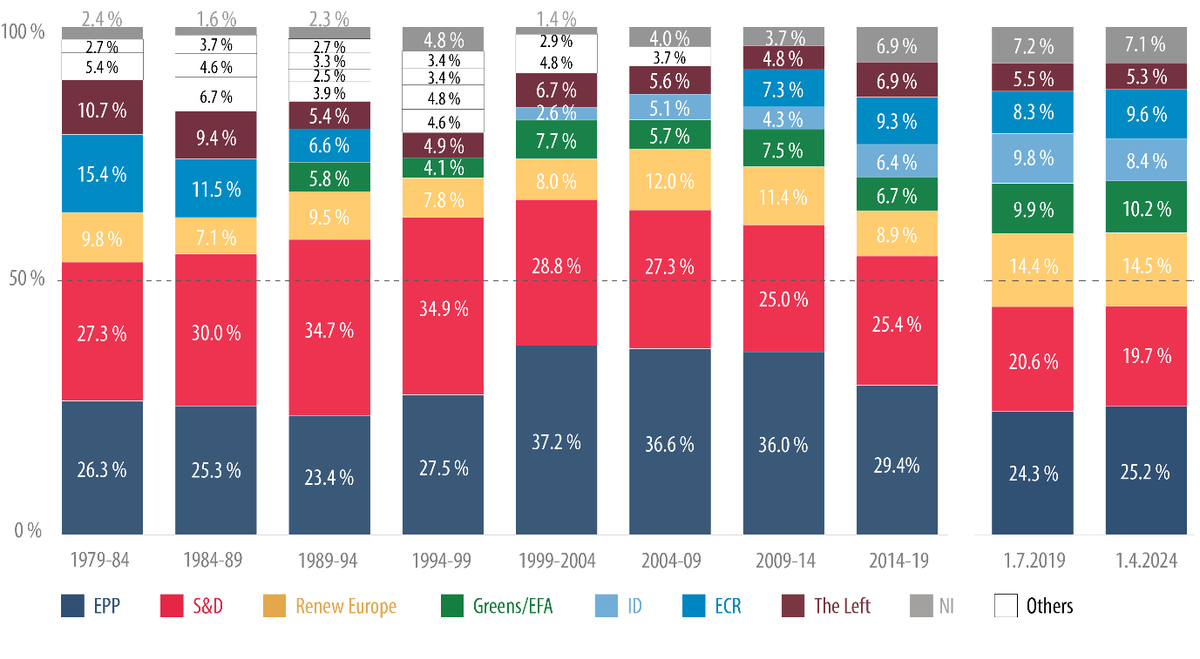
Graphics: Giulio Sabbati, EPRS. Chart showing the changes in the political groups' relative size over the nine legislative terms since 1979. Two groups have dominated throughout the entire period: the European Peoples Party (EPP) and the Socialists and Democrats (S&D). These two groups' combined strength usually accounts for over 50 % of the seats. Only in the most recent term has their combined number of seats dipped under 50 %. In the last legislative term, four parties accounted for almost 70 % of the seats, EPP (25.2 %), S&D (19.7 %), Renew Europe (14.5 %) and Greens/EFA (10.2 %). Source: European Parliament: Facts and Figures, EPRS, April 2024. NB: The figures for the first 8 terms relate to the constituent sessions in July.
Formation and dissolution of political groups
The rules for the formation of political groups are stipulated in Parliament's Rules of Procedure,3 which provide that 'Members may form themselves into groups according to their political affinities' (Rule 33). Parliament does not normally assess the political affinity of members of a group, taking this as read, unless the Members concerned indicate otherwise (interpretation of Rule 33). To form a political group, a minimum of 23 Members elected in at least one quarter of the EU Member States (currently seven) is required. A Member may not belong to more than one political group.
The Rules of Procedure therefore require all members of a new group to declare in a written statement 'that they share the same political affinity' (Rule 33(5)). Formation of a group must be notified in a statement to the President of Parliament. Such a statement must contain: (a) the name of the group, (b) a political declaration setting out the purpose of the group, and (c) the names of its members and bureau members.
The political declaration is defined as follows.
The political declaration of a group shall set out the values that the group stands for and the main political objectives which its members intend to pursue together in the framework of the exercise of their mandate. The declaration shall describe the common political orientation of the group in a substantial, distinctive and genuine way.
Moreover, all members of the group must declare in writing in an annex to the statement that they share a political affinity.
The definition of 'political affinity' has long been a contentious issue, underpinned by the wish to prevent the formation of purely technical groups, created to take advantage of the benefits offered by belonging to a group. In 1999, Parliament rejected the creation of a Technical Group of Independent Members (TDI). When challenged, this decision was upheld by the European Court of First Instance, which considered it as justified to allow Parliament to ensure its proper functioning.
Individual Members may switch their affiliation to a different political group or become non‑attached Members. No provision in the Rules of Procedure limits them from doing so multiple times during the parliamentary term.
One consequence of the United Kingdom's withdrawal from the EU (Brexit) was the departure of the 73 UK Members from the European Parliament. Subsequently, 14 of the remaining Member States gained a total of 27 additional seats. The number of seats in the European Parliament thus fell from 751 to 705 for the remainder of the legislative term. For the new term starting in July 2024, the number of Members increases to 720, with 12 Member States sharing 15 additional seats. While Brexit was one reason for the fluctuation in political group sizes during the ninth term, Figure 2 shows that there have been significant changes in group sizes since the UK's departure on 31 January 2020.
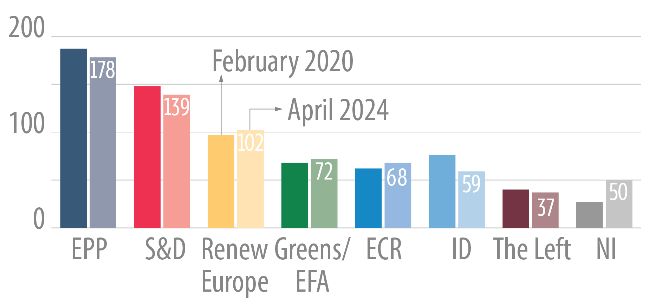
Graphics: Giulio Sabbati, EPRS. Bar chart showing small changes in political group sizes between February 2020 and April 2024. This demonstrates that relative group sizes fluctuate during the legislative term. DUring the most recent term, the two biggest groups ‑ EPP and S&D ‑ saw their numbers decrease, to the advantage of Renew, the Greens, ECR and non‑attached members. Source: European Parliament: Facts and Figures, EPRS, European Parliament, April 2024.
If a group falls below the required threshold during the legislative term, the President, with the agreement of the Conference of Presidents, may allow the group to continue until Parliament's next constitutive sitting, under two conditions: that the Members continue to represent at least one fifth of the Member States, and that the group has existed for a period longer than one year. This exception is not applied if there is sufficient evidence to suspect that it is being abused (Rule 33). The President must announce the establishment as well as the dissolution of political groups in Parliament.
Non‑attached Members do not establish a separate political group, in contrast to some national parliaments, which have a 'mixed group'.
Rights of political groups and of non‑attached Members
Advantages of belonging to a political group
Belonging to a political group is of particular relevance for the allocation of key positions in Parliament's political and organisational structures. For example, nominations for Parliament's President, the 14 Vice‑Presidents and the 5 Quaestors may only be made by a political group or Members reaching at least the 'low threshold' (Rule 15), which is defined as 1/20th of Parliament's Members, i.e. 36 Members from 16 July 2024 (Rule 186). Non‑attached Members can nominate individuals to committees and delegations (Rules 216 and 229), but they are unlikely to be elected to positions as committee chairs or to be appointed rapporteurs on significant dossiers. However, even small political groups may obtain a committee chair position.
Belonging to a political group is also important when it comes to the allocation of speaking time in plenary debates. For the first part of a debate, a first block of speaking time is divided equally among all political groups; a further share is then divided among the political groups in proportion to their size. Finally, Members who do not belong to a political group are allocated an overall speaking time based on the fractions allocated to each political group in proportion to the total number of non‑attached Members (Rule 178). Similarly, only political groups or a group of Members reaching at least the low threshold (36 Members) may request that an extraordinary debate on a matter of major interest relating to European Union policy be placed on the Parliament's agenda (Rule 168).
Rights of individual Members or groups of Members acting together
Although the political groups play a very prominent role in Parliament's life, Parliament's Rules of Procedure provide numerous rights for individual Members and/or several Members acting together. For instance, although only the political group chairs, together with Parliament's President, are members of the Conference of Presidents – Parliament's political body responsible, among other things, for the organisation of Parliament's work, matters of legislative planning (e.g. drafting the agenda for plenary sessions), or issues concerning Parliament's relations with the other institutions and bodies of the European Union and with the national parliaments of Member States – one non‑attached Member is invited by the President to attend its meetings but does not have a vote (Rule 26).
Like any other Member, non‑attached Members can table amendments for consideration in committee (Rule 224) or make a personal statement at the end of the discussion of the agenda item which is being dealt with, or when the minutes of the sitting to which the request for leave to speak refers are considered for approval (Rule 180). Moreover, like political groups, they can participate in the oversight of other EU institutions. Acting together, 36 Members can, for instance, put questions to the Council or the European Commission for oral answer with debate (Rule 142), whilst any Member may put questions for written answer to these and other EU institutions (Rule 144). Moreover, any Member is entitled to participate in question time with the Commission in plenary. The President is required to ensure, as far as possible, that Members holding different political views and coming from different Member States are given the opportunity to put a question to the Commission during such sessions (Rule 143).
Members can put a question to another Member by raising a 'blue card' during that Member's speech (Rule 178) and make one‑minute‑long explanations of vote (Rule 201). Furthermore, at least 39 Members can ask the President for a vote to establish whether a quorum is present, whereas political groups are not entitled to make such a request on behalf of their Members (Rule 185).
Any Member, as well as a group of up to 10 Members, may table a legislative proposal based on the (indirect) right of initiative conferred upon Parliament under Article 225 of the Treaty on the Functioning of the European Union (TFEU) and (Rule 47). However, following such a proposal, a legislative‑initiative report must be adopted by a parliamentary committee. The decision to request authorisation to draw up own‑initiative reports is prepared by the political group coordinators in the committee concerned. While non‑attached Members do not participate in coordinators' meetings, they must be guaranteed access to information regarding the proceedings (interpretation of Rule 220).
The payment of salaries to Members' accredited assistants is covered by separate budget items, with every Member having the same amount at their disposal to spend on assistants regardless of group membership.
(Article 29(4), Implementing measures for the statute for Members).
Financing and staff
The European Parliament budget is the sole source of funding for political groups and non‑attached Members. Budget allocations to political groups and non‑attached Members are subject to decisions laid down by Parliament's Bureau. Appropriations are made available under rules on the use of appropriations from budget item 400 (Current administrative expenditure and expenditure relating to the political and information activities of the political groups and non‑attached Members) of the general budget of the Union, and amount to €67.5 million for 2024 (€66 million in 2023). This is intended to cover both the administrative and operational expenditure (staffing and other parliamentary activities) of the secretariats of political groups and non‑attached Members, and expenditure on political and information activities conducted in connection with the Union's activities. Funding European political parties comes under a different budget line (see below) and the amounts cannot be used for any European, national, regional or local electoral campaign. The Bureau allocates the budget at the beginning of each year, on the basis of the number of Members in each group (and the number of non‑attached Members) as of 1 January of the year in question, according to a proposal from the chairs of the political groups.
Each political group receives its annual budget for political and information activities at the beginning of the year, and is responsible for the management of its expenditure. By contrast, Parliament's secretariat settles expenditure for non‑attached Members, either through direct payments to suppliers or through reimbursement. The Parliament's administration verifies that all such expenditure for non‑attached Members complies with the rules.
The audited annual statements of political group revenue and expenditure, together with consolidated statements for all non‑attached Members, are prepared by Parliament's secretariat and delivered to the Bureau and to the Committee on Budgetary Control, and published on Parliament's website. Up to 50 % of the annual appropriations not used by groups or by the non‑attached Members may be carried over to the following year. Any amount exceeding this limit is returned to Parliament. Years in which European elections are held are split into two budgeting periods (1 January to 30 June and 1 July to 31 December). In such years, for the purpose of calculating the carry‑over for groups that continue to exist after the elections, the two half‑yearly periods are aggregated and regarded as a single financial year.
Each political group establishes a secretariat, funded from Parliament's budget. The number and grades of the – predominantly temporary – staff are determined in proportion to the number of Members in the group. Non‑attached Members are also provided with a secretariat paid from Parliament's budget. Political groups may also employ contractual staff, using funding under budget item 400, whereas non‑attached Members may not use such funding for this purpose.
Changes in the composition of groups
Changes in the composition of political groups (or non‑attached Members) during the course of the financial year result in a re‑allocation from the beginning of the following month, but which effectively takes place only at the beginning of the following financial year, when the appropriations are paid (and any recovery of sums paid is effected). Where a non‑attached Member joins a political group, the balance of appropriations not used by the non‑attached Member is, if appropriate, transferred to the group concerned.Accordingly, if a new political group is formed in the course of a legislative term, its allocations for the calendar year of its formation would be funded partly from allocations paid to any non‑attached Members joining the group and partly from a redistribution of allocations to the existing groups, with the latter taking effect only at the beginning of the following financial year, unless the Bureau decides otherwise.
European political parties and foundations
The political groups in the European Parliament are not identical to the European political parties. Most of the national parties represented within a given political group are also members of the corresponding political party at EU level; however, in some political groups there is more than one European political party. Moreover, one and the same political group may house several national parties from the same country. Members can normally join a political group in the Parliament, even if they do not belong to a national party that is a member of the related European political party, under conditions laid down in the rules of the group concerned.
European political parties are (con)federations of national political parties and/or individuals as members sharing a political affiliation and registered with the Authority for European political parties and European political foundations. The role of political parties at EU level is set out in Article 10(4) TEU and Article 12(2) of the EU Charter of Fundamental Rights, stipulating that 'Political parties at European level contribute to forming European political awareness and to expressing the will of citizens of the Union'. The importance of European political parties for democracy at EU level is thus twofold. On the one hand, they represent the link between Union citizens and the public power in the European institutions.4 On the other, European political parties function as channels for a truly European public debate in a transnational public space.
European political parties came under the spotlight in the 2014 and 2019 European elections, with most European political families nominating lead candidates for the position of the President of the European Commission. After this Spitzenkandidaten process reached an impasse and failed to produce the name of the European Commission President after the 2019 elections, some European political parties expressed doubts about the procedure and did not select one lead candidate for the 2024 European Parliament elections. Some of them selected several candidates (e.g. the parties making up the Renew Europe group), whereas others selected none at all.
Since July 2004, European political parties have been able to receive annual funding from the European Parliament for their activities at EU level. The rules governing the European political parties and their funding are laid down in Regulation 1141/2014, adopted by the Parliament and Council following the ordinary legislative procedure (Article 224 TFEU). This regulation has been amended twice. In 2018, the main goal was to prohibit multi‑party membership and modify financing rules. In 2019, the legislators strengthened the protection of personal data ahead of the 2019 European elections. A recent attempt was made to further amend the regulation, because of the growing importance of European political parties. However, the negotiations stalled in 2023, as the co‑legislators could not reach agreement. In 2024, the budget available for grants to European political parties was set at €50 million ('budget item 402 of the budget of the EU').
European political foundations are organisations affiliated with a European political party. They underpin and complement the objectives of the party concerned, and have to be registered with the Authority for European political parties and European political foundations. They are intended to contribute to the debate on European public policy issues, inter alia, by organising conferences and conducting studies. They can apply for funding from Parliament through the European political party to which they are affiliated and that is represented in the European Parliament by at least one Member. In 2024, the maximum available budget for European political foundations amounted to €24 million (budget item 403).
Main references
- Ahrens P., Elomäki A. and Kantola J. (eds.), European Parliament's Political Groups in Turbulent Times, Palgrave, 2022.
- Coosemans T., Les partis politiques européens, Courrier hebdomadaire du CRISP, No 2201‑2202 (2014), pp. 1‑123.
- Corbett R., Jacobs F. and Neville D., The European Parliament, 9th edition, John Harper Publishing, 2016.
- Ripoll Servent A., The European Parliament, Red Globe Press, 2017.
Endnotes
Classification
Policy areas: EU Democracy, Institutional and Parliamentary Law | Democracy
Regions: European Union
Disclaimer
This document is prepared for, and addressed to, the Members and staff of the European Parliament as background material to assist them in their parliamentary work. The content of the document is the sole responsibility of its author(s) and any opinions expressed herein should not be taken to represent an official position of the Parliament.
Copyright
© European Union.
The reuse of this document is authorised under a Creative Commons Attribution 4.0 International (CC-BY 4.0) licence.

To use or reproduce elements that are not owned by the European Union, permission may need to be sought directly from the respective rightsholders.