
Article page checkbox is not checked in page info.
European Parliament's scrutiny of the European Council: The use of Parliament resolutions
European Parliament's scrutiny of the European Council: The use of Parliament resolutions
Ralf Drachenberg with Paweł Bącal, European Council Oversight Unit
Summary
Resolutions are an essential way for the European Parliament to express its views on political processes, EU policies and developments in the world. Parliament also uses them to scrutinise other EU institutions, including the European Council. The need for accountability and increased scrutiny of the European Council has been a constant theme in the European Parliament's resolutions throughout the 2019-2024 legislative term. The increased need to scrutinise the European Council also results from the changing role of the institution over recent years.
Based on an analysis of Parliament's resolutions, this briefing will present the need for democratic oversight of the European Council and outline the different tools at Parliament's disposal to do so. It provides a unique overview of the content of Parliament's resolutions addressing the European Council and the messages it sends to EU leaders. Finally, the briefing identifies potential ways of further strengthening Parliament's scrutiny of the European Council.
The European Council and the need for scrutiny
It is necessary to correct institutional imbalances that have arisen over time and to increase the accountability of the executive toward the legislature, in particular to grant Parliament scrutiny powers over the European Council.
European Parliament, 14 September 2023.
The European Council – a formal EU institution since the entry into force of the Treaty of Lisbon – consists of the Heads of State or Government of the 27 EU Member States, the President of the European Council and the President of the European Commission. The European Council's core role is to 'provide the Union with the necessary impetus for its development and define the general political directions and priorities' (Article 15(1) of the Treaty on European Union (TEU)). Over the last decade, and notably fuelled by the various crises the EU has had to face, the European Council has expanded its influence over policymaking, which some consider to be 'legislative trespassing',1 and has de facto assumed executive powers. This development has been pointed out by Parliament:
under the pressure of the crisis, the European Council has considerably aggrandised its role, increasing the number of extraordinary meetings and raising to European Council level matters normally dealt with at Council of Ministers level; whereas in this respect the European Council has gone beyond the crucial Treaty injunction that it has no legislative functions. 2
Parliament has repeatedly criticised the growing institutional imbalance and, during both the ninth and eighth legislative terms, called for the situation to be remedied. In 2019, for example, it stated that the 'European Council has, against the spirit and the letter of the Treaties, taken a number of important political decisions outside of the Treaty framework, thereby de facto excluding those decisions from the oversight of Parliament and undermining the democratic accountability which is essential with regard to such European policies'.3
Accountability is one of the central principles of democracy. This principle also applies to the European Union: Article 10 TEU explicitly provides that 'the functioning of the Union shall be founded on representative democracy'. Therefore, all the institutions shall be accountable either to the citizens directly, or to their representatives.
As Parliament underlined following the entry into force of the TEU, notably in its December 2013 resolution, members of the European Council, while being accountable individually to their own national parliaments, collectively are accountable only to themselves.4 Academics have argued that, in the EU's architecture, the European Parliament is the only institution that might be able to provide a forum for democratic oversight over the European Council as a collective entity.5
Parliament has been given a general political oversight function over the executive in the Treaties (Article 14(1) TEU). In an EU framework described by many observers as having a 'dual executive' split between the European Commission and the European Council – with respective responsibilities differing according to policy area – the Treaties provide the European Parliament with a number of instruments to hold the European Commission and its President accountable (e.g. censuring the Commission). However, they do not provide Parliament with similar instruments to hold the European Council and its President to account.
This rise in influence of the European Council has not been accompanied by the necessary increase in its accountability. On the contrary, it has even been argued that, in the context of the negotiations on the multiannual financial framework (MFF), 'the European Council's dominance distorted the institutional balance laid down in the Treaties … and undermined the transparency and democratic accountability of the decision-making process … the role played by the EUCO is difficult to reconcile with the wording and spirit of the [Lisbon Treaty]'.6 Therefore, as the role of the European Council has increased, so has the need for the scrutiny.
Parliament's tools for scrutinising the European Council
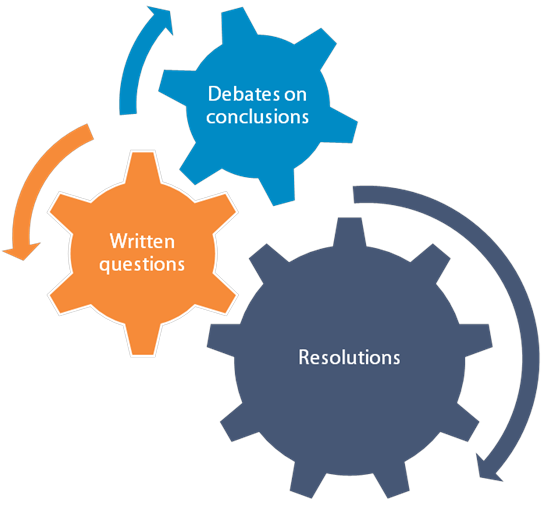
With room for improvement, Parliament already has a range of tools at its disposal to scrutinise the activities of the European Council. The main ones are: i) plenary debates with the President of the European Council; ii) the use of written questions to the President of the European Council; and iii) European Parliament resolutions (see Figure 1).
Source: EPRS.
Plenary debates with the President of the European Council
The Treaties do not say much about the relations between the European Council and the European Parliament, and do not refer specifically to a European Parliament scrutiny function vis-à-vis the European Council. The only provision in that context concerns the President of the European Council. Article 15(6)(d) TEU provides that the President of the European Council has to present a report to the European Parliament after each of the [formal] meetings of the European Council.7 While this provision does not make the European Council President accountable to Parliament, EPRS research has shown that plenary debates with the President of the European Council following its meetings are an important means of holding this EU institution accountable. Indeed, these debates constitute the only EU-level forum where the European Council's results are examined and scrutinised.8
Written questions to the President of the European Council
The first full-time President of the European Council, Herman Van Rompuy, agreed to voluntarily answer written questions from Members of the European Parliament, insofar as they dealt with his own political activities rather than those of the European Council as an institution. This practice was maintained by both of his successors, Donald Tusk and Charles Michel. Over time, the possibility of putting written questions to the President of the European Council, in addition to representatives of the Council and the European Commission, has been included in Rule 138 of the Rules of Procedure of the European Parliament.
Parliament resolutions
Resolutions are an important means for Parliament to express its views on political processes, EU policies and developments in the world. Parliament can also use them to scrutinise other EU institutions, including the European Council. In contrast to the previously mentioned tools, resolutions represent Parliament's majority view, not only that of individual MEPs or political groups.
Parliament adopts three different types of resolution. The first are legislative, adopted under the ordinary legislative procedure or under other procedures envisaged by the Treaties. The second are resolutions adopted in the budgetary procedure. The third are non-legislative, which Parliament adopts on its own initiative. This third type gives Parliament more flexibility, as it can address any topic it considers relevant. Although such resolutions are non-binding (i.e. recipients are not obliged to follow Parliament's calls), they are nonetheless significant tools, through which Parliament can influence other institutions' activities by drawing their attention to a specific issue.
Parliament's resolutions mentioning the European Council
How often does Parliament address the European Council in its resolutions? What are the topics and what messages do they contain?
During the 2019-2024 legislative term, Parliament adopted 2 337 resolutions, of which 426 contained a reference to the European Council (18 % of all resolutions). However, only 162 of them included references to the European Council that are not of a strictly procedural nature.9 The following analysis examines the origin, communication, topics and messages of these 162 resolutions.
Origin of the resolutions
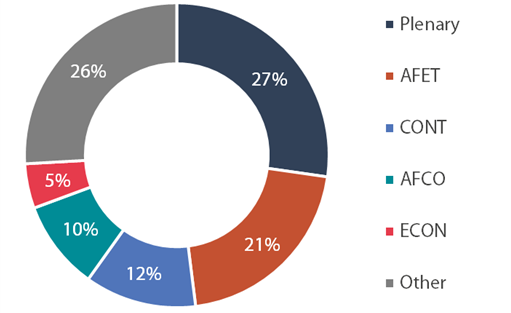
Parliament had 20 standing committees in the 2019-2024 legislative term. Figure 2 shows that the majority of Parliament's resolutions referring to the European Council originated from four committees: the Committee on Foreign Affairs (AFET), the Committee on Budgetary Control (CONT), the Committee on Constitutional Affairs (AFCO), and the Committee on Economic and Monetary Affairs (ECON). This is to be expected, as these committees deal with topics which are debated more often by the European Council and for which the latter has specific competences – such as foreign affairs and defence (Article 24 TEU) or Treaty changes (Article 48 TEU) – or a specific role, such as Euro Summits.
Source: EPRS.
At the same time, many resolutions addressing the European Council do not originate from a committee. Instead, they originate directly from the plenary, where they are generally initiated by one or more political groups in Parliament.
Communicating Parliament's views on the European Council
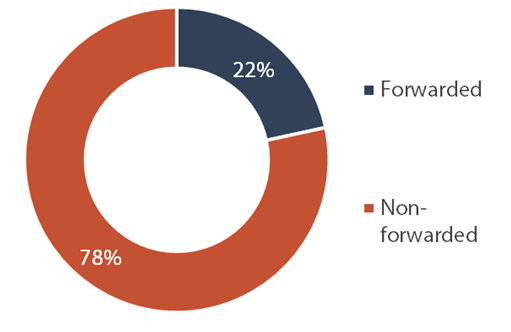
Parliament's resolutions normally finish with a sentence instructing its President to forward the resolution to the relevant actors – most of the time, the other EU institutions. Specifying the addressee(s) increases the chances that Parliament's voice will be heard. However, as Figure 3 shows, Parliament rarely uses this tool in the context of the European Council. Only 22 % of the resolutions – even though they talk about the European Council – specifically mention that the resolution should be forwarded to the European Council. One explanation could be that Parliament does not have an automatic reflex of adding the European Council to the addressees, as many resolutions concern legislation and the European Council does 'not exercise legislative functions' (Article 15 TEU).
Source: EPRS.
Topics on which Parliament addresses the European Council
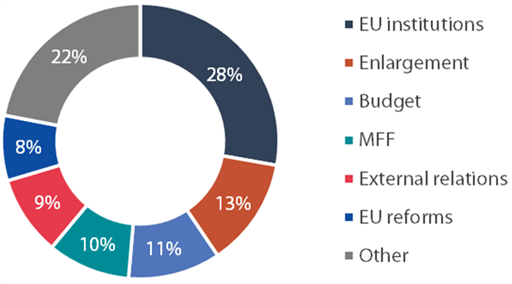
Overall, Parliament mentioned 20 different topics in its resolutions addressing the European Council. Some of them – like policy on migration or cohesion – are invoked only a few times, whereas others are referred to more often. As shown in Figure 4, the topic of 'EU institutions' stands out, being mentioned on 28 % of occasions,10 followed by 'Enlargement' (13 %), 'Budget' (11 %), 'MFF' (10 %), 'External relations' (9 %), and 'EU reforms' (8 %).
Source: EPRS.
EU institutions
The topic of 'EU institutions' relates to the EU institutional architecture within the current Treaty framework. Parliament has raised three main issues in relation to the European Council. The first relates to the Spitzenkandidaten procedure, which, in Parliament's view, should be formalised in an institutional agreement between the European Parliament and the European Council. Moreover, as Parliament sees it, the European Council should consult the leaders of the European political parties and wait for Parliament to propose a common candidate for the position of European Commission President.
Secondly, Parliament has regularly highlighted the growing institutional imbalance and called on the European Council to remain within the current Treaty framework, which prohibits the latter from exercising legislative functions. According to Parliament, the European Council's practice of adopting very detailed conclusions is not in compliance with the Treaty provisions.
Thirdly, Parliament has addressed the issue of transparency in the European Council. However, this has mainly concerned the European Council President and his meetings with lobbyists, as well as the European Council's internal rules on the 'revolving door'. In addition, Parliament has called on national parliaments to monitor their leaders' activity in the European Council.
Enlargement
Parliament has addressed the European Council on enlargement-related issues on a number of occasions, giving two main messages. First, Parliament has expressed its support for the enlargement process, and encouraged the European Council to grant applicant countries candidate status, with a view to opening negotiations with some of them at a later stage. Parliament has also welcomed the European Council's decision to open negotiations with certain candidate countries, and criticised it when it failed to do so – as was the case with North Macedonia and Albania. Second, Parliament sees the need to familiarise candidate countries' leaders with the EU's work early in the negotiation process. Hence, it has called on the European Council to involve candidate country leaders in the EU leaders' activities on the margins of the European Council. Parliament has also taken over some activities in this respect and called for interparliamentary dialogue with the candidate countries, as was the case in previous enlargement rounds.
Budget
Considering Parliament's budgetary powers, the EU's annual budget and Parliament's connected role as discharge authority represents a notable share of its work. This is also reflected in Parliament's resolutions mentioning the European Council. Indeed, notwithstanding the 1970 'Gentlemen's Agreement', an arrangement according to which the Council and Parliament commit 'not to make amendments to the estimate of expenditure' by the other, over the years Parliament has developed a practice of also adopting a position on the Council and European Council budget, as these two EU institutions have a common budget. In the 2019-2024 term, Parliament refused each year to discharge the Council and European Council budget. Parliament has called on these institutions to separate their budgets to improve transparency and criticised them for not following this recommendation. Parliament also monitors the expenses of the European Council President, criticising them if they do not seem justified. Lastly, Parliament addresses the European Council with regard to the size of the annual budget, welcoming increases and, more often, criticising cuts.
MFF
As discussions on the 2021-2027 MFF took place early in the 2019-2024 legislative term, Parliament addressed the European Council several times on that matter, highlighting two messages. Parliament expressed the view that the European Council exercised too much power over the negotiation process by delaying its final decision on the MFF and adopting very detailed conclusions. This approach left little room for negotiations between the Council and Parliament. Regarding the size of the MFF, Parliament strongly advocated increasing the EU's budgetary capabilities, and thus welcomed individual increases and criticised cuts in specific funding.
External relations
In its resolutions concerning external relations, Parliament addresses the European Council on a broad range of topics, not only on Ukraine and the Middle East, but also ranging from support for Colombia to the situation in Cambodia. In these resolutions, it notes and condemns human rights violations across the world, urging the European Council to do the same. Parliament also sees the need for a more systematic approach, calling on the European Council to adopt an EU human rights sanctions mechanism. Parliament also supported the involvement of the European Council President in the peace talks between Armenia and Azerbaijan.
EU reforms
Parliament not only addresses the current institutional setting as mentioned above, but also outlines its views on how to change it. The European Council is referred to in that respect due to the significant role it plays in the Treaty change process. As provided for in Article 48 TEU, the European Council examines the proposals for Treaty change and decides on the next steps, notably by convening a Convention and Intergovernmental Conference. Following the Conference on the Future of Europe, Parliament has put forward proposals for Treaty change and repeatedly called on the European Council to advance on this issue. Moreover, it has urged the European Council several times to change the voting system in the Council, from unanimity to qualified majority voting (QMV) in selected areas, most prominently external relations. Finally, in Parliament's view, there is a need for a change in its relationship with the European Council, notably by granting Parliament scrutiny powers over the European Council.
European Council conclusions
As outlined above, the plenary debates on the conclusions of the European Council with its President constitute key moments for Parliament's scrutiny of the European Council. There were only two specific resolutions on the conclusions of the European Council or on the debates with its President during the ninth term – although the conclusions of 25 meetings of the European Council were discussed in plenary with the European Council President.
The first resolution was adopted in 2020 and concerned the conclusions of the 17-21 July special European Council meeting on the MFF, when EU Heads of State or Government politically agreed the new financial framework. Parliament regretted that the European Council had adopted its position 'extremely late' and recalled that 'the European Council's conclusions on the MFF represent no more than a political agreement between the Heads of State and Government'. Parliament also stressed that it 'will not rubber-stamp a fait accompli and is prepared to withhold its consent for the MFF until a satisfactory agreement is reached in the upcoming negotiations between Parliament and the Council'. This resolution was forwarded to the European Council. The second resolution on the European Council's conclusions was issued in 2022 in the context of Russia's full-scale aggression against Ukraine. Parliament welcomed the European Council's Versailles Declaration adopted at the informal European Council meeting, stating that Ukraine was a member of the European family. This resolution had many recipients (including the Presidents of Russia and Belarus); however, the European Council was not among them.
Messages for the European Council
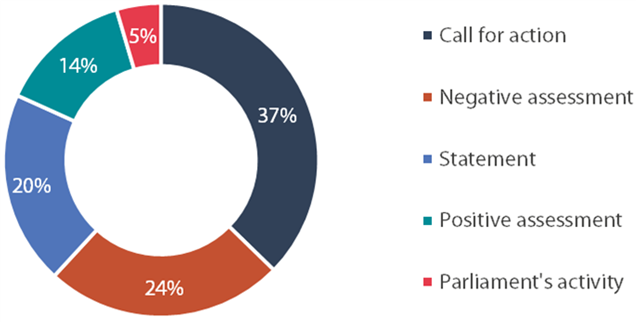
Parliament's resolutions mentioning the European Council not only differ by topic but also regarding their messages. Depending on the situation, Parliament has either called on the European Council to take specific action or commented (positively or negatively) on the European Council's previous activities.
Source: EPRS.
Sometimes, Parliament has simply made a statement on the European Council's activity in a neutral way. Another type of messaging was to indicate Parliament's own activities with respect to the European Council (e.g. discharging or not of its budget).
Figure 5 shows that Parliament's most common message is to call on the European Council to take specific action. Negative assessments are the second most frequent type of message, followed by statements, positive assessments and Parliament's own activity. Calls for action and messages on Parliament's own activity are proactive types of message, while the other three are reactive.
Call for action
There are three main topics on which Parliament called on the European Council to take action. The first concerned the EU institutions, notably regarding the Spitzenkandidaten procedure and the lack of transparency in the European Council. The second related to EU reforms, i.e. the changes to the Treaty framework that Parliament would like to see implemented. The third dealt with enlargement, with Parliament calling on the European Council to move forward on the matter.
Assessing European Council activities
Regarding the assessment of European Council activities, the data show that Parliament is more often critical of the European Council than supportive of its activities. Parliament's main criticism relates to the European Council's growing role in the EU institutional system, which goes beyond the Treaty provisions. As mentioned earlier, Parliament has also criticised the European Council regarding its in-depth involvement in the MFF procedure. Similarly, Parliament has expressed its negative opinion about the (lack of) transparency of the European Council, particularly as regards the European Council President's meetings with lobbyists and the European Council's refusal to join the Institutional Agreement on Transparency. In relation to enlargement, however, Parliament is mostly supportive of the European Council's activities. It welcomes and supports all the European Council decisions granting candidate status (e.g. to Ukraine or Moldova), opening negotiations (e.g. with Bosnia and Herzegovina) or recognising the European perspective of a country (e.g. of Georgia).
Very often, a connection between a call for action and a negative assessment can be established, as Parliament first invites the European Council to do something, and later criticises it for not following up on the recommendation. Parliament's follow-up on its previous messages to the European Council shows that it regularly monitors European Council activities, making it part of a more long-term scrutiny process.
Statements
When mentioning the European Council in its resolutions, Parliament also makes factual statements. These can include taking note of the European Council's activity or invoking relevant Treaty provisions. The latter are, in practice, the most common type of statement. Parliament reiterates, for instance, that the Treaties do not allow the European Council to exercise any legislative functions. Parliament also underlines that European Council conclusions are political – and not legislative – in their nature; here, Parliament refers to the relevant ruling of the Court of Justice of the European Union. Statements are very often followed by criticism of the European Council's practice, which does not comply with the Treaty provisions.
Parliament's own activities
In its resolutions, Parliament occasionally refers to its own activities when addressing the European Council. This is mostly the case in relation to the budget discharge, as Parliament has withheld the discharge of the Council and European Council budget. This is usually followed by a justification, highlighting the critical points from Parliament's perspective. Another example of Parliament's own activity concerns the MFF, with Parliament stating that it would not 'rubber-stamp' the European Council's position, but wanted to have its own say on the MFF.
Lessons learned
This section will consider the main lessons learned from the analysis of Parliament's resolutions mentioning the European Council, with the aim of further optimising the use of its resolutions as an effective tool to scrutinise the European Council in the future. Then, it will outline other possible adjustments that could strengthen Parliament's scrutiny toolbox.
Use of Parliament's resolutions
Looking at the way Parliament's resolutions have been used in the ninth legislature, a number of observations can be made and possible adjustments considered to further maximise the use of its resolutions to scrutinise the European Council.
Forwarding Parliament's resolutions more systematically to the European Council
One of the main aims of Parliament's resolutions is to communicate its views on certain issues to specific actors. Therefore, it is crucial to transmit these views to the relevant actor. The analysis showed that Parliament does not forward its resolutions to the European Council often enough. As mentioned, resolutions effectively forwarded to the European Council only make up 22 % of the total number of resolutions referring to this EU institution in the text. By forwarding the adopted text, Parliament makes sure, at least formally, that the European Council can acknowledge the resolution. This appears as the first procedural condition to enable Parliament to influence the European Council's activities. Therefore, Parliament should consider doing so more often – even if it does not have to be the case for every single resolution referring to the European Council. However, it ought to do so when the European Council is a core actor on the issue subject to a given resolution, when Parliament calls on the European Council to take a specific action or when it intends to express its dissatisfaction with certain activities of EU Heads of State or Government.
Using resolutions on the European Council conclusions more often
As shown in the analysis, Parliament's resolutions were used very rarely – only twice, in fact – in the 2019-2024 parliamentary term to outline Parliament's view ahead of a European Council meeting, to comment on the conclusions after one or to wrap up a plenary debate with the President of the European Council, although there were many occasions where this could have been used. Adopting such resolutions more frequently – and not just when a major crisis arises – would show that Parliament is scrupulously following the European Council's activities. More fundamentally, knowing that a follow-up in the form of a Parliament resolution could be expected in the aftermath would most likely provide greater weight to the debates with the President of the European Council, and maybe also generate more qualitative and/or comprehensive answers to the questions put by MEPs to the European Council President.
During previous legislative periods, resolutions ahead of a European Council meeting or the conclusions thereof were used more often as a tool by Parliament. Former European Parliament President Jerzy Buzek stressed that one way for Parliament to 'influence the workings of the European Council' was through 'the adoption of timely resolutions ahead of summits'.11 EPRS research has also argued that resolutions ahead of European Council meetings could further strengthen the position of the European Parliament President when speaking to EU Heads of State or Government at European Council meetings.12
Crafting more precise messages to the European Council
Finally, Parliament could add further details to its demands regarding its relationship with the European Council. As Parliament calls to be granted more scrutiny powers over the European Council, it should specify tools it would like to have to scrutinise the European Council and how they could help strengthen its scrutiny powers. A positive example from the 2019-2024 term is Parliament's request for an institutional agreement formalising the Spitzenkandidaten procedure.
Possible adjustments and addition to Parliament's scrutiny tools
In addition to fine-tuning the use of resolutions, other instruments could also be developed to increase Parliament's scrutiny of the European Council's activities. Ideas in this respect come from the European Parliament itself, academia and the previously mentioned research by EPRS.
Hitherto, the relations between Parliament and the European Council have been a matter of practice rather than of formal agreements. Nevertheless, as early as 2009 Parliament had suggested that its relationship with the European Council could be formalised in an institutional agreement, which would clearly specify the mutual rights and duties, and outline what Parliament can expect from the European Council. A renewed push by Parliament for such an agreement could provide an opportunity to bring together all the demands currently spread across the various resolutions, helping to make Parliament's position more precise.
As mentioned earlier, Parliament has called on national parliaments to monitor their leaders' activity in the European Council. The link between the European Parliament and national parliaments in that context could be further enhanced, and take the form of cooperation. Article 10 TEU states that Heads of State or Government representing the Member States in the European Council are 'democratically accountable either to their national Parliaments, or to their citizens'. As argued above, this still leaves a gap, as the European Council is not effectively held accountable at EU level. Consequently, the European Parliament should explore further avenues of cooperating with national parliaments to (jointly) scrutinise the activities of the European Council (and its members).
Other ideas relate to the President of the European Council more specifically, as they deal with Parliament directly. Each President of the European Council has stressed that they were accountable only to the European Council, not Parliament. This results from the fact that the European Council is solely responsible for selecting its President. Hence, in formal terms, Parliament has no tools to influence that choice. However, as suggested by recent EPRS research, what Parliament could possibly do is to hold a symbolic vote on the European Council President-elect, once the European Council has made its choice. This could be preceded by a discussion with the President-elect, during which they could outline their priorities and vision regarding the relationship with Parliament. Historically, Parliament developed the same type of non-binding vote on the office of European Commission President by itself, years before it was granted any such Treaty-based powers.
The President of the European Council has the duty to report to the European Parliament only after the European Council's meetings. However, Parliament also holds pre-European Council meeting plenary debates, in which MEPs can express their views on the matters to be discussed later by the Heads of State or Government. As EPRS has already argued, regular attendance by the European Council President at the pre-European Council plenary debates could be called for, voluntarily or in the framework of an interinstitutional agreement, as a means to develop exchange and cooperation between Parliament and the European Council. Their presence would also indicate ahead of time which topics Parliament would like to see added to the European Council's agenda.
Finally, the data presented above suggest one additional way to scrutinise the European Council, and its President more specifically. Parliament could hold a symbolic vote on the acceptance of the European Council President's report. Currently, the latter is obliged only to deliver the report, but not to answer MEPs' comments and questions. As often happens, the President leaves directly after their own speech and is not present during the entire debate. By holding a vote on the President's report, Parliament could express its views on the information submitted and on the quality of the European Council President's answers to MEPs' questions. If Parliament were to use resolutions on European Council conclusions more often, its position on the (non) acceptance of the President's report could also feature in such resolutions.
Main references
- Buzek J., State of the Union: Three Cheers for the Lisbon Treaty and Two Warnings for Political Parties, Journal of Common Market Studies, Vol. 49(s1), 2011, pp. 7-18.
- Dinan D., Relations between the European Council and the European Parliament, EPRS, 2018.
- Drachenberg R., Interaction between the European Council and the European Parliament: The European Parliament President at European Council meetings, EPRS, April 2024.
- Drachenberg R. with Sabel M., Interaction between the European Parliament and the European Council, EPRS, March 2023.
Endnotes
Disclaimer
This document is prepared for, and addressed to, the Members and staff of the European Parliament as background material to assist them in their parliamentary work. The content of the document is the sole responsibility of its author(s) and any opinions expressed herein should not be taken to represent an official position of the Parliament.
Copyright
© European Union.
The reuse of this document is authorised under a Creative Commons Attribution 4.0 International (CC-BY 4.0) licence.

https://creativecommons.org/licenses/by/4.0/deed.en
To use or reproduce elements that are not owned by the European Union, permission may need to be sought directly from the respective rightsholders.