
Article page checkbox is not checked in page info.
Electoral thresholds in European Parliament elections
Electoral thresholds in European Parliament elections
Micaela Del Monte, Maria Díaz Crego, Silvia Kotanidis and Hendrik Mildebrath, Members' Research Service
Summary
An electoral threshold for the allocation of seats is the minimum percentage of votes that a political party or a coalition is required to collect in order to gain a seat in the legislative assembly. Thresholds are said to enable a better balance between governability and representativeness, by favouring the formation of stable majorities and avoiding excessive fragmentation of the legislative assembly. Thresholds are sometimes imposed by law, but in the absence of an explicit legal requirement, they can be the de facto result of the size of the constituency and the relevant electoral law determining the apportionment of seats between constituencies.
Provisions for electoral thresholds are common in proportional electoral systems, which tend to favour multipartyism. Thresholds can, however, be problematic when they limit or impede the representation of regional parties and ethnic and linguistic minorities, for instance. The current European Electoral Act contains a set of common principles to be upheld by the different domestic laws applicable to the election of the European Parliament. The original act of 1976 did not contain any provisions on minimum thresholds. Following modifications introduced in 2002, Article 3 allows Member States to set a minimum threshold for the allocation of seats; this must not exceed 5 % of the votes cast.
The electoral thresholds applied in the 2019 European elections ranged between 5 % of the valid votes cast, required in nine Member States (Czechia, France, Croatia, Latvia, Lithuania, Hungary, Poland, Romania and Slovakia) and 1.8 %, required in Cyprus, while 14 Member States set no threshold. Italy, Austria and Sweden applied a 4 % threshold; and Greece 3 %. At the time of writing, it appears that these thresholds will still be applicable for the 2024 European elections.
This updates and expands on a June 2023 EPRS briefing.
Introduction
The electoral threshold for the allocation of seats is the minimum percentage of votes that a political party or a coalition is required to gain in order to be entitled to representation in the legislative assembly. Electoral thresholds facilitate the formation of stable majorities by avoiding excessive fragmentation that could jeopardise the parliament's work, for instance by paralysing the decision-making process. They represent an artificial interference with the principle of equal voting justified by the need to avoid parliamentary fragmentation and ensure stability.1 Their purpose is to ensure a better balance between governability and representativeness. Provisions for electoral thresholds are often present in proportional electoral systems, which tend to favour multipartyism. In that context, the provision might require a party (or coalition of parties) to win a certain percentage of the vote, at either national or district level, to gain a seat in parliament.
What are electoral thresholds and why do they exist?
As the Venice Commission reported in 2010, various types of restriction on access to parliament, including electoral thresholds, are understandable in a context where representative democracies imply that we need 'to pass from a few million, or tens of millions, of votes to a few hundred representatives' which necessarily 'entails a degree of simplification, and thus deformation'. The European Court of Human Rights (ECtHR) has also considered that electoral thresholds for the attribution of seats are acceptable because each electoral system has to marry competing if not conflicting purposes: 'on the one hand to reflect fairly faithfully the opinions of the people and, on the other, to channel currents of thought so as to promote the emergence of a sufficiently clear and coherent political will'. In fact, in Partija 'Jaunie Demokrāti' and Partija 'Mūsu Zeme' v Latvia , the ECtHR clarified that Article 3 of Protocol No 1 to the European Convention on Human Rights (ECHR) does not mean that all ballots have equal weight as regards the election results, or that each candidate has the same chances of winning.
In certain instances, a formal, legal, or artificial electoral threshold is not relevant in practice because of the limited number of seats to be attributed. Party lists in a given country might need to achieve an even higher percentage of the votes cast in order to be allocated a seat. This is called a 'natural or hidden electoral threshold'. This exclusionary effect (i.e. the exclusion from the allocation of seats of any list that does not reach a certain number of votes), may also arise in the absence of an explicit legal threshold, as a result of the number of seats to be allocated or the size of the constituency. A constituency with a very small number of seats to be allocated would require a higher proportion of votes to win a seat. Conversely, legal thresholds are more relevant in countries with bigger constituencies, though other factors play a role too, including the formula used to allocate the seats, for example the d'Hondt method, the number of candidates, or the size of the legislative assembly.
It is argued that limiting the number of political actors helps citizens to gain a better understanding of the positions of the political parties represented in parliament. Electoral thresholds can favour the formation of stronger majorities and also a stronger opposition. While a general assessment of the function and purposes of electoral thresholds is possible, 'any assessment of a threshold clause and of its effects on the specific operation of the electoral system must take account of the need to contextualise the analysis with reference to the relevant political party, historical and social circumstances and, in particular, to the territory within which that electoral system is applied' as stated by the Italian Constitutional Court in 2018.
A similar principle was stated by the ECtHR in Yumak and Sadak v Turkey (see paragraph 131: 'However, the effects of an electoral threshold can differ from one country to another and the various systems can pursue different, sometimes even antagonistic, political aims'). The 2002 Code of good practice in electoral matters adopted by the Venice Commission also stressed the need to evaluate any electoral system in relation to the specific circumstances, as it is accepted that electoral systems might 'pursue different, sometimes even antagonistic, political aims'. In fact, in one country the main objective of the electoral system might be to ensure fair representation of a large spectrum of parties while in another the main objective could be to avoid fragmentation.
Among the criticisms of electoral thresholds, it is often said that they artificially distort the representativeness of the parliamentary assembly because they create a gap between the elected representatives and those they represent. They are also said to undermine pluralism, which is a crucial pillar of democracy, to artificially force small parties into coalition to overcome the entry barrier, and ultimately to disenfranchise small-party voters. However, as recognised by the Venice Commission: 'no electoral system can be perfectly proportional in practice' as a larger body of electors needs to be translated into a smaller body of elected representatives.
The problem of inclusiveness is a common issue regarding legal thresholds at national level as they can limit or impede the representation of regional parties, and ethnic and linguistic minorities. This is why certain countries have opted for thresholds at constituency level instead, or have introduced other mechanisms in their electoral laws (for instance, a party that does not reach the national threshold may still be allocated a seat if it won in one or more constituencies). Corrective measures (such as the attribution of seats to ethnic and linguistic minorities) to address imbalances in representation are considered acceptable if they are proportionate and not discriminatory.
Yumak and Sadak v Turkey
This case, decided in July 2008 by the European Court of Human Rights (ECtHR), concerned the imposition of a 10 % threshold in Turkey for national elections, which the claimants argued was infringing Article 3 of Protocol No 1 to the European Convention on Human Rights. This article establishes the principle of effective democracy underpinned by the commitment to run free elections and to ensure free expression of the opinion of the people in the choice of the legislature. The Court however considered that the threshold of 10 % in Turkey imposed on parliamentary elections was aimed at strengthening stability by preventing debilitating parliamentary fragmentation. The ECtHR considered that this aim could be seen as necessary in the circumstances and that it complied with the principle of proportionality.
The 2005 Venice Commission report on electoral rules and affirmative action for national minorities recommended a number of measures to ensure and promote fair representation of minorities; two of them related to thresholds. It stated that 'electoral thresholds should not affect the chances of national minorities to be elected' and that electoral districts should be designed with a view to enhancing minorities' participation. Countries have developed a variety of legal thresholds in relation to their legal and political traditions. As pointed out in the 2018 Venice Commission report, based on an analysis of various domestic electoral laws in Europe, it appears that thresholds operate at different levels (nationwide, or constituency or district level), at different stages in the electoral process (first, second or subsequent rounds of the seat allocation), and with different percentages depending on whether they are applicable to a party or a party coalition. This is the case for instance in Lithuania where, according to Article 168(3) of the Electoral Code, a list of candidates can receive mandates if at least 5 % of the voters who participated in the European elections voted for it, and a joint (or equivalent) list of candidates if at least 7 % of the voters who participated in the European elections voted for it. In some countries, thresholds only apply to a limited number of seats, while in others the percentage of the threshold varies depending on whether it applies to party or independent candidates (see paragraph 64 of Yumak and Sadak v Turkey ).
In its 2007 Resolution 1547, the Parliamentary Assembly of the Council of Europe (PACE) recommended a threshold for parliamentary elections not higher than 3 % for 'well-established democracies', arguing that in these democracies it should 'be possible to express a maximum number of opinions because excluding 'groups of people from the right to be represented is detrimental to a democratic system'. In a subsequent Recommendation 1791, PACE recommended that Member States decrease the thresholds for parliamentary elections to 3 % and take into consideration both the principle of fair representation and the need for parliament to be effective. The Venice Commission considered a threshold higher than 5 % to be problematic, while thresholds between 3 % and 5 % were acceptable when other conditions were also met, for instance that safeguards were in place to ensure representation of national minorities. In 2007, the European Court of Human Rights in Yumak and Sadak v Turkey stated that Turkey's 10 % threshold was not in violation of Article 3 of Protocol 1 to the ECHR (right to free elections), though it recognised that it was exceptionally high – compared to 5 % in most European countries – and recommended it be lowered. The plaintiff alleged that the 10 % threshold interfered with the free expression of the opinion of the electors in the choice of legislature. To evaluate the alleged breach of Article 3, the ECtHR assessed whether the challenged measure served a legitimate aim, whether there was any arbitrariness and finally whether the measure was proportionate in relation to the aim pursued. The ECtHR recognised that this high threshold could deprive part of the electorate of representation, but accepted that it was introduced to ensure a stable majority in parliament and thus governability. The Court stressed once again that countries enjoy a wide margin of appreciation in establishing their electoral systems. In the Court's view, due consideration should also be given to the different objectives at stake: the need to faithfully reflect the opinion of the voters and the need to channel the votes to enable the emergence of a 'clear and coherent political will'. Against this background, the ECtHR clarified that not all votes must necessarily have equal weight regarding the election outcome or all candidates have equal chances of victory. 'No electoral system can eliminate ''wasted votes''' (paragraph 112).
EU electoral law
Already modified a number of times since its initial adoption in 1976 (in particular in 2002 and 2018, although the later amendment is not yet in force), the current European Electoral Act does not provide for a uniform electoral system applicable in all the EU Member States in European elections. On the contrary, it contains a set of common principles that must be upheld in the different domestic laws applicable to European elections. The original act did not contain any provisions on minimum thresholds. Following the 2002 modifications, in force since 2004, Article 3 in its current wording allows Member States to set a minimum threshold for the allocation of seats; it may not however exceed 5 % of the votes cast. EU law does not therefore require Member States to apply a threshold, but should they decide to do so, the threshold cannot exceed 5 % of the votes cast. In its 2012 resolution on the upcoming 2014 European elections, the European Parliament stressed the need to build 'reliable majorities in Parliament' for the stability of the EU. In order to ensure both appropriate representation but also the smooth functioning of the Parliament itself, Parliament called on the Member States to set 'appropriate and proportionate minimum thresholds' in accordance with Article 3 of the European Electoral Act.
In 2018, the Council agreed to further amendments to the 1976 Act (Council Decision (EU, Euratom) 2018/994) which were expected to enter into force before the 2019 European elections. The decision was approved by the Council (26 Member States voted in favour while Belgium and the United Kingdom abstained). It is still not in force, however, because Spain has not yet approved it, in accordance with its constitutional requirements. Among the novelties introduced by the 2018 amendments to the 1976 Act there is the obligation for Member States to establish an electoral threshold of between 2 % and 5 % for constituencies comprising more than 35 seats, including for single-constituency Member States. Portugal is reported to have voted for the mandatory threshold on the assumption that it would never be applicable in Portugal (it currently has 21 seats in the European Parliament) as Article 152(1) of the Portuguese Constitution explicitly prohibits electoral thresholds: 'The law may not set limits on the conversion of votes into seats by requiring a minimum national percentage of votes cast'.
In the ninth legislative term, Parliament's willingness to harmonise the rules applicable to the European elections was clearly expressed in the draft legislative act adopted in May 2022, seeking to repeal the 1976 Act. The draft legislative act proposes to further harmonise several aspects of the electoral procedure applicable in European elections, including the rules applicable to thresholds. It reiterates the idea of imposing an electoral threshold for European elections in big national constituencies. However, the requirements are relaxed and, although Member States would remain free to establish an electoral threshold of no more than 5 % of the valid votes cast, they would have to set a threshold between 3.5 % and 5 % for national constituencies comprising more than 60 seats. In practice, the rule concerning compulsory electoral thresholds for national constituencies comprising more than 60 seats would only affect Germany and Spain. In fact, only four Member States will be allocated more than 60 seats in Parliament at the 2024 European elections after the increased composition of Parliament adopted by the European Council in September 2023: Germany (96), France (81), Italy (76) and Spain (61). Italy has five constituencies and none of them elected more than 60 seats in the 2019 European elections. Germany and France have a single constituency for the European elections, but France already imposed an electoral threshold of 5 % (Article 3 Loi n° 77-729 of 7 July 1977 on the election of representatives to the European Parliament). The German legislature has twice tried to adopt self-imposed electoral thresholds for the European elections, but the German Federal Constitutional Court declared them unconstitutional in 2011 and 2014. Spain has a single constituency electing 61 seats.
Case law in selected Member States
In the last decade, a number of judgments of the highest courts in Member States have dealt with the issue of the compatibility of electoral thresholds with national constitutions.
In two landmark decisions of 2011 and 2014, the German Federal Constitutional Court (GFCC) found that the self-imposed electoral thresholds of 5 % and 3 % for European Parliament elections – neither being then binding under EU law – were unconstitutional, for violating the principles of equal suffrage and equal opportunities for political parties. The former requires that, in general, the vote of each person entitled to vote has the same weight and legal chance of success (Article 3(1) of the Basic Law). The latter requires that parties or groups of voters and their candidates have the same opportunities in the electoral process and distribution of seats (Articles 21(1) and 3(1) of the Basic Law).
The GFCC argued that self-imposed thresholds interfere with both principles and therefore require special justification, such as maintaining the proper functioning of the European Parliament. Theoretically, in the absence of thresholds, the entry of a large number of small parties and voters' associations in the European Parliament could seriously impair its ability to act and function. However, supporters of the threshold were unable to show convincingly that Parliament's functioning was at serious risk. The GFCC, on the contrary, held that political groups helped maintain Parliament's functioning by integrating additional parties and streamlining political views. Moreover, it considered that parties cooperated and reached decisions within a reasonable time. It observed that, unlike the Bundestag, the European Parliament does not elect a government that depends on the Parliament's continuous support. Additionally, the GFCC found no common or firm belief among EU legislators that thresholds were necessary. It included the caveat that changed factual circumstances may justify self-imposing a threshold, even if not mandated by EU law.
In Germany, the ratification process of the 2018 EU electoral reform rekindled political and legal debates over the constitutionality of thresholds and the need for a two-thirds majority for approving an electoral reform mandating a threshold (see summary of expert hearings). Ultimately, both houses voted in favour with a two-thirds majority, but the ratification law was challenged by both the (satirical) political party Die Partei and its leader prior to being promulgated. Specifically, the applicants claimed that the approval of the 2018 amendment of the 1976 European Electoral Act ('Direct Elections Act 2018') constituted an unjustified interference with their rights to equal opportunities for political parties and to equal suffrage. They argued that the envisaged Direct Elections Act 2018 would exceed the EU's competencies (ultra vires review) and encroach on the principle of democracy guaranteed by the German eternity clause (identity review) and therefore fails to legitimise an interference with their abovementioned constitutional rights.
Contrary to its previous rulings, the GFCC dismissed the application on 6 February 2024, finding that the applicants failed to show how their constitutional rights are violated by the obligation to introduce an electoral threshold of at least two percent of the valid votes cast. Unlike in the previous cases, the GFCC's power of review was limited (to an incidental ultra vires and identity review) given the primacy of EU law and Germany's duty to integrate.2 The GFCC considered that the applicants failed to show a violation of Member State competencies. The EU was empowered to adopt such an electoral act under Article 223(1) TFEU, the 2018 rules would not transfer sovereign powers and it was not discernible how the principle of subsidiarity could shield Member States from implementing minimum thresholds adopted as part of an electoral act under Article 223(1) TFEU, given that Member States enjoyed full discretion in giving or withholding their approval to the electoral act. Additionally, the applicants did not sufficiently substantiate their claims of an interference with the principle of democracy. They failed to demonstrate that the minimum threshold excessively interferes with the principle of democracy relative to the legitimate objectives of maintaining the functioning of the European Parliament and harmonising democratic representation throughout the EU (balancing exercise). Firstly, the law of the European Union contains a number of safeguards ensuring democratic governance. Consequently, the EU itself is committed to democracy. Secondly, the GFCC – contrary to its previous rulings – emphasised (i) the need for Parliament to form actionable majorities to exercise legislative, budgetary and supervisory powers,3 (ii) the growing risk of fragmentation of the Parliament, and (iii) the limited ability of political groups to integrate representatives from different parties.
By contrast, the Czech Constitutional Court ruled in 2015 that the provision for a 5 % threshold established by the Czech law on elections to the European Parliament was not unconstitutional. The petitioner was the Supreme Administrative Court which argued, inter alia, that the 'European Parliament plays a qualitatively different role in the functioning of the European Union than do the national parliaments in the functioning of the Member States'. The Constitutional Court recognised that 'a mechanical comparison' of the functions of the European Parliament with the position of national parliaments was 'not appropriate', though it rejected the argument that the European Parliament was not a legitimate 'legislative assembly'.
Along similar lines, in 2018 the Italian Constitutional Court ruled that the 4 % threshold of the Italian law applicable to the European elections was not unconstitutional. The question referred by the Consiglio di Stato (the highest administrative court in Italy) questioned the imposition of a qualifying threshold of 4 %, arguing a violation of the 'principles of representative voting and equality in voting' in the absence of any compelling general interest that could justify it. The Italian Constitutional Court held that qualifying thresholds in electoral law serve two main purposes, ensuring: the stability of the government and the proper functioning of the parliamentary assembly. It added that qualifying thresholds are 'typical manifestations of the discretion of a legislator that wishes to avoid fragmented political representation, and to promote governability'.
In France, the Constitutional Council (Conseil constitutionnel) by Decision n° 2019-811 of 25 October 2019 declared that the electoral threshold of 5 % was in conformity with the French Constitution. It first acknowledged the constitutional role of the principle of electoral equality (Article 3 of the French Constitution and Article 6 of the Declaration of Rights of Man and of the Citizen of 1789) and the principle of pluralism of political ideas; it then argued that restrictions of those principles should be subject to the principle of proportionality. The Constitutional Council observed that, with the introduction of a threshold, French legislation pursued two objectives. On the one hand, it sought to bolster the representation in the European Parliament of political opinions expressed in France and in this way strengthen their representation in that institution. On the other, it aimed to consolidate the presence of political groups of a significant size, trying to avoid the fragmentation of votes. The Constitutional Council acknowledged that, although this pursuit cannot be achieved with the action of an individual Member State, the French legislator was nevertheless justified in trying to achieve this goal. The judgment, not exempt from criticism, follows the line of previous case law.
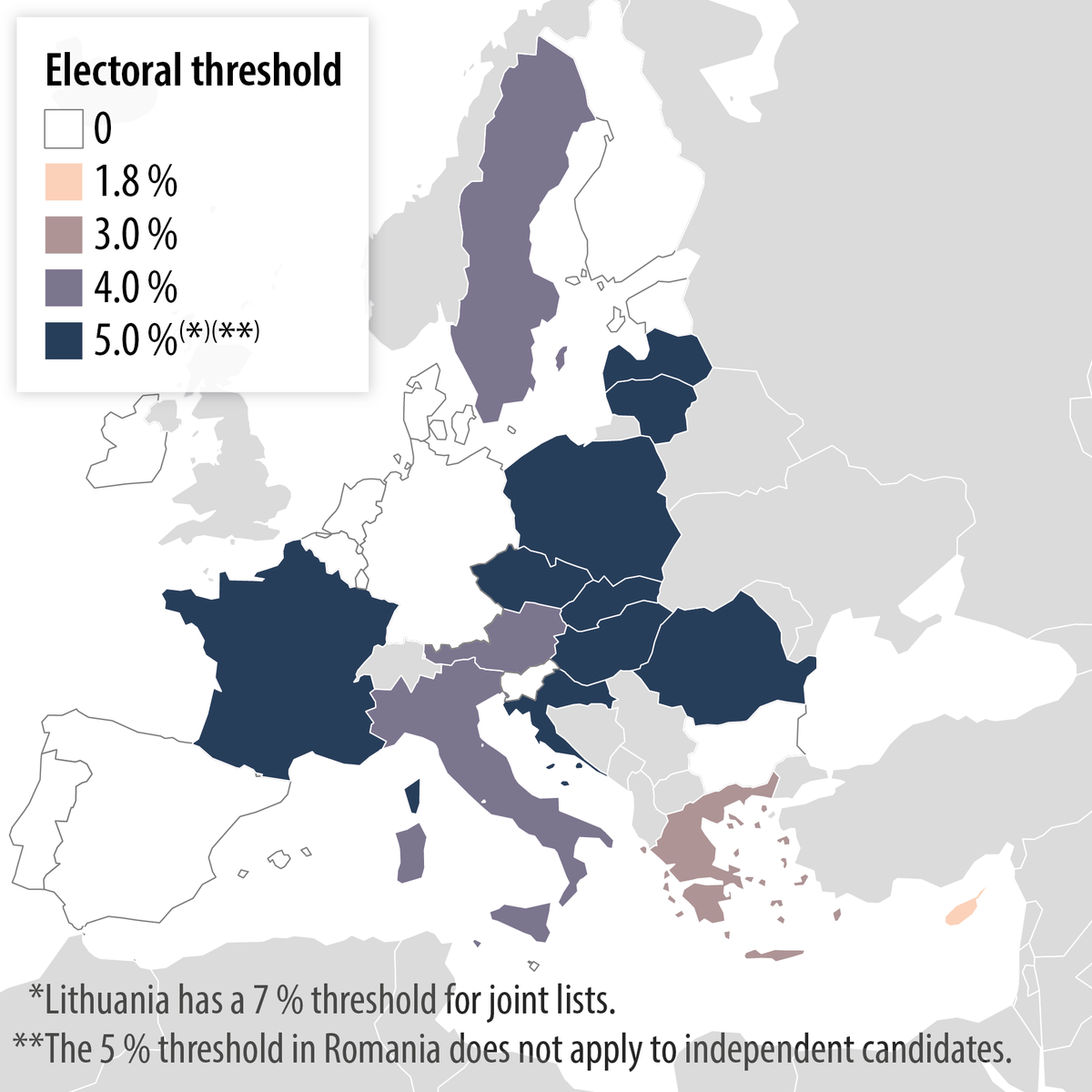
Graphic by Samy Chahri, EPRS, 2023.
National provisions
Based on the current provisions on electoral thresholds in place for the 2024 European elections, out of 27 Member States, 13 will not apply electoral thresholds, nine Member States (Czechia, France, Croatia, Latvia, Lithuania, Hungary, Poland, Romania and Slovakia) will apply a 5 % threshold, three Member States (Italy, Austria and Sweden) will apply a 4 % threshold, Greece will apply a 3 % threshold, and Cyprus, 1.8 %.
The table below presents the electoral thresholds and respective legal bases in 14 EU Member States. It was compiled by the authors on the basis of information provided through the European Centre for Parliamentary Research and Documentation (ECPRD). ECPRD's main activity is sharing information among parliaments in order to compare legislative activities and practices across countries.
| Country | Thresholds | Source |
|---|---|---|
| Czechia | 5 % | § 47(2), Act No 62/2003 Coll., Act on Elections to the European Parliament and on Amendments to Certain Acts, as amended |
| Greece | 3 % | Article 6 para. 5, Law on European Elections, No 4255/14 |
| France | 5 % | Article 3 of Law No 77-729 of 7 July 1977 on the election of the MEPs |
| Croatia | 5 % | Article 25, The Republic of Croatia European Parliamentary Elections Act |
| Italy | 4 % | Article 21(1-bis) and (2), Law of 24 January 1979, No 18 |
| Cyprus | 1.8 % | § 23(2), Law on the election of MEPs |
| Latvia | 5 % | Section 44 (1), Election to the European Parliament Law |
| Lithuania | 5 %
7 % for joint lists | Article 168(3)(2), of the Electoral Code |
| Hungary | 5 % | Section 8(2), Act CXIII of 2003 on the election of MEPs |
| Austria | 4 % | § 77(2), European Electoral Law |
| Poland | 5 % | Article 335, Electoral Code |
| Romania | 5 % | Article 51(1), Law 33/2017, with the exception of independent candidates |
| Slovakia | 5 % | § 93(2), Act No 180/2014 Coll. |
| Sweden | 4 % | Chapter 14, Section 6(3) Elections Act (Act (2019:923)). |
Main references
- Compilation of Venice Commission Opinions and Reports concerning thresholds which bar parties from access to Parliament, European Commission for Democracy through law (Venice Commission), June 2018.
- Delledonne G., 'A Goal That Applies to the European Parliament No Differently From How It applies to National Parliaments': The Italian Constitutional Court Vindicates 4% Thresholds for European Elections, European Constitutional Law Review, Vol.15, pp.376-389, 2019.
- Díaz Crego M., Towards new rules for European elections? EPRS, European Parliament, 2022.
- Guide on Article 3 of Protocol No. 1 to the European Convention on Human Rights, Right to Free Elections, p. 18, August 2022.
- Kotanidis S., European Union electoral law, EPRS, European Parliament, October 2019.
- Poptcheva E. M., Electoral thresholds in European elections: Developments in Germany, EPRS, European Parliament, February 2014.
- Report on Electoral Law and Electoral Administration in Europe, European Commission for Democracy through law (Venice Commission), October 2020.
- Schultz D. and Toplak J., Routledge Handbook of Election Law, Taylor & Francis Group, 2022.
Endnotes
Disclaimer
This document is prepared for, and addressed to, the Members and staff of the European Parliament as background material to assist them in their parliamentary work. The content of the document is the sole responsibility of its author(s) and any opinions expressed herein should not be taken to represent an official position of the Parliament.
Copyright
© European Union.
The reuse of this document is authorised under a Creative Commons Attribution 4.0 International (CC-BY 4.0) licence.

https://creativecommons.org/licenses/by/4.0/deed.en
To use or reproduce elements that are not owned by the European Union, permission may need to be sought directly from the respective rightsholders.