
Self‑driving cars in the EU Connected and automated vehicles
Summary
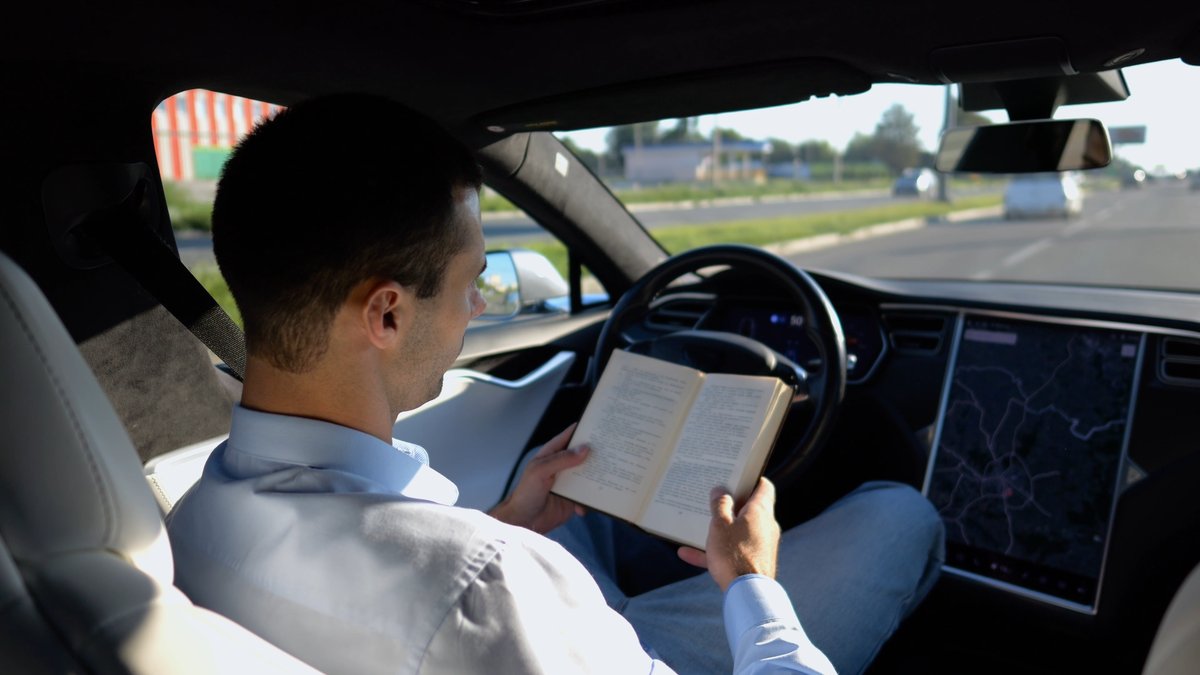
Connected and automated vehicles (CAVs) are equipped with technologies that transfer driving functions from a human driver to a technical system. EU strategies pursue large‑scale deployment of CAVs in the coming years, driven by interconnected objectives relating to road safety, industrial competitiveness and sustainable mobility, and supported by an evolving regulatory framework. While driver‑assistance systems are already commercially available, higher levels of automation remain largely confined to pilots and limited deployments, with challenges relating to public acceptance, data protection, cybersecurity, liability and regulatory fragmentation still to be addressed.
The focus is on the current state of CAVs in the EU, including key EU policy goals, technical concepts, EU legislation, current challenges and research on the possible impacts of their deployment.
Introduction
The European Union seeks to transform its automotive industry to build a cleaner, safer and more efficient transport system, and to make the EU a world leader in connected and automated mobility. Road transport accounts for nearly three quarters of EU overall transport greenhouse‑gas emissions, and is a major source of air pollution in cities. Connected and automated vehicles (CAVs) could help reduce fuel consumption and transport emissions by enabling smarter traffic management, among other things. In 2022, about 20 600 people were killed in road crashes in the EU. CAVs could help reduce accidents caused by human error, which is involved in 95 % of road accidents. Such vehicles could also remove barriers to personal transport and ease mobility for all, supporting inclusive mobility for elderly or disabled people.
As far as global competitiveness is concerned, the CAV market is expected to grow exponentially, with the potential to create jobs and economic opportunities. A 2026 study by the Commission Joint Research Centre finds that the economy‑wide effects of CAVs would depend on whether they are deployed mainly as private vehicles or as part of shared mobility services. The study finds that deploying CAVs through shared mobility services could produce more positive outcomes, including fewer accidents, less congestion and increased energy efficiency.
Intelligent vehicles of the future? Connected and automated
Connectivity and automation are two concepts that are often confused but reinforce each other. For instance, a vehicle's ability to receive and transmit data (connectivity) can increase autonomous capabilities (automation) and vice versa.
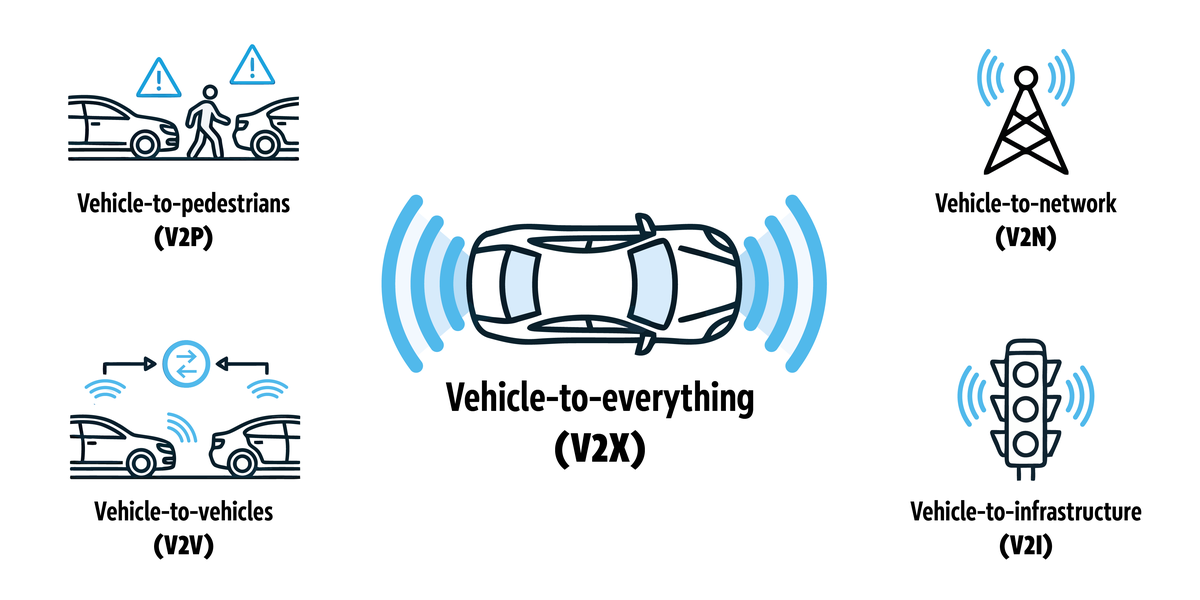
Connectivity refers to the ways in which a vehicle communicates with its surrounding environment, including infrastructure and other vehicles. These communication links are collectively referred to as 'vehicle‑to‑everything' (V2X, see Figure 1).
Communication in connected cars is divided in two main groups:
-
short‑range communication for time‑critical services that cannot tolerate transmission delays, such as vehicle‑to‑vehicle (V2V) communications (e.g. a warning that the car ahead is braking or a message relaying an in‑vehicle speed limit).
-
longer‑range communication for less time‑critical, delay‑tolerant services (e.g.vehicle‑to‑network (V2N) services), such as warnings about traffic jams ahead.
Automation refers to the level of driving automation reached by a vehicle in the absence of human supervision through on‑board sensors and systems able to operate with little or no human input.While the terms 'automated' and 'autonomous' vehicles are sometimes used interchangeably, they describe different levels of automation. Automated vehicles assist or perform specific driving tasks in the presence of human drivers, while autonomous (or fully automated) vehicles operate without human involvement. When referring to the different levels of automation, most organisations follow the classification developed by the International Society of Automotive Engineers (SAE). The levels of automation identify how the aspects of the dynamic driving task are divided between the human and the vehicle's systems in different driving modes (see Figure 2).
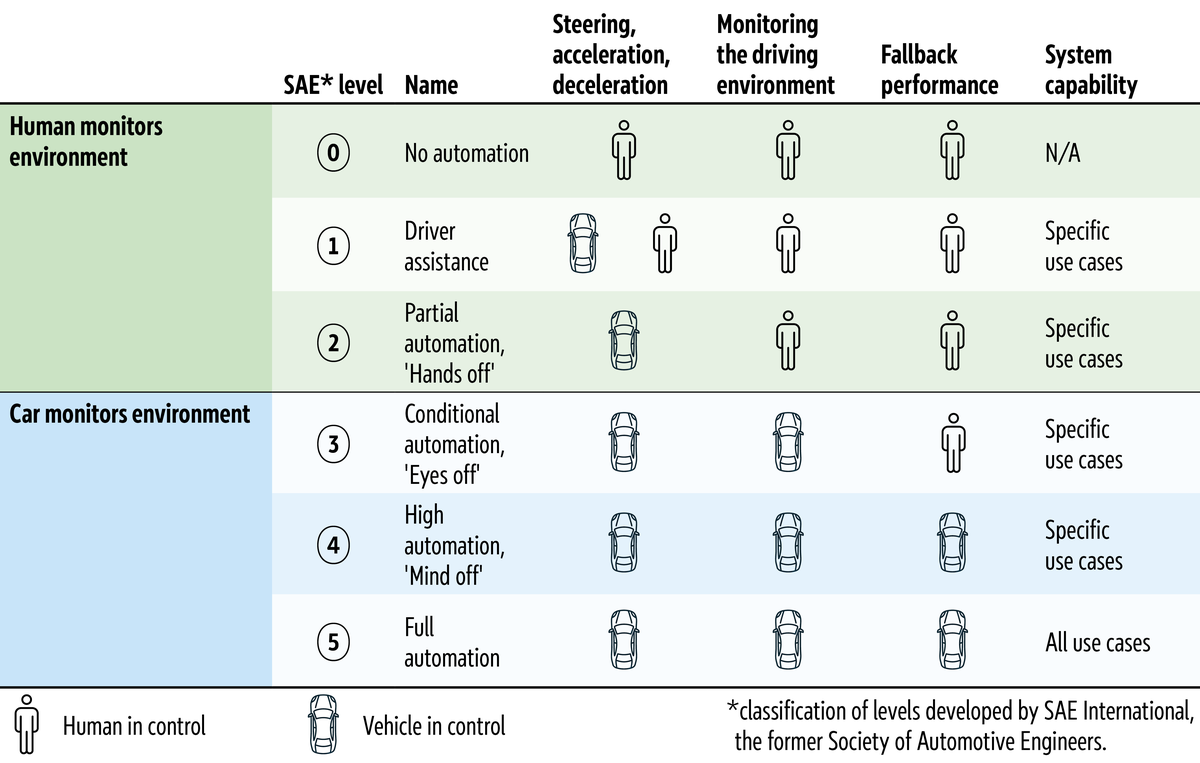
At level 0 (e.g.the vintage car), the driver must constantly supervise the road, while the fully autonomous car of the future (level 5) can perform all driving functions under any condition without driver input.
At present, CAVs with SAE levels 4 and 5, corresponding to highly and fully autonomous vehicles, are not yet commercially available in the EU, as their introduction requires further technological development and regulatory updates. Nonetheless, vehicles with driver‑assistance systems (levels 1 and 2) are already available on the EU market (e.g. lane‑keeping assistance). Level 3 automated vehicles for low‑speed driving on motorways became commercially available in the EU in 2021.
The rise of artificial intelligence (AI) is playing a key role in helping CAVs to interpret vast streams of sensor and connectivity data and turn them into safe driving decisions. Industry has broadly developed two main approaches to design AI systems for such vehicles:
-
modular approach: The driving task is divided into distinct functions (e.g.perceiving the environment, planning a trajectory and controlling the vehicle), each handled by separate AI components that can be developed, tested and updated individually;
-
end‑to‑end approach: A single AI model is trained to map raw sensor and connectivity inputs directly to steering, braking and acceleration commands, learning the overall driving behaviour from large datasets but posing specific challenges for transparency and safety validation compared with the modular approach.
EU policy objectives
A key EU ambition is to reach large‑scale CAV deployment by 2030. The European Commission's sustainable and smart mobility strategy (SSMS) presents a set of interconnected objectives, primarily centred on safety, competitiveness, sustainability and technological leadership.
Road safety is a key early driver of automation. Automation can contribute to the EU's overarching goal of reaching zero fatalities in road transport by 2050, known as Vision Zero 2050. The vision sets interim targets of reducing both road deaths and serious injuries by 50 % by 2030. While its impact should not be overestimated, automation could reduce accidents caused by human error and increase safety outcomes. A study estimates that by 2040, around 22 % of collisions could be prevented through a robust CAV framework. In its 2021 resolution on the EU road safety policy framework, the European Parliament explicitly called on the Commission to propose 'a new harmonised regulatory framework' for CAVs. The Commission acknowledged the request, but a fully harmonised framework for CAVs is not yet in place.
Beyond safety, industrial competitiveness is a strategic objective in the EU's efforts to position itself as a global leader in connected, cooperative and automated mobility (CCAM). The Commission's 2018 communication 'On the road to automated mobility' outlines the objective, which was also supported by Parliament's 2018 resolution on cooperative intelligent transport systems and its 2019 resolution on autonomous driving. The automotive sector remains a cornerstone of the EU economy. It directly employs more than three million people and accounts for around one third of private research and development investment in the EU. The EU has therefore backed CCAM development through research and innovation funding, including the Horizon Europe CCAM Partnership, which has planned investment of €500 million. The Commission's March 2025 automotive industrial action plan identifies CAVs as a means of strengthening competitiveness and calls for harmonised EU rules, cross‑border test beds, industrial alliances, secure data access, cybersecurity standards, and investment in chips, batteries and digital infrastructure. In June 2026, 18 Member States signed a joint declaration of intent on large‑scale cross‑border CAV test beds, seeking common approval principles, coordinated permitting and deployment, and greater certainty for innovators and investors.
From a sustainability perspective, connectivity and automation are expected to optimise traffic flows, making transport more efficient. As set out in the 2030 climate target plan, increasing the share of connected, automated and multimodal mobility can lower pollution, especially in cities.
Vehicle automation has also been incorporated into broader strategies to secure technological leadership in digital and AI policy. The Commission's 2025 apply AI strategy identifies mobility as a key sectoral flagship. It has also launched the Autonomous Drive Ambition Cities initiative to accelerate the deployment of autonomous mobility technologies and services (e.g. robotaxis, autonomous shuttles and advanced self‑driving cars) in EU cities by 2030. At the same time, the Commission has emphasised the importance of establishing the European Common Mobility Data Space to facilitate secure data pooling and sharing across transport systems, including reducing dependence on non‑European data platforms and ensuring access to real‑time traffic information.
EU legislative framework
Putting CAVs on EU roads: From strategy to deployment
While the EU aims to establish a single market for CAVs, conditions for CAV deployment still differ across the 27 Member States. The EU has started harmonising its regulatory CAV framework, drawing on international rules, notably United Nations (UN) Regulations Nos 157 and 171. In June 2026, the World Forum for Harmonization of Vehicle Regulations (WP.29) adopted a new regulation establishing the first global regulatory framework for fully driverless automated driving systems (ADS). It sets out common safety requirements and a harmonised method for validating ADS, with the aim of reducing regulatory fragmentation. These new rules have not yet been incorporated into EU law.
In the EU vehicle type‑approval system, manufacturers must meet technical requirements to obtain approval for a new vehicle type. Once approved by the authority in one Member State, vehicles of that type can generally be marketed EU‑wide without repeating the full approval process. Regulation (EU) 2018/858 on motor vehicle type‑approval and market surveillance establishes the general EU type‑approval system for vehicles, systems and components before they can be placed on the EU market.1 The EU type‑approval framework incorporates the relevant UN regulations, except the new ADS one, making them part of the mandatory or equivalent technical requirements for obtaining EU type‑approval. Regulation (EU) 2019/2144 (the General Safety Regulation), Implementing Regulation (EU) 2022/1426 and Delegated Regulation (EU) 2022/2236 introduce CAV‑specific safety and cybersecurity requirements.
| Automation level | Status in the EU | Primary regulation |
|---|---|---|
| 2 (partial) | Widely available | UN Regulation No 171 + EU alignment via Regulation (EU) 2019/2144 |
| 3 (conditional) | Approved for motorway use | UN Regulation No 157 + EU alignment via Regulation (EU) 2019/2144 |
| 4 (high) | Limited small series & defined areas | Regulation (EU) 2019/2144 + Commission Implementing Regulation (EU) 2022/1426 + Delegated Regulation (EU) 2022/2236 |
| 5 (full) | Not covered by EU law | Not yet in place, Regulation (EU) 2019/2144 as a basis for future rules |
However, EU type‑approval by itself does not authorise testing and operation on EU roads. Open‑road testing, transport licensing and deployment conditions remain mostly subject to national laws and local authorisations. Not all Member States have yet established national rules for testing.
Once placed on the EU market and used on public roads, vehicles must undergo regular roadworthiness inspections. The 2014 roadworthiness package does not yet contain CAV‑specific rules. The 2025 proposal for a revised package aims to adapt inspections to new technologies.2
Germany's legal framework for level‑4 CAVs
Germany was the first EU country to establish a legal framework for highly automated vehicles (level‑4 CAVs ) on public roads, but only within designated operational areas and subject to prior approval. The law took effect in July 2021, with an implementing regulation setting out technical requirements. The Federal Motor Transport Authority (Kraftfahrtbundesamt) is the national type‑approval authority for CAVs, while designated operational areas are approved by the state authorities or (for federal highways) by the Federal Motorway Company (Autobahn GmbH).
Data on wheels: governing privacy in connected cars
Current CAVs can generate 25 GB per hour of driving. Autonomous cars (level 5) will probably generate more than 300 TB of data per year. CAVs will provide data for various driving‑related applications. This may involve processing data that qualify as personal data or information if they can directly or indirectly identify a person (e.g. driving style or geolocation).
There is no EU privacy and data protection legislation specifically for CAVs. However, the sector is subject to (i) the General Data Protection Regulation (GDPR) and (ii) the e-Privacy Directive (ePD). The GDPR is the EU's horizontal general data protection legislation that applies to the processing of personal data in all sectors. It requires personal data to be processed on one of the grounds laid down in the regulation, taking into account the type of data processed (e.g. consent, legitimate interest or performance of a contract). The ePD is a sector‑specific directive that includes specific rules (mainly requiring users' consent) to protect the confidentiality of communications over publicly available communications networks (ECNs), including machine‑to machine (M2M) communications.
Cybersecurity: Enabling safe, connected and automated mobility
Cybersecurity is a precondition for the safe and trusted deployment of CAVs because the vehicles rely on software, sensors, connectivity modules, cloud services and remote updates for core driving and support functions. A compromise of vehicle control systems, processing and decision‑making systems, or communication interfaces can lead to privacy breaches, accidents, material damage and loss of public trust in automated mobility. Publicly documented incidents show the practical relevance of these risks. Researchers have remotely taken control of vehicle functions through infotainment connectivity, manipulated lane‑recognition through deceptive visual inputs, and exposed backend vulnerabilities that could allow access to vehicle data and functions.
Specific cybersecurity framework for CAVs
At the international level, the core cybersecurity framework applied in the EU is built around the UNECE regulations, which have been incorporated into the EU type-approval system.3
The EU legal framework for CAV‑specific rules cybersecurity rules includes the following:
-
Regulation (EU) 2018/858 on motor vehicle type‑approval and market surveillance, which sets out the procedures for certifying vehicles, systems and components, including those for CAVs, before they are placed on the EU market. It incorporates the above‑mentioned UN regulations on CAV cybersecurity, making them part of the mandatory or equivalent technical requirements for obtaining EU type‑approval.
-
Regulation (EU) 2019/2144 (the General Safety Regulation), which introduces specific safety and cybersecurity requirements for 'automated' and 'fully automated' vehicles.
Horizontal cybersecurity framework
In addition to the specific regulatory framework, the CAVs sector is also subject to horizontal cybersecurity legislation covering data protection (e.g. data security and breach notification), network and information security (infrastructure security and incident notification for networks and services), product‑security, and AI‑specific frameworks.
| Legal instrument | Scope | CAV‑relevant cybersecurity angle |
|---|---|---|
| GDPR |
The GDPR applies to the processing of all personal data relating to people in the territory of the EU. It prohibits the transfer of personal data to third countries unless there are broadly equivalent safeguards. |
Secure processing of in‑vehicle and backend data; protection of telemetry and location data; security and governance of cloud/telematics platforms; constraints on routing CAV data to third countries. |
| NIS2 Directive |
The directive covers certain entities in critical sectors relevant to the CAV ecosystem, including vehicle manufacturing, intelligent road/transport infrastructure, telecom networks (including 5G) and electricity systems. |
Technical, operational and organisational cybersecurity risk‑management measures for entities in the EU's critical sectors relevant for CAVs |
| Cyber Resilience Act | The CRA applies to products with digital elements such as hardware‑ and software. CAVs under the General Safety Regulation are excluded, as they are already covered by UN R155, while standalone digital components/services used with CAVs may remain in scope. |
Applies to CAV‑related digital products that are marketed separately and do not qualify as spare parts (e.g. after‑market telematics, certain software or backend services). |
| AI Act |
The AI Act may classify AI systems used as vehicle safety components, such as automated driving systems (ADS), as 'high‑risk AI systems'. However, its substantive high‑risk provisions do not apply directly to automotive products covered by the product legislation in Section B of Annex I. |
This classification triggers the integration of relevant AI requirements in the automotive sectoral legislation, including the EU vehicle type‑approval rules (e.g. high safety and ethical standards). Following the adoption of the AI Omnibus, the relevant high‑risk provisions for AI systems covered by Annex I will apply from 2 August 2028. |
Supply chain attacks, a type of cybersecurity exploiting vulnerabilities in an organisation's partners, providers or dependencies to disrupt operations or access sensitive data, have become a popular way to spread disruption, as compromising a single third‑party provider can grant attackers access to numerous integrated systems simultaneously, including connected vehicles. The proposed revision of the Cybersecurity Act (CSA2) includes provisions specifically addressing ICT supply chains. It aims to harmonise fragmented national frameworks and address non‑technical risk factors (e.g. addressing geopolitical threats and foreign interference) to increase cybersecurity resilience. The proposal would introduce a mechanism enabling the Commission to designate and restrict the use of ICT components from high‑risk suppliers in key assets covered by the NIS Directive, such as transport and digital infrastructure on which CAVs rely.
ICT supply chains and bans
The US Department of Commerce (2025) has barred the sale or import of CAVs and key vehicle components linked to China or Russia, arguing that the technologies involved in making them could enable cyber espionage, remote interference and access to sensitive driver data. This measure covers passenger vehicles' connectivity and automated driving systems, including hardware and software used for WiFi, Bluetooth, cellular, satellite and autonomous functions. In April and May 2026, the Connected Vehicle Security Act bill was introduced in the House and the Senate and is currently in committee stage in both chambers. If adopted, it would codify the above‑mentioned Department of Commerce's rule, banning the import, sale and operation of connected vehicles and components linked to China, Russia and other foreign adversaries.
Liability
CAVs raise several issues of liability in the event of accidents, as many driving tasks move from the human driver to AI. There are two main risk types related to the operation of vehicles:
-
fault on the part of the driver/system, causing injury to people or damage to property, which triggers liability under civil or criminal law (fault‑based liability); and/or
-
a technical malfunction of the car, which triggers product liability (no‑fault‑based liability).
In a 2023 Commission‑led expert survey on CAV deployment, liability regulation was identified by 49 % of respondents as the most urgent regulatory need. There is a need for clarification on liability in cases of malfunction to understand when responsibility should rest with the manufacturer, the owner or the driver, depending on the circumstances. CAVs have been central to Parliament's debate on strict liability (independent of fault)4 #_edn1 and high‑risk AI systems. Parliament's 2020 resolution proposed a strict liability regime with compulsory capped insurance for operators of high‑risk AI systems. The Commission report on the safety and liability implications of AI, the internet of things and robotics also notes that the operation of some autonomous AI devices and services (e.g. fully autonomous vehicles) could have a 'specific risk profile' in terms of liability, because they may cause significant harm to important legal interests such as life, health and property, and expose the public at large to risks.
UK liability framework
The UK has a specific civil liability framework for CAVs on British roads. According to this framework, liability is allocated to an authorised CAV entity (typically the car manufacturer or fleet operator) if the accident arises when the vehicle is in autonomous mode. The driver always remains responsible for accidents caused when the vehicle is outside autonomous mode. In addition, the vehicle's insurer would be held liable to compensate the insured person or any other person who suffers damage as a result of the accident. The insurer may then seek recovery from any other liable party, such as the vehicle manufacturer, software developer or connectivity provider.
EU liability for CAVs is structured around three pillars, as outlined below.
-
The Motor Insurance Directive – the primary compensation route for an injured third party – has been repeatedly revised to adapt to vehicle automation, with provisions on liability for damage caused by vehicles in autonomous mode.
-
The revised Product Liability Directive (PLD), as the backbone of no‑fault‑based liability, explicitly treats software, including AI systems, as 'products' and AI providers as manufacturers, extending defectiveness to non‑compliance with mandatory safety rules (e.g. vehicle‑safety/type‑approval legislation). In CAV cases, this means that violations of the AI Act or automotive‑safety obligations (e.g. cybersecurity) are prima faciae evidence of a defect and can trigger presumptions of defectiveness and causation. Procedurally, the PLD introduces evidence‑disclosure duties and causation presumptions that substantially lower information asymmetries in complex automated‑driving accidents.
-
Residual national tort law addresses other cases in the absence of a dedicated AI‑liability instrument after the withdrawal of the AI Liability Directive (AILD). The withdrawn AILD would have complemented the PLD with two procedural instruments for AI‑related tort claims: (i) targeted rights to obtain documentation from AI providers and deployers and (ii) rebuttable presumptions of causality linked to breaches of specified AI‑Act duties, including for high‑risk AI systems. Parliament's complementary impact assessment criticises the Commission for under‑exploring stricter options (strict liability with caps, broader reversals of the burden of proof, or a regulation rather than a directive).
The AI Act, as an ex‑ante safety regulation, may classify AI systems used as safety components of automated driving systems as high‑risk AI systems, imposing obligations on providers and deployers, including risk‑management requirements. Non‑compliance with these obligations may serve as relevant as evidence in subsequent liability cases, but the AI Act neither creates a private right of action nor harmonises standards for non‑contractual civil‑liability.
Challenges related to CAV deployment
Barriers to large‑scale deployment remain, affecting the competitiveness of the CAV sector.
The EU is relatively strong in research and development (R&D). However, several moral questions and ethical dilemmas remain to be addressed, such as algorithmic bias in pedestrian detection, surveillance through mobility data and the democratic legitimacy of companies making moral decisions about CAV behaviour without public oversight.
Following R&D, demonstration and piloting are key. Level 3 and 4 pilot projects (such as the automated shuttle bus in Leuven) provide learning opportunities. The Commission further identifies several level 3 and 4 use cases, including motorway chauffeur functions, urban shuttles, automated valet parking and freight applications that can help advance to higher levels of automation. The Commission has announced plans to establish a minimum of three large‑scale cross‑border test beds, regulatory sandboxes and European automated driving corridors to improve the conditions for road testing. In June 2026, the Autonomous Drive Ambitious Cities (ADACities) initiative was launched. Participating cities are expected to become real‑world leaders in the deployment of CAVs with target fleets of 100 or more CAVs by 2030.
The EU is strong in the field of semi‑automated vehicles (levels 1 and 2), but hurdles to scaling up production of higher‑level CAVs persist. Mario Draghi's 2024 report notes that the EU automotive industry is weakened by high production costs, lagging technological capabilities and supply chain dependencies. Chinese and US producers dominate the CAV market. R&D capacity does not automatically translate into the capacity to scale up, due to several main gaps, as listed below.
-
Regulatory harmonisation: The single market can provide advantages if EU instruments (e.g. research and regulation) are coordinated. Although EU legislation on type‑approval and roadworthiness exists, implementation remains fragmented between Member States, creating barriers to cross‑border testing and wider deployment.As EIT Urban Mobility notes with regard to piloting projects, 'scaling these initiatives across Europe requires cohesive regulation and support' to enable cross‑border interoperability and a functional unified single market for automated driving.
-
Funding for scale‑up: Private investments in connected and self‑driving vehicles in 2024 amounted to an estimated US$10 billion on the American continent, US$6.6 billion in Asia and only US$1.5 billion across Europe. Parliament's Scientific Foresight Unit (STOA) identifies fragmented regulations on CAV deployment and the high cost of CAVs as possible reasons for the EU's limited investment and low consumer adoption rate. The Commission has launched the European Connected and Autonomous Vehicle Alliance (ECAVA) bringing together stakeholders from across the automotive value chain to coordinate and accelerate technological development and investment in CAVs.
-
Supply chain dependencies: STOA notes that external dependencies in the EU CAV sector, especially on large‑scale AI systems, remain. According to several experts who were interviewed, it is unlikely for the EU to lead in the CAV market while depending on global partners for critical technologies such as software stacks and advanced AI chips.
To avoid risks, the 2023 Chips Act aims to contribute to the expansion and increased competitiveness of semiconductor manufacturing facilities in the EU. In addition, the proposal for a Chips Act 2.0, published in June 2026, aims to strengthen EU resilience and technological sovereignty in semiconductor technologies and applications essential for the automotive sector. Finally, the Chips Joint Undertaking is an EU initiative to increase collaboration among key players.
User acceptance and public trust
Building public trust requires demonstrated safety over extended periods of time and transparent communication about the capabilities and limitations of the new technology. Studies emphasise that user‑related aspects must be addressed before a new technology can successfully enter the market. A 2025 study found that only 29 % of Europeans are interested in riding in fully autonomous taxis.
Re‑thinking transport and mobility
Although the full effects of high‑level vehicle automation on EU society, the economy and traffic flows remain uncertain, the technology will likely transform transport systems. Expected benefits include reduced delays and congestion, better accessibility, lower travel costs and new revenue opportunities for ride‑sharing operators. Effects depend heavily on CAV market share and ownership structure. Several factors are expected to increase total road transport kilometres, potentially offsetting some of the benefits, as described below.
-
Accessibility for passengers: CAVs can expand mobility for people who cannot currently drive, including older persons, children and people with disabilities.
-
Convenience and time savings: CAVs can improve travel comfort and free up time for other activities, changing the perceived burden of travel, incentivising longer average travel times and drawing users away from public transport to automated taxis.
-
Energy efficiency and infrastructure use: Large‑scale CAV deployment can lead to more stable speed profiles and more efficient traffic. In mixed traffic, however, new safety risks and induced demand may offset some of these gains.
-
Financial costs: Up‑front investment in CAVs is high, and current US cases show that Waymo's robotaxi rides are still around 20‑40 % more expensive than human‑driven taxis. In the long run, robotaxis are, however, likely to become cheaper than taxis with human drivers.
The Commission highlights the potential for new mobility services based on CAVs and for the spread of cooperative intelligent transport services. In designated areas such as highways, ports and shuttle routes, highly automated vehicles are already operating.
CAVs can serve both passenger and freight transport. The European Automobile Manufacturers Association (ACEA) identifies six use cases: for passenger transport, automated valet parking, (shared) passenger services and private vehicles on highways, and for freight transport, yard operations, last‑mile delivery, and hub‑to‑hub freight transport.
Mobility
Evidence suggests that CAV deployment will likely increase road transport demand in the long run. Two long‑term scenarios for the built environment with large‑scale passenger vehicle automation are considered plausible.
-
High levels of shared CAVs, together with strong public transport and policies incentivising active mobility as foreseen in the SSMS, could reduce parking demand in urban areas and support denser city centres. Kilometre‑based charges can discourage long trips. Effects in rural areas depend on individual contexts.
-
High levels of private CAVs could increase urban sprawl as the perceived cost of travel falls and longer commutes become acceptable. The need for more parking space would make settlements less dense and suburban living more appealing. The Economist sees a risk of CAVs pulling customers away from public transport, creating a self‑reinforcing cycle of fewer customers, lower revenues and worse service.
Shared mobility on demand
Shared smart systems can support a shift from ownership to usership and reduce the total number of vehicles. The city of Vienna foresees a long‑term future where SAE level 5 vehicles will function as on‑demand services, not replacing but complementing the existing public transport. According to a study, autonomous shuttles are estimated to decrease average waiting times for public transport by up to 50 % in German rural areas.
Workforce changes
In 2026, the JRC found that a large‑scale introduction of CAVs will reduce traditional driving jobs and therefore the number of jobs in the transport and agricultural sectors. At the same time, new jobs in hardware and software production are expected, with employment in these sectors possibly increasing by around 2.15 % to 3.18 %.
The introduction of robotaxis reduces the need for taxi drivers and chauffeurs. Freight transport can also be further automatised: through 'platooning', vehicles can travel closely together and automatically accelerate or brake, reducing the need for drivers. This comes as the freight transport sector faces a labour shortfall. The International Road Transport Union predicts a global shortage of 745 000 truck drivers by 2028, equivalent to 17 % of the required workforce – a problem that might be addressed through automation.
At the same time, automation may improve working conditions as driverless lorries and taxis require a different skill set and could reduce monotonous and physically demanding tasks, increase flexibility and improve safety. The deployment of self‑driving technologies should be carefully managed to avoid unwanted social effects. Identified risks of automation include possibly higher stress levels for people monitoring CAV traffic flows.
Robotaxis in the US
Alphabet‑owned Waymo has launched several fleets of level 4 robotaxis that can be hailed via an app in several US cities, including San Francisco, Los Angeles and Atlanta. Zoox and Tesla offer limited services in some cities; more deployments are planned. A 2026 study estimates that the cost per kilometre for robotaxis will drop from currently US$5‑10 to US$0.80 in 2035 with commercial operations becoming profitable after around seven years. CAVs can still cause accidents, but Waymo's researchers found their vehicles caused fewer crashes involving injuries than human‑driven cars, and an older independent study found a comparable crash rate between Waymo's CAVs and human drivers in San Francisco.
Policy views
Regarding the processing of personal data, the European Data Protection Board (EDPB) published guidelines on personal data processing in the CAV context in March 2021. Considering the vast volume of personal data produced by CAVs, the EDPB recommends that CAVs follow a 'privacy‑by‑design' approach. Manufacturers and service providers should collect only the data needed for a specific purpose, use privacy‑friendly settings by default, and give drivers and passengers clear information and practical control over their data. Whenever possible, data should be processed inside the vehicle rather than transferred to external servers. Where sharing is necessary, data should be anonymised/pseudonymised and subject to appropriate security safeguards. Special care is needed for location, biometric and data revealing traffic offences, as these may expose sensitive information about a person's habits or behaviour.
The EDPB also considers CAVs to be 'terminal equipment' under the e‑PD. Therefore, in principle, prior user consent (Article 5(3) of the ePD) is required for accessing data stored in the vehicle.5 The GDPR – with all the other grounds for processing personal data (Article 6 GDPR) – governs any subsequent processing.
ENISA published a set of AI recommendations addressing cybersecurity challenges posed by CAVs, ranging from the systematic security validation of AI models and data to incident handling and vulnerability discovery. These recommendations include: (i) adopting resilience mechanisms that prepare alternative plans and incident response activities in case of incidents; (ii) establishing a proper AI security policy across the supply chain, including third‑party providers; (iii) promoting the use of standardised components and homogeneous AI solutions in the automotive context; (iv) establishing a culture of learning from AI security incidents and improving information sharing among stakeholders.
Part of academia suggests introducing strict liability for a limited class of high‑risk systems (e.g. CAVs) as necessary to complete the architecture envisaged when the AI Act, the Product Liability Directive and the then withdrawn AI Liability Directive were conceived as an integrated package. The Commission's expert group on liability and new technologies suggested applying strict liability to high‑risk emerging digital technologies that are operated in public environments and may cause significant harm, including autonomous vehicles and drones. As an example, the expert group recommended that the legislator 'could decide that for CAVs with a level of automation of 4 or 5, it is the provider running the system and who enters the AV in the national registry who is liable. This provider would therefore also take out insurance and could pass on the premiums through the fees paid for its services.'
On research and development, STOA recommends combining a limited number of European Centres of Excellence with a distributed network of research institutions, balancing concentrated expertise with broad participation. To address the lack of coordination and harmonisation in the sector, it suggests creating a new European administrative agency for road vehicles to harmonise operational design domain (ODD) criteria, standardise safety cases, coordinate incident/accident data and enable mutual recognition of national operational approvals. Clearer safety standards and communication can be beneficial for public trust and user acceptance.
To address the impact of automation on the transport workforce, Commission recommendation (EU) 2024/236 invites employers, workers' organisations, and national authorities to pursue a transition along five lines: raising awareness of automation's impact, upskilling and re‑skilling the workforce, improving working conditions, managing change proactively and ensuring adequate funding. It places emphasis on social dialogue between employers and workers to shape how automation is introduced.
High levels of shared mobility/CAVs have a greater potential to increase benefits of the new technology: In an ideal scenario, they can reduce congestion and human‑induced traffic collisions by up to 70 %. In its analysis, the French national strategic foresight advisory body encourages a systemic approach to passenger transport mobility. The approach combines express bus and carpooling lines with other services to create a system that is also competitive outside dense urban areas, and it supports local trip sharing initiatives (reserved lanes for sharing services) and favourable parking policies.
Main references
- Bogucki, A., 'The European approach to liability for the AI Age', Centre for European Policy Studies Task Force report, June 2026.
- Norman‑López, A., Weitzel, M., Tamba, M., Duboz, L., Krause, J. and Ciuffo, B., 'Economy-wide impacts from different speeds of deployment of automated vehicles on European Union roads', Technology in Society, Volume 84, March 2026, 103066.
- Botsch, M. and Huber, W., Expected impact of the deployment of Automated Vehicles in the EU, Study, Scientific Foresight Unit, EPRS, European Parliament, May 2026.
Endnotes
Classification
Policy areas: Transport | Digital
Committees: Transport and Tourism (TRAN), Industry, Research and Energy (ITRE), Internal Market and Consumer Protection (IMCO)
Statement on the use of AI
Any AI‑generated content in this text has been reviewed by the authors. AI was used to improve the readability of the text and broaden the range of sources available to the authors.
Disclaimer
This document is prepared for, and addressed to, the Members and staff of the European Parliament as background material to assist them in their parliamentary work. The content of the document is the sole responsibility of its author(s) and any opinions expressed herein should not be taken to represent an official position of the Parliament.
Copyright
© European Union.
The reuse of this document is authorised under a Creative Commons Attribution 4.0 International (CC-BY 4.0) licence.

To use or reproduce elements that are not owned by the European Union, permission may need to be sought directly from the respective rightsholders.