
European Investigation Order

Issues at stake
-
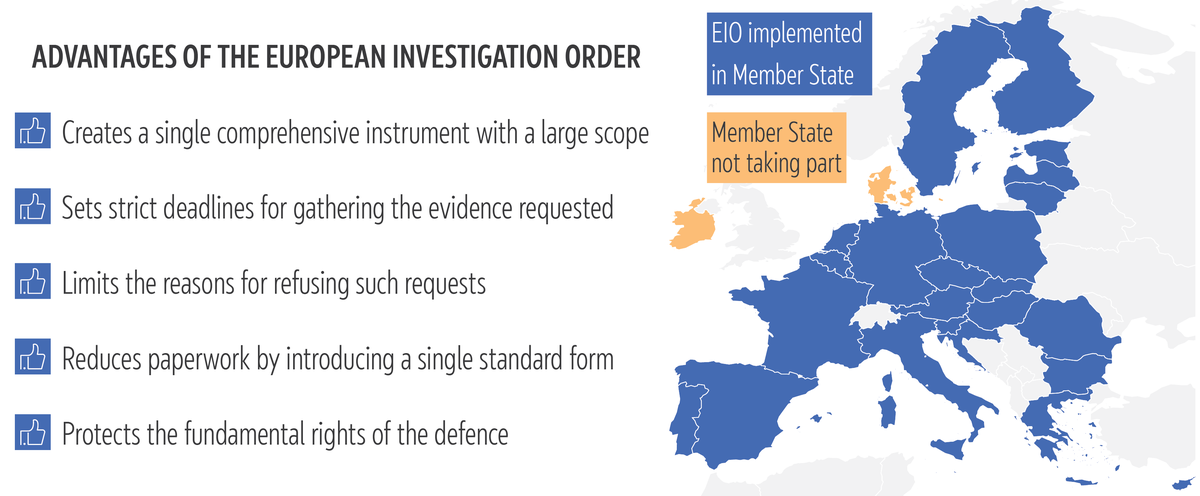
The European Investigation Order (EIO) is a judicial cooperation instrument used in criminal matters within the European Union, except for Denmark and Ireland. The EIO provides a comprehensive framework for simplifying and accelerating cross‑border criminal investigations.
-
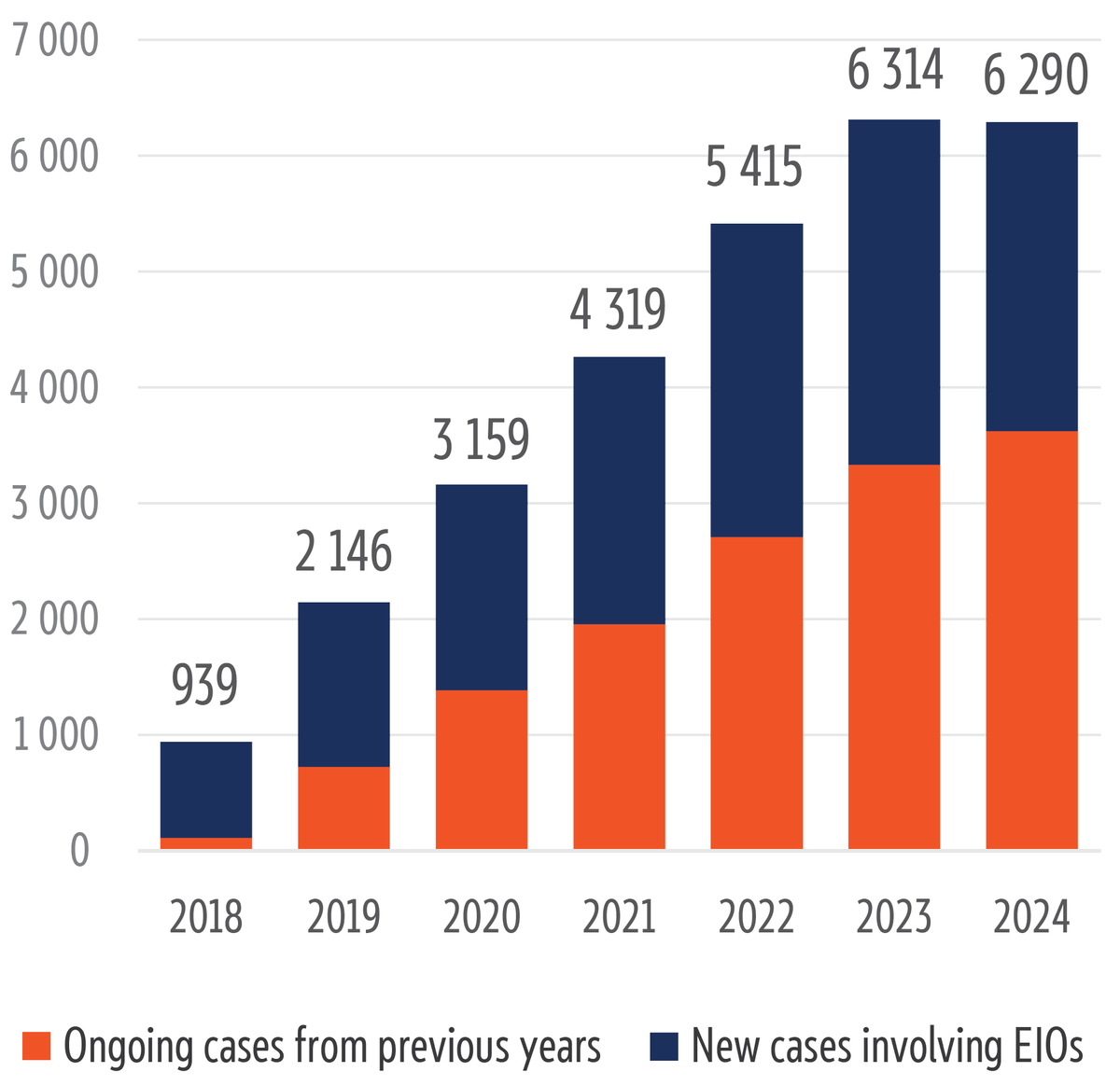
Available data indicate a steady rise in use of the EIO since it was introduced.
-
Directive 2014/41/EU on the European Investigation Order in criminal matters ('the EIO Directive') provides the legal framework. It has applied since 22 May 2017 and has generally been found to work well.
-
Nevertheless, recent reports have highlighted the need to address additional aspects of cross‑border investigations.
-
The European Commission therefore proposes to make targeted legislative improvements to the EIO Directive.
-
The revision will focus on improving the cross‑border gathering of evidence in criminal matters and facilitating remote videoconference participation of suspects, accused persons and victims of crime in court hearings.
Purpose statement
This European Parliamentary Research Service paper aims to inform Members on issues related to a forthcoming Commission initiative. It highlights the main choices which may shape the initiative and which Members may wish to explore ahead of formal Commission adoption. Based on documentary and other sources, it reflects the information available at the time of writing.
For further information on this topic, Members and staff of the European Parliament may contact the author.
Developments and insights – European Commission
Timetable of the revision
In the European internal security strategy (ProtectEU) published on 1 April 2025, the Commission announced it would 'assess the need to further strengthen the European Investigation Order', as part of efforts to equip the EU criminal justice system with effective tools to address emerging threats. On 6 January 2026, the Commission launched a call for evidence for an initiative to revise the EIO Directive. The call was aimed at stakeholders, including national authorities, legal practitioners, non‑governmental organisations (NGOs), and researchers. Stakeholders sent in 15 replies and the feedback period ended on 3 February 2026. The Commission is expected to publish a legislative proposal in June 2026, suggesting targeted legislative improvements.
Purpose of the revision
The Criminal Procedural Law Unit (JUST.A5) within the Directorate‑General for Justice and Consumers (DG JUST) will oversee the file. The purpose of the upcoming revision is to address two main issues.
First, the Commission1 would like to improve cross‑border evidence gathering in criminal matters, by closing gaps in the legal framework. The EIO legal framework currently lacks specific rules, which leads to practical difficulties in cross‑border evidence gathering and may result in legal uncertainty over the admissibility of evidence obtained through the EIO. Specifically, the additions and/or amendments concern:
-
the procedure for requesting consent to use information previously shared by law‑enforcement authorities as evidence in criminal proceedings;
-
the rule of speciality;
-
the provisions on 'interception of telecommunications';
-
the use of technical devices intended to record a person's movements and/or their conversations, where such devices cross into the territory of another Member State;
-
cross‑border surveillance and the relationship between the EIO Directive and Article 40 of the Convention Implementing the Schengen Agreement (CISA);
-
the EIO form (Annex A to the EIO Directive).
Second, the Commission would like to regulate the remote videoconference participation of suspects, accused persons and victims of crime in court hearings from another Member State. Such remote participation is currently not regulated at EU level and the legal landscape on remote participation is fragmented across Member States. This leads to inconsistent practices, barriers to access to justice and the exercise of free movement, and legal uncertainty.
Consent to use information as evidence
The EIO Directive lacks a provision regulating the procedure for issuing an EIO to request and grant consent to use information previously shared between law‑enforcement authorities as evidence in criminal proceedings.
The rule of speciality
The EIO Directive does not expressly regulate the rule of speciality,2 and Member States' views diverge on whether it applies in the context of the EIO Directive. Some Member States explicitly mention that evidence may only be used for the purpose of that specific investigation, when executing an EIO; others make no mention, but assume the evidence will not be used for another purpose. Some Member States consider permission must always be sought from the executing Member State before evidence is used in a different case; others consider this step unnecessary.
Interception of telecommunications in cross‑border situations
Member States disagree on whether surveillance measures conducted by technical means, such as GPS‑tracking, 'bugging' vehicles, installing spyware on a device to intercept conversations at source, or audio/video surveillance, fall within the notion of 'interception of telecommunications'. This uncertainty causes difficulties, especially as regards the notification required under Article 31 of the Directive (which requires that the Member State where interception takes place is notified of the surveillance).
Cross‑border surveillance
On cross-border surveillance, the Commission has been asked to clarify the relationship between the EIO Directive and Article 40 of the CISA. Member States disagree whether cross‑border surveillance is a police cooperation or judicial cooperation measure.
Annex A
Practitioners from several Member States have called for legislative intervention aimed at making Annex A more user‑friendly, to improve communication between issuing and executing authorities.
Presidential support/priority
The Cyprus EU Presidency priorities comprise security, strategic autonomy (including border protection) and migration management (including implementing the pact on migration and asylum, focusing on returns and external partnerships). Specifically, priorities involve supporting judicial cooperation against cybercrime; organised crime (including fraud, human trafficking, financial crime, crypto fraud, investment scams); and trafficking of drug precursors, enhancing enforcement; and strengthening border security measures, leveraging Cyprus's location and expertise.
Member State positions
The Coordinating Committee in the area of police and judicial cooperation in criminal matters (CATS), set up under Article 36 of the Treaty on European Union, focuses on coordinating work related to criminal justice and law enforcement cooperation between Member States. The CATS agreed that the 10th round of mutual evaluations would focus on the implementation of the EIO Directive. The final report on the 10th round of mutual evaluations summarises the key findings, conclusions and recommendations of the individual country reports and formulates recommendations to the Member States and to the Commission, the European Judicial Network (EJN), the European Judicial Training Network (EJTN) and Eurojust.
Debates leading up to the adoption of the EIO Directive in 2014 show the EIO was controversial from the start on fundamental rights grounds. There is an acknowledged tension, within the directive itself, between the mechanism's efficiency and the protection of fundamental rights. This reflects different Member States' positions, with some favouring fundamental rights safeguards, while others want to see the efficient promotion of cross‑border justice. Similar fault‑lines are likely to appear during future negotiations on changes to the EIO Directive. Member States agree that the EIO needs updating, and that better integration with modern investigative practices is necessary. However, Member States are likely to disagree over how to balance efficiency versus fundamental rights; on whether the EIO should remain central or be replaced by e‑evidence tools; over the degree of harmonisation versus national discretion; and safeguards around remote procedures.
Position of parties that may be impacted
Fair Trials Europe
In response to the Commission's call for evidence, the Fair Trials Europe NGO submitted two observations: on the effect of remote participation on the right to a fair trial; and on cross‑border evidence gathering.
Remote participation
The organisation notes that any EU framework on remote participation must strengthen the right to a fair trial, rather than prioritise efficiency or convenience. The NGO notes that the EIO allows videoconferencing for evidential purposes, including hearings of suspects or accused persons. However, it does not cover all forms of participation in criminal hearings. Fair Trials sees merit in establishing a dedicated EU framework for cross‑border videoconferencing in criminal hearings, whether through reform of the EIO or a separate instrument. However, the NGO also noted that greater availability of videoconferencing risks being used for convenience, particularly where it is difficult to surrender the suspect or the accused in person. Fair Trials therefore considers the accused's informed consent is essential. The NGO notes that any EU instrument must ensure confidential access to a lawyer at the trial stage before, during, and after the hearing; sufficient time for defence preparation; technical conditions that replicate the courtroom and protect the presumption of innocence; obligations to suspend hearings where participation is impaired; access to case materials in line with Directive 2012/13 on the right to information in criminal proceedings; and high‑quality interpretation adapted to remote hearings, consistent with Directive 2010/64 on the right to interpretation and translation in criminal proceedings. Fair Trials asks the Commission to reflect on the interaction with Directive 2016/343 on the strengthening of certain aspects of the presumption of innocence and of the right to be present at the trial in criminal proceedings, and whether remote attendance constitutes presence at trial – or a waiver thereof.
Cross‑border gathering of evidence
Fair Trials notes that 'courts and the defence are often presented with evidence without insight into how it was obtained'. At both issuance and execution stages of an EIO, defence involvement is minimal, making challenges extremely difficult. When evidence later appears in the case file, lawyers typically see only the EIO request and its outcome. The NGO notes that the absence of common evidentiary standards means that cross‑border evidence is rarely excluded, often on the basis of presumed reliability, mutual trust, or mutual recognition. Such approaches 'undermine fair trial guarantees by limiting scrutiny of legality and reliability'. For that reason, Fair Trials urges the Commission to strengthen remedies, judicial oversight, and the defence's ability to challenge and seek exclusion of unlawfully obtained cross‑border evidence.
Bundesverband Anuas e.V.
The Bundesverband Anuas e.V. is a nationwide German support and self‑help organisation. It provides assistance to, inter alia, relatives of victims of homicide or manslaughter. In response to the Commission's call for evidence, the organisation points to the lack of attention paid in the EIO Directive to the rights of co‑victims of crime.
German Bar Association
The German Bar Association welcomes the Commission's initiative to review the EIO. The association describes the EIO as 'an important step forward in comparison with traditional mutual legal assistance, as it is intended, in principle, to standardise and speed up cross‑border investigations'. The association points out, however, that 'significant shortcomings have emerged in practical application, leading to legal uncertainty, delays and, above all, structural gaps in the protection of procedural and defence rights'. These shortcomings are described in detail in the association's submission.
European Parliament views
Adoption of the EIO Directive
In its capacity as co‑legislator, the European Parliament supported the adoption of the EIO Directive in 2017, voting in favour of the creation of a single instrument on gathering cross‑border evidence. Parliament wanted to see a broad scope for the instrument, covering almost all investigative measures, including hearings, searches, surveillance, etc. Parliament was explicitly in favour of using the EIO to obtain information on banking and other financial operations, on the content of telecommunications as well as traffic and location data associated with such telecommunications, and for covert investigations. At the same time, Parliament insisted on strong safeguards and limits, including the protection of fundamental rights, clear grounds for refusal of the execution of an EIO, proportionality and legality checks, and the availability of legal remedies.
Parliament has adopted no standalone resolutions specifically dedicated to the EIO since the adoption of the EIO Directive.
Adoption of the e‑evidence package
During negotiations that led to the adoption of the 'e‑evidence package', a distinction was made between the (existing) EIO – a judicial cooperation instrument based on mutual recognition – and new measures on electronic evidence gathering in criminal proceedings. In 2023, the EU introduced a new system for gathering of electronic evidence in criminal proceedings in the EU. The new rules on e‑evidence consist of two legislative measures – Regulation (EU) 2023/1543 on European Production Orders and European Preservation Orders for electronic evidence in criminal proceedings and for the execution of custodial sentences following criminal proceedings (which will come into force in August 2026), and Directive (EU) 2023/1544 laying down harmonised rules on the designation of designated establishments and the appointment of legal representatives for the purpose of gathering electronic evidence in criminal proceedings (which entered into force in February 2026). Together, these two measures will make it easier for law enforcement and judicial authorities to directly obtain electronic evidence they need to investigate and prosecute criminals from service providers in other EU countries.
The e‑Evidence Regulation enables a judicial authority in one Member State to directly compel service providers – or their legal representatives – in other Member States to produce electronic evidence within 10 days (or 6‑8 hours in emergencies). This compares to up to 120 days for the EIO. It also enables judicial authorities to request that a service provider in another Member State preserve specific data in view of a subsequent request to produce this data, including by way of an EIO.
In discussions on cross‑border access to electronic evidence (emails, cloud data), Parliament frequently compared the proposal for the e‑evidence package to the EIO. The EIO was described as a judicial cooperation model that was sometimes too slow for digital evidence. Members debated whether the new tools should replace or complement the EIO.
Why is the initiative important?
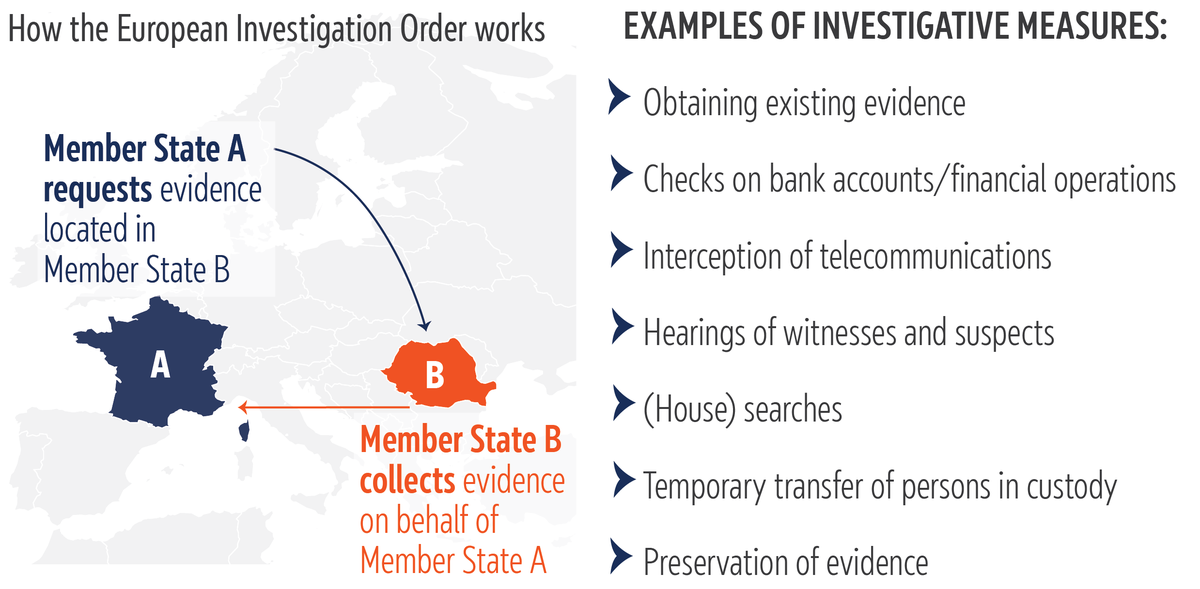
An EIO is a judicial decision issued in or validated by a judicial authority in one Member State (the issuing state), which requests specific investigative measures to obtain evidence in criminal matters to be carried out in another Member State (the executing state). This can include providing existing evidence, such as banking information, or carrying out investigative measures, such as hearing witnesses, intercepting telephone conversations, or carrying out covert investigations. The investigative measures requested must be necessary and proportionate to the investigation. Moreover, the investigation must be carried out in the same way and under the same modalities as if the investigative measure concerned had been ordered by an authority of the executing country.
There is little statistical data on the EIO's implementation, as most Member States have not provided comprehensive statistics. The only statistical information available concerns EIOs in which the European Union Agency for Criminal Justice Cooperation (Eurojust) has been involved. Eurojust's annual reports from 2018 to 2024 provide an overview of new EIO cases and ongoing EIO cases from previous years in which Eurojust was involved. The reports show a steady increase in the total number of EIO cases over the seven‑years where Eurojust has been involved, reaching a total of 28 582 cases. The number of new EIO cases each year has risen from 830 in 2018 to a peak of 2 982 in 2023. The number of ongoing EIO cases carried over from previous years has also substantially increased from 109 in 2018 to 3 622 in 2024. The total number of EIOs involving Eurojust has on average increased by 34 % each year.
The legal framework governing the EIO is Directive 2014/41/EU of the European Parliament and of the Council of 3 April 2014. The directive provided a detailed roadmap for submitting and exchanging requests between EU Member States, facilitating efficient and effective collection of evidence. However, several recent reports have identified where the EIO could be improved. These reports include: (i) the final report on the 10th round of mutual evaluations on the EIO's implementation; (ii) the final report of the High Level Group on access to data for effective law enforcement; (iii) the Commission staff working document 'Assessment of the effect given by the Member States to Council Recommendation (EU) 2022/915' of 9 June 2022 on operational law enforcement cooperation; (iv) Eurojust reports; and (v) the findings of the European Judicial Network in criminal matters.
Endnotes
Classification
Policy areas: Area of Freedom, Security and Justice
Committees: Civil Liberties, Justice and Home Affairs (LIBE)
Disclaimer
This document is prepared for, and addressed to, the Members and staff of the European Parliament as background material to assist them in their parliamentary work. The content of the document is the sole responsibility of its author(s) and any opinions expressed herein should not be taken to represent an official position of the Parliament.
Copyright
© European Union.
The reuse of this document is authorised under a Creative Commons Attribution 4.0 International (CC-BY 4.0) licence.

To use or reproduce elements that are not owned by the European Union, permission may need to be sought directly from the respective rightsholders.