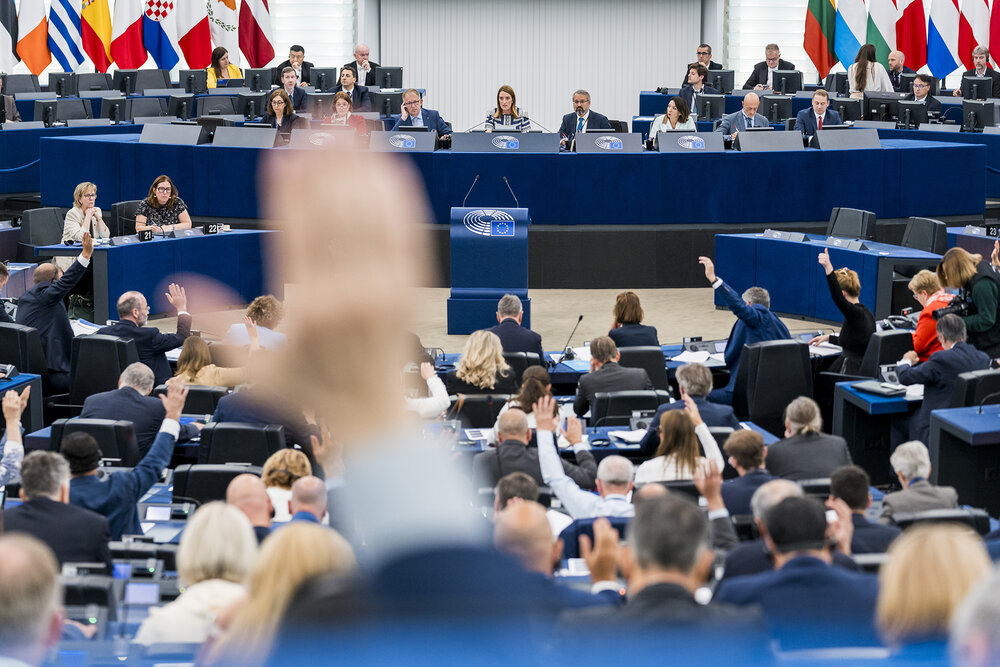
During the European Parliament’s second plenary session of October 2026, Members are set to discuss the European Union's general budget for 2026 and longer-term spending plans, the environment, and passenger rights. On Monday, Parliament commemorates the International Day for the Eradication of Poverty and on Wednesday, Members are due to debate the outcome of the European Council meeting of 15 16 October, as well as hear a presentation of the 2025 Court of Auditors’ annual report. On Wednesday afternoon, Members are set to debate the upcoming United Nations Climate Conference (COP31) that will take place in Antalya, Turkey, in November 2026.
As decisions on the EU’s next long-term budget (MFF) for 2028-2034 draw closer, Parliament has aims to be involved in shaping the allocation of funds.
Erasmus+
Parliament is to vote on a report from its Committee on Culture and Education (CULT) on the Erasmus+ programme for 2028-2034, to set its position for interinstitutional negotiations. The Commission proposes a 49 % increase in funding (to €40.8 billion) in comparison to 2021-2027. The CULT committee proposes to increase this amount further, to €47.38 billion. It stresses that the visibility of the European Solidarity Corps should be maintained, despite its planned integration into the fund.
Euro counterfeiting
The EU has a budget for training and studies to help combat counterfeiting of the euro through the Pericles programme. The next edition of the scheme, Pericles V, will come under the 2028-2034 MFF. The report from Parliament's Committee on Civil Liberties, Justice and Home Affairs (LIBE) proposes a higher budget than the European Commission had, at €7.8 million. It calls to avoid overlaps between Pericles V and other programmes, and asks the Commission to report on its status annually. Parliament is due to vote its position for negotiations with the Council.
European Union annual budget
The discharge procedure allows Parliament to scrutinise how the EU's budget has been spent – it can either approve, postpone, or refuse discharge for each EU institution. Parliament's Committee on Budgetary Control (CONT) publishes a report on each EU body, and has again advised Parliament to refuse discharge to the Council and the European Council for 2024. Discharge was already postponed for these two institutions in April 2026, and a second, final report was adopted by the CONT committee in October 2026. The report underlines that the Council did not participate in a budget hearing organised for the institutions, nor did its Secretariat answer a Parliament questionnaire.
Passenger rights
Members will vote on the provisional agreement reached between Parliament and the Council on more harmonised, efficient and clearer rules for passenger rights. During interinstitutional negotiations, Parliament’s Committee on Transport and Tourism (TRAN) called for clearer rules on travel tickets bought via intermediaries (i.e. tickets not purchased directly from the travel company itself) and supported the establishment of a common European form for compensation. In the agreed text, air-ticket intermediaries' obligations are clarified and a common EU form for air, sea, and bus (but not rail) is set out. Also in line with the Parliament’s position, the agreement secures a stronger role for enforcement bodies.
Cross-border protection of vulnerable adults
Members are due to vote on a provisional text concerning adult citizens who have limited decision-making capacity and have moved between Member States. The proposed regulation aims to clarify which Member States' jurisdiction applies in these specific cross-border cases. It would also allow certificates of support and representation to be recognised across Member States. The Commission originally proposed an interconnected system of national registers, however this has been removed in the final text; instead, it was agreed to facilitate more decentralised electronic communications between national authorities. Parliament's Committee on Legal Affairs (JURI) underlines the importance of supported decision-making in its report on the proposal. This was secured in the provisional text, which emphasises supported decision-making (above another person making decisions for someone else) – aiming to grant more autonomy to adults who need assistance.
Environment (Omnibus VIII)
Extended producer responsibility is the principle that producers are responsible for a product for its whole life cycle, including when it becomes waste. An authorised representative (AR) is appointed to fulfil these producer obligations. The Commission put forward two proposals suspending the obligation of EU-based, cross-border producers to appoint ARs. One of the proposals covers products such as batteries and packaging; the other relates to single-use plastics, textiles and e-waste. Parliament's Committee on the Environment, Climate and Food Safety (ENVI) adopted two corresponding reports, due for debate on Monday. The vote on these reports will form the basis of Parliament’s position for interinstitutional negotiations. The ENVI committee suggested, among other amendments, that this suspension of ARs should only apply to small enterprises.
Critical Raw Materials Act
On Monday, a debate is scheduled on amending the Critical Raw Materials (CRM) Act. A report from the Committee on Industry, Research and Energy (ITRE) favours the Commission’s plan to establish a European CRM Centre as an EU body. This centre would be responsible for tasks such as joint purchasing, European contingency stocks, identifying supply chain vulnerabilities, and risk analysis. The vote on the report will constitute Parliament’s mandate in negotiations.
Chemicals (Omnibus VI)
The Council and Parliament have reached a provisional agreement on simplifying certain chemical procedures and requirements – ensuring that human health is safeguarded, notwithstanding a reduction in compliance costs. This includes that labels on products must be clearly visible. On fertilisers, the final text retains provisions the Commission proposal sought to replace. It also includes stricter provisions on the transition periods for taking newly banned carcinogenic, mutagenic and reprotoxic substances (CMR) off the market. Interinstitutional negotiations have halved the time that these chemicals are allowed to be placed on the market and in circulation (after they have been outlawed). A debate on the agreed text is scheduled for Wednesday afternoon.