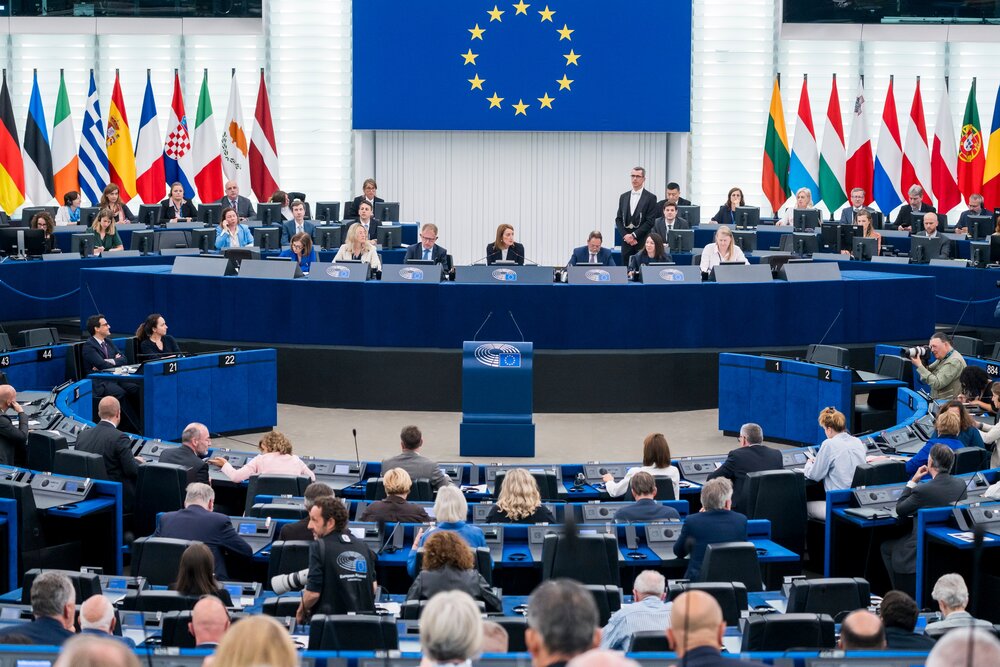
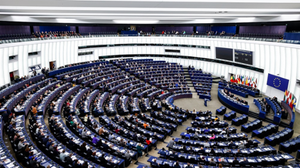
Besides its role as co-legislator, with equal weight to the Council of the European Union under the ordinary legislative procedure, Parliament exercises its influence in other areas of EU decision-making.
International agreements
Parliament is influential in concluding international agreements. In most cases, Parliament's consent is required before the EU can ratify an agreement with a non-EU country or with an international organisation. Without that consent, the agreement cannot proceed. In certain cases, Parliament can issue a non-binding opinion on an international agreement.
Furthermore, according to Article 218(10) of the Treaty on the Functioning of the European Union (TFEU), Parliament 'must be immediately and fully informed at all stages' of the procedure to negotiate agreements with non-EU partners. The Court of Justice of the EU (CJEU) links this to the right of the Parliament 'to exercise democratic scrutiny of the Union's external action.'
Legislative initiative
One limitation to Parliament's powers is that it does not have the direct right of legislative initiative – which belongs fully with the European Commission. However, Parliament can call on the Commission to propose legislation, and the Commission has committed to respond rapidly to such calls from the Parliament.
To invite the Commission to propose legislation, Parliament must produce a legislative-initiative report, drafted by one of its committees. The report is then submitted to the Commission, once adopted in plenary by a majority representing at least half of all the Members.
The standard protocol for the adoption of a legislative act in the EU is the ordinary legislative procedure. This means that the Commission, Council, and Parliament must agree on an identical text. This is achieved through informal tripartite meetings known as trilogues. Although not explicitly mentioned in the EU Treaties, trilogue meetings are now a key part of negotiations.
Scrutiny powers
To ensure high-quality EU law, Parliament scrutinises the actions of the EU's executive throughout the legislative cycle, assessing both the impact and the outcome of EU legislation.
Parliament also possesses a unique and exclusive authority – the right to dismiss the Commission through a motion of censure. At least one-tenth of Members may call to hold such a vote. The motion of censure itself must be approved by a public, double-majority vote (two-thirds of the votes cast and a majority of Members participating in the vote).
Between the 2024 European elections and summer 2026 there were four motions of censure against Ursula von der Leyen's Commission, all of which failed to gather sufficient support. It has been suggested that, although the motion of censure had been regarded as a 'nuclear option', it has recently been used less to try to force the Commission to resign, but rather to exert political pressure.
Meanwhile, Parliament has expressed concern over democratic legitimacy and oversight regarding Article 122 TFEU. This provides a legal basis for the Commission and the Council to adopt a non-legislative act without involving the Parliament. The option to adopt emergency measures is generally understood to be invoked in situations where Member States need economic assistance rapidly under exceptional circumstances – such as during the COVID-19 pandemic and when the defence loan, Security Action for Europe (SAFE), was established in 2025. Nevertheless, Members have sought to discourage the Commission from using Article 122 as the basis for action in situations which cannot be described as crises.