Skip to main content (press "Enter")

Fact-checking compass

How to spot information manipulation

Information vs disinformation compass

Misleading information can throw any of us off course. Both misinformation – mistakes without ill intent – and disinformation – created and spread with the aim of fooling people – can make it hard to take informed decisions.

Fast evolving technologies – including deepfake video and audio – make it too easy to produce and spread deceptive content very rapidly. Many of us worry about the effect: some 85 % of people worldwide are concerned about the impact of disinformation on their fellow citizens; 87 % think disinformation has already affected political life in their country; and 38 % of EU citizens list false and/or misleading information as a threat to democracy. These tips will help you steer around falsehoods.

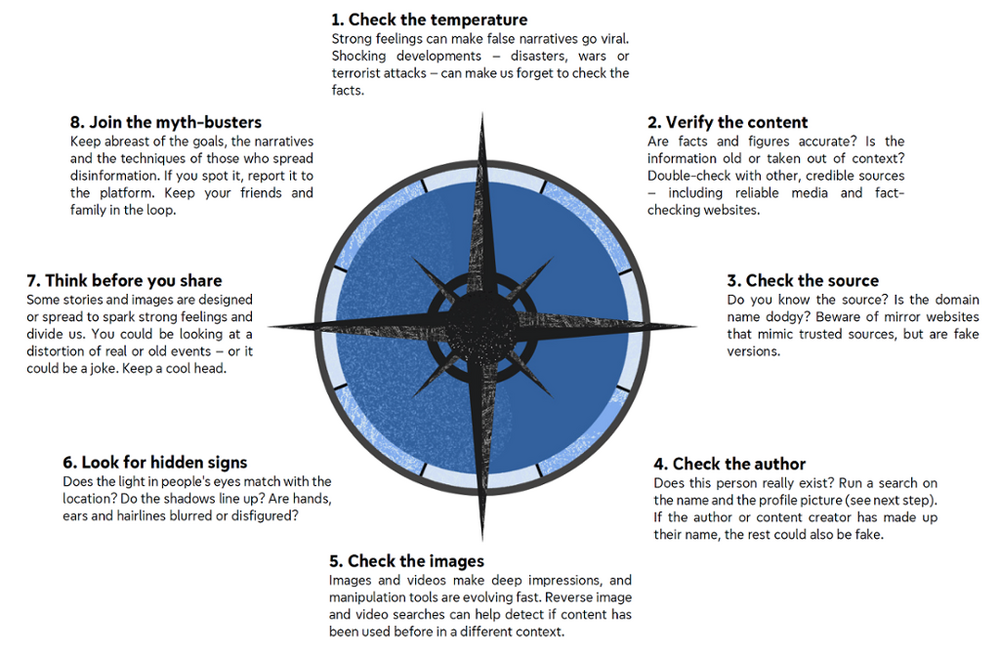
The below infographic is available in 36 different languages: Bulgarian (BG), Spanish (ES), Czech (CS), Danish (DA), German (DE), Estonian (ET), Greek (EL), English (EN), French (FR), Irish (GA), Croatian (HR), Italian (IT), Latvian (LV), Lithuanian (LT), Hungarian (HU), Maltese (MT), Dutch (NL), Polish (PL), Portuguese (PT), Romanian (RO), Slovak (SK), Slovenian (SL), Finnish (FI), Swedish (SV)

Non-EU languages: Albanian (SQ), Arabic (AR), Armenian (HY), Bosnian (BS), Chinese (ZH), Montenegrin (CG), Georgian (KA), Macedonian (MK), Russian (RU), Serbian (SR), Turkish (TR), Ukrainian (UK)

Fact-Checking Compass

Fact-Checking Compass