
Article page checkbox is not checked in page info.
Revision of the Regulation on the Governance of the Energy Union and Climate Action
Revision of the Regulation on the Governance of the Energy Union and Climate Action
Liselotte Jensen and Agnieszka Widuto, Members' Research Service.
Issues at stake
-
Targets and indicators: The proposal is expected to simplify the current energy and climate target architecture, with greater use of headline targets and a limited set of key performance indicators (KPIs);
-
Streamlined planning and reporting: The aim is to reconsider the relationship between long‑term strategies, national energy and climate plans (NECPs) and progress reports, and reduce administrative burden by simplifying reporting requirements and improving data reuse;
-
Coordination and delivery: The changes should address remaining fragmentation and uncoordinated national approaches, further integrate energy and climate planning and wider economic governance, and ensure a stronger link between planning and delivery;
-
Enforcement: As the existing framework relies heavily on non‑binding European Commission recommendations, the revision is likely to revisit how underperformance is addressed;
-
Alignment with the post‑2030 framework: To ensure a governance framework to reflect the substantially changed regulatory and geopolitical context, including the 2040 climate target, energy security, resilience and competitiveness
Purpose statement
This European Parliamentary Research Service paper aims to inform Members on issues related to a forthcoming Commission initiative. It highlights the main choices which may shape the initiative and which Members may wish to explore ahead of formal Commission adoption. Based on documentary and other sources, it reflects the information available at the time of writing.
For further information on this topic, Members and staff of the European Parliament may contact the authors.
Developments and insights – European Commission
The revision of the Regulation on the Governance of the Energy Union and Climate Action was announced for the fourth quarter of 2026 in the Commission's 2026 work programme. The Commission plans to present a legislative proposal to revise the Governance Regulation with the aim of updating and simplifying the existing governance framework, while strengthening its capacity to support post‑2030 energy and climate objectives.
The revision takes place in a substantially different regulatory and geopolitical environment from that in which the regulation was adopted in 2018. The subsequent European Climate Law and Fit for 55 package under the European Green Deal have expanded and amended the EU energy and climate framework. The COVID‑19 pandemic, Russia's war against Ukraine, the ensuing energy crisis and REPowerEU have increased the prominence of energy security, resilience and reduced dependence on Russian fossil fuels. The 2026 Middle East energy crisis, which again is exposing the EU to higher and more volatile fossil‑fuel prices and potential supply disruptions, has further underlined the need for the future governance framework to integrate energy security, resilience and crisis preparedness more systematically into national planning, while strengthening coordination between Member States and reducing dependence on imported fossil fuels.
Against this background, electrification is set to become one of the key parts of the post‑2030 framework: the Commission's July 2026 electrification action plan sets an indicative target of increasing electricity's share in final energy consumption from around 23 % today to 46 % by 2040, linking faster electrification to lower fossil‑fuel dependence, greater energy security and improved competitiveness. The amended European Climate Law, including the binding 90 % net greenhouse gas (GHG) emissions reduction target for 2040, entered into force in April 2026. In her 2026 State of the Union address, Commission President Ursula von der Leyen also underlined the importance of greater energy independence, including through increased use of affordable, home‑grown, renewable and nuclear energy and reduced dependence on imported fossil fuels (see Figure 1). The Commission is developing the post‑2030 renewable energy and energy efficiency frameworks as well as the approach to national climate targets and flexibilities in parallel with the Governance Regulation revision.

Data source Energy mix (share of gross available energy): Eurostat, nrg_bal_c. Fossil fuel subsidies (2023 prices), EEA dataset. Graphic by Nadejda Kresnichka‑Nikolchova, EPRS.
Why is the initiative important?
The current Governance Regulation consolidates requirements on planning, reporting and monitoring to ensure progress on key EU climate and energy targets. These can be binding at either EU or national level. For example, the Renewable Energy Directive's overall target for 2030 is binding at EU level, but the directive also sets sector‑specific sub‑targets, binding at national level. The overall EU 2030 natural carbon sink target is an EU target, with binding Member State carbon sink budgets to deliver it. It is on this array of targets across legislative acts that the headline climate targets of the European Climate Law are designed to be delivered. The Governance Regulation thus becomes a key tool in enforcement of EU climate and energy policy. Under the NECP submission and evaluation process, the regulation also contains provisions seeking to address insufficient ambition or implementation shortcomings.
The Commission's 2024 review report found the Governance Regulation broadly achieved its original purpose. It made energy and climate planning more integrated and coherent, strengthened coordination within and between Member States and improved the quality and accessibility of reported information. However, implementation also revealed persistent weaknesses. The scope and quality of NECPs vary considerably between Member States, submissions have frequently been late and reported information remains incomplete or inconsistent in some areas. Public consultations and multi‑level climate and energy dialogues have also not always been organised sufficiently early or inclusively. Only four Member States submitted their final updated NECPs by the June 2024 deadline, illustrating how delays can impede the Commission's ability to obtain a timely EU‑wide picture of progress towards common energy and climate objectives. Compliance under the regulation relies largely on non‑binding Commission recommendations: an assessment of the 2020 final NECPs found that 53 % of recommendations were only partially addressed and 13 % were not addressed.
The review also identified shortcomings that affect the capacity of the governance framework to steer implementation and investment. NECPs often provide insufficient detail on investment needs, funding sources and the macroeconomic effects of planned measures, while greater coherence is needed between NECPs, long‑term strategies, national budgets and EU funding programmes. The review also pointed to weaknesses concerning climate adaptation, sector‑specific planning, stakeholder engagement and enforcement. The revision therefore comes at a point when the governance framework is about to move from steering delivery of the 2030 framework towards organising national planning, investment and monitoring for the period beyond 2030, while maintaining sufficient coordination to deliver EU‑wide objectives and reducing unnecessary administrative burden.
The impact assessment, informing the 2040 climate target, assumed a decarbonised energy system by 2040, underscoring the need for a strong and enforceable governance framework across energy and climate policies.
Towards a new approach
Under the overarching objectives of improved competitiveness, decarbonisation and energy security, the revision is expected to entail a broader redesign of the governance framework, moving from a relatively document‑ and reporting‑heavy system towards one focused more directly on delivery. One option under consideration would be to simplify the current target architecture around a limited number of headline targets and a broader set of KPIs. While energy targets may be directly integrated in the governance regulation, climate targets could be treated separately in the national targets and flexibilities proposal. One option the Commission is considering is a working range of around 20‑40 KPIs , with emphasis on ensuring the enabling conditions towards headline targets, these could focus on areas such as renewable energy, primary and final energy consumption, electricity interconnection, electrification, and dependence on fossil fuels, as well as carbon removals, enabling increase of the land sink over time. Limiting to 20‑40 KPIs would, the Commission has expressed, require some hard choices; it is unclear if enabling conditions towards infrastructure for CO2 transport towards storage facilities might be included. To decarbonise hard‑to‑abate sectors via carbon capture or permanent carbon removals from direct air capture or bioenergy with CO2 capture, such infrastructure is a key enabling condition to scale implementation. The Governance Regulation would provide the broader framework for monitoring energy‑system transformation and progress on policies and measures needed to deliver agreed energy and climate objectives (see overview of current energy targets in Figure 2). This echoes the May 2026, second stakeholder workshop, organised by the Commission, which focused on the possible role of KPIs in monitoring medium‑ and long‑term investment requirements and improving the credibility and accountability of NECPs.
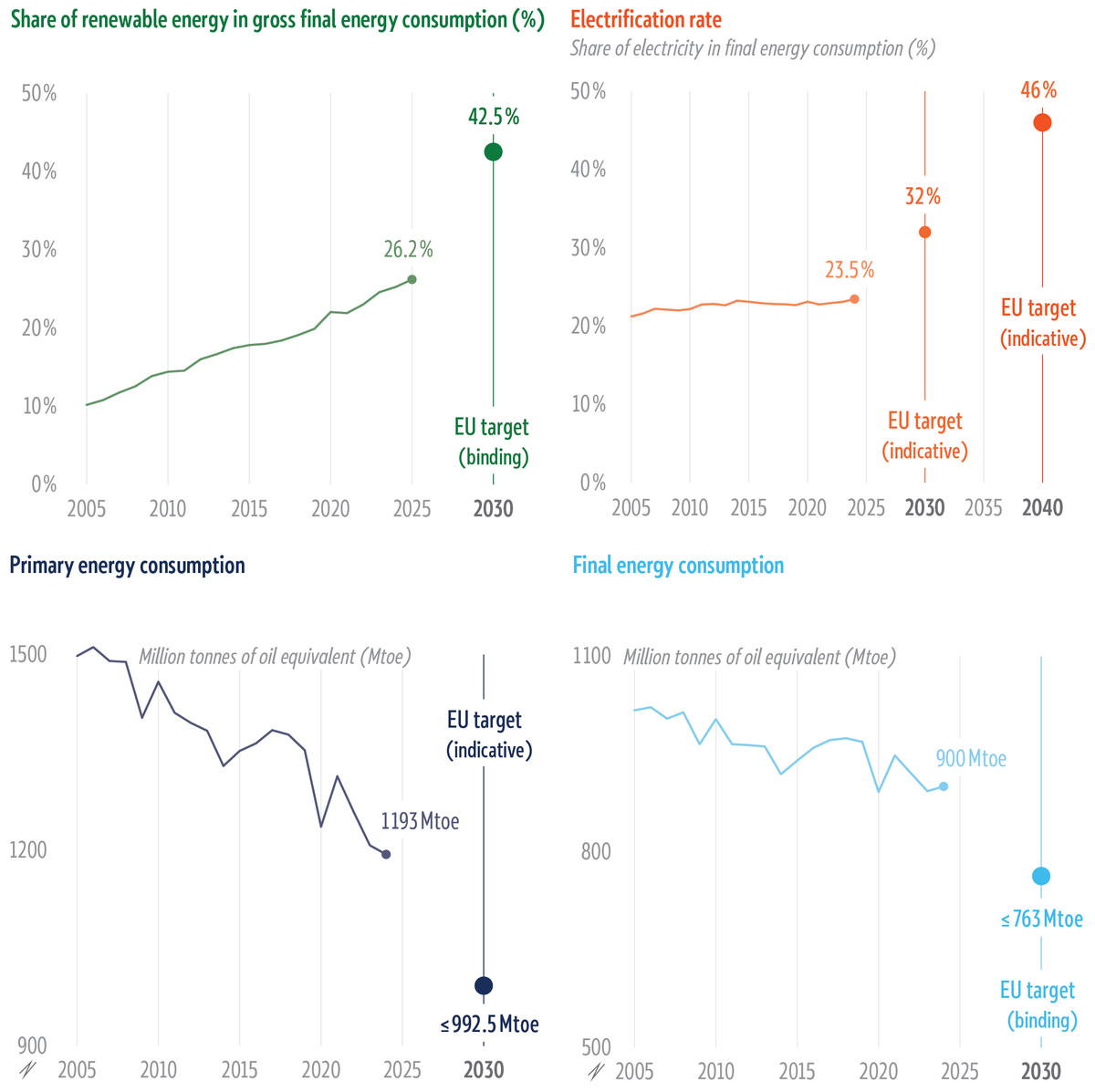
Data source: Eurostat datasets: nrg_ind_ren, nrg_ind_eff and nrg_ind_fecf; Graphic by Nadejda Kresnichka‑Nikolchova, EPRS.
A parallel objective is to substantially simplify planning and reporting. One idea floated in discussions is that reporting requirements could be reduced where information is already available elsewhere, including through greater automatic import of Eurostat data, thereby limiting the need for Member States to submit the same information through different channels. Templates could also become less restrictive and easier to update, with a clearer distinction between information required for strategic planning and data needed for monitoring implementation. More fundamentally, the current separation between NECPs, 30‑year long‑term strategies and biennial progress reports could be reconsidered, with greater alignment or consolidation into a single planning framework. Reporting cycles could also be better aligned with the United Nations Framework Convention on Climate Change (UNFCCC) reporting cycle. The two electronic reporting platforms currently used under the regulation would likely be consolidated or better integrated, to lower the administrative burden. The Commission's 2024 review had already identified scope for further simplification after the regulation initially brought together numerous previously separate planning and reporting requirements. Given the breadth of policy measures covered, the State of the Energy Union report, the Climate Action Progress Report and the EEA's trends and projections work could remain distinct publications, while drawing more efficiently on a common underlying information base.
As the first workshop hosted by the Commission's Directorates‑General for Energy and for Climate Action on the revision highlighted, the Commission seeks to turn NECPs into investment roadmaps, ensuring closer links between future NECPs and investment and economic policy. The Commission is examining how the plans could develop from predominantly planning documents into more operational investment and reform strategies, identifying not only objectives but also investment needs, financing sources, including private capital, and the policies required to deliver them. Possible links with the European Semester are being considered, including closer alignment of timelines and potentially a stronger connection between energy and climate assessments and country‑specific recommendations. This could also involve closer links with the proposed national and regional partnership plans under the 2028-2034 multiannual financial framework, which are intended to bring together Member State and regional investments and reforms. Such links would make the governance framework more directly relevant to the allocation of funds and help identify gaps between national energy and climate objectives and the investment required to achieve them.
A stronger forward‑looking dimension is also being considered. While climate projections are already relatively developed, energy projections could rely more systematically on modelling, common reference scenarios and foresight to assess whether national trajectories are consistent with EU objectives. This would shift some of the emphasis from reporting past performance towards assessing whether planned policies and measures are likely to deliver future targets and KPIs. Greater attention could therefore be given to the policies and measures underpinning national projections, rather than focusing primarily on whether individual indicators are moving in the expected direction. Adaptation reporting could also be revised to reflect more clearly the resilience of critical infrastructure to the impacts of climate change, including resilience of the energy system and associated risks and investment needs. The forthcoming integrated framework for climate resilience is expected to place specific obligations on Member States to ensure appropriate risk management.
Finally, the revision may address the enforcement of the governance framework in case of insufficient progress. The current system relies heavily on Commission assessments and recommendations, and different options are being considered to make underperformance more visible and trigger a clearer follow‑up. These could include more structured performance assessments or other mechanisms linking identified gaps to corrective action, although the precise form remains open.
Taken together, the changes under consideration would shift the Governance Regulation towards a framework with fewer duplicative reporting requirements, a simpler set of objectives and indicators and a stronger focus on investment, forward‑looking planning and implementation.
Member State positions and interested parties' opinions
With the Commission proposal not yet released, Member State positions have emerged mainly through discussions on the wider post‑2030 energy and climate framework and through responses to the Commission consultation on the Governance Regulation. At the June 2026 Energy Council meeting, ministers discussed the future framework for renewable energy, energy efficiency and NECPs, stressing the need to balance ambition with flexibility and to take account of competitiveness, strategic autonomy and energy security. This builds on earlier Council positions calling for closer coordination of national energy planning in areas such as electricity infrastructure. For instance in May 2024, the Council supported long‑term planning at European level combined with bottom‑up coordination of national plans at regional level, and called for gaps in EU‑level governance of cross‑border infrastructure to be addressed. In June 2025, Presidency conclusions backed by 25 Member States emphasised energy security as a key component of strengthening the Energy Union.
The Commission's public consultation and call for evidence on the revision ran until 19 March 2026. National submissions indicate some divergence over how extensively the existing governance framework should be changed. Poland argues that the Governance Regulation should remain in its current form and should not create additional planning obligations or strategy documents, pointing to the administrative burden on national authorities. Hungary likewise considers the existing governance mechanism broadly sufficient, while emphasising the need to preserve national specificities. Slovenia, by contrast, sees scope for a more substantial revision, arguing that implementation has exposed structural limitations and calls for greater strategic coherence, effectiveness and usability of the NECP and long‑term planning framework. The Netherlands submitted its contribution as chair of the Coalition on Phasing Out Fossil Fuel Incentives Including Subsidies (COFFIS), bringing the phase‑out of fossil‑fuel subsidies into the discussion on the future governance framework.
Member State positions also differ on the design of the post‑2030 energy framework and the energy targets that the future governance framework and NECPs would implement. In a joint position in June 2026, followed by a letter to the Commission in July 2026, 15 members of the Nuclear Alliance1 called for a technology‑neutral and flexible post‑2030 framework allowing Member States greater choice over their decarbonisation pathways. They advocated an overarching clean energy target encompassing both nuclear and renewable energy rather than a renewables‑only approach. The emerging debate therefore concerns not only reporting and planning simplification, but also the flexibility allowed to Member States and regions in choosing their energy mix.
Climate Action Network Europe (CAN), a non‑governmental organisation (NGO) coalition, calls to retain binding EU targets for renewable energy and energy efficiency beyond 2030, accompanied by stronger compliance and enforcement mechanisms. It proposes KPIs to track enabling conditions, automatic corrective mechanisms in cases of underperformance and improved access to justice. It warns against undermining accountability in the name of simplification measures. In a 2026 brief, the NGO Bellona Europa recommends a gradual evolution of the existing governance architecture rather than a major overhaul, combined with stronger compliance mechanisms. It supports developing NECPs into more credible investment plans with improved information of financing gaps, while maintaining their primary role as policy instruments. They propose separate planning, accounting and reporting for permanent carbon removals and international credits and stronger provisions on transparency, public participation and compliance with the Aarhus Convention.
The European Network of Transmission System Operators for Electricity (ENTSO‑E) recommends stronger regional cooperation rather than centralisation of grid planning and operations, greater harmonisation and comparability of NECP data and streamlined reporting requirements. It also recommends that NECPs incorporate energy‑security considerations and provide clearer information relevant to grid planning, while national network development plans should remain the principal investment plans for grids.
The post‑2030 energy target structure has produced more distinct positions. The E3G think‑tank supports maintaining a renewable‑energy target and a clear energy‑savings trajectory, complemented by an electrification KPI. It proposes making NECPs the central or 'keystone' plans in the wider planning framework, harmonising indicators across energy, climate and economic governance and strengthening their role in mobilising investment. The European Renewable Energies Federation (EREF) similarly argues for retaining a binding EU renewable energy target and explicitly opposes replacing it with a broader 'clean energy' or 'low‑carbon' target. It also calls for stronger monitoring, corrective action and enforcement and more detailed investment planning in NECPs.
By contrast, Nucleareurope, a trade association for the nuclear energy industry in Europe, calls for an overarching technology‑neutral clean energy target encompassing nuclear and renewable energy, alongside a flexible electrification framework and an electrification KPI. It argues that Member States should retain substantial flexibility in determining how electrification objectives are met. Eurelectric takes a related position, proposing an EU‑level clean power target rather than choosing among the target structures presented in the Commission consultation, together with non‑binding national electrification KPIs. It also calls for more granular investment information in NECPs, stronger integration of grid development needs and greater voluntary regional coordination.
European Parliament views
From the start of the Energy Union initiative, Parliament has consistently supported a stronger and more integrated governance framework for EU energy policy. In its December 2015 resolution on the topic, Parliament called for transparent Energy Union governance, a stable framework and a strong role for Parliament, while stressing regional cooperation and coordination between Member States. More recently, its electricity grids resolution of June 2025 called for integrated grid planning at local, regional, national and EU levels and to align network development plans with the NECPs. Parliament considered that a strengthened governance framework would help align grid development with national and EU policy objectives.
On the same day, Parliament also adopted its resolution on the 'Clean Industrial Deal' calling for completion of the Energy Union and deeper electricity‑market integration, highlighting fragmentation of regulatory oversight and investment planning across Member States; it also reiterated the 15 % electricity interconnection target set out in the Governance Regulation. In an April 2026 resolution on the application of EU law, Parliament welcomed Commission action concerning Member States that had failed to submit updated draft NECPs on time and called for integrated monitoring, better enforcement mechanisms and closer alignment between EU climate objectives and national strategies. It also underlined the importance of timely implementation of EU energy legislation, including the Governance Regulation.
While consistently noting the fossil fuel subsidy issue in all of its resolutions ahead of the annual climate change conferences (COP) since 2019, Parliament's COP29 resolution in 2024 urged Member States and the Commission to improve reporting on fossil fuel subsidies, making concrete plans and timelines for their phase‑out. It further called on the Commission to develop a governance framework to that effect, in line with the requirements of the 8th environment action programme. The urgency of the topic was present also in the COP30 resolution where it was also noted that EU subsidies for fossil fuel imports distort incentives for the clean energy transition. The draft resolution for COP31 reiterates these points.
Parliament recognises the importance of addressing the financing dimension of the investment needs that Member States are required to reflect in their NECPs. In its April 2026 resolution linked to the next multiannual financial framework negotiations, Parliament called to reinforce the Connecting Europe Facility (CEF), noting the importance and added value of EU investment in developing clean energy infrastructure and accelerating grid modernisation and cross‑border interconnection, while noting that future funds would be dependent on close synchronisation between programmes such as the CEF, the competitiveness fund and the national and regional partnership plans.
Further reading
- Widuto, A., Future of the Energy Union, EPRS, European Parliament, December 2025.
- Jensen, L., National climate targets and flexibilities post-2030, EPRS, European Parliament, September 2026.
Endnotes
Classification
Policy areas: Energy | Environment
Regions: European Union
Committees: Industry, Research and Energy (ITRE), Environment, Climate and Food Safety (ENVI)
Statement on the use of AI
Any AI‑generated content in this text has been reviewed by the authors.
Disclaimer
This document is prepared for, and addressed to, the Members and staff of the European Parliament as background material to assist them in their parliamentary work. The content of the document is the sole responsibility of its author(s) and any opinions expressed herein should not be taken to represent an official position of the Parliament.
Copyright
© European Union.
The reuse of this document is authorised under a Creative Commons Attribution 4.0 International (CC-BY 4.0) licence.

To use or reproduce elements that are not owned by the European Union, permission may need to be sought directly from the respective rightsholders.