
Article page checkbox is not checked in page info.
Atlantic salmon in the EU
Atlantic salmon in the EU Fisheries, aquaculture and processing
Frederik Scholaert, Members' Research Service
Summary
The Atlantic salmon is an iconic species. Born in fresh water, they migrate to the ocean to live and grow, and then return to their native river to reproduce. However, wild stocks have declined sharply in recent decades due to human-induced pressures. By contrast, salmon farming has made the Atlantic salmon one of the most widely available fish species. In terms of value, it is the world's first farmed fish species.
Salmon aquaculture is dominated by Norway and Chile. The EU is a minor producer, although its production is increasing. Ireland is the EU's largest salmon farming Member State, with most of its production certified as organic. Several EU Member States are setting up new land-based salmon farms using closed-water circulation systems, a technique pioneered by Denmark.
The EU's salmon processing industry relies heavily on imports, particularly from Norway. Poland is the EU's leading producer of smoked salmon, accounting for almost half of the EU's total output. The sector generates significant added value in the EU.
Under the EU's common fisheries policy (CFP), fishing for salmon in marine waters is prohibited, with some exceptions in the Baltic Sea. Following the closure of most commercial Atlantic salmon fisheries, recreational fishing, particularly in rivers, has become the primary method of fishing for this species. Some rivers in Scandinavia and Ireland have become internationally recognised angling destinations.
In a September 2026 resolution, Parliament points out that the EU's fisheries, aquaculture and processing sectors play a critical role in the EU's food system and calls on the Commission and the Council to attach greater importance to food security. In a resolution of May 2026, Parliament called on the Commission to consider including salmon and trout stocks in the CFP's Baltic multiannual plan.
The Atlantic salmon
Life cycle
Atlantic salmon (Salmo salar) is an iconic migratory fish species with a remarkable life cycle. It is an anadromous species, meaning it is born in fresh water, migrates to the ocean and then returns to fresh water to reproduce. Before and during their migration to the sea, juvenile salmon undergo a transformation to allow life in the sea. Salmon at this life stage are known as smolts. In this process, they develop a silver colour. Salmon typically return to the same river where they smoltified. Maturation takes place during this upstream migration, and they change colour to reddish-brown. A few cases of landlocked populations exist; these complete their whole life cycle in fresh water, usually migrating between rivers and large lakes instead of between rivers and the sea; an example is the Gullspång salmon in Sweden. Salmon are a keystone species in aquatic ecosystems. They are an important food source for many larger aquatic and terrestrial predators, and they transfer ocean-derived nutrients to river ecosystems when they migrate to spawn.
The geographic range of the Atlantic salmon extends across the northern Atlantic, typically divided into four main areas: West Atlantic salmon in North America, East Atlantic salmon in Europe, Northern Atlantic salmon in the Barents region, and Atlantic salmon in the Baltic Sea (Baltic salmon). The latter is considered genetically distinct from the other populations as it is adapted to the characteristics (e.g. temperatures and salinity) of the Baltic Sea. Furthermore, Atlantic salmon populations adapt to their local environment: since no two rivers are exactly the same, numerous strains of salmon exist, each adapted to its own river. This has implications for conservation and management measures, since maintaining genetic variation within small native populations is crucial.
Salmon are a key species in aquaculture. They are farmed in environments that replicate their natural life cycle. In freshwater hatcheries, the salmon hatch from eggs and are raised for around a year. They are then usually transferred to sea farms as smolts. These sea farms are typically large, floating pens located in coastal marine waters. A key difference between farmed and wild salmon is their diet, and consequently the nutrients they provide to humans. The composition of feed for farmed salmon has changed over the past few decades, shifting from marine-based to plant-based ingredients.1 Recently, recirculating aquaculture systems have emerged as a method of producing salmon. These land-based facilities use a closed-water circulation system. They are designed to recycle up to 99 % of their water, thereby minimising water usage and avoiding nutrient discharge.2 Closed systems also prevent the spread of sea lice and reduce the risk of farmed salmon escaping, both of which are well-known ecological problems associated with traditional marine cage farms.
State of the wild population
The number of wild Atlantic salmon has declined severely over the past decades due to various pressures: overexploitation, habitat degradation, pollution, sea lice infestation from salmon farms and increased predation (e.g. by seals and cormorants).
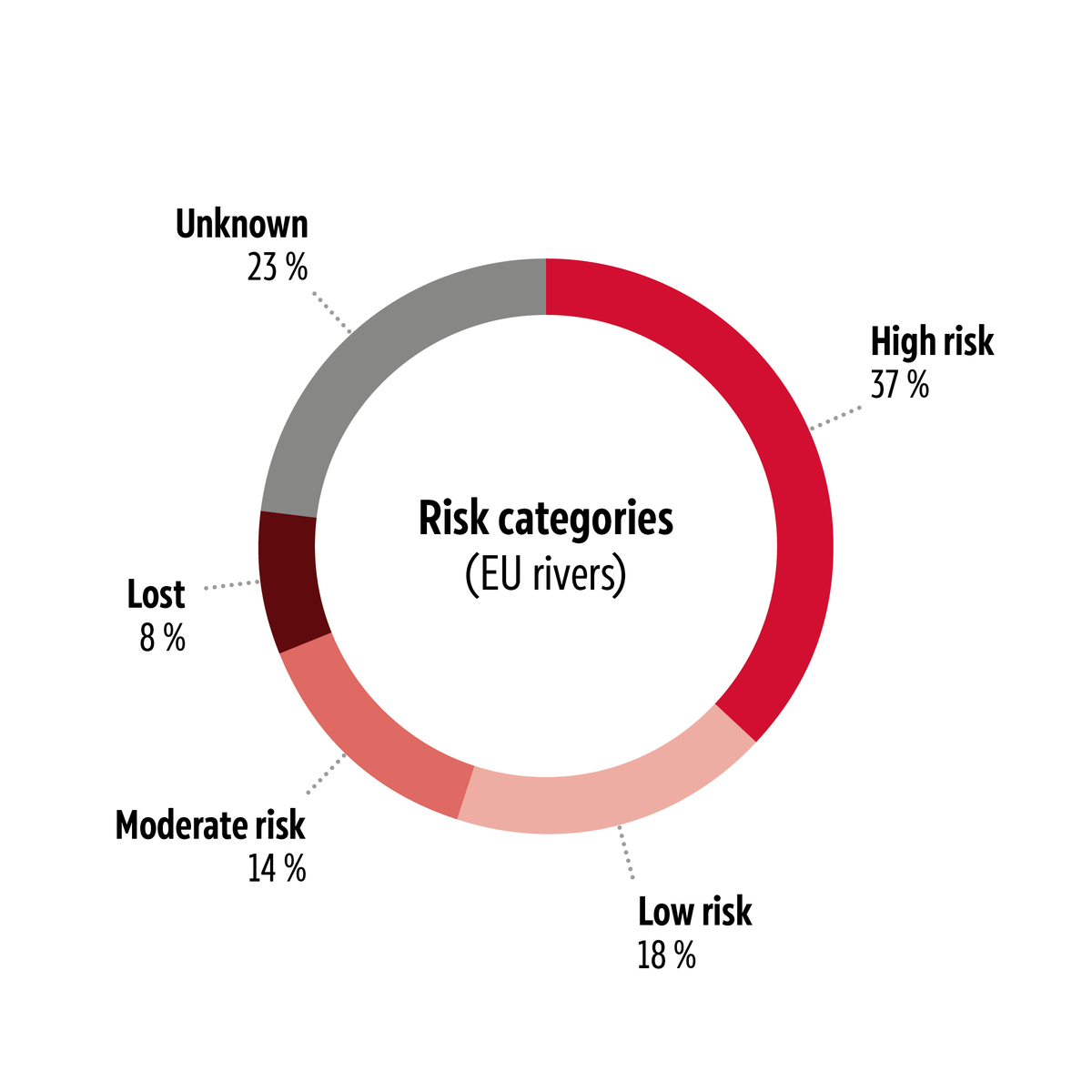
In 2019, the North Atlantic Salmon Conservation Organization (NASCO) published a report on the state of the stock. It noted an alarming decline in the total population, with the number of wild Atlantic salmon falling by more than half between 1983 and 2016. However, it also reported positive outcomes, such as stopping historic overfishing and local conservation successes (e.g. through the removal of river barriers). NASCO regularly collects information on river populations. Each river is assigned a risk category by the relevant authority, shown on NASCO's Wild Atlantic Salmon Atlas. The atlas includes a total of 299 salmon rivers from EU Member States: Ireland (141), France (75), Spain (42), Sweden (24), Denmark (9), Germany (4), Finland (2) and Portugal (2). As Figure 1 shows, only 18 % of EU rivers have low (or no) risks to the wild salmon population.
Data source: NASCO Wild Atlantic Salmon Atlas; graphic by Samy Chahri, EPRS, 2026.
In 2025, each Member State conducted an analysis of the main threats and pressures to wild Atlantic salmon under their jurisdiction.
Atlantic salmon in fisheries, aquaculture and processing
Fisheries
The Atlantic salmon is one of the continent's oldest documented fishery resources. It is also one of the few species for which fisheries management rules are recorded in historical legislation. For example, such rules appear in Scottish and Norwegian documents from the 12th and 13th centuries, respectively. However, salmon populations in European rivers declined significantly in the pre‑industrial era. Scientific evidence indicates that certain river populations declined by up to 90 % between the Middle Ages and the early modern period (around 1600 AD) in north-western Europe, primarily due to the geographic expansion of watermill technology. Further declines are attributed to large-scale river regulation, pollution and exploitation in the 19th and 20th centuries.3
Large-scale commercial fishing
Technological improvements in the mid-20th century made it possible to exploit salmon in the open sea, which led to a period of intense fishing of wild Atlantic salmon in marine waters between the 1960s and 1990s. This significantly contributed to the decline of salmon populations in rivers. The following list illustrates this evolution for major European salmon fishing fleets.
-
In the Baltic Sea, the annual catch trebled from around 1 000 tonnes in the mid-1940s to 3 000 tonnes by the end of that decade due to the use of drift gill nets. In the 1950s, Sweden started a stocking programme to compensate for the damage to salmon stocks caused by damming. Further increases in Baltic salmon catches were therefore supported by the release of hatchery-reared smolts.
-
Norway had a long tradition of coastal salmon fishing using fixed nets, and large-scale offshore salmon fishing with drift gill nets did not begin until 1960. The number of drift nets then increased rapidly and catches peaked at about 1 000 tonnes in 1979.
-
Similarly, commercial open-sea salmon fishing expanded in other parts of the Atlantic during the 1960s, including off the north-east coast of England and west of Ireland.
-
Direct exploitation of salmon by local fishers in West Greenland using fixed nets in coastal waters started around 1959. Previously, Greenlandic fishers only caught salmon as bycatch when targeting other species. Large-scale offshore salmon exploitation in West Greenland began in 1965, with the introduction of drift gill nets by Faroese and Norwegian fishers. They were soon joined by fishers from Greenland and Denmark. The West Greenlandic salmon fishery then expanded rapidly, reaching a peak of 2 700 tonnes in total catches in 1971. As most of the salmon caught in these waters originated from North American and European rivers, this reduced spawning returns on both sides of the Atlantic.
-
There is no record of native salmon populations in Faroese rivers, and salmon fishing in the surrounding marine waters only began in 1968. The salmon in these waters mainly originate from Northern European rivers. Rather than using nets, the fishing technique involved drifting longliners. Faroese salmon fishing continued at a low level until 1978, when it intensified, peaking at more than 1 000 tonnes in 1981.
-
A specific practice in salmon fisheries involves ranching, which combines aquaculture and fisheries, whereby hatchery-reared smolts are released into the sea to feed and grow freely, before being harvested when they return to the release site. Iceland is the main North Atlantic country that used to carry out large-scale ranching for commercial purposes. The related catch peaked in 1993 at over 500 tonnes. Commercial ranching ceased in Iceland in 1998, but the practice continues for recreational purposes.
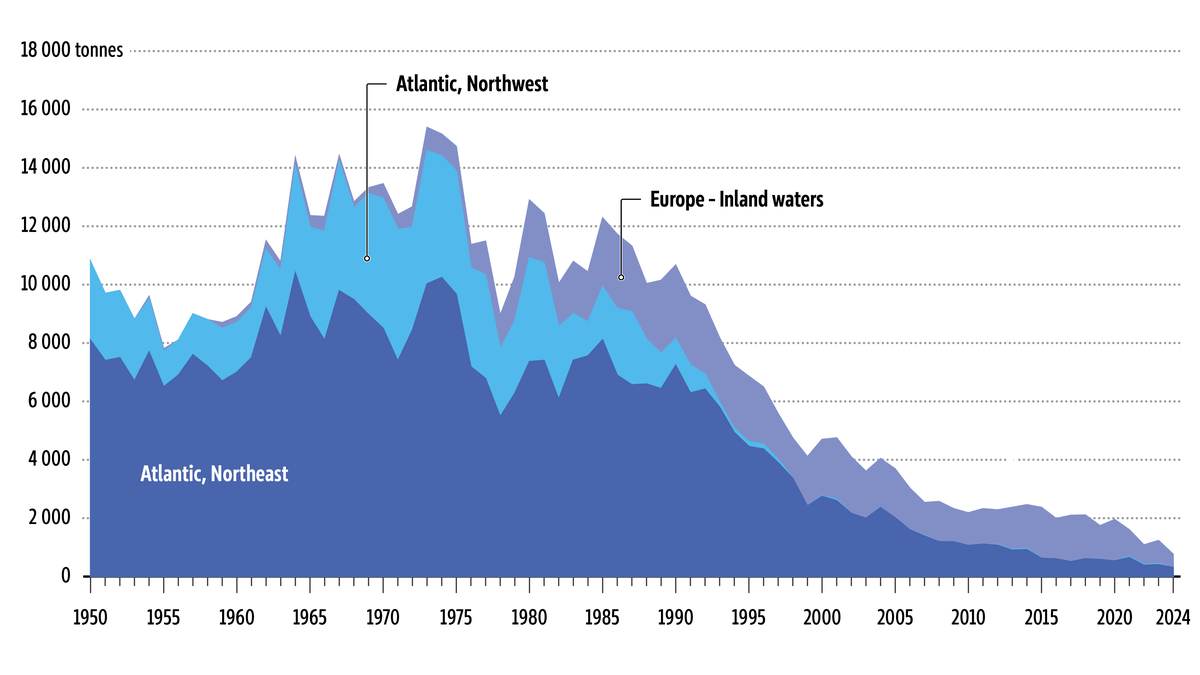
Figure 2 illustrates the evolution of Atlantic salmon catches, showing an overall peak in the mid-1970s. The development of open-sea salmon fisheries, coupled with growing concerns about the decline of salmon populations in rivers, led to the establishment of NASCO in 1983. Its members are Canada, Denmark (in respect of the Faroe Islands and Greenland), the EU, Iceland, Norway, the Russian Federation, the United Kingdom (UK) and the United States (US). NASCO is a regional fisheries management organisation (RFMO). RFMOs are multilateral organisations responsible for managing internationally shared fish resources, particularly in areas beyond national jurisdiction. However, NASCO is unique in that it prohibits rather than manages such fisheries: NASCO prohibits salmon fishing in areas beyond 12 nautical miles from the coast. Exceptions to these rules apply in West Greenlandic and Faroese waters. However, commercial salmon fishing in Faroese waters ceased in 1991. In West Greenland, the total allowable catch (TAC) dropped to a limited amount for domestic consumption only (100 times less than at its peak in the 1970s). NASCO's main aim is to drive the actions necessary to slow the decline of the wild Atlantic salmon population, and to demonstrate that restoration is possible.
Data source: Food and Agriculture Organization, FishStat – Global capture production quantity online query; graphic by Samy Chahri, EPRS, 2026.
Recreational fishing
Fishing for salmon is a popular recreational activity with distinctive cultural traditions. In Ireland, for example, salmon angling is part of a broader cultural landscape in which the species has significant symbolic value in folk tradition. In northern Scandinavia, indigenous Sámi fishing traditions have attracted tourist angling since the 19th century. Large Finnish and Swedish rivers flowing into Bothnian Bay are very productive wild salmon rivers and bring in several thousand anglers every year. Certain rivers, for example in Ireland and Sweden, have become internationally recognised angling destinations. Recreational salmon fishing is predominantly conducted by anglers using rod and line, particularly in rivers, although trolling and other methods are also used in some coastal and Baltic Sea fisheries. Given their knowledge of and proximity to the environments in which they operate, recreational fisheries organisations often play a role in environmental monitoring and management.
As commercial Atlantic salmon fishing has largely ceased, recreational fishing has become the dominant and more economically valuable activity. A study estimated that in 2017, around 300 000 anglers caught approximately 380 000 salmon (including salmon that are released again) in about 2 million fishing days. By contrast, it was estimated that more than 5 400 net and trap fishers (who fish mainly for commercial or subsistence purposes) caught around half this amount in the same year. The study estimated that salmon anglers spent some €300 million to €500 million in the local economies of NASCO countries. Furthermore, a 2026 position paper of the European Anglers Alliance (EEA) points to the socio-economic importance of the recreational salmon troll fishery for coastal communities around the Baltic Sea.
Catch and release is an increasingly popular practice by anglers. The practice has become common as a mandatory or voluntary management measure given the decline in salmon abundance. In 2025 about two thirds of all the Atlantic salmon caught in rod fisheries (in terms of weight) were caught and released. However, there are large differences by country (from 31 % in Sweden to 98 % in the UK), reflecting varying management practices and angler attitudes.
Recreational fisheries also exploit farmed salmon: while the commercial exploitation of ranched salmon has ceased, the technique is still used for angling purposes. In 2025, the total catch of ranched Atlantic salmon reached 18 tonnes, of which 16 tonnes were caught in Iceland and 2 tonnes in Sweden. In Sweden, this involves the exploitation of adult salmon that originate from hatchery-reared smolts released as part of programmes to mitigate the impact of hydropower. Fishing for these salmon reduces the pressure on wild salmon populations. Ranching for angling purposes also occurs in other countries, such as Norway and Ireland, but on a much smaller scale.
Aquaculture
Global evolution
The world's first commercial salmon farms were established in Norway in the mid-1960s with the aim of breeding Atlantic salmon to a marketable size. Norway's geographical conditions, with its deep, cool, oxygen-rich coastal waters and fjord bays that protect sea cages from strong ocean waves and storms, provide ideal conditions for salmon farming. This early success in Norway led to the development of salmon farming first in the UK (Scotland) and then in Ireland, Iceland, the Faroe Islands, Sweden and Canada by the end of the 1970s. While the initial production was modest (globally about 5 000 tonnes in 1980, less than half of the Atlantic salmon catches at the time), farmed salmon became an increasingly cheap alternative to wild-caught salmon.
Over the past four decades, salmon aquaculture has grown rapidly, with more countries starting to farm Atlantic salmon. This includes Chile and Australia (mostly Tasmania) in the southern hemisphere, where wild Atlantic salmon does not occur naturally, but where the physical conditions are favourable.
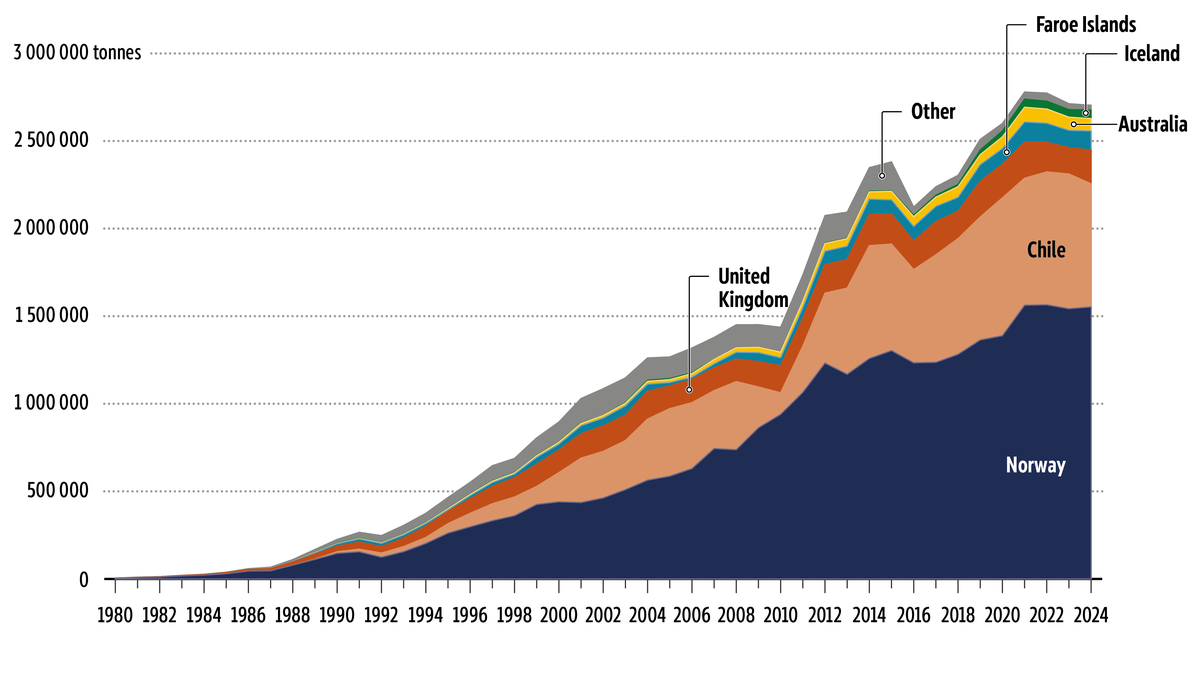
From 2021 to 2024, global annual production stabilised at a high 2.7 million tonnes, exceeding capture production by more than 2 000 times. In 2024, Norway (57 %) and Chile (26 %) dominated Atlantic salmon production, followed by the UK (7 %), the Faroe Islands (4 %), Australia (3 %) and Iceland (2 %). The remaining countries, mainly Ireland, Russia, the USA and Denmark, only accounted for around 1 % of global production.
Atlantic salmon is now the twelfth most farmed fish species in the world, accounting for 4 % of global farmed fish production (in terms of weight). However, its economic value is much more substantial. Atlantic salmon ranks as the leading farmed fish species worldwide in terms of monetary value.4 According to the statistics of the Food and Agriculture Organization (FAO), the production of Atlantic salmon was worth US$20.5 billion in 2024.
Data source: Food and Agriculture Organization, FishStat – Global aquaculture production online query; graphic by Samy Chahri, EPRS, 2026.
The impressive growth of salmon aquaculture has had a profound impact on consumption habits. Prior to the 1980s, salmon was marketed as a luxury product due to the limited and seasonal supply of wild-caught salmon. Today, it is the second most widely consumed fish species in the EU (after tuna).
Production in the EU
The EU plays a minor role in the global aquaculture sector, and this is particularly true of salmon farming. The self-sufficiency rate for salmon is only 1 %, and salmon is by far the main aquatic species imported into the EU. In 2024, imports of salmon reached 1.04 million tonnes. However, traditional salmon farms in Ireland, as well as new initiatives in other Member States, often backed by EU funding, have the potential to somewhat reduce the EU's dependency on salmon imports. France, for example, has set the objective of reaching a production volume of 20 000 tonnes of salmon, which would meet 10 % of its consumption. The following is an illustration of current and potential production capacity in EU Member States.
-
After the UK left the EU, Ireland became the EU's largest salmon farming Member State. In 2024, 13 405 tonnes of salmon were produced in Ireland, worth €137.78 million. Irish salmon farming has had a long history, and is marketed as a premium product. Its production is exclusively organic, even if not all producers are certified (about 95 % of its production is certified organic). Organic means that the salmon are only fed with sustainable organic feed and raised in more spacious pens than traditional farmed salmon. Organic salmon is the most valuable export species for the Irish seafood industry. Ireland has also a protected geographical indication (PGI) for the salmon production around Clare Island.
-
Salmon farming in Denmark is more recent and characterised by its use of highly specialised recirculating aquaculture systems (RAS). Denmark is a pioneer in this type of aquaculture.5 The two best known companies are Danish Salmon and Skagen Salmon, both of which scaled up recently and now have a potential production capacity of up to 2 700 and 4 000 tonnes, respectively. One reason for their development is the moratorium on expanding sea cage farming beyond the existing 19 rainbow trout farms.
-
In France, a commercial sea cage farm, Saumon de France, has existed since 1991. Located in Normandy, the farm is reportedly Europe's southernmost net pen salmon producer and currently produces around 400 tonnes, although its licence allows it to produce up to 3 000 tonnes. A French project for a land-based RAS salmon farm in Verdon-sur-Mer recently received a favourable opinion on its application for an environmental permit. This first RAS salmon farm in France would have an annual production capacity of 10 000 tonnes, and is on track to become the EU's largest salmon farm, with the first sales anticipated in 2030. The project is nevertheless controversial and contested by a coalition of 27 non-governmental organisations (NGOs). Another RAS salmon farm is planned in Boulogne-sur-Mer, with an envisaged production of almost 10 000 tonnes.
-
In Spain, new RAS salmon farms have recently come into existence. The first Spanish salmon farm was set up in Cantabria, which achieved its first harvest in 2025. Current capacity is 100 tonnes, but the aim is to reach 3 000 tonnes per year once the site is fully operational. Another new farm is currently being built in Galicia, co‑financed by the European Maritime, Fisheries and Aquaculture Fund (EMFAF) with €17.5 million. The farm is set to have a capacity of 3 500 tonnes.
-
In Sweden, a large-scale inland RAS farm is planned for Säffle, Värmland, with support from the European Investment Bank (EIB). Its planned capacity is 10 000 tonnes per year, which would amount to almost 20 % of Sweden's salmon consumption. The project has received further funding through the EMFAF, although financing appears to not yet be fully complete. Another project, with support from the EMFAF, has been granted an environmental permit to build an RAS salmon farm in Kungshamn on the Swedish west coast, with a capacity of 6 000 tonnes.
-
A plan for an RAS salmon farm in Ostend, Belgium, with an envisaged production capacity of 12 000 tonnes – which would have made it the biggest farm in Europe – was cancelled in April 2026 after a six-year-long legal battle initiated by environmental and animal rights organisations.
-
In Poland, near Warsaw, an Atlantic salmon R&D facility has been in operation since 2016, aiming to support further innovation in the RAS area while also serving as a training facility. It produces up to 600 tonnes of salmon per year. A small-scale, innovative RAS farm was set up in Janowa and opened in 2015, using geothermal saline water and producing up to 1 000 tonnes per year. However, the company ran into production difficulties and went bankrupt in 2026.
-
In the Netherlands, the first salmon farm was set up in Uden, in a former pig farm. The farm received EU funding and opened in 2025, with an envisaged production of 200 tonnes per year and a short supply chain (nearby restaurants and sales directly on the farm).
-
In Germany, the first land-based RAS salmon farm is under construction in Griestal, Bavaria, with a production capacity of 1 200 tonnes per year. The project is a redevelopment of a former freshwater trout farm. The first salmon harvest is planned for mid‑2029. The founders intend to ultimately expand further in Germany, with a project in Lower Saxony (envisaged annual production of 12 000 tonnes) and other potential sites identified across the country.
Processing
The EU has a significant salmon processing industry for producing smoked salmon and prepared salmon (e.g. pre‑prepared meals). The sector relies almost entirely on imports of raw material. Norway is the main supplier (accounting for 79 % of all EU salmon imports in the period from January to November 2025), followed by the Faroe Islands (6 %), the UK (5 %), Iceland (3 %), the USA (2 %) and Chile (1 %). The remaining countries account for 4 % of total salmon imports. Efficient transport logistics are critical for maintaining processing schedules and product quality. Sweden and Denmark play key roles as entry hubs for imported Norwegian salmon, re‑exporting it to other EU countries, notably Poland, Germany and France. It is estimated that the unprocessed salmon from Norway creates thousands of jobs in the EU salmon processing industry. The imports from the USA consist of wild-caught Pacific salmon.
In recent years, an estimated 160 000 tonnes of smoked salmon have been produced in the EU, worth €3.3 billion in 2024 (up from €2.1 billion in 2015). Poland is the leading EU processor of smoked salmon, accounting for nearly half of EU production, followed by France, Lithuania, Denmark and Spain. A study on the EU's smoked salmon sector shows that it generates substantial added value. The raw material accounts for between 21 % (in France) and 34 % (in Poland) of the final price.
EU processors also produce substantial volumes of prepared and preserved salmon. Annual production was valued at around €260 to €270 million in 2024, with an output of approximately 32 000 tonnes.
Although the EU is a net importer of salmon, it also exports salmon, either as re‑exports of fresh or chilled salmon to markets outside the EU, or as processed products. The major export markets are the US and Switzerland.
EU policy framework
Fisheries
The conservation of marine biological resources under the common fisheries policy (CFP) is an exclusive competence of the EU. It covers the fishing of diadromous species, such as salmon, during the marine part of their life cycle.6 As a contracting party to NASCO, the EU does not allow offshore fishing for salmon. The exception is the Baltic Sea, which is not covered by NASCO. The Baltic Sea is therefore the only EU sea basin where Atlantic salmon is managed through catch limits (TACs and quotas) and gear restrictions. The Baltic salmon fishery is heterogeneous, with commercial and recreational fishing taking place in the sea, estuaries and rivers using a variety of gear. Part of the catch comes from hatchery-reared salmon, whereby hatcheries remove the adipose fin to distinguish reared fish from wild fish. Scientific advice on catches is provided by the International Council for the Exploration of the Sea (ICES), which provides separate catch advice for the Baltic Sea excluding the Gulf of Finland (main basin salmon), and for the Gulf of Finland. The corresponding TACs are adopted by the EU through the Council Regulation on the fixing and allocation of fishing opportunities for the Baltic Sea.
The CFP's technical measures regulation includes rules on the use of fishing gear and sets minimum catch sizes for Baltic salmon. A drift net ban has been in force in the Baltic Sea since 2008.
A dedicated Baltic salmon multiannual plan was proposed in 2011 but was eventually withdrawn. The Commission's 2011 proposal was quite ambitious: it covered Baltic salmon throughout its entire life cycle. The Commission argued at that time that exclusive EU competence for conservation of marine biological resources extended to salmon while they were in rivers, if river measures were necessary to conserve the marine stock. The proposal thus extended to competences typically dealt with by Member States. In addition, the proposal faltered in a wider institutional impasse with the Council over how multiannual plans (MAPs) should be adopted jointly by Parliament and Council, and which elements relating to fishing opportunities belonged to the Council alone. In 2020 the Commission formally withdrew the proposal. The withdrawal was also a result of the many technical and scientific challenges identified by ICES on the draft plan. Consequently, Baltic salmon continues to be managed primarily through annual fishing opportunities regulations and the technical measures regulation, rather than through a multiannual management plan. The Baltic multiannual plan (MAP) adopted in 2016, Regulation 2016/1139, does not cover salmon, as it focuses on the main commercial fisheries in the Baltic Sea, namely cod, herring and sprat.
As the salmon population in the Baltic Sea originates from various river stocks, some of which are in poor condition, ICES advised the closure of main basin salmon fisheries in 2022, with a derogation for coastal summer fisheries in some northern areas of the Gulf of Bothnia and the Åland Sea from May to August. Consequently, the EU sets quotas for main basin salmon to account for these coastal catches as well as for unavoidable bycatch when targeting other species. While these catch quotas only apply to commercial fisheries, the Council Regulation also enforces the same spatial and temporal closures for recreational fisheries. However, the regulation also allows the continuation of recreational fisheries in other parts of the Baltic main basin, where one specimen of adipose fin-clipped salmon may be caught and retained per recreational fisher per day. Unlike quotas for other Baltic species, salmon quotas are expressed in terms of the number of individual fish rather than tonnes. For 2026, the EU quota is 25 537 main basin salmon (a 27 % decrease compared with 2025; the highest quotas are allocated to Sweden and Finland) and 10 232 Gulf of Finland salmon (an increase of 1 % compared with 2025, with quotas allocated to Finland and Estonia).
Furthermore, the 2023 revision of the fisheries control regulation strengthened the control framework for marine recreational fisheries targeting species that are subject to Union conservation measures, including salmon in the Baltic Sea. Recreational fishers are now required to register and report their catches electronically. This obligation applies from 10 January 2026, with the first submission of data to the Commission required by 31 May 2027.
The CFP does not regulate inland fisheries; this competence lies with the Member States. However, the CFP may support inland fisheries or freshwater fish restoration projects via the EMFAF. Furthermore, the EU's environmental policy includes a number of instruments that apply to freshwater species and habitats, which consequently impact the management of inland fisheries by Member States. The EU Water Framework Directive is the EU's primary legal instrument for safeguarding and restoring EU freshwater ecosystems. It requires Member States to ensure that rivers, lakes and other surface waters achieve good ecological and chemical status. The directive tackles many of the threats facing salmon in their freshwater habitats, such as chemical pollution, acidification and alterations to river flows. Furthermore, the EU's Habitat Directive includes Atlantic salmon (in fresh water) in both its Annex II and Annex V. Annex II requires Member States to designate Special Areas of Conservation (SACs) for important freshwater salmon populations and to establish related conservation measures. In Ireland, for instance, 26 of its 439 SACs include conservation objectives for Atlantic salmon, such as ensuring a minimum number of adult spawning fish. Related conservation measures include keeping rivers free of barriers. Annex V is directly concerned with exploitation. It requires Member States to ensure that the removal of salmon from the wild is compatible with maintaining the species' favourable conservation status. National rules on recreational salmon fishing are therefore typically strict. In Denmark, for example, inspectors ensure that anglers have a valid licence and are not using illegal fishing gear; that the salmon caught meets the minimum size requirements; and that no more than one salmon is taken home per angler. All catches must be declared and when more than one salmon is caught, it must be released immediately. In addition, yearly quotas are set by river.
Aquaculture and processing
Both aquaculture and the processing of fisheries are covered under the CFP, but unlike marine fisheries, these areas fall under shared competence with Member States.
The role of the EU under the CFP in aquaculture policy is of a supportive nature. Following Article 34 of the CFP Regulation, the Commission establishes non-binding aquaculture guidelines for Member States to stimulate the sector. Under the same article, Member States are required to put multiannual national aquaculture plans into place. Financial support is available through the EMFAF, which has already supported several salmon farm projects across the EU. In October 2025, the Commission published an EU-funded report on good husbandry practices for aquaculture, including on Atlantic salmon. A recent campaign aims to support the EU's aquaculture sector, including salmon farming.
The CFP's coverage of the processing sector is limited to certain market measures. Notably, the CFP's regulation on the common organisation of markets (CMO) for fishery and aquaculture products also covers processed fish products. The Polish Fish Processors Association, for instance, is a recognised producer organisation under the CMO and includes salmon processors among its members. Similarly, the new traceability requirements for fisheries and aquaculture products, introduced by the 2023 reform of the fisheries control system, apply to processed products as well. From 10 January 2026, detailed digital traceability requirements apply to fish products, including smoked salmon fillets.7 Similar requirements for prepared and preserved fishery and aquaculture products will apply from 10 January 2029.8
Apart from the CFP, the aquaculture and processing sectors must comply with a large body of EU legislation, including relating to food safety, animal welfare and water use.
Parliament's position
During the negotiations on revising the fisheries control regulation, Parliament voiced strong support for monitoring marine recreational fisheries. Although the Council considered recreational fisheries a national competence, Parliament emphasised their impact on common fishery resources, which fall under EU competence. In response to recent parliamentary questions regarding the practical implementation of the new digital traceability requirements introduced by the reformed control system, including those relating to the import of raw materials for the EU's salmon processing industry, the Commission stated that the transition period during which the old system can be used would be extended until 30 November 2026.
In a May 2026 resolution on the Baltic MAP, Parliament called on the Commission to consider including salmon and trout stocks in the Baltic MAP, thereby taking into account their linkages with herring stocks and the food ecosystem. The Parliament also urged the Commission to enhance monitoring and research to support sustainable salmon management, and to ensure that the ecosystem impacts of the fisheries of herring, sprat and cod on salmon are properly understood.
In several previous resolutions, Parliament highlighted the need to support the sustainable development of aquaculture while ensuring fair competition with third countries, for example in its January 2024 resolution on the implementation of the CMO regulation. In reply to a 2025 written question from the European Parliament on how to support EU micro and small aquaculture firms and reduce their competitive disadvantage in relation to Norway, the European Commissioner Costas Kadis stated that Member States can support their aquaculture industries through EU funding programmes. The Commissioner also added that these industries' high environmental sustainability standards can be used as a competitive advantage, provided consumers are informed of the origin of aquaculture products and the advantages of EU aquaculture production.
In a September 2026 resolution on safeguarding fair competition for all aquatic food products, Parliament points to the fact that the EU's fisheries and aquaculture sectors, including the processing sector, play a critical role in the EU's food system, and calls on the Commission and the Council to attach greater importance to food security. The report urges the Commission to draw up a European blue food action plan by the end of 2026 to promote the production, processing, marketing and consumption of aquatic food products. In another September 2026 resolution on the evaluation of the CFP, Parliament reiterated the conclusions of its resolution on the Baltic Sea MAP. The resolution also emphasised the importance of supporting the sustainable growth, development and competitiveness of EU aquaculture, called for a level playing field between EU and non‑EU producers, and welcomed the Commission's announcement of a fisheries and aquaculture simplification package.
Endnotes
Classification
Policy areas: Fisheries | Environment
Regions: European Union, Non-EU Europe and the North
Committees: Fisheries (PECH)
Statement on the use of AI
Any AI-generated content in this text has been reviewed by the author.
Disclaimer
This document is prepared for, and addressed to, the Members and staff of the European Parliament as background material to assist them in their parliamentary work. The content of the document is the sole responsibility of its author(s) and any opinions expressed herein should not be taken to represent an official position of the Parliament.
Copyright
© European Union.
The reuse of this document is authorised under a Creative Commons Attribution 4.0 International (CC-BY 4.0) licence.

https://creativecommons.org/licenses/by/4.0/deed.en
To use or reproduce elements that are not owned by the European Union, permission may need to be sought directly from the respective rightsholders.