
Article page checkbox is not checked in page info.
EU eastern border regions: Adapting cohesion policy to a changing security landscape
EU eastern border regions Adapting cohesion policy to a changing security landscape
Rebecca Hausner and Vasilis Margaras, Members' Research Service
Summary
Since the outset of Russia's war against Ukraine, the EU's eastern border regions in nine European Union (EU) Member States bordering Russia, Belarus and Ukraine – Finland, Estonia, Latvia, Lithuania, Poland, Slovakia, Hungary, Romania and Bulgaria – have been particularly affected by migration, economic and trade disruption, demographic decline and heightened security risks. These war-related pressures have compounded long-standing structural weaknesses associated with their remote geographical location, resulting in slower growth, reduced investment, depopulation, labour shortages and higher security costs.
In response, the EU has mobilised technical and financial support to these regions. However, existing measures have not fully offset the economic consequences of the war. To address this, the European Commission has recently adopted a comprehensive strategy that sets out actions across five priority areas: security and resilience, growth and regional prosperity, building on local strengths, connectivity, and people (including measures to address depopulation and labour shortages).
The European Parliament has been at the forefront of supporting border regions by drawing attention to their challenges in several resolutions. Its Committee on Regional Development (REGI) has highlighted the needs of EU border regions in numerous occasions. Parliament is currently working on its own initiative report on the EU eastern border regions strategy.
The fragility of the EU's eastern border regions
The 9th European Commission 2024 report on economic, social and territorial cohesion, notes that the specific geographical features of islands, outermost regions, border regions, northern sparsely populated regions, and mountain and coastal regions may weaken their economic development. Many EU border regions are peripheral, distant from metropolitan centres, and have limited access to healthcare and other essential services. Border regions face particular challenges during crises, including restrictions on cross-border movement during pandemics and sudden influxes of refugees from a conflict across the border. Disaster prevention and precautionary action tend to be more difficult because of differences in governance, administrative and legal systems. Cooperation across borders can help overcome bureaucratic hurdles and create economic opportunities. Additionally, border regions have high growth potential. Their cultural and linguistic diversity can encourage social and economic interaction. Many residents carry out daily activities on both sides of the border, and cooperation between municipalities on either side of it provides opportunities for growth. Many border regions are often mountainous and/or sparsely populated, further constraining their development. Rail travel across EU borders is still hindered by many obstacles despite some progress towards technical interoperability, and gaps remain where national railways are not fully connected to each other.
The report notes that Russia's war of aggression against Ukraine has led some EU border regions to experience a sharp reduction in investment, trade flows and economic activity (including tourism), as well as new economic barriers and job losses. The war has resulted in an unprecedented number of people seeking shelter in the EU. The EU has provided legal, operational and financial support to both those fleeing to the EU and the Member States receiving them. However, some regions have seen particularly high numbers of arrivals, which put pressure on local integration systems. Regions bordering Russia and Belarus are also facing security challenges and the threat or use of the instrumentalisation of migration. Furthermore, certain eastern border regions have lost their cross-border cooperation partners. The Commission has introduced changes allowing for the integration of these regions into other cooperation programmes, but the negative impact of Russia's war on Ukraine has yet to be overcome. These regions need further support to look for new cooperation and development opportunities. The report highlights that there is room to strengthen regional cooperation at different levels – notably in delivering common public goods across borders – as well as potential for cross-border cooperation across all types of EU regions in developing value chains for the twin digital and green transitions. Future policy needs to be better tailored to regions' different economic profiles and geographical characteristics, enabling more targeted investments. Efficient programming of EU funds in different regions needs to reflect the individual local conditions.
Commission President Ursula von der Leyen stated in her September 2024 mission letter to Executive Vice-President for Cohesion and Reforms, Rafaelle Fitto, that one of his tasks would be to ensure support for the eastern border regions most affected by Russia's war, address their specific challenges and support the reorientation of their local economies. Another of his tasks would be to work on enabling all citizens to have an effective right to stay in the place they call home by supporting the needs of their communities.
The 2025 OECD report 'Reinforcing the attractiveness of Europe's Eastern Border Regions' mentions that shared challenges of these regions need to be addressed through a long-term, multi-dimensional perspective on regional attractiveness. This perspective should consider how recent geopolitical shocks have exacerbated long-standing economic, social and structural challenges unique to these border regions. Investment in dual-use and strategic infrastructure serving both civilian and military purposes – such as roads, railways, border crossings, and logistics hubs – should be prioritised.
Furthermore, according to the report, action plans for eastern border regions urgently require a strategic shift from reactive crisis responses toward proactive and comprehensive planning focused on structural transformations. While security is a priority, focussing too strongly on it can overshadow essential socio-economic objectives and limit long-term resilience. Place-based policies must systematically integrate measurable well-being outcomes to ensure that strategies are aligned with residents' goals and improve their quality of life. It recommends linking labour migration incentives to strategic settlement goals. As the integration of Ukrainian refugees continues, a dual-intent approach can support both long-term inclusion and the potential for return, to help balance humanitarian and regional development objectives. Possible measures include easier recognition of foreign qualifications, targeted language training and support for refugees' caregiving responsibilities.
The report states that EU and national territorial support instruments can be adapted to respond to the regions' unique challenges. Eastern border regions require funding programmes that go beyond narrow sectoral silos. Local and regional authorities need sufficient flexibility to design integrated responses that account for demographic, economic and geopolitical factors. A coherent, coordinated policy response requires security and defence policy to be joined up with other policy areas. Sectoral national strategies, such as those on industrial development and innovation, might incorporate a territorial lens with particular consideration to eastern border regions. Inclusive policy design through participatory mechanisms involving civil society, residents and local players, combined with strategic foresight, can also help strengthen resilience and long-term planning.
Finally, the report states the importance of cross-regional cooperation. It identifies two particularly promising avenues: The first is stronger collaboration among eastern border regions through peer learning, improved use of EU funding and feedback loops for more responsive national and EU policies. The second is partnerships with non-border regions to unlock synergies, such as land availability and knowledge or talent exchange, thereby better integrating eastern border regions into broader national and macroregional development.
According to a 2024 ESPON study, despite systemic disadvantages such as peripherality and lower institutional quality, many eastern border regions exhibit what the study calls 'exaptive resilience' by creatively reallocating resources and leveraging endogenous strengths, enabling them to adapt in ways that contrast with the stability-focused resilience of central regions. According to the study, exaptive resilience is driven by three critical dimensions: the mobilisation of local actors and networks, supportive institutional frameworks, and investments in skills, capacities, and infrastructure. These factors enable regions to repurpose resources, foster innovation and adapt to crises. The report's case studies demonstrate the potential of peripheral and lagging regions to break out of the ''middle-income trap'' and achieve smart, sustainable, and inclusive growth through place-based strategies that build on their unique strengths and potential.
Communication on the EU's eastern border regions
The Commission published its communication on the EU's eastern regions bordering Russia, Belarus and Ukraine on 18 February 2026. The communication sets out a comprehensive strategy to step up support for these regions through a coordinated package of policy actions and investment measures. It confirms its commitment to supporting these regions while also strengthening their resilience, prosperity and attractiveness and emphasising their role as gatekeepers of EU security. It states that the EU's eastern border regions are spread out across nine Member States: Finland, Estonia, Latvia, Lithuania and Poland sharing 3 600 km of land border with Russia and Belarus; Poland, Slovakia, Hungary and Romania sharing 1 370 km of land border with Ukraine; and Romania and Bulgaria sharing 600 km of Black Sea coastline bordering the Black Sea basin, which is also shared with Ukraine and Russia.
These regions face security risks as well as demographic and economic challenges. They are exposed to hybrid threats, cyber incidents, disrupted trade and transport and population decline, resulting in labour shortages and pressure on public services. However, their stability is essential for the security and prosperity of the whole EU.
The EU currently provides support for these regions through avenues such as its cohesion policy, common agricultural policy and other instruments that strengthen infrastructure, jobs, services and crisis preparedness. This includes reprogrammed cohesion funds for defence, civil preparedness and critical infrastructure; support from the Just Transition Fund (JTF) and Interreg; and targeted investment in connectivity, energy security, digitalisation, health, research, skills and the fight against disinformation.
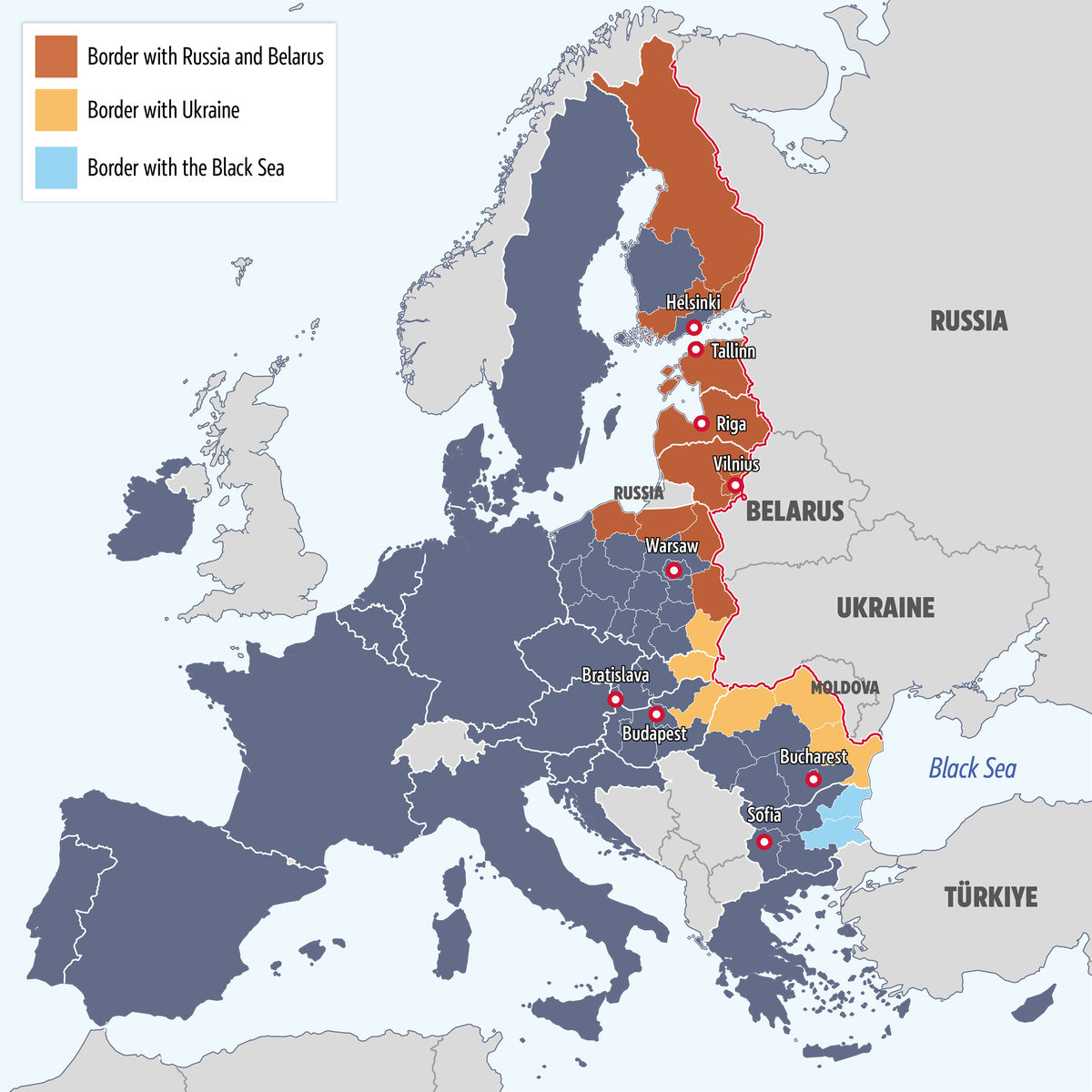
Data source: European Commission, February 2026. Graphics by Samy Chahri, EPRS
The proposed Commission strategy sets out further action in five key areas:
-
security and resilience: The strategy seeks to address hybrid threats and security gaps by strengthening preparedness, including through the development of the Eastern Flank Watch, the European Drone Defence Initiative and the European Air Shield.
-
growth and regional prosperity: Investment in these regions is often perceived as high-risk. The establishment of the EastInvest facility (see the Section on 'Funding') aims to stimulate investment and provide more coordinated and locally adapted financing.
-
leveraging local strengths: The regions' assets include industry, bioeconomy, agriculture, natural resources and skills. Support for these sectors can strengthen local resilience. Measures include integrating the Baltic states' electricity systems with European networks and developing cross-border hydrogen infrastructure.
-
connectivity: The strategy promotes improvements to digital and transport infrastructure, including cross-border connections with Ukraine and Moldova and dual-use roads, railways and port infrastructure.
-
people: To support the attractiveness of the regions for communities and safeguard the right to stay, the strategy seeks to address depopulation and labour shortages through investment in skills, youth retention, media literacy and social services. Measures include education-to-employment pathways, municipal access to critical equipment, community-led development initiatives and the media resilience programme.
Member States are invited to use EU funds more strategically for these goals, so that eastern border regions remain places where people want to live and work and continue to anchor the EU's security and cohesion.
During the presentation of the communication the 18 February 2026 in Brussels, Commissioner Fitto emphasised that the strategy is guided by 'a place-based approach and multi-level governance' as solutions need to be adapted to the individual context and be 'tailored, not one-size-fits-all'. The Commission also set up a yearly high-level political dialogue on the development and security of the eastern border regions, with the inaugural meeting taking place on 26 February 2026.
Funding
According to the strategy, the Commission plans to establish the EastInvest facility, an investment platform designed to facilitate access to financing for businesses and local authorities in the regions concerned through targeted lending. The facility would support public and private projects in these regions by providing up to €28 billion by the end of 2027 for key priorities such as infrastructure, renewable energy, innovation and regional connectivity. Cooperation between international financial institutions and development banks would form the basis for the facility: advisory support would be provided by the European Investment Bank, the European Bank for Reconstruction and Development and the Council of Europe Development Bank, while lending would be provided through the same institutions, as well as the Nordic Investment Bank and national promotional banks active in the individual countries. The declaration of intent to set up the facility was signed by representatives of these institutions during the high-level conference on the eastern border regions on 26 February 2026.
The strategy can also be viewed in the context of the EU's current and upcoming funding architecture. After the adoption of the 2025 mid-term review of the EU's cohesion policy, the Commission presented the reallocation of cohesion policy funds for the remainder of the current multiannual financial framework (2021-2027). A total of €34.6 billion will be reallocated to address the five strategic priorities: competitiveness, defence, affordable housing, water management and energy infrastructure. In line with the Commission communication, €5.6 billion alone is to be redirected to the eastern border regions. The 2025 mid-term review acknowledges the particular challenges faced by eastern border regions and proposes that programmes covering these regions benefit from 100 % of EU co-financing, additional pre-financing of 9.5 % of the total programme allocation in 2026, and a 30 % pre-financing rate in 2026 for the amounts reallocated to the new mid-term review priorities (STEP, defence, housing, water resilience and energy transition). These incentives apply only if at least 15 % of the total programme allocation is reallocated to those priorities. One year on, the first results of the mid-term review show that investments primarily target military mobility, critical technologies and the defence industry, and contribute to the security and economic competitiveness of the regions. Poland and Slovakia have reallocated the highest amounts, with allocations in each country exceeding €1 billion. As outlined in the strategy, several other EU funds, such as the JTF and Interreg, allocate targeted funding to these regions.
European Parliament
The European Parliament has, in a number of resolutions, voiced strong support for the empowerment of border regions through improvements in EU policies and increased funding. For instance in its 2024 own-initiative report on current and future challenges regarding cross-border cooperation with neighbouring countries, Parliament describes cross-border cooperation as a cornerstone of the EU's neighbourhood policy, promoting cooperation between Member States and neighbouring countries sharing land or sea borders. Such cooperation contributes to sustainable development along the EU's external borders, helps reduce differences in living standards and addresses common challenges. Russia's war of aggression against Ukraine and Belarus's support for it have significantly disrupted cooperation programmes involving Ukraine, Moldova, Russia and Belarus. The report identifies administrative and language barriers and legal uncertainties as the main obstacles to project implementation. It further notes that the uncertain political situation in many countries have exacerbated the challenges to cross-border cooperation.
During the 12 February 2025 plenary debate, Members of the European Parliament (MEPs) stressed that the EU's eastern regions bordering Russia, Belarus and Ukraine require targeted long-term support to address the security, economic and demographic impacts of Russia's war against Ukraine. The debate also underscored the growing link between cohesion policy and the EU's broader security and resilience objectives.
In May 2025, Parliament endorsed the BRIDGEforEU agreement, completing the legislative process for a new EU Border Regions' Instrument for Development and Growth designed to facilitate cross-border solutions to administrative and legal obstacles in border regions. The agreement empowers regional and local authorities, as well as private bodies, to flag cross-border obstacles affecting infrastructure, public services or economic growth to coordination points set up by participating Member States. After assessing each case, the coordination point can use a number of voluntary tools (including those provided for under international agreements) to address the obstacle.
In September 2025, Regulation (EU) 2025/1914 amended the rules governing the European Regional Development Fund (ERDF), the Cohesion Fund and the Just Transition Fund (JTF) as to introduce specific measures addressing strategic challenges identified in the mid-term review. Among other measures, the regulation introduces additional support for the eastern border regions. In 2026, the Commission will provide an additional one-off pre-financing equivalent to 1.5 % of the total ERDF, Cohesion Fund and JTF support. The rate will increase to 9.5 % for programmes under the Investment for Jobs and Growth goal covering one or more NUTS level 2 regions bordering Russia, Belarus or Ukraine, provided that the programme does not cover the entire territory of the Member State concerned.
On 25 March 2026, an extraordinary meeting of the Committee on Regional Development (REGI) brought together MEPs and Commissioner Fitto to discuss the Commission communication on the EU's eastern regions bordering Russia, Belarus and Ukraine and the possibilities for supporting these border regions through cohesion policy funds.
The REGI committee is preparing an own initiative report on cohesion policy in the EU's eastern border regions, entitled Strengthening territorial resilience and cross-border cooperation. The draft report was presented at the committee meeting of 15 June, where MEPs held an initial exchange of views and put forward comments on its content.
Views of EU institutions, advisory bodies and stakeholders
Within the Council, the Commission communication on the eastern border regions has been discussed in the broader context of debates on cohesion, resilience and investment. It has fed into the political discussion on the 2026 European Semester, at which ministers endorsed the need to create fiscal space for 'key investments, including on defence and competitiveness', with a strong emphasis on targeted public and private investment in resilience, clean energy, connectivity and skills, explicitly covering the eastern border regions as priority territories.
During the high-level dialogue held on 26 February 2026, national ministers from EU countries with eastern border regions discussed the economic and security challenges facing these regions and the Commission's proposed response. They broadly agreed that these regions require sustained EU support to address the structural disadvantages exacerbated by Russia's war against Ukraine. Ministers emphasised the importance of EU security and solidarity with communities most exposed to geopolitical pressures and underscored the need for targeted investment to strengthen infrastructure, economic development and security.
In the context of the discussions on the National Recovery and Resilience Plan Regulation, Estonia, Latvia and Lithuania published a joint statement on 15 June 2026, emphasising that regions bordering Russia and Belarus should receive greater prominence in the future financial framework and be backed by additional EU measures and MFF funding. They warned that insufficient support would undermine the EU's strategic objectives.
Selected stakeholder contributions to the call for evidence
The Regional Council of Kymenlaakso in Finland emphasised the need for a transition strategy for the region, whose geographic location – once an asset – has turned into a weakness following the closure of the Russian border, which has brought trade and cross-border cooperation halt. It also underlines the need for adequate resources and multilevel commitment.
In its feedback, the Estonian municipality of Narva calls for 'concrete, region-based actions and long-term, predictable funding'. To address low business activity, demographic decline and limited investment, it proposes measures including a dedicated Eastern border component in the Estonian partnership plan under the new MFF, risk-sharing mechanisms to increase investment, sectoral incubators for business diversification, investment in the energy transition, investment in infrastructure, and support for education and skills to strengthen human capital, retain young people and attract skilled workers.
The Latvian association 'Alūksnes lauku partnerība', which implements LEADER projects to promote regional development, highlights the need for adequate housing. It notes a shortage of rental housing in rural regions and argues that Latvian legislation does not incentivise people to rent out their private apartments. Improving access to adequate housing, it argues, is essential to attract new inhabitants.
Lithuania's Ministry of Education, Science and Sport stresses the importance of ensuring that residents of border regions speak or learn the official language of their Member State and calls for EU support for educational institutions to improve proficiency in official EU languages.
The Polish business association Pracodawcy Ziemi Lubelskiej describes how long-standing structural problems, including low innovation, weak infrastructure and limited access to capital have been compounded by the collapse of trade and investment links, rising energy and transport costs, depopulation and security concerns linked to the war in Ukraine. It therefore calls for targeted financial, investment and organisational support from the EU.
The Slovak Self-Governing Region of Košice supports the initiative and identifies infrastructure improvements, cyber resilience, innovation and regional rebranding to attract investment and tourism as essential. It also highlights the lack of recognition of Ukrainian diplomas, e.g. in the medical sector, together with the need for regional de-risking schemes that encourage investment in SMEs, as well as technical assistance to strengthen the administrative capacity of local authorities.
The Bureau for Cross-Border Cooperation Suceava, a Romanian NGO supporting cross-border cooperation between Romania and Ukraine, identifies cyber resilience, improved communication between civil society and governments, improved cross-border connectivity infrastructure and emergency coordination for man-made and natural disasters as he priorities. It further underlines the need to improve refugees' access to employment and labour market participation.
The Commission collected stakeholder feedback through a call for evidence on the proposed Pact for the eastern border regions (later adopted as the communication on the EU's eastern border regions) from 7 August to 18 September 2025. A total of 249 national and regional public authorities, non-governmental organisations, companies, business associations, academic and research institutions and citizens voiced their opinions and were mostly supportive of the initiative. Respondents highlighted geopolitical threats, market disruption, demographic decline, infrastructure gaps, limited access to investment and factors undermining civil resilience. Their contributions also underscored the diversity of the eastern border regions, highlighting the regions' specific needs, strengths and challenges that point to the need for tailored policy responses
The European Committee of the Regions (CoR) is expected to issue an opinion on the Eastern border regions in its December 2026 plenary session. On 10 April 2026, the CoR held a seminar in Elbląg, Poland, to discuss how local and regional authorities can strengthen preparedness, resilience and cohesion in the EU's eastern border regions.
In its April 2024 opinion on the mid-term review, the European Economic and Social Committee (EESC) highlighted particular vulnerabilities of the eastern border regions and supported targeted cohesion policy support to these regions. While supporting for flexibility and the reprogramming of cohesion funds, it stressed the importance of transparent monitoring to ensure that reallocated resources remain aligned with EU fundamental principles and values. In an opinion adopted at its plenary session of 17 June 2026, the EESC endorsed the Commission's strategy for the eastern border regions. It stressed that defence and cohesion must go hand in hand and called for a shift from viewing these regions as peripheral areas to recognising them as a central part of EU security. The EESC warned that reallocating existing EU resources, as proposed, would be insufficient, and called for additional EU financial resources to move 'from compensation to transformation'. It also proposed dedicated programme calls for the eastern border regions under the European Competitiveness Fund and the introduction of EU guarantee and risk-sharing mechanisms. It furthermore argued that capacity building and administrative support would be essential to enable the regions to access the available funding.
Outlook
The Commission communication on the EU's eastern border regions sets out the challenges and opportunities facing these regions and proposes measures to strengthen their resilience and development. Rather than establishing a dedicated funding instrument, it seeks to mobilise support by reallocating funding from existing programmes to these regions, meaning that financial assistance will continue to be governed by these programmes' funding logic. The new EastInvest facility aims to provide advisory and lending support to stakeholders in the region. However, it remains to be seen whether local actors will have the capacity for further implementing existing programmes or will be able to access available loans and whether additional forms of support will also be obtained. The current Commission proposal for the MFF 2028-2034 does not contain a dedicated budget line or fund to support the EU's eastern border regions, but instead emphasises the provision of targeted support for these regions across the future EU funding architecture. According to the current proposal, the national and regional partnership plans would 'provide targeted support across EU policies to urgent needs, such as the challenges faced by EBRs most affected by Russia's war of aggression against Ukraine'. Other proposed funding areas relevant to these regions include border management, security, military mobility and dual-use transport infrastructure. As negotiations on the MFF are still ongoing, the extent to which these priorities will be reflected in the final funding architecture remains uncertain.
Main references
- European Commission, Communication on the EU's eastern regions bordering Russia, Belarus and Ukraine, February 2026.
Classification
Policy areas: Regional Development
Regions: European Union
Committees: Regional Development (REGI)
Statement on the use of AI
Any AI-generated content in this text has been reviewed by the author(s).
Disclaimer
This document is prepared for, and addressed to, the Members and staff of the European Parliament as background material to assist them in their parliamentary work. The content of the document is the sole responsibility of its author(s) and any opinions expressed herein should not be taken to represent an official position of the Parliament.
Copyright
© European Union.
The reuse of this document is authorised under a Creative Commons Attribution 4.0 International (CC-BY 4.0) licence.

https://creativecommons.org/licenses/by/4.0/deed.en
To use or reproduce elements that are not owned by the European Union, permission may need to be sought directly from the respective rightsholders.