
Article page checkbox is not checked in page info.
The 2026 State of the Union address: Purpose, historical significance and overview of addresses to the European Parliament since 2010
The 2026 State of the Union address Purpose, historical significance and overview of addresses to the European Parliament since 2010
Kamil Baraník, Members' Research Service
Summary
The practice of European Commission Presidents delivering a State of the Union address each year in September, during a plenary session of the European Parliament, began in 2010. This address reviews the achievements of the past year and outlines the priorities for the forthcoming year. It serves as an essential tool for the Commission's accountability to Parliament, aimed at making the EU-level priorities more transparent while also communicating these priorities to the public. This practice aligns with similar traditions in national democracies; for example, the United States has a long history of presidential State of the Union addresses. Unlike the US Constitution, however, the EU Treaties do not mandate a State of the Union address. The EU version of this address was established by the 2010 Framework Agreement on relations between the European Parliament and the European Commission.
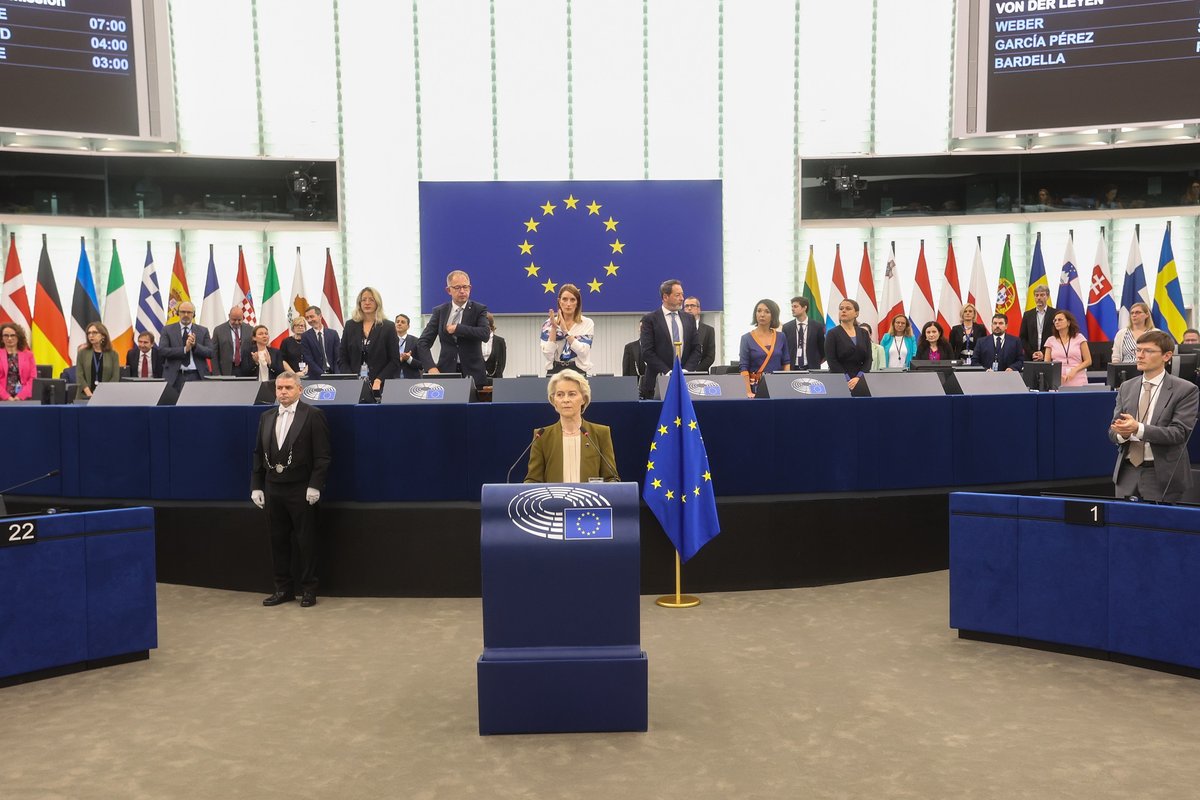
The European Commission President, Ursula von der Leyen, will deliver her sixth State of the Union address on 16 September 2026. This will be her second address during the current legislative term. The Commission President is expected to outline the main priorities and flagship initiatives for the forthcoming year, building on the EU's achievements from recent years. The theme of the address will most likely be developing responses to the current geopolitical challenges, drawing on the priorities set out in the President's political guidelines for the 2024-2029 European Commission.
This briefing further updates a briefing published regularly, with earlier versions written first by Eva-Maria Poptcheva and more recently by Rafał Mańko.
State of the union addresses around the world
Presidential state of the union addresses are a feature in several federal states, in particular in the United States (US), where the President gives a speech in the Capitol before a joint session of Congress, thus fulfilling the constitutional obligation to 'from time to time give to the Congress Information of the State of the Union' (Article II(3) of the US Constitution). President George Washington was the first to address Congress in 1790, and the exact form of the speech has evolved over time. Whereas Washington established the precedent of delivering an annual State of the Union address in person before Congress, Thomas Jefferson preferred to deliver his message in writing. It was only in 1913 that the address was delivered (by Woodrow Wilson) before a joint session of Congress. Lyndon Johnson decided to move the speech from daytime to evening, to attract a larger audience.1 With modern communication technology, the address has become a powerful rhetorical tool that is broadcast to a wide audience and receives intense media attention.
The State of the Union address, as part of the US political system of checks and balances, reports on current conditions in the US and sets the policy agenda for the forthcoming legislative year.2 This is all the more important in the US system of separation of powers, characterised by the absence of a direct connection between the legislative and executive branches of the federal government, in which the President, as head of the executive, does not participate in the proceedings of Congress. In this context, commentators have argued that the State of the Union address can affect legislation in two ways: either by influencing the actions of legislators, who have a monopoly on legislative initiative, or by influencing the public first and thereby influencing lawmakers.3 The legislative success of proposals mentioned in the State of the Union address is often seen as an indicator of the President's overall policy success.4 Despite changes over time, scholars have identified three consistent rhetorical arguments that all US presidential addresses pursue: public meditations on values; assessments of information and issues; and policy recommendations.5 US Presidents traditionally deliver the State of the Union address in February. President Donald Trump delivered the most recent one on 24 February 2026.
Since 1966, the President's address has been followed by an opposition response delivered by a member of Congress or a governor from the opposing party.
State of the union addresses can also be found in parliamentary systems, in which the executive is accountable to the parliament. These addresses originate from the 'speeches from the throne' that can be traced back to the 16th century. In the United Kingdom, for instance, the Monarch's Speech is given at the State Opening of Parliament and marks the start of a new parliamentary session. Although the monarch reads out the speech, it is written by the government and outlines its policies and legislation for the forthcoming parliamentary session (the latest one was delivered on 13 May 2026). On top of the Monarch's Speech during the State Opening, British monarchs also deliver, less regularly, addresses to the joint Houses of Parliament. During her reign, Queen Elizabeth II delivered six addresses to both Houses of Parliament, five of which were delivered in Westminster Hall. King Charles III delivered a formal Address to both Houses for the first time on 12 September 2022, responding to addresses of condolences delivered by the Speaker and Lord Speaker following the death of his mother, Queen Elizabeth II.
Similarly, in Canada, the 'Speech from the Throne' marks the beginning of a parliamentary session and has traditionally been delivered by the governor general6 on the monarch's behalf, although in 2025, King Charles III delivered it in person. Similar to the US State of the Union address, the Throne Speech provides the government with an opportunity to present its perspective on the state of the country to a broad audience and to lay the groundwork for forthcoming legislative proposals.
Similar addresses, both in form and substance, can also be found in other parliamentary democracies. In Spain and Luxembourg,7 the address is delivered by the prime minister, whereas in the Netherlands, it is given by the monarch and is also known as the 'Speech from the Throne'. In Poland, the constitution authorises the President of the Republic to deliver an address to one of the chambers of parliament (the Sejm or the Senate) or both chambers jointly (the National Assembly). There is no rule limiting the President to giving only one address annually, and in practice, such addresses are given whenever the President deems it necessary.8 They can touch on any internal or foreign policy issues that the President considers essential.9 In Slovakia, without specifying the frequency, the Constitution requires the President to deliver the 'Message of the State of the Republic', evaluating the country's political situation to the parliament, highlighting achievements and challenges, and outlining recommendations for the government, parliament and society.10
The EU State of the Union debate
Origin
Unlike in the US, where they are a requirement of the Constitution, State of the Union addresses by the President of the European Commission are not prescribed by the EU Treaties. Instead, they were instigated by the 2010 Framework Agreement on relations between the European Parliament and the European Commission as part of the EU's annual political and legislative programming.
The 2010 framework agreement was replaced by the 2026 framework agreement, which, in its Article 5 of Annex 4, preserves the obligation that 'each year in the first part-session of September, a State of the Union debate will be held in which the President of the Commission shall deliver an address, taking stock of the current year and looking ahead to priorities for the following years'. The presence of a debate, rather than an opposition response, differentiates the EU and US models of a state of the union.
Even before the 2010 framework agreement was adopted, on 7 September 2010, then Commission President, José Manuel Barroso, delivered the first State of the Union address to the European Parliament. He stated that 'from now on the State of the Union address will be the occasion when we will chart our work for the next 12 months'. The framework agreement also established regular consultations between Parliament and the Commission, as part of their 'special relationship', including regular meetings between the Presidents of the two institutions, as well as between the Commission President, the Vice-President for interinstitutional relations or the College of Commissioners, on one side, and Parliament's Conference of Presidents and Conference of Committee Chairs, on the other. Whereas the first official State of the Union address to the plenary by the President of the European Commission took place in 2010, Parliament had previously held State of the Union debates in the 1990s, during which Members discussed major political priorities of the time, such as enlargement, economic and monetary union, and food safety.
Constitutional significance
Accountability and transparency
The Commission President's State of the Union addresses to Parliament are similar in form to the State of the Union addresses given by the US President to Congress. However, they differ significantly in substance owing to the distinct systems of government. Similar to the US President's address, the Commission President's State of the Union seeks to build consensus and garner broad support for the forthcoming Commission work programme (hereafter referred to as the work programme), which is presented a month after the State of the Union debate. However, unlike in the US, the EU's State of the Union address serves both to promote transparency and communication and to fulfil a role of political accountability to Parliament. In the US system, the President derives legitimacy directly from voters and is not politically accountable to Congress. By contrast, the President of the European Commission is elected by the European Parliament, and the Commission as a whole is accountable to Parliament (Article 17(7) and (8) of the Treaty on European Union (TEU).
Commission work programme
The Commission work programme sets annual priorities and outlines legislative initiatives to be submitted by the Commission in relevant policy areas. The timetable for its adoption does not apply in European Parliament election years, when the Commission is still being formed in September. This is why Ursula von der Leyen did not deliver a State of the Union address in 2019 or 2024.
The State of the Union address by the Commission President therefore constitutes an essential instrument of ex-ante accountability, along with instruments of ex-post accountability such as questions for oral or written answer (Article 230(2) of the Treaty on the Functioning of the European Union (TFEU), committees of inquiry (Article 226 TFEU), budget discharge and, as a last resort, the motion of censure (Article 234 TFEU). Additionally, the State of the Union address aims to enhance transparency regarding the definition of priorities at the EU level and to communicate these priorities to citizens effectively. A debate in plenary is particularly suitable in this respect. It has been pointed out in the literature that the function of the annual work programme is, indeed, to 'further detail' the 'priorities and objectives' set out in the State of the Union address, and that the work programme 'identifies concrete actions of either a legislative or non-legislative nature that translate those priorities and objectives into operational terms'.11
The debates that follow the State of the Union address also provide an opportunity for Parliament to shape, together with the Commission and the Council, the EU's political and legislative agenda, allowing Parliament to participate actively in political programming.12
This process enhances the executive's political accountability and aligns with efforts to address perceived shortcomings in the EU's democratic legitimacy. In this context, the State of the Union address and the subsequent parliamentary debate seek to render the process of forming EU political priorities more transparent and indeed more political, making them subject to a parliamentary debate and interinstitutional negotiation, as prescribed in Article 17(1) TEU, rather than resulting in purely technocratic or opaque political dealings. In response to this criticism, the framework agreement made essential changes to the way the Commission adopts its work programme, ensuring that the process begins with discussions between the institutions on the EU's political priorities. This structured interinstitutional dialogue was further deepened by the Interinstitutional Agreement on Better Law-making, adopted in April 2016.
The State of the Union debates have become part of the broader context of increasing politicisation in the EU decision-making process, highlighting a stronger political connection between Parliament and the Commission. The Lisbon Treaty strengthened the relationship between the European Commission and the European Parliament. Under this framework, the European Council nominates a candidate for President of the Commission, taking the outcomes of the European Parliament elections into account. This candidate is then elected by the European Parliament by a majority vote of its members (as stated in Article 17(7) TEU). This process is in stark contrast to the pre-Lisbon situation, when the Council, meeting in the composition of Heads of State or Government, appointed the President of the Commission, while the European Parliament merely 'approved' this nomination (Article 214(2) of the Treaty establishing the European Community – TEC).13
The election of the President of the European Commission, which implies a political choice, has been regarded as strengthening the parliamentary dimension of the EU's democratic constitutional framework. Furthermore, many have argued that the Spitzenkandidaten (lead candidate) process, introduced during the 2014 European elections, has further strengthened the political link between Parliament and the Commission. This process helped lead candidates to campaign publicly, increasing the visibility of the Commission President's nomination linked to election outcomes. However, in 2019, despite its application, the European Commission President did not emerge from among the initial candidates. The procedure showed that the final nomination depends both on majority support in Parliament and on the European Council's decision (the EU's dual legitimacy structure). The implementation of the Spitzenkandidaten process in 2024 revived the practice, although its constitutional status remains contested. This process, although tricky, has therefore highlighted the close connection between European Parliament voters' choices and the Commission presidency. Consequently, the Spitzenkandidaten process can be considered as an additional step towards a parliamentary governance system, making the Commission more politically accountable and thereby increasing its democratic legitimacy.14
State of the Union address and institutional challenges
The formal framework for annual State of the Union addresses was established shortly after the entry into force of the Lisbon Treaty, when the roles of the Commission and Parliament in the EU institutional set-up were undergoing significant changes. The extension of the ordinary legislative procedure to most EU policy fields has led to a more direct relationship between Parliament and the Council, relegating the Commission, in the opinion of many, to the position of a mere 'honest broker' in the institutional triangle.15 Furthermore, the Commission's executive power, although strengthened vis-à-vis the Council, which lost executive tasks except in the field of the EU's common foreign and security policy (Articles 24 and 26 TEU), was diluted during the economic and financial crisis by major initiatives authored by the European Council.16 The European Commission's monopoly on legislative initiative has thus also been weakened, with political initiatives during the financial crisis often coming from the European Council, which has increasingly used its conclusions to 'invite' the Commission to propose specific measures. The creation of the full-time presidency of the European Council, as outlined in the Lisbon Treaty, also emerged as a further challenge to the role of the Commission and its President within the EU institutional framework. Notably, the State of the Union address is not delivered by the President of the European Council. The address has therefore reaffirmed, to a certain extent, the central role of the European Commission in setting the political and legislative agenda as the leading EU executive body.
Presidentialisation versus collegiality in the European Commission
The State of the Union address is delivered by the President of the Commission because of the President's representative function. However, it is also a further sign of the increasing 'presidentialisation' of the European Commission that began with the Treaty of Nice, preferring coherence and efficiency over collegiality in Commission decision-making processes. The Commission President is now seen as more than merely 'first among equals'. Instead, the President lays down the guidelines within which the Commission operates (Article 17(6) TEU), assigns portfolios to each of the Commissioners, and can reallocate responsibilities among them (Article 248 TFEU). Furthermore, Commissioners perform the duties delegated to them by the President under their authority (Article 248 TFEU) to ensure the Commission's efficient and coherent functioning. In this sense, the European Commission's presidentialisation is believed to have contributed significantly to its effectiveness and political accountability. However, some commentators have criticised it as being detrimental to the defence of the 'general interest', which the principle of collegiality is supposed to safeguard.17 The Commission President's speech on the State of the Union before the European Parliament, together with the political guidelines, serves therefore as an additional instrument and a reflection of political leadership, while also strengthening the President's 'inner executive powers' in terms of enhanced presidential authority.18
Role in the annual legislative programming
The State of the Union debate is a significant milestone in the annual political cycle of legislative programming and part of the timetable for adopting the annual Commission work programme outlined in Annex 4 to the 2026 framework agreement. It envisages a structured dialogue between the Commission and the corresponding parliamentary committees during the first half of a given year on the implementation of the work programme for that year and on the preparation of the future work programme. Based on the outcome of that dialogue, the parliamentary committees report to the Conference of Committee Chairs. In parallel, the Conference of Committee Chairs holds regular exchanges of views with the Vice-President of the Commission responsible for interinstitutional relations.
Based on the summary report by the Conference of Presidents on the implementation of the previous Commission work programme, Parliament may adopt a resolution (Rule 39, European Parliament's Rules of Procedure) at the July part-session, outlining its position and including requests based on legislative initiative reports. At the September part-session each year, the President of the Commission then delivers the State of the Union address to Parliament, taking stock of the current year and looking ahead to priorities for the next year, which should become part of the Commission work programme for that period. The State of the Union debate is launched with an address by Parliament's President, with the Council Presidency also speaking. The political groups in Parliament then present their positions. Following the State of the Union debate, Parliament continues its dialogue with the Commissioners responsible for the various policy areas, to ensure that Parliament's priorities are duly considered before the work programme is adopted by the Commission. The Commission President then presents the work programme either to the Conference of Presidents or to Parliament in plenary in October.
The 2016 Interinstitutional Agreement on Better Law-making contains further commitments regarding the dialogue between the Commission, Parliament and Council, both before and after the adoption of the annual work programme (including early exchanges of views described above and the 'letter of intent' from the President of the Commission and the Commission Vice-President responsible for interinstitutional relations on issues of major political importance for the following year and on intended withdrawals of Commission proposals). Furthermore, following the debate on the State of the Union and before the adoption of the work programme, Parliament and Council hold an exchange of views with the Commission based on the letter of intent. The Commission has committed to taking due account of the views expressed by Parliament and the Council at each stage of the dialogue, including their requests for initiatives. Based on the work programme, Parliament, the Commission and the Council exchange views on initiatives for the coming year and agree on a joint declaration on annual interinstitutional programming.
Context of the 2026 State of the Union
The 2026 State of the Union will be delivered on 16 September 2026 against a backdrop of critical geopolitical developments. The EU's most pressing challenge in that regard remains the fifth year of Russia's ongoing war of aggression against Ukraine and the related need to maintain pressure on Russia, including through the EU's 21st package of sanctions against the country. Significantly, in recent weeks, Russia has escalated its campaign of threats against the EU when it directly affected the physical integrity of NATO territory (airspace violations involving Poland and Romania).
Another pressing concern is the risk of a fragile ceasefire that could leave the EU exposed to renewed aggression and long‑term instability on its eastern flank. Closely linked is the fear of reduced US engagement under a more transactional US administration, which could undermine NATO cohesion and weaken already reduced US support for Kyiv.
Despite the EU-US trade deal framework, which entered into force on 1 July 2026, tensions between the transatlantic partners have persisted. The United States has threatened to impose tariffs or other retaliatory measures if EU countries maintain or expand digital services taxes or the EU imposes fines under the Digital Markets Act on US tech firms, especially technology giants such as Apple, Google, Meta and Amazon.
The Middle East remains another critical flashpoint. The conflict involving Iran directly affects EU energy security and oil markets: actual or potential disruptions to shipping routes through the Strait of Hormuz and attacks on Gulf refineries have pushed up prices and inflation, with knock‑on effects on growth and household budgets in the EU. This conflict has also intensified instability in the wider Middle East, including in Lebanon, Syria, Iraq and Yemen, which in turn could drive new waves of displacement and irregular migration towards the EU and complicate EU migration and asylum policies.
Additionally, relations with an increasingly assertive China require the EU to navigate economic interdependence and de‑risking in critical sectors while aligning with the US on technology and export‑control policies.
The prospect of further EU enlargement, particularly to Montenegro, Albania, Moldova and Ukraine, presents strategic opportunities but also institutional and budgetary challenges, given the need for pre‑accession reforms and the prospect of a much larger, more heterogeneous EU.
Weak GDP growth , high energy prices and a widening competitiveness gap with the US and China dominate the economic agenda, with particular concerns about innovation, productivity and the ability to finance the green and digital transitions at scale. The Draghi and Letta reports have highlighted the need for substantial additional investment, with the Draghi report the need at €750–800 billion per year. At the same time, fiscal rules, debt levels and political resistance constrain public spending and reform. Rising defence spending raises important questions about already strained Member State budgets, burden-sharing, industrial capacity and the balance between defence spending and social and climate investment.
These economic complications could be addressed by the multiannual financial framework (MFF). The Commission's proposal for the MFF 2028-2034, amounting to almost €2 trillion, unveiled on 16 July 2025, has been subject to difficult negotiations that have yet to produce a shared vision for a 'policy-driven' EU budget, according to some policy commentators. The final MFF, resulting from trilateral talks between Parliament, the Council and the Commission, will indicate whether the EU will be able to maintain its proclaimed ambition to address upcoming internal and external challenges.
Ahead of the 2026 State of the Union
In addition to focusing on the interrelated geopolitical and internal EU challenges mentioned above, the 2026 State of the Union address can be expected to build on the seven priorities set out in the President's political guidelines for the European Commission (2024-2029), which she presented on the day of her re-election as President of the Commission in July 2024. The guidelines identify seven main priorities for the new Commission, aimed at bolstering the EU's security, prosperity and democracy.
-
A new plan for Europe's sustainable prosperity and competitiveness
The first priority focuses on simplifying the business environment, deepening the single market, delivering a Clean Industrial Deal, driving digital tech adoption, boosting research and innovation, tackling skills shortages and creating new investment tools.
-
A new era for European defence and security
The second priority aims to strengthen EU defence capabilities, coordinate investment and enhance crisis preparedness. It includes sustained support for Ukraine, developing a European defence union, expanding cooperation with NATO, investing in defence innovation and improving cyber and internal security frameworks.
-
Supporting people, strengthening our societies and our social model
The third priority focuses on improving social fairness, quality jobs, affordable housing, youth empowerment,and equality, ensuring that no-one is left behind.
-
Sustaining our quality of life: food security, water and nature
The fourth priority seeks to deliver a comprehensive strategy to safeguard the EU's quality of life by ensuring food and water security, supporting sustainable farming and fisheries, protecting nature and strengthening climate resilience through targeted investment, innovation and crisis preparedness.
-
Protecting our democracy, upholding our values
Under the fifth priority, the political guidelines commit to protecting EU democracy by countering disinformation, upholding the rule of law, supporting media freedom and enhancing citizen participation to safeguard fundamental rights and strengthen democratic resilience across the EU.
-
A global Europe: Leveraging our power and partnerships
The sixth priority envisions a more assertive and strategic EU that defends democracy, supports Ukraine, advances EU enlargement, strengthens global partnerships, enhances economic security and works to strengthen and reform the multilateral system to address today's geopolitical and financial challenges.
-
Delivering together and preparing our Union for the future
The seventh priority calls for a joint effort by EU institutions and Member States to implement reforms, streamline the EU budget, prepare for enlargement and strengthen democratic governance, ensuring the EU is equipped to meet future challenges.
The Commission's 2026 work programme, adopted on 21 October 2025, translates these seven priorities into concrete initiatives. The 2026 work programme focuses on strengthening competitiveness, advancing clean and digital innovation, reinforcing the EU's social model and ensuring collective security. To support these goals, the Commission will continue its simplification agenda through further measures, including omnibus packages (see the 2025 Overview Report covering the Commission's six omnibus packages proposed in the first months of 2025), while maintaining its focus on competitiveness.
Previous State of the Union addresses to Parliament
Ursula von der Leyen's second term
Since no State of the Union address is delivered in a European Parliament election year, when the Commission is being formed, the Commission President delivered the first address of her second mandate on 10 September 2025. The 2025 State of the Union address began with a 'stark appraisal' that although Europe is fundamentally a peace project, it must now 'fight' for its freedom, independence and values, and thus for its future and place in an increasingly unpredictable world. The address emphasised foreign policy goals with a strong reaffirmation of EU support for Ukraine, further economic sanctions against Russia, a declaration that what was happening in Gaza was unacceptable, and the announcement of further sanctions and international cooperation involving diversification and partnerships.
The Commission President declared competitiveness the EU's top priority, including the introduction of a proposed 'made in Europe' criterion for public procurement, major investment in green and digital technologies (including a future European competitiveness fund and a proposed doubling of the Horizon Europe budget), as well as the continuation of the simplification agenda (with further simplification packages, also referred to as 'omnibus' packages), the battery booster package and the European grids package. The speech highlighted the need for digital and technological sovereignty, referring to the European AI &Tech Declaration by EU technology companies, plans to develop a '28th regime', and accelerated work on the savings and investment union.
On the issue of defence, the President called for new joint projects, concrete 2030 targets and the creation of a European 'defence semester' to coordinate and accelerate the development of the EU's defence capabilities. She also expressed support for an Eastern Flank Watch and a European Drone Wall, and highlighted progress under the SAFE programme for joint defence equipment procurement under the 'Readiness 2030' plan.
Social policy received attention through the announced EU anti-poverty strategy, aiming to eradicate poverty by 2050, a European affordable housing plan accompanied by revised State aid rules to enable housing support measures, the announced quality jobs act, and a commitment to strengthen the European Child Guarantee and address cost‑of‑living pressures. President von der Leyen addressed migration and border management through proposals to secure the EU's external borders and called for swift agreement on the proposed common European system for returns.
At the end of her speech, President von der Leyen welcomed the provisional agreement reached the previous day on the revision of the framework agreement between Parliament and the Commission. The provisional agreement led to the adoption of the new framework agreement, which entered into force in April 2026. She also reaffirmed her support for Parliament's right of initiative and advocated replacing the unanimity requirement with qualified majority voting in certain decision-making areas.
Ursula von der Leyen's first term (2020-2023)
Ursula von der Leyen's first State of the Union address, delivered on 16 September 2020, was deeply marked by the coronavirus pandemic. The key priorities involved health (European health union), the environment (European Green Deal, aimed at making Europe the first climate-neutral continent by 2050), the economy (EU single market), social policy (a framework for an EU-wide minimum wage), foreign policy, and protecting EU values.
Von der Leyen's second State of the Union address, delivered on 15 September 2021, ocused on the challenges posed to EU society and the economy by the COVID-19 pandemic, as well as the path to recovery from the ensuing crisis. The main issues of the 2021 State of the Union address included: combating the coronavirus pandemic in the EU and beyond; boosting the economy (the Next Generation EU spending programme, plans for what would become the European Chips Act and the ALMA programme); the European Green Deal (with particular focus on the proposal that led to the establishment of the Social Climate Fund); the proposed measures that would become the Pact on Migration and Asylum; and various aspects of foreign policy and EU values (most notably the rule of law and media freedom).
In her third State of the Union address, delivered on 14 September 2022, von der Leyen focused on EU support for Ukraine and on overcoming the EU's dependence on Russian energy sources through the REPowerEU initiative. The speech also highlighted the Commission's flagship initiatives, such as the Next Generation EU spending programme and the European Green Deal, including the proposal for what would become the European Hydrogen Bank and the existing EU biodiversity strategy for 2030. Several key elements of the address concerned economic policies: the proposed reform of economic governance, including more flexibility for sovereign debt reduction and greater space for strategic investment; the announced relief package for small and medium-sized enterprises (SMEs); and the BEFIT initiative to simplify corporate taxation. In foreign policy, the Commission President discussed plans for further EU enlargement, as well as progress towards trade agreements with Chile, Mexico and New Zealand. Finally, the President announced a 'defence of democracy' package focused on shielding against foreign interference, strengthening judicial independence, fighting corruption and protecting the EU budget through the conditionality mechanism.
Von der Leyen delivered her 2023 State of the Union address on 13 September 2023, reflecting on the EU's progress, challenges and ambitions ahead of the 2024 European Parliament elections. The address called for building a Union that is green, digital, competitive, inclusive and ready for enlargement. Its central theme was the European Green Deal. On economic and social policy, the address identified three major challenges: labour and skills shortages, high inflation and the business environment. The President advocated policies that would enhance youth employment, qualified migration, access to childcare and women's participation in the labour market. She emphasised the need for continued investment, simplification for SMEs and strategic autonomy in critical areas such as semiconductors and raw materials. Notably, von der Leyen announced that Mario Draghi would prepare a report on EU competitiveness. On artificial intelligence (AI), the address stressed the importance of global governance and responsible innovation, highlighting the proposed AI Act, which was later adopted. The address also expressed continued support for Ukraine, including through a proposal for extending temporary protection and the proposal for what would become the Ukraine Facility, worth €50 billion for investment and reforms over the next four years. EU enlargement was presented as a strategic imperative and 'catalyst for progress'.
Jean-Claude Juncker (2015-2018)
Jean-Claude Juncker delivered his first State of the Union address in 2015. The political context included the Greek debt crisis, the asylum and migration crisis and the situation in Ukraine. Juncker called for common EU solutions and greater solidarity among Member States. He referred to several concrete legislative proposals, including the one for the relocation of an additional 120 000 asylum-seekers from Member States on the external EU borders, particularly those affected by the refugee crisis. Juncker also called for a stronger Frontex (Border and Coast Guard Agency) and pleaded for investment in the single market to boost economic growth.
In his second State of the Union address, Juncker called for substantial investment in EU youth, job seekers and start-ups; an ambitious investment plan for Africa; free wi-fi for every European village and city by 2020; fair pay for journalists, publishers and authors; and more vigorous defence of EU borders.
In his third State of the Union address, he called for a stronger European trade agenda, promising that the 'European Parliament will have the final say on all trade agreements'; a new industrial policy strategy that should 'help our industries stay or become the world leader in innovation, digitisation and decarbonisation'; EU leadership in combating climate change; better protection of EU citizens in the digital age; and a continued focus on migration policy and better protection of EU borders.
Juncker's fourth and final State of the Union address pleaded for continued growth of the EU economy and recovery from the crisis. It defended the Paris Agreement and the goals to reduce CO2 emissions, making the EU a global player in international policy, with specific mention of the European Defence Fund and permanent structured cooperation in defence, and completion of the security union and protecting the rule of law in the Member States.
José Manuel Barroso (2010-2013)
The first State of the Union address was delivered by Commission President José Manuel Barroso. He delivered four State of the Union addresses between 2010 and 2013, during his second term as President of the Commission. In a period marked by the economic and financial crisis in the EU, his addresses focused primarily on economic issues. Barroso's most ambitious State of the Union address was that of 2012, when he argued for Treaty change to create a 'federation of states', not as a 'superstate' but to 'tackle our common problems, through the sharing of sovereignty in a way that each country and each citizen are better equipped to control their own destiny'.
Main references
- Sheil, S., The policy priorities of the von der Leyen II Commission: State of play ahead of the 2026 State of the Union address, EPRS, European Parliament, September 2026.
- Sheil, S., Ten issues to watch in 2026, EPRS, European Parliament, January 2026.
- Del Monte, M., The US President's State of the Union Address, EPRS, European Parliament, 2015.
- Mańko, R., Annual legislative planning in the EU, EPRS, European Parliament, 2023.
Endnotes
Classification
Policy areas: EU Democracy, Institutional and Parliamentary Law
Committees: Constitutional Affairs (AFCO)
Disclaimer
This document is prepared for, and addressed to, the Members and staff of the European Parliament as background material to assist them in their parliamentary work. The content of the document is the sole responsibility of its author(s) and any opinions expressed herein should not be taken to represent an official position of the Parliament.
Copyright
© European Union.
The reuse of this document is authorised under a Creative Commons Attribution 4.0 International (CC-BY 4.0) licence.

https://creativecommons.org/licenses/by/4.0/deed.en
To use or reproduce elements that are not owned by the European Union, permission may need to be sought directly from the respective rightsholders.