
Article page checkbox is not checked in page info.
Standardisation Regulation: Implementation takeaways
Standardisation Regulation: Implementation takeaways
Simona Megne and Eleanora Eirini Takitzi
Key findings
European standards – voluntary technical specifications setting out requirements for products, production processes, services or test methods – are developed by stakeholders within the European standardisation system, a private, independently operating system that predates Regulation (EU) No 1025/2012 ('Standardisation Regulation') by many decades.The Standardisation Regulation governs how the European Commission and this system work together on standards requested to support EU law and policies, and focuses on the delivery of harmonised standards.
The regulation has been assessed several times. The most recent evaluation by the Commission in June 2025 covers 2013 to 2023, extended to August 2024 where data were available; it neither assesses the regulation's 2022 amendment nor the European standardisation system as a whole, but only its delivery of standards for EU legislation and policies. It found that this process is now faster and more inclusive than in 2013, confirming its value for the internal market, yet concluded that it struggles to meet legislative and market needs. Developing harmonised standards takes around six years, and such standards are regularly cited in the Official Journal of the European Union only after the legislation they support has begun to apply. Earlier assessments had already pointed to delays, obstacles to participation and incomplete monitoring data. The Commission has committed to revising the regulation in 2026 under its work programme, as part of the forthcoming European product act.
This implementation appraisal reviews the findings of the 2025 evaluation and prior assessments. It examines Court of Justice of the European Union case law on the legal status of and access to harmonised standards, and sets out the positions of the European Parliament, groups of Member States, EU advisory bodies and stakeholder organisations. Delays in preparing and citing harmonised standards are raised across institutional and stakeholder sources. Views differ among stakeholders on what should follow between the adoption of guidance or a soft-law measure and a full revision. The appraisal also shows that the available evidence is incomplete, with the Commission itself reporting significant data gaps, particularly on costs and benefits.
Purpose statement (this title will not be shown in the final layouts)
This briefing is one in a series of implementation appraisals produced by the European Parliamentary Research Service (EPRS) on the operation of existing EU legislation in practice. Each briefing focuses on a specific EU law that is announced to be amended or reviewed in the European Commission's annual work programme. Implementation appraisals aim at providing a succinct overview of publicly available material on the implementation, application and effectiveness to date of that specific EU law, drawing on input from EU institutions and bodies, as well as external organisations.
Background and existing legislation
'Standards are the silent foundation of the EU Single Market and global competitiveness',1 said the European Commission when presenting its standardisation strategy in 2022. The EU's standardisation framework supports the functioning of the EU internal market by ensuring that products and services circulating within it are substitutable, safe and fit for purpose. Standards help businesses to reduce costs and foster innovation. This is achieved through the development of standards, or voluntary technical specifications. These specifications provide crucial information about products and services, such as their quality, performance criteria, or testing methods.
At the heart of the EU's standardisation framework is Regulation (EU) No 1025/2012 (the Standardisation Regulation), adopted in October 2012, which established a centralised legal framework for standardisation in the EU.
However, standardisation policy was on the EU's agenda long before the adoption of the Standardisation Regulation. In 1973, Directive 73/23/EEC, better known as the Low Voltage Directive, introduced the concept of harmonised standards, together with the presumption of conformity (see below). In 1985, Council Resolution 85/C 136/01 on a new approach to technical harmonisation and standards (the New Approach) established general rules on harmonisation applicable to products.2 At the time of its adoption, the New Approach meant significant simplification of technical harmonisation within the EU, with the intention of only harmonising essential requirements. The aim was to eliminate obstacles to the free movement of goods, by adopting directives on the essential safety requirements with which products put on the market would need to conform. The technical standards would be developed and adopted by the private European standardisation organisations (ESOs), namely the European Committee for Standardization (CEN) and the European Committee for Electrotechnical Standardization (CENELEC),3 in close collaboration with the industry concerned. European standards were regarded as essential for the competitiveness of European industry. Compliance with these standards would mean that products were presumed to meet the corresponding essential requirements laid down in the applicable directive (the presumption of conformity).4 The Commission believed, that with the New Approach, the use of standards to support legislation could be further extended to new areas of European legislation.5 The New Approach directives were complemented by a horizontal legal framework for European standardisation, consisting of three main legal instruments, namely:
-
Directive 98/34/EC of June 1998, which established procedures for the exchange of information on standards between the Commission and European and national standardisation bodies, and on technical regulations between the Member States and the Commission, and enabled the Commission to request the ESOs to develop European standards;
-
Council Decision 87/95/EEC of December 1986, which focused on standardisation in the information and communications technology (ICT) sector; and
-
Decision 1673/2006/EC of October 2006, which established the legal framework for Community financing of European standardisation.
Although the New Approach proved to be an efficient and successful model for EU product legislation, experience with its implementation revealed weaknesses. These concerned notably the designation and surveillance of notified bodies, conformity assessment, market surveillance, and the consistent application of requirements across sectoral directives.6 Strengthening the operation of the New Approach had been on the agenda of the Parliament, Commission and Council since 1999.7 As a result, the new legislative framework (NLF) adopted in 2008,8 reinforced the New Approach by establishing common principles and reference provisions for EU product legislation and a horizontal framework for accreditation and conformity assessment.9 The Commission's 2022 evaluation of the NLF found that the NLF had contributed strongly to its general objectives and strengthened the consistency and coherence of EU harmonisation legislation. It also identified implementation challenges, notably in conformity assessment, and a need to keep the framework aligned with digitalisation and circular-economy developments. The Commission has subsequently decided to merge the NLF review with the review of the Market Surveillance Regulation into a single planned European product act.10
The aforementioned horizontal European standardisation framework itself was reviewed in response to changes in markets, technology and innovation. In its 2008 communication towards an increased contribution from standardisation to innovation in Europe, the Commission announced an in-depth reflection on the future scope and role of European standardisation. Later, the Expert Panel for the Review of the European Standardisation System (EXPRESS), established by the Commission, recommended in its report in 2010 that the legislative framework for European standardisation be modernised, including through revision of Directive 98/34/EC and Council Decision 87/95/EEC and changes to the financing arrangements. Following the EXPRESS report, the European Parliament's resolution on the future of European standardisation of October 2010 further urged the Commission to submit a proposal for a modern, integrated standardisation policy. The Commission presented its proposal for a regulation on European standardisation in June 2011.
Standardisation Regulation
The Standardisation Regulation was adopted on 25 October 2012, entered into force on 4 December 2012 and has applied since 1 January 2013. It replaced key elements of the previous horizontal framework, repealing Decisions 87/95/EEC and 1673/2006/EC and amending Directive 98/34/EC. The regulation establishes rules governing the cooperation between the ESOs, national standardisation bodies (NSBs), Member States and the Commission, the creation of European standards for products and services in support of EU legislation, stakeholder participation, the identification of ICT technical specifications, and EU financing (Article 1).
Under the regulation, a standard is a technical specification adopted by a recognised standardisation body for repeated or continuous application, with which compliance is not compulsory (Article 2(1)). A European standard is a standard adopted by one of the three ESOs: CEN, CENELEC or the European Telecommunications Standards Institute (ETSI). A harmonised standard is a European standard adopted on the basis of a Commission request for the application of EU harmonisation legislation. Harmonised standards are therefore a subset of European standards. Other European standards are sometimes referred to as 'non-harmonised European standards'; the regulation itself does not define this term. Common specifications are not standards; they are an alternative way of demonstrating conformity with the requirements of sectoral legislation, and may be adopted by the Commission by implementing act, including where harmonised standards are absent or insufficient. They are not established by the Standardisation Regulation.11
The regulation contains provisions on inclusiveness and participation (Articles 5-7), including the involvement of small and medium-sized enterprises (SMEs), consumer, environmental and social stakeholders, and public authorities
Through Article 10 of the Standardisation Regulation, the Commission can request one or more ESOs to draft a European standard within a set deadline. The relevant ESO must indicate within one month whether it accepts the request. Where the request is made in support of EU harmonisation legislation, the resulting European standard is a harmonised standard. The Commission and the ESOs assess whether the drafted standard complies with the request (Article 10(5)). In practice, the Commission services are sometimes supported in this assessment by harmonised standards assessment (HAS) consultants.12 Where a harmonised standard developed in response to such a request satisfies the requirements it aims to cover under the relevant Union harmonisation legislation, the Commission publishes its reference in the Official Journal of the European Union (OJEU) (see Figure 1). Under the relevant sectoral legislation, compliance with a harmonised standard whose reference has been published gives rise to a presumption of conformity with the essential requirements it covers. After the publication of the new harmonised standard, conflicting national standards must be withdrawn within a reasonable deadline (Article 3(6)).
Article 11 of the Standardisation Regulation provides a formal-objection procedure where a Member State or the European Parliament considers that a harmonised standard does not entirely satisfy the relevant legislative requirements. In such cases, the Commission decides whether to publish, not to publish, or to publish with restrictions the OJEU reference, or whether to maintain, maintain with restrictions, or withdraw an already published reference. It may also request a revision of the standard.
The regulation also enables the Commission to identify qualifying ICT technical specifications that are not national, European or international standards, so that they can be referenced in public procurement, primarily to enable interoperability (Articles 13 and 14). It also provides for Union financing of standardisation organisations and eligible European stakeholder organisations (Articles 15-17).
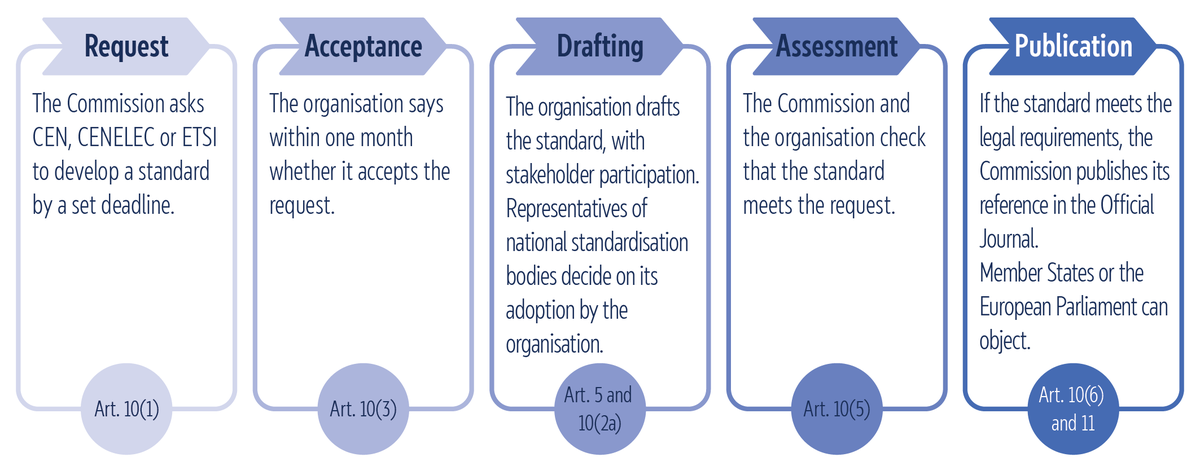
Source: Compiled by the authors; simplified presentation based on Articles 5, 10 and 11 of the Standardisation Regulation, as amended; graphic by Nadejda Kresnichka-Nikolchova, EPRS, 2026.
Amendment of the Standardisation Regulation
On 2 February 2022, the Commission proposed a targeted amendment to Article 10 of the Standardisation Regulation, together with the EU standardisation strategy. In 2021, the Commission had published a roadmap for the strategy, inviting stakeholders to give their views and input. The strategy takes account of the feedback received.
The Commission considered that changes in the internal governance and decision-making procedures of the ESOs, and their increased cooperation with international and European stakeholders, required additional safeguards. These were to ensure that decisions taken under Article 10 duly took account of EU interests, policy objectives and values. The Commission considered national standardisation bodies best placed to ensure this. The proposal therefore aimed to strengthen their role in those decisions.
Accordingly, Regulation (EU) 2022/2480 amending the Standardisation Regulation was adopted on 14 December 2022. It requires that decisions on the acceptance or refusal of standardisation requests, related new work items, and the adoption, revision or withdrawal of the resulting European standards or standardisation deliverables be taken exclusively by representatives of national standardisation bodies within the relevant ESO's competent decision-making body. The amending regulation entered into force on 8 January 2023 and has applied since 9 July 2023.
European Commission reports, studies and consultations in preparation of the revision
Earlier reporting on the regulation
Several reports and assessments were published before the 2025 evaluation of the Standardisation Regulation. These comprised an independent review and a Commission report under Article 25 in 2015, followed by implementation reports under Article 24(3) in 2016 and 2022; the 2016 report was accompanied by analysis of implementation.
The 2015 independent review found that the average time needed to develop European standards, measured from the formal start of work to publication, fell from around five years in 2009 to around three in 2013. At the same time, the review identified continuing issues concerning timeliness, monitoring and SME participation. The Article 25 evaluation report found that consulting Member State representatives through the Committee on Standards as part of the procedure for adopting standardisation requests had not itself created a bottleneck or delay, yet considered the available data insufficient for concrete conclusions on the effect of the new procedure.
The 2016 Article 24(3) implementation report, together with the accompanying analysis in SWD(2016) 126, found improvements in transparency and stakeholder participation, alongside continuing difficulties for SMEs and societal stakeholders, and concluded that no major problem in the application of the regulation justified a revision at that stage.
The 2022 implementation report, published at the same time as the EU standardisation strategy, again recorded progress, including a substantial reduction in the backlog of harmonised standards awaiting assessment, but identified continuing weaknesses in inclusiveness, the role of national standardisation bodies and the timely delivery of harmonised standards, as well as limited information on public-authority participation. These earlier assessments therefore already identified several of the issues examined again in the 2025 evaluation.
2025 Commission evaluation
In the EU Competitiveness Compass of 29 January 2025, the Commission committed to revising the Standardisation Regulation in 2026 to make standard-setting processes faster and more accessible, particularly for SMEs and start‑ups. The Commission also emphasised the need to examine alternative routes for businesses to ensure compliance with EU law where harmonised standards do not exist or are not available.13
On 23 June 2025, the Commission published its evaluation of the implementation of the Standardisation Regulation against the five Better Regulation evaluation criteria: effectiveness, efficiency, coherence, EU added value, and relevance. It is based on an external accompanying study for the evaluation conducted by Intellera Consulting, Fraunhofer ISI and Trinomics B.V. The evaluation covers the period from 1 January 2013 to 1 January 2023, extended to 31 August 2024 where data were readily available. It does not constitute an evaluation of the European standardisation system as a whole, nor of the amendments made to the Standardisation Regulation in 2022.
Measured against the regulation's original objectives,14 the Commission identifies four improvements: the standards-setting process became faster, from a baseline of more than nine years to six years;15 conflicting national standards were removed in favour of European standards; the system became more inclusive for societal stakeholders and SMEs; and a structured approach to ICT standardisation was established. However, the evaluation concludes that the system struggles to meet both legislative and market needs.
On effectiveness, the Commission finds the Standardisation Regulation moderately effective in increasing the speed of standards delivery and stakeholder participation. Nevertheless, the average six-year development process – more than three years of which are spent on drafting and consensus-building – remains, in the Commission's words, 'much too slow'. Confirming concerns raised earlier by Member States (see the section on Member States views below), the evaluation finds that harmonised standards are regularly applied and cited only after the relevant legislation has begun to apply. The Commission attributes delays to procedural hurdles, recurrent quality gaps, communication and resource constraints, and insufficient use of digital technologies.
Quality also remains a concern: 68.7 % of 2 793 draft harmonised standards assessed by the HAS consultants between April 2018 and March 2022 received a negative assessment. Prioritisation has produced limited results. The 2022 annual Union work programme for European standardisation reflected the standardisation priorities identified in the 2022 standardisation strategy, and from 2023, the Commission has set a list of priorities in each annual programme (Article 8 of the Standardisation Regulation). At the time of the evaluation, only one of eight priority areas in 2022, and three of nine in 2023, had received a response from ESOs. According to the evaluation, Member States filled 41 formal objections between 2014 and April 2024, and the procedure takes 21 months on average The Commission also notes that, under the regulation, standardisation requests may be addressed only to the three ESOs, leaving it without an alternative standardisation body when harmonised standards are not delivered on time.
On efficiency, the evaluation stresses that significant data gaps prevent definitive conclusions, particularly on the cost-benefit analysis. These include fragmented data across the standards' lifecycle, limited monitoring of stakeholder and public-authority participation, and insufficient information on the efforts and costs borne by different stakeholders. At the same time, it finds indications that the regulation has been cost-effective for all affected stakeholder groups. The evaluation links increased administrative burden in the system to legal and procedural developments, notably the Commission's role in assessing draft standards and deciding on citation, combined with subsequent Court of Justice case law; however, it also considers this burden necessary to guarantee the legal effect of harmonised standards.
On coherence, the evaluation finds the regulation to be internally coherent; the challenges identified in the effectiveness analysis did not come from conflicts between its provisions, but from how they were implemented in practice. The evaluation nevertheless identifies four developments affecting external coherence. First, an increasing number of sectoral acts provide for common or technical specifications adopted as a fall-back option. Second, outside the NLF, standardisation legislation are fragmented, with a trend towards relying on bodies and means other than the ESOs to deliver common or technical specifications. Third, the General Product Safety Regulation has led to some incoherence in the terminology and application of harmonised standards. Fourth, conditions for the participation of societal stakeholders are still fragmented at national level.
With respect to EU added value, the assessment is positive. European standards reduce technical trade barriers and production and compliance costs, and allow businesses to rely on a single standard across the internal market.
Finally, it finds that the regulation's objectives remain broadly relevant, but do not fully reflect the priorities set out in the 2022 EU standardisation strategy. The evaluation points in particular to the need for faster and better anticipation of standardisation needs, particularly in rapidly developing green and digital technologies, as well as sufficient stakeholder participation and technical expertise. It also notes that alternative options to the ESOs may be needed where regulatory deadlines cannot be met. These concerns are supported by the limited responsiveness of harmonised standards to innovation: very few are updated every five years, and a substantial share of those cited in the OJEU are more than 10 years old.
Stakeholder consultations
Evaluation cycle
The 2025 evaluation was supported by stakeholder consultation activities, including a call for evidence in September 2023, which received 90 valid replies, and a public consultation, carried out from 2 May to 25 July 2024, which received 255 replies, of which 253 were kept after the removal of duplicates. As most feedback submitted to the call for evidence was repeated in the public consultation, the Commission focused its detailed analysis mainly on the consultation. The Commission published a synopsis report of the consultation activities as an annex to the evaluation. According to the synopsis, respondents were divided on whether the regulation had reduced the time taken by the standardisation process: 40 % considered this objective achieved to a large or moderate extent, while 44 % considered it achieved only to a small extent or not at all. On integrity and inclusiveness, 61 % considered the regulation suitable to a large or moderate extent. Promoting stakeholder involvement and inclusivity was considered an essential action area for the future by 81 % of respondents (39 % strongly agreeing and 42 % agreeing).
Revision cycle
A call for evidence for the impact assessment for the revision of the Standardisation Regulation, organised in June and July 2025, received 200 responses, and a public consultation from 24 September to 17 December 2025 received 599 valid replies. The factual summary report shows that 66 % of respondents had encountered unavailable or delayed harmonised standards, compared with 47 % for European standards. Some 62 % of respondents strongly supported simplifying the Commission's procedures for requesting, evaluating and citing harmonised standards.
European Parliament position and oversight activities
Parliamentary resolutions
During the ninth legislative term, in May 2023, Parliament adopted a resolution on the standardisation strategy for the single market, where it highlighted delays in standardisation. It also called on the Commission to avoid overly prescriptive requirements in standardisation requests, and called for consideration of an open-access register of EU-developed standards to increase transparency.
During the current, 10th legislative term, Parliament returned to the issue of standardisation in several resolutions.16 In May 2025, Parliament adopted its resolution on old challenges and new commercial practices in internal market, where it underlined the need to improve the agility of the standardisation framework, particularly for the emerging green and digital value chains. It also considered the need for a new mechanism with Member States and national standardisation bodies to coordinate the European approach to international standardisation. A September 2025 resolution on implementation and streamlining of EU internal market rules stressed the need to improve the system while maintaining its operational integrity, while an October 2025 resolution on a new legislative framework for products highlighted continuing delays, and called for maximum deadlines for standardisation requests and a streamlined standardisation process.
Selection of parliamentary questions
During the ninth and 10th legislative terms, and particularly following the adoption of the amending regulation, MEPs raised a wide range of industry-specific questions concerning the creation, extension, or removal of particular technical standards. Questions have, for instance, pertained to digital, electrical and electrotechnical equipment, such as common chargers for e‑bikes and their connectors, alarm and communication systems, battery-powered tools and systems, and radio equipment; safety equipment such as firefighting equipment; circular-economy matters including waste-wood recycling; and transportation.
Petitions and citizens' enquiries
Similar to the questions raised by the MEPs, following the adoption of the amending regulation, citizens have submitted petitions focusing on industry-specific standardisation issues. The petitions have ranged from consumer goods, such as clothing sizes, foot sizes, and lawn trimmers, to electrotechnical equipment, such as batteries for electric vehicles or motorcycle intercoms, and transport-related matters including carry-on luggage dimensions and low- and zero-emission zones.
Views of Member States
Groups of Member States have drawn attention to delays in the preparation and citation of harmonised standards. In 2020, 17 Member States circulated a joint non-paper. It stated that, in 2018, following the James Elliott judgment, the Commission had introduced an expiry date for standardisation requests and a prescriptive list of detailed requirements. In their view, these restricted the standardisation process and its potential to support innovation, and caused considerable delays. They added that, as a result, new EU legislation could enter into force without supporting harmonised standards, leaving industry, particularly SMEs, with limited means of demonstrating conformity. As noted above, the Commission's 2025 evaluation reached a similar finding. The non-paper recommended finding a balance in standardisation requests between the qualitative requirements of EU legislation and flexibility for the ESOs, publishing clear criteria for the technical evaluation of harmonised standards, and ensuring short processing times for their citation in the OJEU. In a joint note for the Competitiveness Council of 27 May 2021, a partly different group of 17 Member States invited the Commission to keep these recommendations in mind, and attached the non-paper as background.
In April 2026, the Council Trio presidency circulated a note, Standardisation in the European Product Act: major challenges ahead, that touched on the major challenges identified in the Commission evaluation of 2025. It noted that standard development still takes around six years, and that a large majority of standards submitted to the HAS consultants for conformity assessment between 2018 and 2022 had been rejected. It also set out three dilemmas facing any revision: speed against inclusiveness; free access against the financial stability of standardisation bodies; and strategic autonomy against global competitiveness.
In a May 2026 information note on the forthcoming European product act, six Member States considered that the system was not able to deliver in a timely manner the more than 1 000 harmonised standards that needed to be developed, and advocated earlier involvement of the ESOs in preparing requests and realistic deadlines for both the ESOs and Commission. The non-paper proposed considering whether other documents, such as technical specifications or national and international standards, could temporarily receive a status supporting the presumption of conformity pending the availability of harmonised standards. It also argued that the revised Standardisation Regulation should be part of the European product act package, yet remain a separate regulation because of its distinct scope and addressees.
Judgments of the Court of Justice of the European Union
The legal status of harmonised standards has been the subject of several cases before the Court of Justice of the European Union (the Court) over the past decade.
In its 2016 James Elliott judgment, the Court held that a harmonised standard whose reference has been published in the OJEU forms part of EU law (paragraph 40). Its reasoning centred on the legal effects produced by publication of the reference, in particular the presumption of conformity conferred on products, and on the Commission's initiative, direction and control over the drafting process (paragraphs 40 and 43). In its 2022 Stichting Rookpreventie Jeugd judgment, concerning International Organization for Standardization (ISO) standards referred to in the Tobacco Products Directive, it held that standards made mandatory by an EU legislative act are binding on the public generally only if they themselves have been published in the OJEU (paragraph 48).
In its 2024 appeal judgment in Public.Resource.Org, concerning access to standards adopted by CEN, the Court set out the Commission's central role in the development of harmonised standards by reference to Articles 10(1), 11(1)(a) and 15 of the Standardisation Regulation (paragraph 73). It held that the requested harmonised standards form part of EU law (paragraph 80), and that the rule of law, enshrined in Article 2 of the Treaty on European Union (TEU), requires free access to EU law, to enable any person whom legislation seeks to protect to verify that its addressees actually comply with it (paragraphs 81 and 82). It found, on that basis, an overriding public interest justifying their disclosure (paragraph 85).
More recently, in its 2026 judgment in Nederlandse Voedsel- en Warenautoriteit and Others, the Court held that access to standards made mandatory by EU legislation must be general, effective, free of charge and non-discriminatory (paragraphs 37 and 38 and paragraph 43). It further held that, where the EU legislature imposes obligations connected with such standards and seeks to protect corresponding individual interests, it falls to the Union to bear the costs associated with providing access to their official and authentic version (paragraph 40).
Views of EU advisory bodies and agencies
European Economic and Social Committee
In an own-initiative opinion adopted in April 2026, the European Economic and Social Committee (EESC) identified several challenges in the operation of the European standardisation system. It highlighted delays throughout the process, from Commission requests to the drafting, assessment and publication of standards. It also observed that collections of non-harmonised standards cited in EU legislation or incorporated into national regulation remain largely unknown, and that Article 6(1) of the Standardisation Regulation, which requires national standardisation bodies to encourage and facilitate SME access to standards and their development, has resulted in uneven conditions for SME participation across Member States. The EESC called for clearer procedures and deadlines, more balanced stakeholder participation, easier public access and stronger monitoring. It also recommended safeguards to ensure that standardisation remains a technical instrument and does not interfere with social dialogue or collective bargaining. This EESC opinion seeks to inform the forthcoming revision of the Standardisation Regulation, and is not an independent evaluation of the Standardisation Regulation. However, the observations made provide a separate institutional perspective on timeliness, uneven national participation, and the limited visibility of non-harmonised standards.
European Union Agency for Cybersecurity
The European Union Agency for Cybersecurity (ENISA) has produced various reports about the role and impact of standardisation on cybersecurity. In April 2024, ENISA and the Commission's Joint Research Centre published a report on the cybersecurity requirements applying to manufacturers placing products with digital elements on the market under what became the Cyber Resilience Act. The report proceeded on the basis that those requirements need to be translated into harmonised standards to facilitate compliance. It identified the most relevant existing standards for each requirement, and highlighted possible gaps in their coverage.
A July 2022 report on digital identity standards, including those produced by the ESOs, proposed strong coordination and a clear division of responsibility between the ESOs to avoid duplication of efforts. An earlier report of March 2023 on cybersecurity of AI and standardisation concluded that general-purpose standards for information security and quality management can mitigate cybersecurity risks to the confidentiality, integrity and availability of artificial intelligence systems; at the same time it identified standardisation gaps concerning evolving technologies, machine learning features, cybersecurity risks, and the competences of organisations responsible for auditing, certifying and testing such systems.
Expert and stakeholder views
The positions below illustrate differences between advisory bodies and stakeholder organisations. They are a selective, non-exhaustive illustration of the views expressed, and show what these bodies have emphasised about the Standardisation Regulation; they are not, in themselves, evidence of how the regulation has operated in practice.
The Fit for Future Platform, in its November 2023 opinion issued as contribution to the Commissions evolution, advised against a full revision of the Standardisation Regulation. It argued that the regulation, as amended in 2022, should first be allowed to operate, and that some inefficiencies could instead be addressed through guidelines. It supported common specifications only as a fallback, under strict conditions, where harmonised standards are unavailable, and called for stronger effective participation, and for more researcher participation. One member of the platform17 did not agree, and the opinion records her dissenting view. The dissent argued that ruling out a full revision before the findings of the evaluation were known would pre-empt the evaluation, and identified the limits of standardisation, fundamental rights and the scrutiny of draft harmonised standards as matters requiring legislative attention.
The positions in this paragraph come from organisations with a defined role under the regulation.18 In their response to the call for evidence for the Standardisation Regulation revision in 2025, CEN and CENELEC argued that faster standards development must be accompanied by faster Commission assessment and citation, while warning against sacrificing quality, inclusiveness and the national-consensus model. They proposed maximum timeframes for the development of standardisation requests under Article 10(1), and for Commission processing under Article 10(6). CEN and CENELEC regarded common specifications as a fallback option, and also supported free readability of harmonised standards, while stressing the need to preserve copyright and the system's financial sustainability. The European consumer voice in standardisation (ANEC) was in favour of amendments to the Standardisation Regulation rather than a full revision, and called for the current HAS consultant system to be replaced by a permanent, independent and transparent mechanism within the Commission. ETSI called for its earlier involvement in drafting standardisation requests and in the development of the corresponding legal acts, so that it could be determined at an early stage how standards should support the legislation and what they would need to address. It argued that greater attention should be paid to the procedures surrounding standards' development, including compliance assessment and citation, and proposed reviewing the HAS consultant system and involving Commission and agency technical experts more directly. At the same time, it cautioned that faster delivery should not come at the expense of quality, inclusiveness or sufficient time for consensus-building.
In its response to the Commission's call for evidence for the evaluation of the Standardisation Regulation, BusinessEurope considered a legislative revision not necessary, and argued that existing problems should first be addressed through evaluation and, where appropriate, soft-law measures. It expressed concern that Better Regulation principles were being observed less closely, citing Regulatory Scrutiny Board findings that in some impact assessments, 'the problem description was predetermined by the envisaged preferred option', and that options 'tended to focus only on the preferred (political) choice'. It also called for any subsequent impact assessment to rely on well-sourced evidence and proportionate policy options, and regretted that the call for evidence had opened before the Fit for Future Platform could finalise its opinion.
Endnotes
Classification
Policy areas: Evaluation of Law and Policy in Practice | Internal Market and Customs Union
Committees: Internal Market and Consumer Protection (IMCO)
Statement on the use of AI
Any AI-generated content in this text has been reviewed by the authors. AI was used to improve the readability of the text and broaden the range of sources available to the authors as well as generate the visual material to explain better the legal text.
Disclaimer
This document is prepared for, and addressed to, the Members and staff of the European Parliament as background material to assist them in their parliamentary work. The content of the document is the sole responsibility of its author(s) and any opinions expressed herein should not be taken to represent an official position of the Parliament.
Copyright
© European Union.
The reuse of this document is authorised under a Creative Commons Attribution 4.0 International (CC-BY 4.0) licence.
https://creativecommons.org/licenses/by/4.0/deed.en
To use or reproduce elements that are not owned by the European Union, permission may need to be sought directly from the respective rightsholders.