
Article page checkbox is not checked in page info.
Timeline for the three key EU budgetary procedures in autumn 2026
Timeline for the three key EU budgetary procedures in autumn 2026
Sidonia Mazur, Members' Research Service
Summary
As every year, two annual procedures are central to the budgetary work of the European Parliament and the other institutions – agreeing on the 2027 budget and granting discharge for the implementation of the 2025 budget. In addition, in 2026, the process of agreeing the next multiannual financial framework (MFF) for the years from 2028 to 2034 will continue. This timeline sets out the main steps in those procedures up to the end of 2026
As every year, two annual procedures are central to the budgetary work of the European Parliament and the other institutions – agreeing on the 2027 budget and granting discharge for the implementation of the 2025 budget. In addition, in 2026, the process of agreeing the next multiannual financial framework (MFF) for the years from 2028 to 2034 will continue. This timeline sets out the main steps in those procedures up to the end of 2026.
EPRS Timeline for the three key EU budgetary procedures in autumn 2026
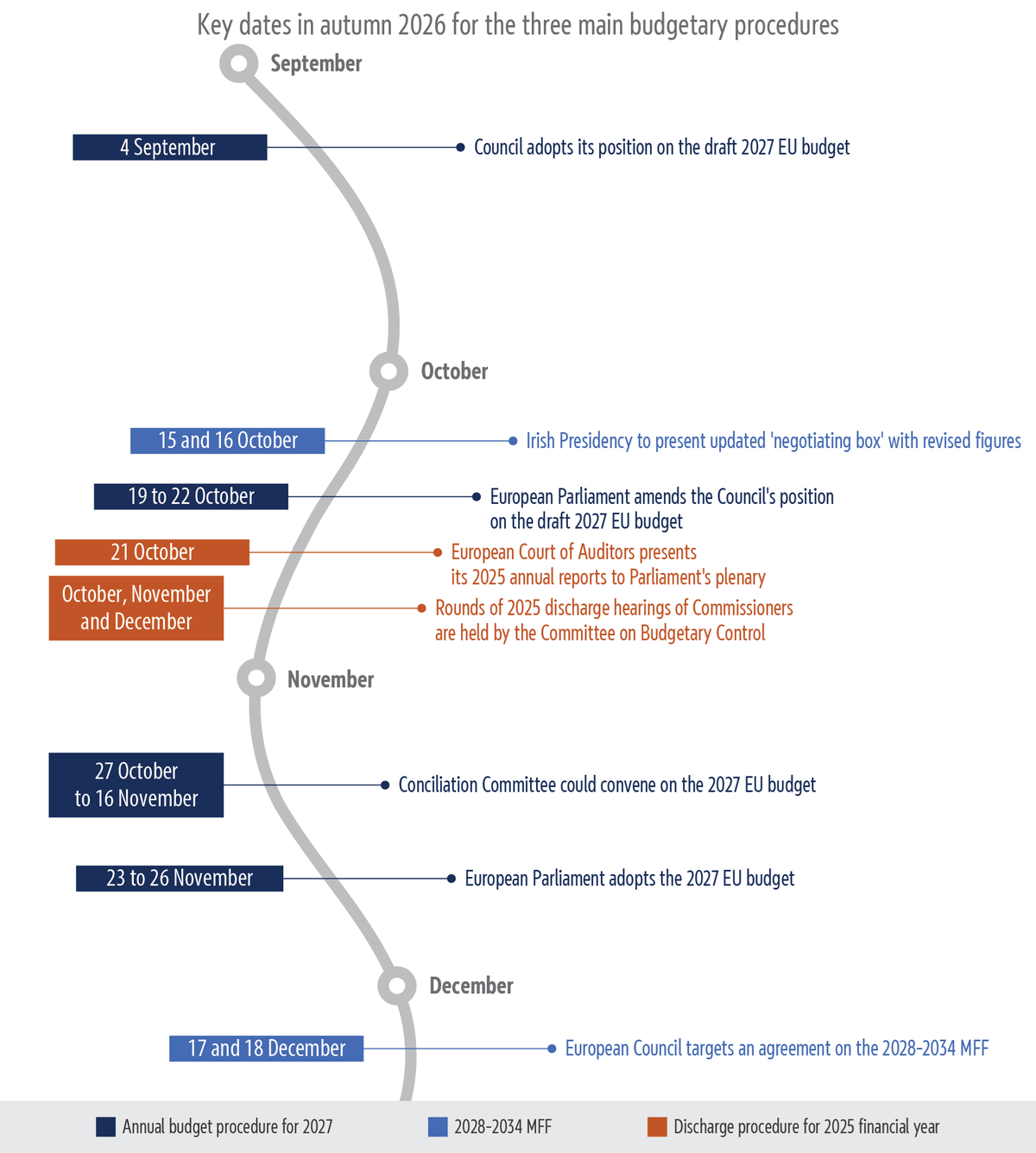
Graphic by: Giulio Sabbati, EPRS.
Notes
| Item | Explanation |
|---|---|
|
Council adopts its position on the draft 2027 EU budget |
The Council formally adopts its amendments to the Commission's draft budget, based on the position agreed in Coreper (the Committee of Permanent Representatives). Coreper oversees discussions among Member States with a view to agreeing the Council's position, and forwards it to the European Parliament. |
|
Irish Presidency to present updated 'negotiating box' with revised figures |
A 'negotiating box' is a Presidency-prepared document identifying the key political issues that still need to be resolved and, for each of them, sets out the Council's preferred position or a range of acceptable outcomes. On 28 April 2026, Parliament adopted its interim report, which sets out its negotiating position for the 2028-2034 MFF. For more on the 2028-2034 MFF, see the EPRS MFF blog. |
|
European Parliament amends the Council's position on the draft 2027 EU budget |
Within the European Parliament, the Rules of Procedure (Title II, Chapter 6) contain specific procedural rules for the adoption of the budget in Parliament. For more on this, see EPRS briefing: Annual EU budgetary procedure: Introduction to the steps in the European Parliament. |
|
European Court of Auditors presents its annual reports for financial year 2025 to Parliament's plenary |
Each year, the European Court of Auditors prepares annual reports on the implementation of the EU budget, which serve as a key element for the discharge procedure. The Commission produces financial and accountability reports, which constitute input for the annual discharge procedure. |
|
Hearings of Commissioners on discharge 2025 are held by the Committee on Budgetary Control |
A round of discharge hearings of Commissioners in Parliament's Committee on Budgetary Control opens the discharge procedure for the 2025 budget. Parliament's decisions on discharge assess the implementation of the EU budget by the European Commission and other institutions and bodies, ensuring compliance with legal provisions and the principle of sound financial management. |
|
Conciliation Committee could convene on the 2027 annual EU budget |
If the Parliament adopts amendments to the Council's position, a Conciliation Committee is set up, composed of the members of the Council or their representatives and an equal number of Members representing the European Parliament. The Conciliation Committee is tasked with presenting a joint text within 21 days. |
|
European Parliament adopts the 2027 annual EU budget |
Once a joint text is agreed on by the Conciliation Committee, the Council and Parliament have 14 days to approve or reject it. If both approve it, the President of the European Parliament declares that the budget has been definitively adopted. |
|
European Council targets an agreement on the 2028‑2034 MFF |
Although the European Council has no formal role in the procedure for adopting the MFF, it is nevertheless heavily involved in the process. Major political decisions are made at the level of Heads of State or Government, including on legislative files jointly decided on by Parliament and the Council under the ordinary legislative procedure (see EPRS explainer). In accordance with Article 312(2) of the Treaty on the Functioning of the European Union (TFEU), when adopting the MFF, the Council (and not the European Council) 'shall act unanimously after obtaining the consent of the European Parliament', given by a majority of its component members. However, most accompanying legislative files are decided on jointly by Parliament and the Council under the ordinary legislative procedure in accordance with Article 294 TFEU. |
Classification
Policy areas: Budget | Budgetary Control
Regions: European Union
Committees: Budgets (BUDG), Budgetary Control (CONT)
Disclaimer
This document is prepared for, and addressed to, the Members and staff of the European Parliament as background material to assist them in their parliamentary work. The content of the document is the sole responsibility of its author(s) and any opinions expressed herein should not be taken to represent an official position of the Parliament.
Copyright
© European Union.
The reuse of this document is authorised under a Creative Commons Attribution 4.0 International (CC-BY 4.0) licence.

https://creativecommons.org/licenses/by/4.0/deed.en
To use or reproduce elements that are not owned by the European Union, permission may need to be sought directly from the respective rightsholders.