
Article page checkbox is not checked in page info.
EU emissions trading system for buildings, road transport and additional sectors (ETS2) : Status and concerns
EU emissions trading system for buildings, road transport and additional sectors (ETS2) Status and concerns
Juan Fernando López Hernández, Members' Research Service
Summary
The EU aims to become the first climate-neutral continent in the world by 2050. Since the announcement of the European Green Deal and following the adoption of the European Climate Law in 2021, the EU's climate agenda has become increasingly centred on the principle of carbon pricing. Today, the EU emissions trading system (ETS) is the cornerstone of the EU's strategy to achieve this vision, complemented by a mix of industrial, energy and climate policies.
Currently, the EU ETS covers stationary (power and industrial) installations, domestic aviation and maritime transport. Following the 2023 revision of the EU ETS Directive, greenhouse gas (GHG) emissions from buildings, road transport and additional sectors not covered by the existing EU ETS will be covered under a new ETS2. With the ETS2, carbon pricing is expected to regulate around 75 % of EU GHG emissions from 2028.
Following the adoption of the revised ETS Directive in 2023, Member States had to transpose the ETS2 into national law. The ETS2 targets GHG emissions from fuel for the sectors covered. Fuel suppliers have to buy and surrender emissions allowances and are likely to pass on the cost of this new instrument to final consumers. Consumers are likely to face higher energy bills if they do not switch to low-carbon technologies, which is why the ETS2, while aiming to achieve climate objectives, has become a social concern.
This is an update of a briefing published in May 2025.
Introduction
On 10 May 2023, the EU adopted the revised Directive (EU) 2023/959 on the EU emissions trading system (ETS). Among other things, the directive expands emissions trading by establishing a second, separate ETS for fuels used for combustion in buildings, road transport and industrial activities that have not previously been covered by the EU ETS (ETS2). National emissions trading systems for heating and transport fuel suppliers have been in place in Germany (nEHS) since 2021 and Austria (NEHG) since 2022. The existing EU ETS reduced greenhouse gas emissions from industry, electricity generation and aviation by 50 % between 2005 and 2025.
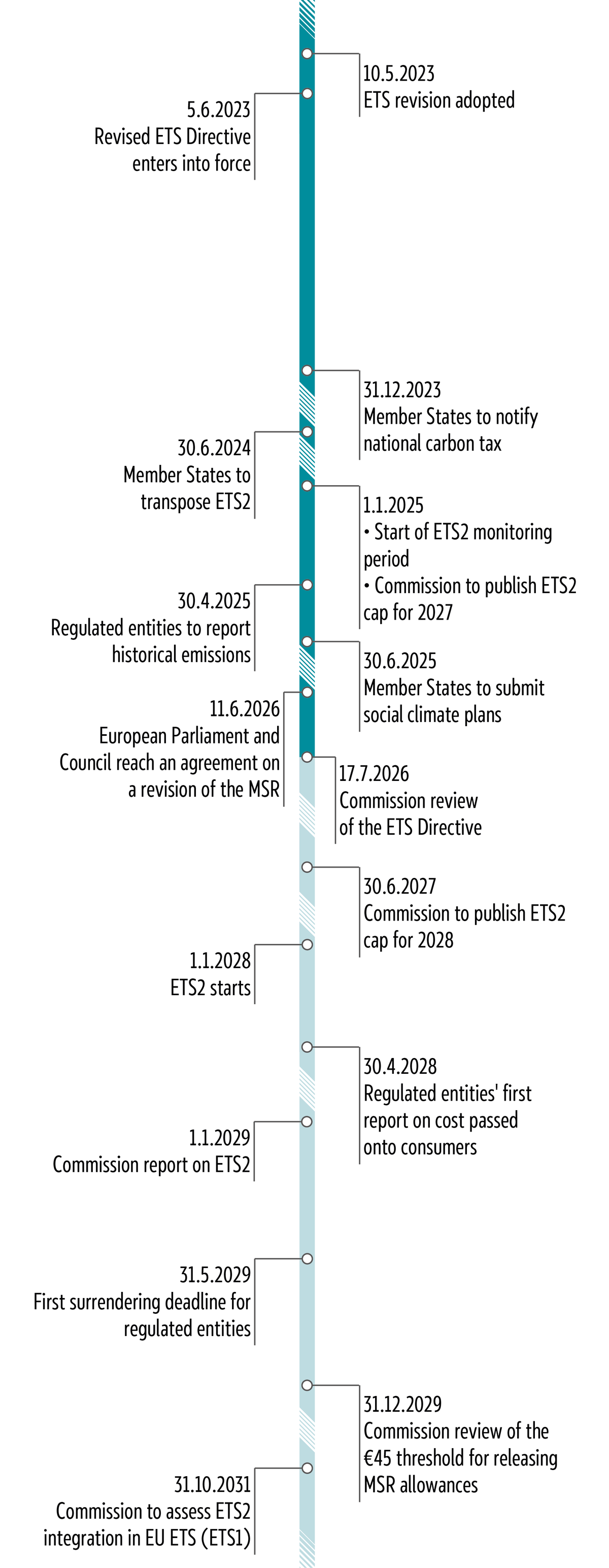
Image source: Lucille Killmayer, EPRS, 2026.
While EU ETS emissions have decreased, the road transport and buildings sectors, which remain under the Effort-sharing Regulation (2023/857) (ESR), have seen less pronounced reductions, highlighting a need for increased efforts in these areas. This cap-and-trade system should incentivise cost-efficient GHG emissions reductions in the sectors covered. While the ESR will continue to cover CO2 and other GHGs, the ETS2 covers only CO2 from combustion processes. The ETS2 was originally envisaged to kick off in 2027, but following the adoption of Regulation (EU) 2026/667 as regards the setting of a Union intermediate climate target for 2040 and the adoption of amending Regulation (EU) 2021/1119 (the European Climate Law), it will be postponed until 2028. The sectors covered by the ETS2 also remain under the ESR.
In parallel to the revision of the EU ETS Directive, the EU adopted Regulation (EU) 2023/955 on the Social Climate Fund (SCF). The SCF will benefit vulnerable households, micro-enterprises and transport users affected by energy and transport poverty, as fuel suppliers covered by the ETS2 are likely to pass on the cost of carbon. The adoption of the SCF was considered necessary to achieve political support for the ETS2.
The ETS2, a system still to be tested and with strong social implications, has been raising concerns among stakeholders since it was proposed by the European Commission and later adopted by the EU. This briefing focuses on key issues that have been raised recently and are part of the ongoing discussion. As the ETS2 has not yet been implemented, and despite the legislative changes agreed in 2026, additional concerns may arise once the system is in place.
Functioning of the ETS2
The ETS2 applies to GHG emissions from fuels for road transport, buildings and other installations (mainly small industrial installations not covered by the EU ETS before 2024); the regulated entities are fuel suppliers. Following a similar principle to the existing EU ETS (one tonne of carbon dioxide equivalent (CO2e) emissions equals one allowance), regulated entities can buy auctioned permits (also called allowances) to cover, below a cap, the GHG emissions of fuels placed on the market. Conversely, regulated entities can also sell their permits on the market if they need fewer permits.
Commission Decision (EU) 2024/2951 set the cap at 1 036 288 784 allowances for 2027 based on the average emissions from fuel combustion over the period 2016-2018. The cap in the ETS2 is reduced annually to yield emissions reductions of 43 % in 2030 compared to 2005. It decreases each year by a 5.1 % linear reduction factor (LRF) and by a 5.38 % LRF from 2028. By 30 June 2027, the Commission has the mandate to publish the updated cap for 2028, based on the average emissions from fuel combustion for the period 2024-2026.
Following the revision of Commission Delegated Regulation (EU) 2026/787, the auctioning of allowances in ETS2 will start in 2027, a year ahead of the market start, with an amount corresponding to 130 % of the value of the cap. The additional 30 % of allowances will be frontloaded from the auction volumes that were to be auctioned between 2030 and 2032. Injecting additional allowances in the early stage of the ETS2 should increase market liquidity and keep the price lower for regulated entities during the first years. In July, the Commission announced that it would publish the 2027 auction calendar for ETS2 allowances by September 2026 at the latest.
The ETS2 is expected to generate between €342 billion and €570 billion between 2027 and 2032. From this amount, between €277 billion and €505 billion will go directly to Member States and will have to be spent on climate- and energy-related activities as specified in Article 10(3) of the EU ETS Directive (EU) 2023/959, giving priority to social aspects (Article 30d(6)); €65 billion will be allocated to the SCF.
Article 30k of the ETS Directive introduced a mechanism allowing the postponement of the ETS2 until 2028 in the event of exceptionally high energy prices. For the ETS2 to be postponed, at least one of the following conditions must be met:
-
the average Title Transfer Facility (TTF) gas price for the six calendar months ending on 30 June 2026 has to be higher than the average TTF gas price in February and March 2022;
-
the average Brent crude oil price for the six calendar months ending on 30 June 2026 has to be more than twice as high as the average Brent crude oil price during the five preceding years.
Market analysts considered the postponement of the ETS2 due to high energy prices to be unlikely. However, the conditions set out in Article 30k will be triggered following the adoption of the revised European Climate Law in 2026.
In its initial stage, the ETS2 operates in a separate market from the EU ETS. The Commission's impact assessment accompanying the proposal for a revision of the ETS Directive provides the reasons for having a separate system. However, Article 30i of the ETS Directive mandates the Commission to perform a review by 2031 to assess the feasibility of integrating the sectors covered by the ETS2 into the EU ETS. A list of milestones for the ETS2 is presented in Figure 1.
Market Stability Reserve
Following the example of the existing Market Stability Reserve (MSR) in the ETS1, Decision (EU) 2015/1814 concerning the establishment and operation of a market stability for the EU ETS (the MSR Decision) establishes a similar instrument in the ETS2. Article 1a of the MSR Decision governs the MSR for ETS2 (MSR2). In 2028, 600 million allowances will support the creation of the MSR2, which is separate from the MSR in the ETS1.
The ETS2 provides some safeguards against substantial fluctuations in market prices. Safeguards rely on a MSR to adjust the supply of allowances. In the ETS1 (covering industrial and energy installations, aircraft operators and maritime transport), the MSR has been working since 2019.
The MSR is a volume-based instrument. If a lower threshold of a total number of allowances in circulation (TNAC) is achieved in the carbon market, allowances are taken out of the MSR and brought back into the carbon market, thus increasing the supply of allowances. Conversely, if an upper threshold is achieved, EU allowances (EUAs) are deducted from the quantity of allowances to be auctioned and sent to the MSR.
The MSR will be an important instrument for mitigating price escalation in the ETS2. In April 2026, the Commission proposed additional amendments to Article 1a of the MSR Decision adopted in 2023 concerning the ETS2 MSR. Parliament and the Council reached a political agreement on 11 June. Among the agreed changes, the co-legislators agreed to introduce an additional threshold to facilitate the release of allowances from the MSR if the TNAC falls below 260 million allowances.
In addition to volume-based, Article 30h of the EU ETS Directive sets out three options to activate the MSR in the ETS2 in the event of excessive price increases:
-
Twenty million allowances are released from the MSR if the average auction price of ETS2 allowances in the auctions exceeds €45 (in 2020 prices, adjusted for inflation) per tonne of CO2 for two consecutive months. This mechanism applies until 31 December 2029, should it be needed. Following the 2026 amendments to the MSR Decision concerning the MSR2, the release volume was increased by an additional 20 million allowances, meaning that the MSR2 may inject up to 80 million allowances into the market each year if the mechanism is activated twice. The amount of €45 per tonne of CO2e is not an absolute threshold. Instead, if the €45 threshold is exceeded and ETS2 allowances are released, the carbon price could still go higher.
-
Fifty million allowances are released from the MSR if, for more than three consecutive months, the average price of allowances in the auctions is more than twice the average price of allowances compared to the six preceding consecutive months. In 2027 and 2028, the average price of allowances should be 1.5 times higher (instead of 2 times higher) for this condition to be triggered.
-
A hundred and fifty million allowances are released from the MSR if the average price of allowances is more than three times the average price of allowances compared to the six preceding consecutive months.
The amended Article 1a (3) of the MSR Decision removes the expiration date for allowances that remain in the MSR2 beyond 1 January 2031. Instead, allowances in the MSR2 will no longer expire beyond this date, creating a safety buffer that may be released from the MSR in the future if there is a shortage of allowances in the carbon market. A larger supply of allowances may have a downward impact on the carbon price.
While Article 30h of the EU ETS Directive provides some guarantees to avoid excessive prices in the ETS2, it also has limitations:
-
Limited volumes: All three releases cannot be triggered simultaneously. Instead, when all three scenarios happen at the same time, only one release mechanism is activated. In the context of the EU ETS2, the MSR initially operates with a maximum release of 150 million allowances.
-
Limited timing: Originally, the MSR release could be activated only once every 12 months. Following the amendments to the MSR2, the release based on the €45/ tCO2 threshold should occur twice and in a double amount.The limited triggering condition applies when at least one of the previous conditions has been met and allowances from the MSR have been released accordingly.
Impact on fuel prices
ETS2 price impact on consumers
A substantial concern is the potential impact that charging fuel distributors could have on prices paid by final consumers. Considering the limitations of the MSR in the ETS2, the carbon price in the ETS2 could go beyond €45 per tonne of CO2e, as recent studies show. According to Vertis Environmental Finance, prices in the ETS2 are expected to be between €111.7 and €259 per tonne of CO2e by 2030, while BloombergNEF forecasts that the ETS2 could reach a carbon price of €149 per tonne of CO2e by the same year. If the MSR2 legislative changes, earlier volume auctions, and the one-year postponement of ETS2 are incorporated, Veyt foresees a carbon price slightly above €60/tCO2 by 2030. An updated Bloomberg analysis shows that the new ETS2 may see carbon prices escalate to €78/tCO2 by 2028. If revenue recycling and complementary policies in other sectors are implemented, on top of these measures, the average carbon prices could reach €45 /tCO2.
For a carbon price of €48 per tonne of CO2e, the Commission impact assessment accompanying the revision of the ETS Directive forecasts a fuel price increase of €0.11 per litre of petrol and €0.13 per litre of diesel. Energy and fuel suppliers will have to pay for ETS2 prices and are likely to pass on this cost of ETS2 allowances to final consumers. Other studies forecast a fuel price increase of up to €0.50 due to the ETS2 by 2030. For every €1/tCO2 increase in the price of carbon, the average annual cost of heating for a poorly insulated Belgian house will increase by €3.1 if heated with natural gas and by €4.1 if heated with heating oil. The higher the carbon price, the higher the price of fuel, which increases the cost for end-consumers who cannot reduce their fuel consumption. In the end, high carbon prices could have an impact on both household budgets and firms.
The distributional implications of a carbon price increase will not be uniform across different segments of the population within and across Member States. In lower-income households, energy costs represent a larger share of budget expenditure, making them more vulnerable to price increases. Across Member States, the impact can vary depending on factors such as the degree of fossil fuel dependence and average household income.
National transposition and implementation
Delayed transposition by Member States
The inclusion of ETS2 sectors within the scope of the revised ETS Directive should generate revenues to finance the SCF. Member States do not make direct financial contributions to the SCF; instead, as specified in Article 10(1) of the SCF Regulation, emission allowances are auctioned to finance the implementation of the SCF, in accordance with the EU ETS Directive. Access to both the SCF and the ETS2 Frontloading Facility is contingent on the operation and implementation of the ETS2.
The EU ETS Directive mandates the transposition of the ETS2 into national law by 30 June 2024. This was a necessary deadline, as rules on monitoring, reporting, verification and accreditation for ETS2- regulated entities were in place before they began to apply on 1 January 2025. By this date, regulated entities covered by the ETS2 were required to hold a GHG emissions permit. They were also required to have monitoring plans approved by national authorities and report their emissions from the previous year by 30 April each year starting in 2025. While the ETS2 will not become operational until 2028, delays in national transposition could make it more difficult for business to prepare for this new system.
However, 26 Member States failed to fully transpose the provisions of the ETS2 into national law by the deadline of 30 June 2024. Only Austria met this deadline, while some other Member States have been requesting a postponement of the system. Due to these delays, the Commission opened infringement proceedings by sending letters of formal notice to the Member States concerned. In the absence of a satisfactory response, the Commission may decide to issue a reasoned opinion. If Member States continue to not transpose the ETS2, the Commission could, as a final step, bring a case before the Court of Justice of the European Union, which could result in substantial fines.1
The Commission closed the infringement proceedings against Greece and Ireland on 16 December 2024, against Sweden and Denmark on 12 February 2025, against Malta on 8 October 2025, against Italy, Slovenia and Lithuania on 21 November 2025, against Croatia, Germany and the Netherlands on 11 December 2025, and against Cyprus on 4 June 2026. By July 2026, at least 21 Member States had notified the national measures transposing the ETS2 provisions.
Member States asking for a postponement
Four Member States have publicly advocated postponing the implementation of the ETS2 and/or voiced opposition to it. ETS2 concerns raised during the negotiations on the European Climate Law resulted in the postponement of the ETS2 by one year, until 2028.
In 2024, Czechia was the first Member State to call for postponing the ETS2 by at least one year, until 2028 or later. Czechia argued that more time was needed to better design the system and to avoid potential social costs.
Poland followed Czechia in calling for the system to be postponed. Poland's request goes beyond Czechia's, calling for a postponement until 2030. For Poland, the postponement of ETS2 should not jeopardise the launch of the SCF, which, as planned, should become operational before the ETS2 kicks off.2
Slovakia stood against the launch of the ETS2 during the negotiations on the European Climate Law, after having raised concerns about the social impact of the ETS2 in late 2026. It also failed to transpose the ETS2 provisions in the latest amendments to its Emissions Trading Act before the deadline and urged the Commission to reconsider the EU ETS Directive.
Estonia has also pushed for a postponement of the ETS2. The request has been supported by the Estonian Parliament, based on uncertainty and administrative concerns.
The group of Member States asking for the ETS2 to be postponed has been increasing. In countries such as Czechia, natural gas, district heating and coal for heating are still drivers behind high household emissions. However, modification of or postponing the ETS2 would require a legislative proposal to amend the EU ETS Directive under the ordinary legislative procedure. It would also make it harder for Member States to achieve their national targets under the ESR and for the EU to achieve its 2030 net emissions reduction target of 55 %.
Exemptions
Article 30e(3) of the EU ETS Directive allows Member States to exempt a regulated entity (fuel distributor) from the requirement to surrender ETS2 allowances. Exempted entities are not be obliged to hold and surrender allowances, but still have to comply with the obligations relating to GHG emissions permits and monitoring, reporting and verification of their emissions. This exemption can apply until 31 December 2030, provided that the regulated entity has effectively paid a carbon tax higher than the average auction clearing price in the ETS2, and the Member State cancels a number of allowances equal to the verified emissions of that regulated entity. The Member States concerned had to notify the Commission of their national carbon tax by 31 December 2023. Ireland and Slovenia have each submitted a request to apply this derogation. Member States making use of Article 30e derogations will still receive funding from the SCF.
Reporting challenges for fuel suppliers
Article 30f(4) of the ETS Directive requires Member States to ensure that regulated entities in their territory covered by the ETS2 report their GHG emissions annually. For emissions generated in 2024, the reporting deadline was 30 April 2025. ETS2-regulated entities were required to hold GHG emissions permits by 1 January 2025. The directive also requires Member States to take appropriate measures to avoid double counting of emissions covered by the current ETS and the ETS2. More than 11 400 regulated entities across the EU are expected to fall within the scope of the ETS2, including tax warehouses for oil, gas suppliers and coal suppliers.
Germany's national emissions trading system (nEHS) provides an example of an operational ETS for fuels. Germany introduced the nEHS in 2021 to reduce emissions from the heating and transport sectors; since 2023, the nEHS also includes other fuels such as coal, in addition to petrol, diesel, heating oil, liquefied petroleum gas, natural gas and biomass on the market. The system has been working in parallel to the EU ETS and regulates emissions from sectors in Germany that are not covered by the EU ETS, including fuel suppliers.
In 2023, almost 5 % of regulated entities covered by the German scheme did not register any emissions. In addition, double counting of emissions (in the EU ETS and the nEHS) remains an issue. While regulated entities have the legal possibility to deduct from the nEHS the emissions of fuels used in the existing EU ETS, it is not always possible to split them. For these emissions, EU ETS operators can apply to the German national authority for ex-post compensation. However, this could imply a longer period to be compensated than for direct emission deductions.
Similar concerns could arise when the ETS2 is implemented. In addition, stakeholders have said that it is not fully clear which entities will be covered and how to prepare for monitoring.
Additional challenges may arise in some of the Member States that extend the scope of the ETS2 to additional sectors and regulated entities. Sweden, the Netherlands, Austria and, more recently, Finland have expanded the scope of the ETS2 to additional sectors.
Conclusion
For the ETS2 to work as intended, there must be a clear price signal. Prices for fossil fuels have to go up for consumers to take the decision to switch to low-carbon technologies such as heat pumps or electric vehicles (EVs). Policy measures like the ETS2 can discourage demand for more expensive fossil fuels through the relative cost channel. By increasing the cost of emissions, the ETS2 can reduce the use of fossil fuels and incentivise the uptake of low-carbon solutions. For the ETS – and especially the ETS2 – to work, the price signal must be very clear, as studies have shown that the elasticity of demand is low regarding changes in fuel costs of road transport and heating in buildings.
As seen in Canada, citizens' discontent with high energy prices can lead to a loss of necessary political support for carbon pricing policies, especially at a time when energy prices were still higher in 2024 than before 2022. In 2026, the conflict in the Strait of Hormuz has also contributed to higher energy prices, increasing the EU's energy bill. To achieve public support, governments can, in addition to carbon pricing, encourage the switch to low-carbon technologies through private investment and regulation. Private investment will be needed as long as governments do not have enough funding to pay for the entire transition, while regulations can also effectively drive behavioural change, even with low demand elasticity. The fact that some public authorities promise to reduce energy costs and do not acknowledge that the ETS2 will inevitably lead to higher fossil fuel prices does not help to incentivise consumers to switch to low-carbon technologies.
Finally, recent developments in the EU are driving political reluctance to introduce carbon pricing measures. The 'yellow vest' protests in France were prompted by a CO2 tax of around 45€/tCO2e. The previous German Building Energy Act, which was unpopular in Germany and was surrounded by a lot of misinformation, also generated public opposition. The act was eventually softened before adoption, while the Christian Democratic Union (CDU) campaigned on a promise to repeal it. By contrast, France's social leasing programme, offering low-income households access to EVs for around €100 per month, seems to be a popular measure.
If governments help to keep fossil fuels for energy costs low (for example, by supporting households and businesses through complementary instruments), the burden created by the ETS2 on society may be lower and social acceptance higher. The ETS2 will drive fossil fuel prices up and is expected to generate significant revenue for Member States through auctioning of allowances, as well as through the SCF. This revenue can be used to support the transition to greater energy efficiency and low-carbon technologies, and to create jobs and growth in ETS2 sectors. It will be up to each Member State to use the ETS2 revenue wisely.
Main references
- Boehm, L. with Kläffling, D., Social and labour market impact of the green transition, EPRS, European Parliament, 2024.
- Erbach, G., Revised EU emissions trading system, EPRS, European Parliament, 2023.
- Graichen, J. and Ludig, S., Supply and demand in the ETS 2, German Environment Agency, 2024.
- Günther, C., Pahle, M., Govorukha, K., Osorio, S. and Fotiou, T., 'Carbon prices on the rise? Shedding light on the emerging second EU Emissions Trading System (EU ETS 2)', Climate Policy, 2024.
- López Hernández, J.F., Market stability reserve for the buildings, road transport and additional sectors, EPRS, European Parliament, January 2026.
- Schroten, A. et al., Research for TRAN Committee – Pricing instruments on transport emissions, Policy Department for Structural and Cohesion Policies, European Parliament, 2022.
- Widuto, A., Social Climate Fund, EPRS, European Parliament, 2023.
Endnotes
Classification
Policy areas: Environment
Regions: European Union
Committees: Environment, Climate and Food Safety (ENVI)
Disclaimer
This document is prepared for, and addressed to, the Members and staff of the European Parliament as background material to assist them in their parliamentary work. The content of the document is the sole responsibility of its author(s) and any opinions expressed herein should not be taken to represent an official position of the Parliament.
Copyright
© European Union.
The reuse of this document is authorised under a Creative Commons Attribution 4.0 International (CC-BY 4.0) licence.

https://creativecommons.org/licenses/by/4.0/deed.en
To use or reproduce elements that are not owned by the European Union, permission may need to be sought directly from the respective rightsholders.
Social acceptance
Effectiveness of the Social Climate Fund
The adoption of the ETS2 was accompanied by Regulation (EU) 2023/955 on a Social Climate Fund. This funding instrument aims to protect vulnerable households, transport users and small and medium-sized enterprises (SMEs) from rising costs due to the introduction of the ETS2.
The SCF will be operational between 2026 and 2032, starting two years before the ETS2 kicks off. Despite the postponement of the ETS2 from 2027 to 2028, the Commission has confirmed that the legal framework of the Social Climate Fund remains unchanged. It will be partially financed from future ETS2 revenues and used for investment in energy efficiency-related building renovations and sustainable transport, and for direct income support to compensate for the expected increase in road transport and heating fuel prices. The SCF is expected to mobilise at least €86.7 billion of public funding. This envelope will be financed from auctioning allowances up to an amount of €65 billion; an additional 25 % (around €21.7 billion) of the total costs of Member States' social climate plans (SCPs) will be covered by national resources. From this €65 billion, Annex I of Regulation (EU) 2023/955 sets out the methodology for calculating the maximum final allocation per Member State based on poverty, population and emission-related indicators. Poland (17.60 % of the total share), France (11.19 %) and Italy (10.81 %) are the main beneficiaries.
Each Member State had to submit its SCP to the Commission by 30 June 2025, ahead of the implementation of the SCF in 2026. Direct income support must not represent more than 37.5 % of the estimated total costs of national plans and must be temporary and decrease over time.
While the SCF should alleviate the impact of the ETS2 on end-consumers, it might not be enough to fight energy and transport poverty, according to analysis carried out by NGOs. In addition, there is the risk that not all Member States will provide their plans on time. Only Sweden respected the 30 June 2025 deadline. By the end of July 2026, the European Commission had adopted Sweden's, Lithuania's, Latvia's, and Malta's SCPs.
In addition to the SCF, the European Commission announced an ETS2 Frontloading Facility in February 2026. Implemented by the European Investment Bank, the facility is expected to unlock at least €3 billion to support the decarbonisation of sectors covered by ETS2. The facility will operate before the ETS2 begins generating auction revenues in 2027.
Canada's carbon tax for road transport and buildings
Canada provides a good example of recent international developments related to the ETS2. Canada announced the cancellation its unpopular carbon tax on fuels such as gasoline and natural gas in March 2025, when the new Prime Minister, Mark Carney, took office. Until then, Canada had effectively supported households, with around 80 % receiving more in rebates than the carbon tax they paid for consumption. A big issue with the tax was that it generated a feeling of discrimination between different provinces in a period of economic uncertainty. The Canadian rebate provided direct cash payments to most households, but it was insufficient to gather political support for the carbon tax to remain in place. Although the carbon tax was cancelled in April 2025, households nevertheless received a final rebate payment for April.
The cancellation of the federal Canadian carbon tax on fuel consumption in 2025 is a good example of how public perception and ineffective communication with citizens can have an impact on the success or failure of the new ETS2 in the EU. It also highlights the need for a targeted communication channel to explain the benefits of the SCPs, reinforce positive messaging on the ETS2's impact, and facilitate access to SCP support. Anticipating social concerns and ensuring the social acceptability of carbon pricing will be key to gaining political and public support.