
Article page checkbox is not checked in page info.
EU Budgetary Outlook 2026: Main findings
EU Budgetary Outlook 2026: Main findings
Alina Dobreva, Karoline Kowald, Sidonia Mazur, Marianna Pari and Tim Peters, Members' Research Service

Summary
The EU budget and its financing architecture are entering a decisive phase. With the Commission's proposal for the 2028-2034 multiannual financial framework (MFF) on the table and Parliament having adopted its interim position in April 2026, the coming months will shape how the Union funds its priorities for the next decade. Set against a backdrop of geopolitical strain, fiscal constraints in many Member States, and unresolved questions over EU own resources and debt-financing, the EU budget debate is set to dominate Brussels well into 2027. The latest annual Budgetary Outlook from EPRS, for 2026, explains the four pillars of the current system – the multiannual framework, the annual budget, own resources, and parliamentary scrutiny – and the latest state of play.
Why does the EU budget matter now?
The EU is caught between the United States and China on trade, defence and artificial intelligence. The Union has also had to absorb the economic fallout of the US-Israeli war against Iran and the resulting closure of the Strait of Hormuz, which pushed up energy prices and inflation worldwide. Russia's war against Ukraine, now in its fifth year, continues to demand sustained European support. A €90 billion EU package has been adopted to help Ukraine defend itself against Russia in 2026 and 2027. Domestically, many Member States are grappling with high debt and weak growth. It is against this backdrop that the Commission tabled its 2028-2034 MFF proposal in July 2025, envisaging a restructured budget built around four headings: national and regional partnership plans; performance-based budgeting; a large European Competitiveness Fund; and new debt-financed loan instruments.
What is changing in the EU budget architecture?
The current 2021-2027 MFF, agreed in December 2020 amid the COVID-19 pandemic, amounts to €1.1 trillion, complemented by the €750 billion Next Generation EU (NGEU) recovery instrument. Successive crises – above all Russia's aggression against Ukraine – prompted a 2024 revision adding €14.6 billion and creating two new instruments, the Ukraine Reserve and the EURI Instrument for NGEU interest costs. The Commission's 2028-2034 proposal, worth €1.76 trillion in 2025 prices and including €149.3 billion for NGEU debt repayment, has met a robust response from Parliament: led by co-rapporteurs Carla Tavares (S&D) and Siegfried Mureşan (EPP), Parliament's April 2026 interim report calls for a 10 % increase, new genuine own resources to cover debt repayment without cutting existing programmes, and stronger governance.
How is EU spending financed and scrutinised?
Own resources – the EU's revenue system under Article 311 TFEU – remain heavily reliant on GNI-based national contributions, alongside VAT-based resources, traditional own resources and a plastics levy. Because changes to the own resources system require unanimity and national ratification, reform has been slow and incremental, despite proposals tied to the emissions trading system, the carbon border adjustment mechanism and e-waste levies. The 2028-2034 package aims to broaden the revenue base and phase out rebates. On the scrutiny side, Parliament and the Council jointly hold budgetary authority under Article 314 TFEU, with Parliament overseeing adoption and implementation. The discharge procedure under Article 319 TFEU provides ex-post accountability, informed by the Court of Auditors' annual report. The Budgetary Conditionality Regulation adds a rule-of-law safeguard, so far applied only to Hungary. Parliament has warned that the Commission's MFF proposal risks weakening democratic oversight – making stronger scrutiny arrangements a central demand as negotiations continue.
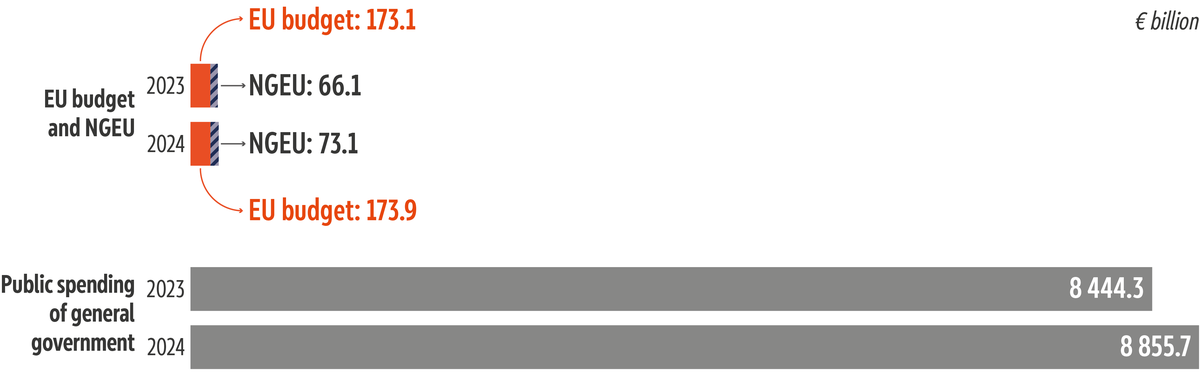
European Commission, EU spending and revenue 2021-2027, and Eurostat; graphic by Lucille Killmayer, EPRS, 2026.
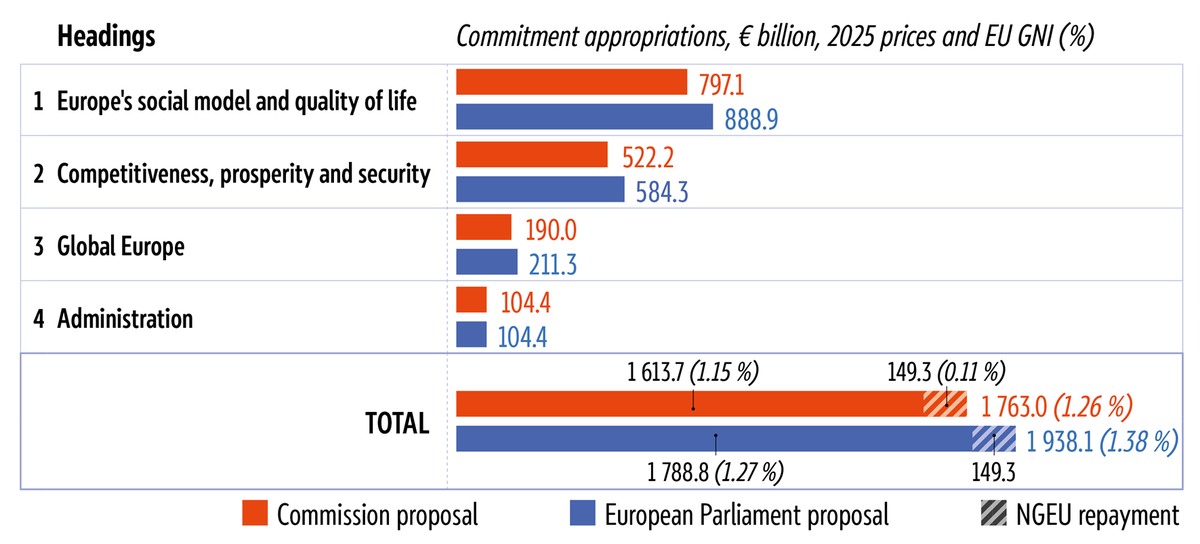
European Parliament interim report, April 2026; graphic by Lucille Killmayer, EPRS, 2026.
Read the full Budgetary Outlook 2026, published by EPRS.
Classification
Policy areas: Budget | Budgetary Control
Committees: Budgets (BUDG), Budgetary Control (CONT)
Statement on the use of AI
Any AI-generated content in this text has been reviewed by the author(s).
Disclaimer
This document is prepared for, and addressed to, the Members and staff of the European Parliament as background material to assist them in their parliamentary work. The content of the document is the sole responsibility of its author(s) and any opinions expressed herein should not be taken to represent an official position of the Parliament.
Copyright
© European Union.
The reuse of this document is authorised under a Creative Commons Attribution 4.0 International (CC-BY 4.0) licence.

https://creativecommons.org/licenses/by/4.0/deed.en
To use or reproduce elements that are not owned by the European Union, permission may need to be sought directly from the respective rightsholders.