
Article page checkbox is not checked in page info.
Threats from new and emerging plant pests - Options for EU management of pest outbreaks
Threats from new and emerging plant pests Options for EU management of pest outbreaks
Scientific Foresight Unit (STOA)
Summary
Plant pests are organisms capable of causing harm to plants or plant products. New and emerging plant pests pose an increasing risk to agriculture, food security, the economy, and the environment in the European Union. Driven by intensifying global trade and tourism, climate change, and changing agricultural systems, pest introduction and spread are accelerating, challenging existing plant health frameworks, and requiring more anticipatory and systemic responses. To anticipate these risks, policymakers need to understand long term pathways and system vulnerabilities that current regulatory tools cannot fully address alone.
Plant pests and outbreaks in the EU today
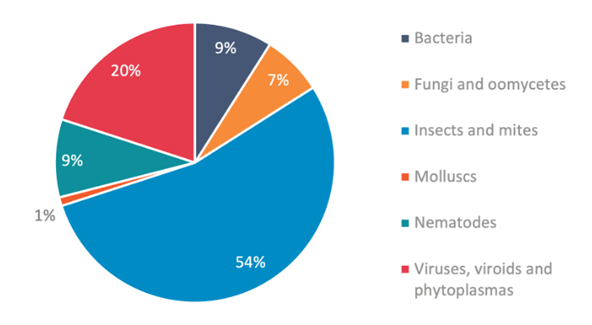
Plant pests are defined in international standards as 'species, strain or biotype of plant, animal or pathogenic agent injurious to plants or plant products'.1 They include a broad biological range of organisms as plant quarantine pests, including phytopathogenic microorganisms such as bacteria, fungi and oomycetes, viruses, viroids and phytoplasmas; as well as invertebrate animals such as phytophagous insects and mites, nematodes, and in limited cases, molluscs (see Figure 1).
Pathways by which plant pests are introduced and spread relate to the mechanisms through which they are introduced and spread across countries and territories. This occurs through both human-mediated and natural pathways. Human activities such as trade, tourism, e-commerce and transport have accelerated the rate, distance, and unpredictability of such pest introductions. Natural spreading mechanisms, such as movements of insects and weather-driven dispersal also play a significant role. These can interact with changing environmental conditions to expand pest ranges. Factors such as land-use changes, shifts in host availability, and climate-driven range expansion can facilitate the establishment of pests.
EU plant health governance
The EU Plant Health Law (Regulation (EU) 2016/2031) establishes the EU's legal framework for addressing plant pests through controls on plants and related products and include import rules, pest surveillance, and traceability measures. The EU Plant Health Law defines the different pest categories and the associated legal obligations. It sets out Member States' responsibilities for surveillance and notification and determines when eradication, containment and emergency measures are required.
The EU system operates within an international framework. The International Plant Protection Convention (IPPC) establishes standards for phytosanitary certification, pest risk analysis and quarantine pest determination, surveillance and pest reporting through its International Standards for Phytosanitary Measures (ISPMs). The standards inform EU methodologies and technical approaches and are formally recognised under the Agreement on the Application of Sanitary and Phytosanitary Measures of the World Trade Organization (WTO). The European Commission's Directorate-General for Health and Food Safety (DG SANTE) oversees implementation within the EU. The Standing Committee on Plants, Animals, Food and Feed (PAFF Committee) delivers opinions to inform the Commission's work.
As an intergovernmental body, the European and Mediterranean Plant Protection Organization (EPPO) provides strategy for the prevention and spread of harmful organisms in its territory and develops standards through expert working groups and with European institutions. The Environmental Food Safety Agency (EFSA) scientific risk assessments provide the evidence base for EU decisions and it provides scientific and technical expertise to the Commission to support identification and assessment of priority pests. The Joint Research Council (JRC) develops pest management tools and conducts research on pest biology. EU reference laboratories develop and validate diagnostic methods, provide advice to the Commission, and support the national reference laboratories (NRLs) to ensure consistent testing quality. The Community Plant Variety Office (CPVO) ensures plant variety testing material used in variety protection procedures meets phytosanitary requirements. National plant protection organisations (NPPOs) implement plant health legislation, conduct surveillance, and report findings to the Commission and EFSA (Figure 2).
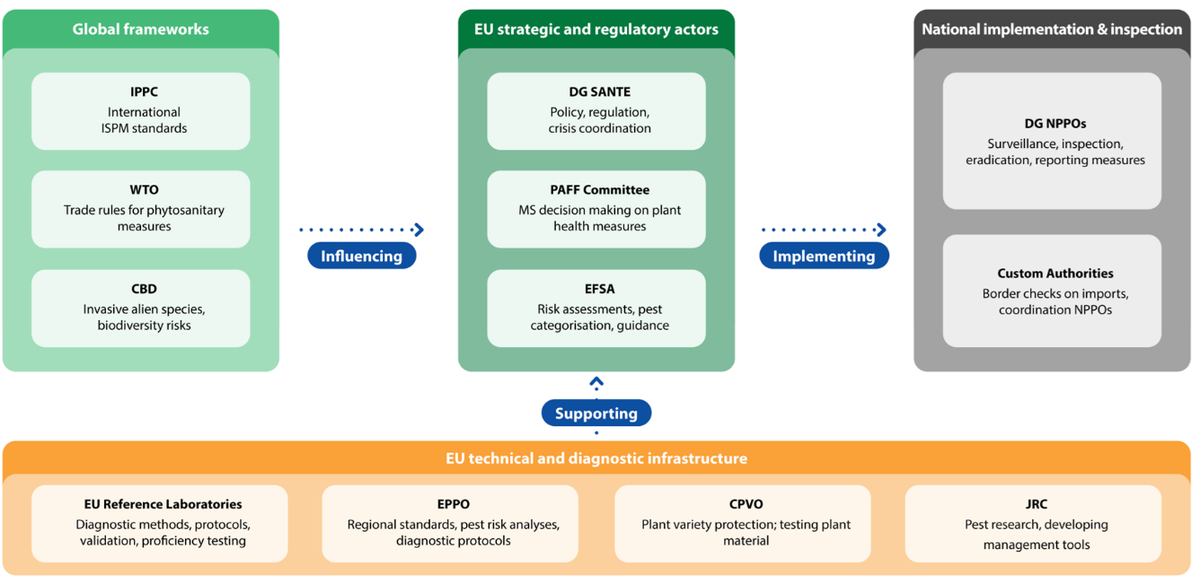
Source: Technopolis, in Threats from new and emerging plant pests, EPRS, 2026.
Future trends influencing plant pests in the EU
As we look towards 2050, pest introduction and spread may accelerate, challenging existing plant health frameworks and requiring more anticipatory and systemic responses. Different medium- to long-term trends influence existing pathways for the appearance and spread of new and emerging plant pests. While underlying pathways are well documented, their relevance and intensity are strongly modified by broader trends. Climate change, globalisation, agricultural development, technology funding and regulations are identified as both highly impactful and uncertain trends. Understanding them is critical to envisaging how pest risks materialise and how to manage them effectively.
Policy options for 2050
Four potential policy options are proposed to improve responses to the key challenges and risks associated with the entry and spread of new and emerging pests in the EU (see Figure 5). These policy options were developed through an analysis of four plausible scenarios for 2050 that were created from two highly uncertain and impactful trends: the increase in trade barriers and the decrease in environmental sustainability. All four policy options are considered relevant in all scenarios, suggesting more specific policy interventions to address future risks (see Figure 3).
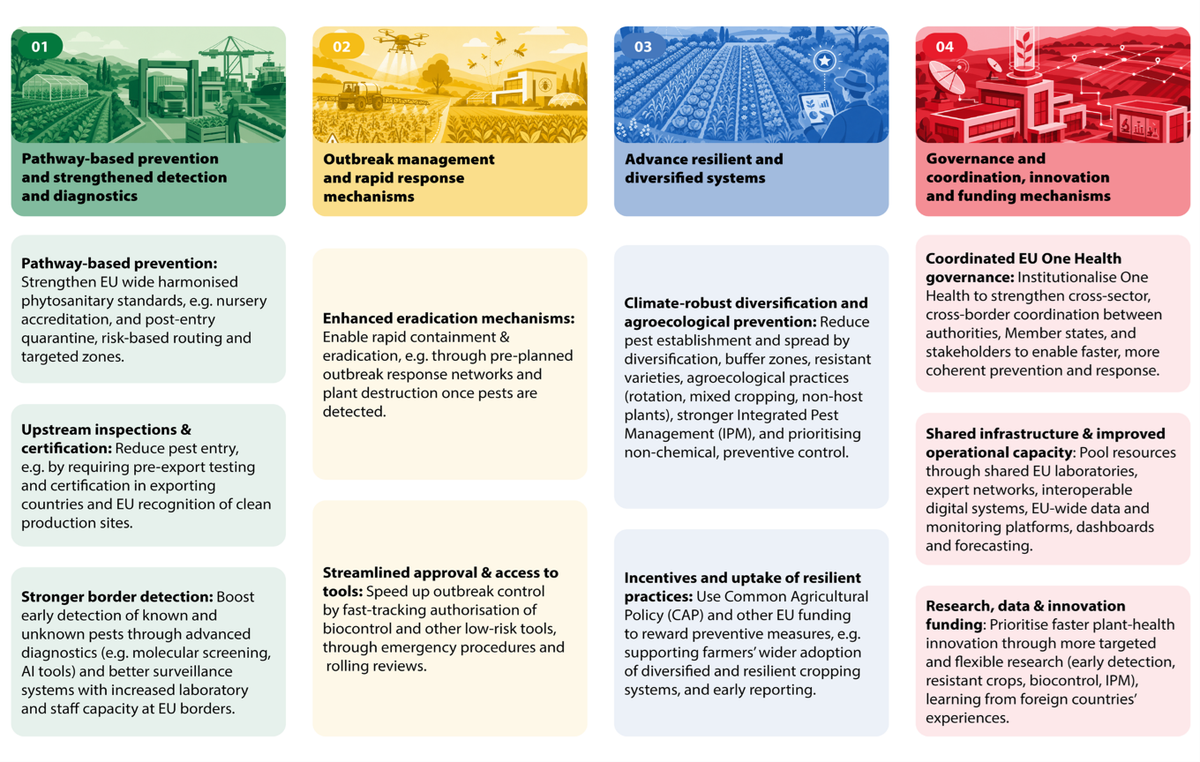
Source: Technopolis, in Threats from new and emerging plant pests, EPRS, 2026
Conclusions
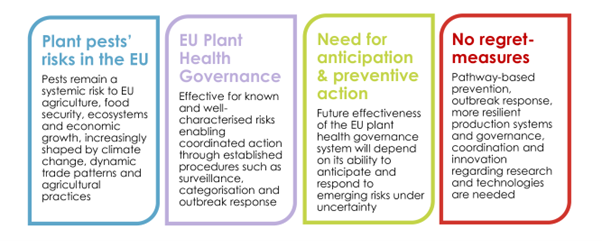
The EU plant health framework, centred on the Plant Health Law, provides a strong basis for managing known risks. Its system works well for already known pests, enabling coordinated surveillance, categorisation, and outbreak response. In practice, it is most effective after pest detection, supported by clear procedures and tools. However, the future effectiveness of the EU plant health governance system will depend on its ability to anticipate and respond to emerging risks under uncertainties – especially when risks arise through new pathways (for example, changing trade patterns), or where pests exploit new host plants or acquire increased viability and virulence under changing climate conditions. Complementing the existing list-based regime with a stronger pathway- and risk-based approach and making use of innovative technologies can help strengthen anticipation capacity, improve system resilience and better prepare the EU for unknown or fast-evolving risks from plant pests.
Source: Technopolis, in Threats from new and emerging plant pests, EPRS, 2026
Endnotes
Classification
Policy areas: Environment | Food Safety | Public Health | Agriculture and Rural Development
Statement on the use of AI
This note was written based on 'Threats from new and emerging plant pests', prepared for EPRS and developed with support from AI-assisted tools, including ChatGPT (GPT-5.1 and GPT-5.1) and Microsoft Copilot. These tools were used to support specific tasks such as summarising descriptions, paraphrasing literature, assisting with drafting, developing glossaries, translating, and copy editing. Any AI-assisted summaries, paraphrases, translations, or drafted text were critically reviewed by the authors, checked against the original sources where applicable, and revised as necessary. All analytical content, interpretations, conclusions, and policy options were produced, reviewed, verified, and validated exclusively by the authors.
Disclaimer
This document is prepared for, and addressed to, the Members and staff of the European Parliament as background material to assist them in their parliamentary work. The content of the document is the sole responsibility of its author(s) and any opinions expressed herein should not be taken to represent an official position of the Parliament.
Copyright
© European Union.
The reuse of this document is authorised under a Creative Commons Attribution 4.0 International (CC-BY 4.0) licence.

https://creativecommons.org/licenses/by/4.0/deed.en
To use or reproduce elements that are not owned by the European Union, permission may need to be sought directly from the respective rightsholders.