
Article page checkbox is not checked in page info.
Mental health of young people in a digital era: Cost of non-Europe report
Mental health of young people in a digital era Main findings from a Cost of non-Europe report
Claudia Koreimann-Özkan and Filippo Sinicato, European Added Value Unit

Summary
With steadily rising mental health issues among European youth, coordinated action across the health, education, labour and social affairs sectors is paramount. If not addressed, mental health issues can affect the education, professional career and relationships of young individuals profoundly. Within its competencies, the EU can support Member States through a mix of preventive, regulatory and coordination actions. A study, requested by the European Parliament's Committee on Public Health, identifies six policy options and their potential EU added value, set out in this briefing.
Why worry? Youth mental health in the EU
Youth mental ill-health in the EU is rising, with anxiety and depression particularly prevalent during vulnerable developmental stages. Since 2000, mental health conditions among children and adolescents have increased. Today, one in five young people have a diagnosable disorder, and many more face sub-clinical distress. Nearly half of those aged 15–24 report unmet needs due to fragmented, under-resourced systems. The burden is uneven, particularly affecting girls, young women, and vulnerable groups (e.g., disadvantaged youth, migrants, LGBTQIA+ individuals, and those in care). Drivers include offline factors (poverty, family conflict, discrimination, trauma) and online risks (excessive use, harmful content, cyberbullying, harmful AI interactions). Long waiting times, high costs, and a 'missing middle' leave many without timely help, risking worsening conditions. These issues disrupt education, social development, and future employment prospects, causing long-term human capital losses.
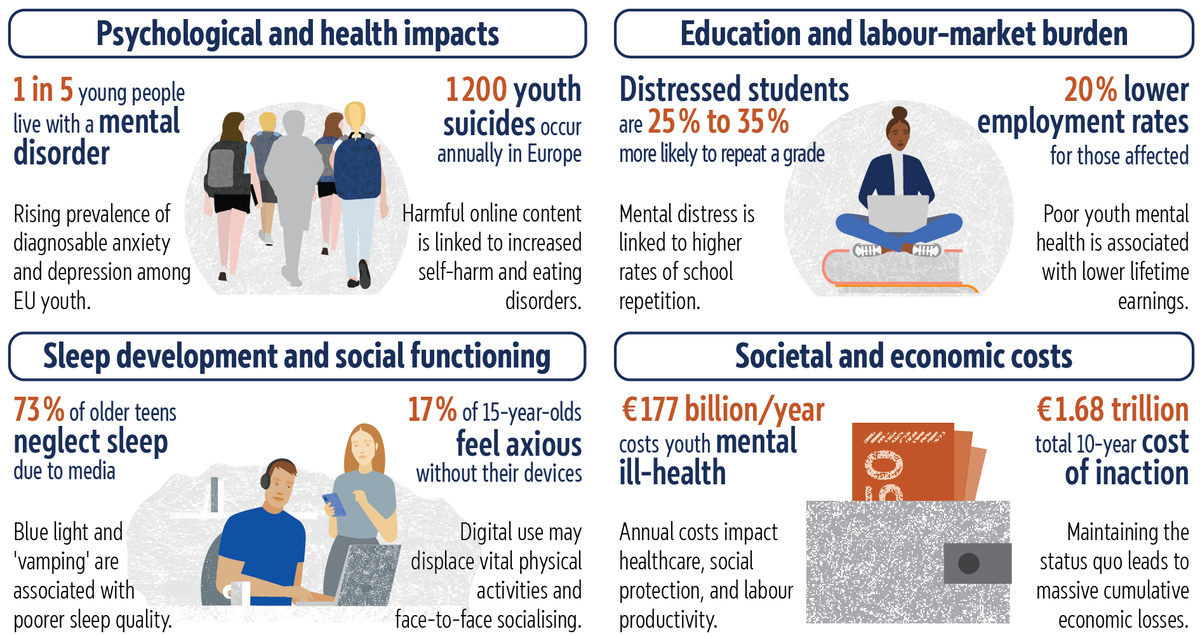
Source: taken from study on Mental health of young people in a digital era, EPRS, 2026. Graphic by Nadejda Kresnichka-Nikolchova, EPRS.
How could EU action be beneficial and why?
Youth mental ill‑health is, apart from the toll on the individual and families, a major macro‑economic issue. The study estimates that youth mental ill-health currently costs the EU-27 around €177 billion per year. The 10‑year cost of inaction is around €1.68 trillion from 2024 to 2033 in 2024 present value across healthcare, social protection, education and lost productivity. The costs rise steadily over the decade, even as the youth population shrinks. Anxiety accounts for the largest share, reflecting its high and rising prevalence.
Which EU measures could be particularly beneficial and why?
The study identifies six complementary policy options that have clear potential to reduce the health, social and economic burden associated with youth mental ill-health. A mix of early intervention programmes, which build socio-emotional skills and mental health literacy, along with community-based pathways under the vigilant scrutiny and support of the EU, were found to be the strongest determinants of EU added value across the thematic areas.
Option 1 - School-based mental health promotion and digital wellbeing: Preventive, school‑based programmes have the strongest evidence for improving youth mental health. EU action could scale up existing models (e.g. MindOut and Zippy's Friends) to promote healthy digital behaviours and reduce risks among students.
Option 2 - Framework for youth friendly early intervention services: Community youth hubs like headspace or Jigsaw offer accessible, low‑threshold support for mild to moderate difficulties. EU support could help fill in the 'missing middle' by encouraging similar hubs across Member States.
Option 3 – Social prescribing and community-based pathways for vulnerable youth: Non-clinical, community-based pathways could support vulnerable young people beyond schools and clinics. Building on initiatives like Barnardo's LINK or C.O.P.E., EU strategies could reduce isolation and improve mental health for NEETs, migrants, refugees and LGBTQIA+ youth.
Option 4 – Quality and safety framework for digital mental health tools and online support: EU‑level standards for quality, safety, data protection and transparency would improve trust in digital mental health tools. A 'trusted library' of vetted apps could guide schools, practitioners and young people towards safe and effective digital support.
Option 5 – Child-centred implementation and possible strengthening of EU digital regulation: A child‑centred approach could clarify systemic risk obligations and ensure EU digital laws address design‑driven overuse, harmful content and AI interactions. Evidence‑based guidance and co‑regulatory tools could strengthen enforcement, including age‑assurance and national implementation.
Option 6 – Data, monitoring, and governance for youth mental health in a digital era: Stronger EU‑level data and coordination systems are needed to track youth mental health trends and guide policy. Building on the European Health Data Space and OECD Programme for International Student Assessment (PISA), the EU could harmonise indicators and reinforce evidence‑based action.
Read the full study in PDF format, on the Think Tank website.