
Article page checkbox is not checked in page info.
Cadmium contamination in the EU: A growing challenge
Cadmium contamination in the EU: A growing challenge
Camille Siefridt, Members' Research Service
Summary
2026 data confirm chronic EU-wide overexposure to cadmium, a toxic heavy metal causing irreversible kidney and bone damage. In the EU, phosphate fertilisers are the primary source of contamination, and contribute 55 % of the cadmium added to EU farmlands annually, causing the toxic heavy metal to accumulate in 45 % of agricultural soils faster than it can be removed. Current regulations are fragmented and scientifically insufficient, yet the European Commission's May 2026 fertiliser action plan missed the chance to set stricter targets. The upcoming review of the Fertilising Products Regulation represents an opportunity for setting safer and binding cadmium limits.
Background
In 2009, the European Food Safety Authority (EFSA) estimated an average lifetime dietary e xposure of 2.04 µg/kg body weight (bw)/week for EU citizens, close to the tolerable weekly intake (TWI) of 2.5 µg/kg bw/week. Children can substantially exceed it, with toddlers reaching 4.85 µg/kg bw/week on average. Underscoring this concern, a February 2026 report published by the French Agency for Food, Environmental and Occupational Health and Safety (ANSES) on actions to reduce the French population's exposure to cadmium concluded that EU maximum levels for cadmium in food 'are not sufficiently protective of consumer health' (e.g. p. 32).
This issue is particularly evident in France. In early 2026, ANSES published its opinion on France's third total diet study (TDS3), which analysed 276 foods representing 90 % of the French diet. While mean cadmium concentrations in food showed a slight decrease compared to TDS2, overall exposure levels remain excessive: in France, 2 3 % to 27 % of children aged 3 to 17 still exceed the tolerable weekly intake (see Box 1).
Box 1 – What is cadmium?
Origin: Cadmium (Cd) is a heavy metal occurring naturally in the Earth's crust. The difference in cadmium content between raw source rocks and processed fertilisers primarily comes down to the geological origin of the rock. Volcanic/igneous rocks generally contain very low levels of Cd (typically <5 mg/kg), whereas sedimentary deposits – which make up 85 % to 90 % of global production – are highly enriched and contain between 1 and 150 mg/kg. Chemical processing fails to remove cadmium from phosphate rock. Because of how the minerals bond, 60 % to 80 % of raw rock's cadmium directly enters the final commercial fertiliser.
Intrinsic toxic properties: Cadmium is classified as a group 1 carcinogen by the International Agency for Research on Cancer (IARC) and a carcinogen 1B under EU law. It also accumulates in the body over decades and primarily damages the kidneys and bones.
Tolerable intake: In 2009, EFSA set a tolerable weekly intake of 2.5 µg per kg body weight, noting that mean adult dietary exposure in the EU is already close to or slightly above this level, and that some groups (children, vegetarians, smokers, people in highly contaminated areas) can reach twice the tolerable weekly intake (TWI).
Main sources of exposure: For non‑smokers, food is the main exposure route to cadmium (see Figure 1); the largest contributions come from cereals and cereal products, vegetables, nuts and pulses, starchy roots and potatoes, and meat and meat products, while smoking can provide a similar dose to that from diet.
Main sources of contamination: Cadmium in the food chain mainly reflects environmental contamination of agricultural soils, whereby cadmium from natural deposits and human activities (especially inorganic phosphate fertilisers, but also industrial emissions) is taken up by crops and enters the human diet.
Bioavailability of cadmium: This refers to the fraction of cadmium that plants can actually absorb. Soil pH is the deciding factor: when soil pH drops from 6.5 to 5.5, cadmium becomes 100 times more mobile. This means acidic soils allow crops to absorb existing cadmium reserves much more easily. This risk is compounded by ammonium-based nitrogen fertilisers, which progressively acidify agricultural soils over time – a critical link currently ignored by EU legislation. Because cadmium accumulates, continuing to use contaminated fertilisers only builds up this historical stock, worsening a long-term threat and increasing the costs of soil remediation.
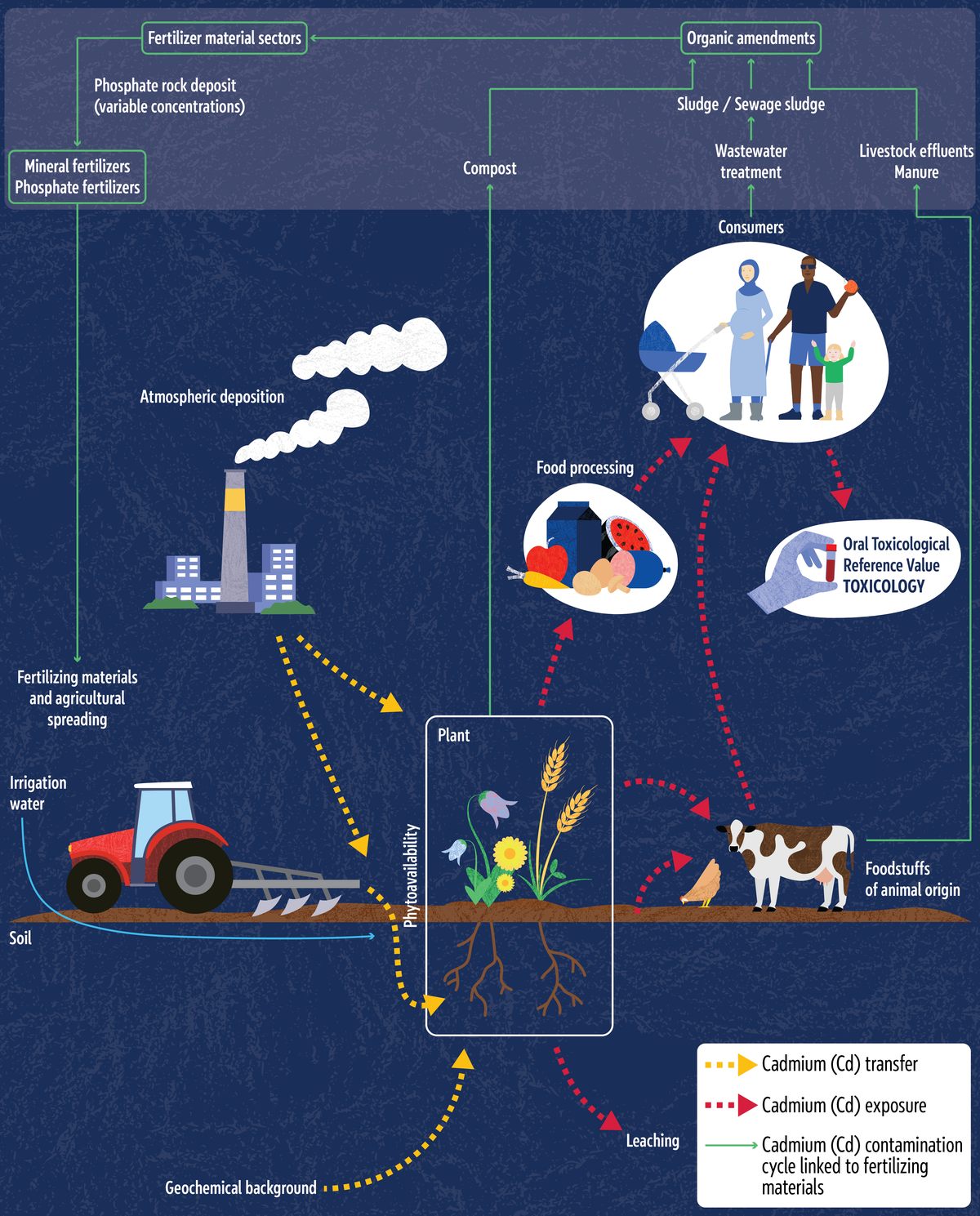
Source: based on ANSES opinion on cadmium exposure, 2015. Graphic by Lucille Killmayer, 2026
Furthermore, the Esteban study (a health study on environment, biomonitoring, physical activity and nutrition) conducted between 2014 and 2016 by the French National Public Health Agency revealed that 47.6 % of the French population aged 18 to 60 years exceeded the critical concentration threshold for cadmium in urine. This research highlighted that French population exposure levels to cadmium are up to three to four times higher than those observed in North American and other EU countries.
The root of this systemic contamination lies in the food supply chain, which represents up to 98 % of cadmium exposure among non-smokers. EU-wide soil data show that cadmium is continuously accumulating in agricultural land; the European Environment Agency (EEA) estimates that 45 % of the EU agricultural area had a net cadmium accumulation in 2017, a share that increased slightly between 2010 and 2017.
Issues at stake
-
Chronic overexposure across the EU: Dietary cadmium exposure for EU adults is already close to or slightly above EFSA's tolerable weekly intake (2.5 µg/kg body weight), and for toddlers it reaches almost twice this in many Member States.
-
Progressive, irreversible health damage at current exposure levels: Evidence shows kidney, bone and potentially cardiovascular effects at current tolerable weekly intake, meaning clinically relevant harm can occur at or near current EU guidance levels. Furthermore, cadmium is eliminated from the human body extremely slowly, with a biological half-life of 10 to 30 years. This means that damage accumulates silently over decades and, once the critical renal threshold is crossed, cannot be reversed by reducing exposure.
-
Long‑term soil accumulation driven by fertilisers: Around 45 % of EU agricultural land experiences net cadmium accumulation, with phosphate fertilisers providing about half the input and 19 % of soil samples already exceeding national threshold values.
-
A fragmented regulatory framework: The EU fertiliser limit of 60 mg Cd/kg P₂O₅ is optional (only for CE‑marked products), and some Member States still allow higher levels (e.g. France at 90 mg/kg). There is no binding EU target for cadmium in agricultural soils, and ANSES deems EU maximum levels for cadmium in food insufficiently protective.
EU-wide issue
French population exposure and contamination to cadmium from food is significant, but this is also an EU-wide issue. EU data on soil contamination (see Figure 2) and population exposure (see Table 1) show that cadmium soil contamination is a structural EU problem in some regions.
EU soil contamination: widespread accumulation
The JRC LUCAS topsoil survey (2024) of 21 682 EU soil samples and the JRC analysis for the review of the Fertiliser Directive reveal that:
-
25 % of samples are close to or above the 1 mg/kg⁻¹ threshold, which is generally considered the limit for risk assessment, with these dangerous excesses being particularly notable in Ireland and Poland;
-
regions with some of the highest mean cadmium concentration are found in Ireland, Germany, Spain, Poland and Slovenia;
-
natural factors like soil properties (pH, clay and organic matter), topography, soil erosion and leaching influence cadmium levels. However, human activities have significantly impacted these soils, with cadmium inputs increasing by 50 % during the 20th century due to sewage sludge spreading, waste dumping, mining and industrial emissions, such as those from zinc smelters;
-
the most important anthropogenic factor driving cadmium levels in agricultural land is the use of phosphate fertilisers.
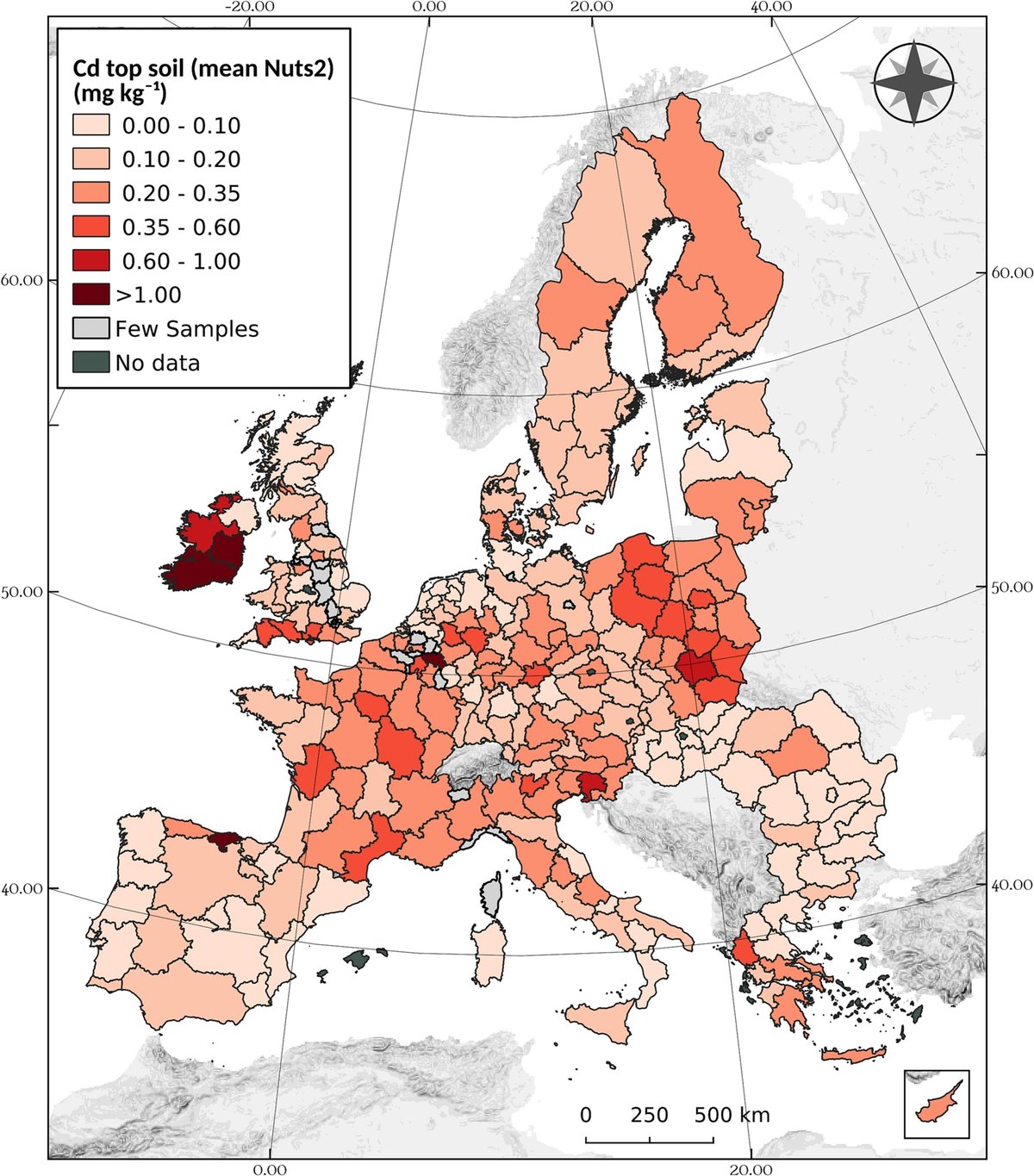
Source: Joint Research Centre (JRC), European Soil Data Centre (ESDAC), Cadmium in topsoils.
EU population exposure already close to the safety limit
EFSA's dietary exposure assessment for cadmium is presented in Table 1.
| EU population group | Mean dietary exposure (µg/kg bw/week) | P95 exposure (µg/kg bw/week) – 95 % of individuals studied are exposed to levels at or below this specific value | EFSA tolerable weekly intake (TWI) (µg/kg bw/week) |
|---|---|---|---|
| Infants (<1 year) | 2.74 | 6.56 | 2.5 |
| Toddlers (1‑3 years) | 4.85 | 8.19 | 2.5 |
| Children (3‑10 years) | 3.96 | 6.58 | 2.5 |
| Adolescents (10‑18 years) | 2.20 | 4.17 | 2.5 |
| Adults (18‑65 years) | 1.70 | 3.09 | 2.5 |
| Elderly (65‑75 years) | 1.56 | 2.82 | 2.5 |
| Very elderly (>75 years) | 1.63 | 2.87 | 2.5 |
| Adjusted average for the whole life | 2.04 | 3.66 | 2.5 |
Data source: EFSA, Cadmium dietary exposure in the European population, 2012.
Key findings
-
The mean EU adult exposure (2.04 µg/kg bw/week) is already 82 % of the TWI of 2.5 µg/kg bw/week. It exceeds this for toddlers, children and adolescents.
-
For toddlers, mean exposure is nearly twice the TWI at EU level (similar to the situation in France).
-
EFSA flagged in 2022 that new scientific evidence on bone mineral density loss and cardiovascular effects at lower exposure levels may justify lowering the TWI, which would mean even more EU citizens are above safe levels.
The main dietary vectors are identical across the EU: cereals and grain products (26.9 %), vegetables (16.0 %) and starchy roots/potatoes (13.2 %).
Geopolitical challenges
The cadmium problem cannot be solved simply by switching to lower-cadmium phosphate sources, because these sources may come with acute geopolitical risk (see Table 2). This is the structural dilemma which the Commission's fertiliser action plan fails to resolve.
The challenge is that phosphate sources with the lowest cadmium content, primarily Russian igneous deposits, are those on which the EU is trying to become less dependent following the launch of Russia's war of aggression against Ukraine. However, EU imports of Russian phosphate rock increased 28 % in the first quarter of 2026 compared with the first quarter of 2025, reaching their highest level since the war began.
| Phosphate source | Cadmium content in rock | EU import share | Challenges |
|---|---|---|---|
| Russia | Low (igneous deposits) | First partner in Q1 2026, €53.8 million | Ukraine war, sanctions |
| Morocco | High (sedimentary deposits) | Second partner in Q1 2026, €47.7 million | |
| Egypt | Medium-high | Third partner in Q1 2026, €11.6 million | |
| Finland | Low | <10 % of EU demand | Limited production capacity |
| West Africa (Senegal, Togo) | Variable, around 60 mg Cd/kg P₂O₅. | Emerging | Current infrastructure constraints |
Data source: Ragnsells, EU Phosphorus Index: Q1 2026; EU SCRREEN2 project, Phosphate rock and phosphorus; FARM foundation, West African phosphates: developing production and anticipating health risks.
EU regulatory framework
Regulation (EU) 2019/1009 on fertilising products sets a harmonised ceiling of 60 mg Cd/kg P₂O₅ for CE‑marked fertilisers, with a voluntary green label of under 20 mg/kg. There are three main challenges:
-
the limit is three times higher than the scientific recommendation;
-
the ceiling rule is optional (applies only to products seeking CE (European conformity) marking, not to nationally regulated products);
-
several Member States have adopted stricter cadmium limits than the EU ceiling – including Denmark, Finland, Hungary, Slovakia and Sweden – while others, such as France (90 mg/kg), remain more permissive, fragmenting the internal market (see Figure 3).
Regulation (EU) 2023/915 on food contaminants sets maximum cadmium levels in food, with successive reductions in 2021‑2024. ANSES concludes that these levels 'are not sufficiently protective'. The German Federal Institute for Risk Assessment (BfR) and the Swedish Food Agency also call for a reassessment of the current cadmium tolerable weekly intake, used to set maximum cadmium levels in food.
Directive (EU) 2025/2360, the Soil Monitoring Directive adopted in 2025, is the first EU law on soil health, and requires registration of contaminated sites by 2035. However, it does not set binding target values for cadmium in agricultural soils.
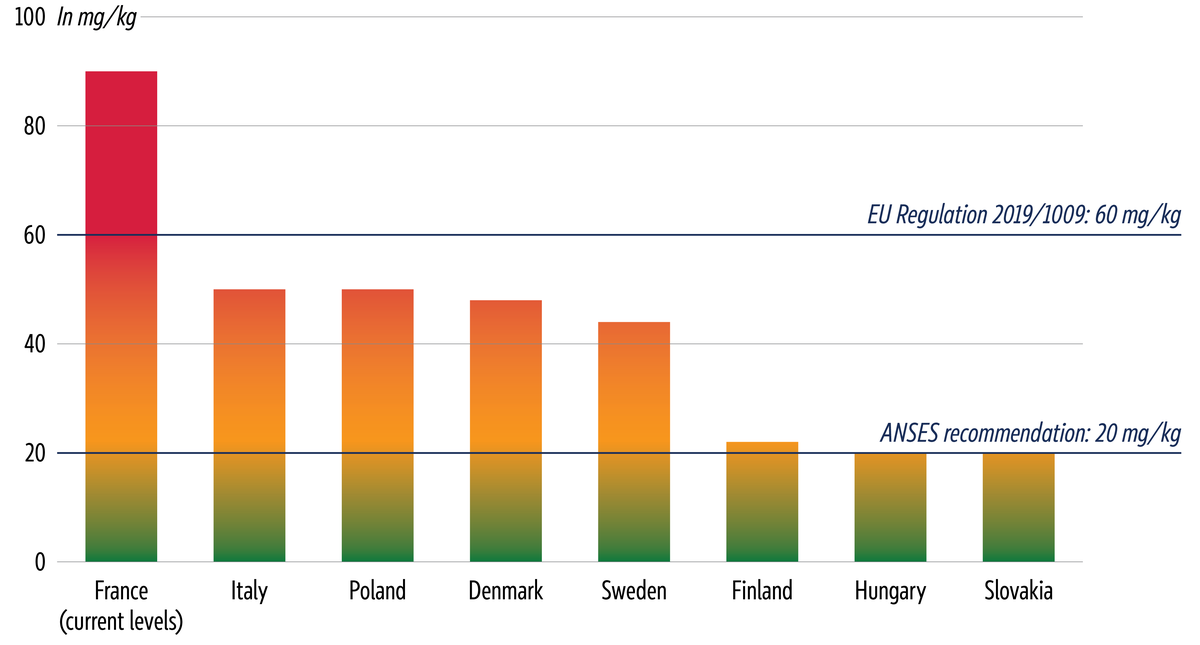
Source: Compiled by the author, 2026. Graphic by Lucille Killmayer, 2026.
Commission's 2026 fertiliser action plan: A missed opportunity to address cadmium challenges
The Commission's fertiliser action plan, adopted on 19 May 2026, aims to respond to the fertiliser price crisis triggered by Middle Eastern instability and the EU's structural import dependence (Russia and Morocco). It sets three objectives: short-term availability and affordability, medium-term strategic autonomy and supply chain transparency. On cadmium, the plan contains a single operational sentence (section 4.2.2, 'Circularity, market integration and decarbonisation'):
'For phosphate fertilisers, the Commission's evaluation of Regulation (EU) 2019/1009 will include a review of the cadmium limit values set out in the Regulation. This review will consider the feasibility of reducing these limit values to a lower appropriate level, taking into account available technologies and scientific evidence regarding health and environmental impacts, as well as the availability and affordability of fertilisers and security of supply.'
The Commission's fertiliser action plan contains several measures with potential indirect effects on cadmium loads in EU soils. First, the plan sets out work on phosphate supply diversification, committing the Commission to assess vulnerabilities in the EU's phosphate supply; if diversification is steered explicitly towards low‑cadmium sources, this could lower cadmium inputs from mineral fertilisers. Second, it aims to boost bio‑based and circular fertilisers, such as digestate and recovered nutrients, which generally have lower or better controlled cadmium concentrations than many imported phosphate rocks. Third, strengthening the role of the EU Fertilising Products Regulation and market uptake of CE‑marked products could facilitate a move towards full harmonisation for inorganic fertilisers, creating the legal basis for a future, EU‑wide low cadmium limit applicable across the whole internal market, rather than only to CE‑marked products.
Box 2 – Five missed opportunities on cadmium in the Commission's fertiliser action plan
-
No target. The plan does not commit to a lower target level (40 or 20 mg/kg P₂O₅). It only says a review is planned as part of the evaluation of Regulation 2019/1009 – whose deadline was fixed at 16 July 2026 by the regulation itself.
-
Public health balanced with supply security. The wording 'taking into account ... the availability and affordability of fertilisers and security of supply' signals that limits may not be lowered to the scientifically recommended level.
-
Optional harmonisation maintained. The plan envisages 'assessing the feasibility of a fully integrated Single Market for inorganic fertilisers'. As long as harmonisation remains optional, Member States can maintain limits above the health-based recommendation.
-
No link between nitrogen management and cadmium bioavailability. The plan addresses nitrogen efficiency and the Nitrates Directive but makes no connection to soil acidification or its effect on cadmium mobility.
Outlook for the European Parliament
The upcoming review of Regulation (EU) 2019/1009 on fertilising products, initially scheduled for 16 July 2026, remains the immediate window of legislative opportunity, as identified in the Commission's fertiliser action plan (see Box 3 for experts' recommendations). If a revision is proposed, co-legislators would be able to influence three key parameters relevant for cadmium: the threshold level (expressed in P₂O₅ mg/kg), its binding or optional nature, and the implementation timeline.
Box 3 – Pathways for possible actions
ANSES recommends the following in its latest report on cadmium:
-
lowering the cadmium threshold in fertilisers to 20 mg/kg P₂O₅;
-
lowering the maximum healthy levels of cadmium in foods, currently deemed insufficiently protective, especially for breakfast cereals, pasta, rice and potatoes;
-
adjusting fertiliser use;
-
removing cadmium (decadmiation) from fertilisers.
Implementing these scientific recommendations could involve levers such as:
-
mandating the EFSA reassessment announced in 2022 for the end of 2026, so that regulatory limits reflect current scientific evidence;
-
creating a direct regulatory link between nitrogen management (Nitrates Directive or its successor), soil pH and cadmium bioavailability;
-
integrating binding target values for cadmium in agricultural soils during the transposition of the Soil Monitoring Directive (2028‑2029 deadline);
-
recognising organic farming as a cadmium reduction lever in common agricultural policy (CAP) national strategic plans;
-
making EU support conditional on decadmiation technologies and diversification toward low-cadmium phosphate sources, with cadmium content an explicit criterion in Global Gateway supply partnerships;
-
regarding phosphate supply diversification, adding a maximum cadmium content criterion to EU trade and partnership agreements governing phosphate imports;
-
requiring labelling of cadmium content on all mineral phosphate fertilisers.
Classification
Policy areas: Environment | Industry
Regions: European Union
Committees: Environment, Climate and Food Safety (ENVI), Industry, Research and Energy (ITRE)
Statement on the use of AI
Any AI-generated content in this text has been reviewed by the author. GPT@EC was used to improve the readability of the text, enhance the alternative text for image readability and broaden the range of sources available to the author.
Disclaimer
This document is prepared for, and addressed to, the Members and staff of the European Parliament as background material to assist them in their parliamentary work. The content of the document is the sole responsibility of its author(s) and any opinions expressed herein should not be taken to represent an official position of the Parliament.
Copyright
© European Union.
The reuse of this document is authorised under a Creative Commons Attribution 4.0 International (CC-BY 4.0) licence.
https://creativecommons.org/licenses/by/4.0/deed.en
To use or reproduce elements that are not owned by the European Union, permission may need to be sought directly from the respective rightsholders.