
Article page checkbox is not checked in page info.
Clean energy in the recovery plans: Is the Recovery and Resilience Facility delivering?
Clean energy in the recovery plans Is the Recovery and Resilience Facility delivering?
Alessandro D'Alfonso, Members' Research Service
Summary
Recent crises have highlighted the importance of renewable energy sources and enhanced energy infrastructure for the European Union (EU) – both to meet its decarbonisation objectives and to enhance its energy security and sovereignty. Following the COVID-19 pandemic, the Recovery and Resilience Facility (RRF) has significantly boosted EU financial support available for investment and reform measures linked to clean energy.
Overall, 26 Member States are investing around €54.2 billion (9.4 % of the RRF envelope) in such measures, with significant allocations in the recovery plans of various countries (Poland, Italy, Spain, Greece and Hungary devoting the largest amounts in absolute figures). Almost evenly distributed between renewable energy (53 %) and networks (47 %), those resources finance a broad range of measures, not least in smart grids, solar energy and wind power.
However, the RRF has shown some limits in its capacity to support cross-border measures, with examples of such projects withdrawn from the plans because of delays. Equally important, the plans' reform component is aimed at improving the regulatory environment for clean energy, for example by streamlining permitting for renewables or improving access to grids.
As of 8 June 2026, progress in the implementation of clean energy investment was lagging behind that of the overall plans in terms of objectives assessed as achieved. With the final deadlines for RRF implementation approaching fast, the second half of 2026 is crucial to determine whether the RRF's estimated benefits in terms of enhanced energy infrastructure, deployment of renewables and emissions reductions can fully materialise. Many clean energy measures are delivered through financial instruments, which should lead to part of the RRF resources being invested on the ground after 2026 and leveraging further investment from other sources. Once the RRF comes to an end, analyses point to a possible public funding gap.
The European Parliament has identified energy as one of the priority areas for strategic EU investment in the post-2027 EU budget, calling for an increase in the relevant allocations.
Introduction
The deployment of renewable energy sources (RES) and the related modernisation of energy networks are key building blocks of the EU's strategy to promote economic competitiveness and reach carbon neutrality. Under the Renewable Energy Directive, the EU has to meet the binding target of having at least a 42.5 % share of renewables in its energy mix by 2030, up from 25.2 % in 2024. Member States have national energy and climate plans (NECPs) to deliver on the broader objectives of the energy union strategy, and the European Commission regularly publishes reports on the state of the energy union, monitoring relevant progress.
Highlighting the importance of harnessing the benefits of decarbonisation by making energy prices lower and less volatile for Europeans, the 2024 Draghi report recommended stepping up investment in the EU energy sector. The European Commission notes that energy systems require massive investment, with needs for power grid and generation alone estimated at €225 billion per year between 2031 and 2050. Through the clean energy investment strategy of 10 March 2026, the Commission aims to mobilise large-scale institutional private capital investment in the energy sector, based on the acknowledged need for additional private investment in the sector. Various analysts stress that renewables and electrification are essential both to meet climate objectives and to improve the EU's energy security that has suffered from various crises in recent years.
Launched by the European Union (EU) in 2021 to address the socioeconomic impact of the COVID-19 pandemic, the Recovery and Resilience Facility (RRF) has a strong focus on the green transition. Endowed with €577 billion, Member States' national recovery and resilience plans (NRRPs) have to devote at least 37 % of their resources to investment and reform measures contributing to climate action. In addition, the NRRPs must contribute to effectively addressing at least a significant subset of the challenges identified in the country-specific recommendations adopted in the context of the European Semester, including on energy, while ensuring consistency with other EU tools such as the NECPs. In the methodology for climate tracking under the RRF, 'Renewable energy and networks' is one of the policy areas that can contribute to achieving the 37 % compulsory green investment target through seven broad intervention fields: (i) wind energy; (ii) solar energy; (iii) biomass; (iv) marine energy; (v) other renewable energy, including geothermal; (vi) smart energy systems and related storage; and (vii) high efficiency co-generation, district heating and cooling. The first five intervention fields relate to renewable energy generation, while the latter two concern the upgrade of energy networks, including to integrate more renewables into the system and enhance security of supply.
Clean energy in the national recovery and resilience plans
In the initial versions of their NRRPs approved in 2021-2022, Member States had already earmarked significant support for clean-energy measures. Following Russia's war of aggression against Ukraine, the plans' dimension devoted to clean energy, including related infrastructure, has been further strengthened with the addition of dedicated REPowerEU chapters that aim to end the EU's dependency on Russian fossil fuels and accelerate the green transition, while strengthening energy security.
As for the other policy areas financed by the RRF, the NRRPs support clean energy and infrastructure objectives through a mix of reform and investment measures that are expected to reinforce each other mutually. Usually, reforms, which are not the focus of this briefing, seek to improve the regulatory framework and facilitate relevant investment, for example by streamlining permitting procedures for renewable energy-generation projects, improving access to grids, or enhancing the flexibility of the energy system.
Focusing on investments, the list of renewable-energy and network measures supported by the RRF has repeatedly changed over time, both because of the inclusion of the REPowerEU chapters since 2023 and because of all Member States having revised their plans – usually more than once – to adjust them to objective circumstances. For example, in line with Commission guidelines, the strict deadline for meeting RRF milestones and targets has led to the exclusion from the NRRPs of those measures that could not reasonably be completed by 31 August 2026. In other cases, delays have been addressed by changing the delivery mode through an increased resort to financial instruments that can continue operating after the 31 August 2026 deadline.
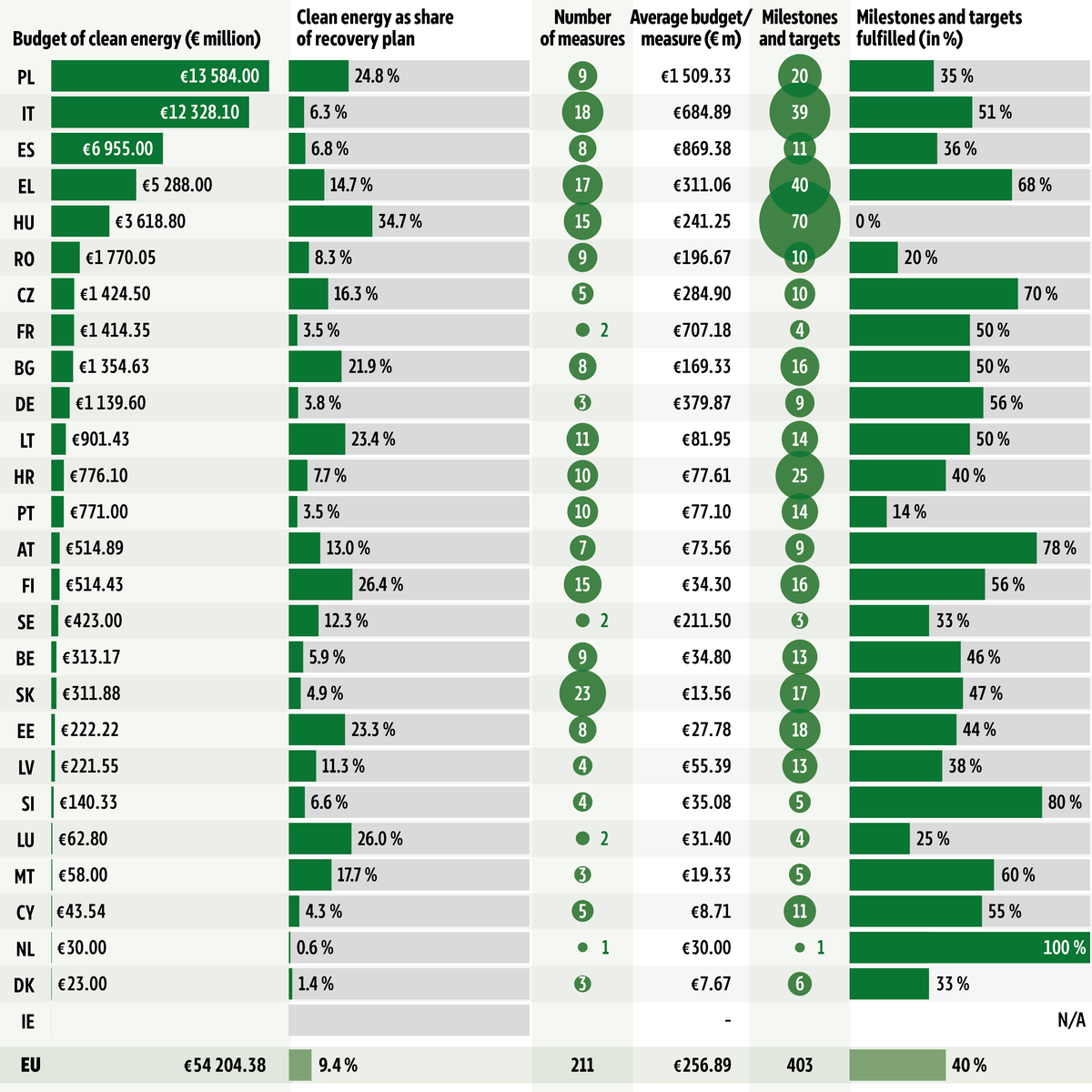
As of 8 June 2026, the climate tracking tables of the revised plans adopted by the Council included a total of 211 measures and sub-measures tagged as 'Renewable energy and networks'. Jointly endowed with resources worth €54.2 billion (9.4 % of the NRRPs' financial envelope), renewable-energy and network measures are associated with 403 milestones and targets through which progress in their implementation is checked (see Figure 1).1
Source: Author's own calculations based on European Commission data; graphic by Samy Chahri, EPRS.
All Member States but Ireland have included at least one measure focusing on clean energy and networks in their plans. Poland's plan stands out as having a strong focus on clean energy, since it devotes to the policy area the highest allocation in absolute figures (€13.58 billion) and the fourth largest as share of the national plan (24.8 %). Other Member States significantly investing in renewable energy and networks include Italy, Spain and Greece in absolute figures and Hungary, Finland and Luxembourg in terms of share of their NRRPs.
Progress in the implementation of renewable-energy and network measures appears slower than in other policy areas supported by the RRF, since the Commission had assessed 40 % of the milestones and targets associated with clean energy as achieved as of 8 June 2026, while that percentage stood at 58 % for the overall plans at the same date. The strong focus of the Hungarian plan on clean energy and its high number of milestones and targets linked to those measures has an impact on the relatively low percentage, since the Hungarian plan is the least advanced in implementation, and the new government's request for amendments – greenlighted by the Commission but yet to be approved by the Council – will significantly redesign the plan, including its clean-energy dimension. However, even when excluding Hungary's data, renewable-energy and network measures still lag behind the overall plans by nine percentage points in terms of milestones and targets assessed as achieved (49 % vs 58 %). One trigger of the delay may be associated with the fact that the energy-focused REPowerEU chapters have been added at a later stage, and Member States have therefore had less time available for the implementation and completion of those measures. For many clean-energy measures, the final implementing steps are planned for the plans' last payment requests (to be submitted by September 2026).
Source: Author's own calculations based on European Commission data; graphic by Samy Chahri, EPRS.
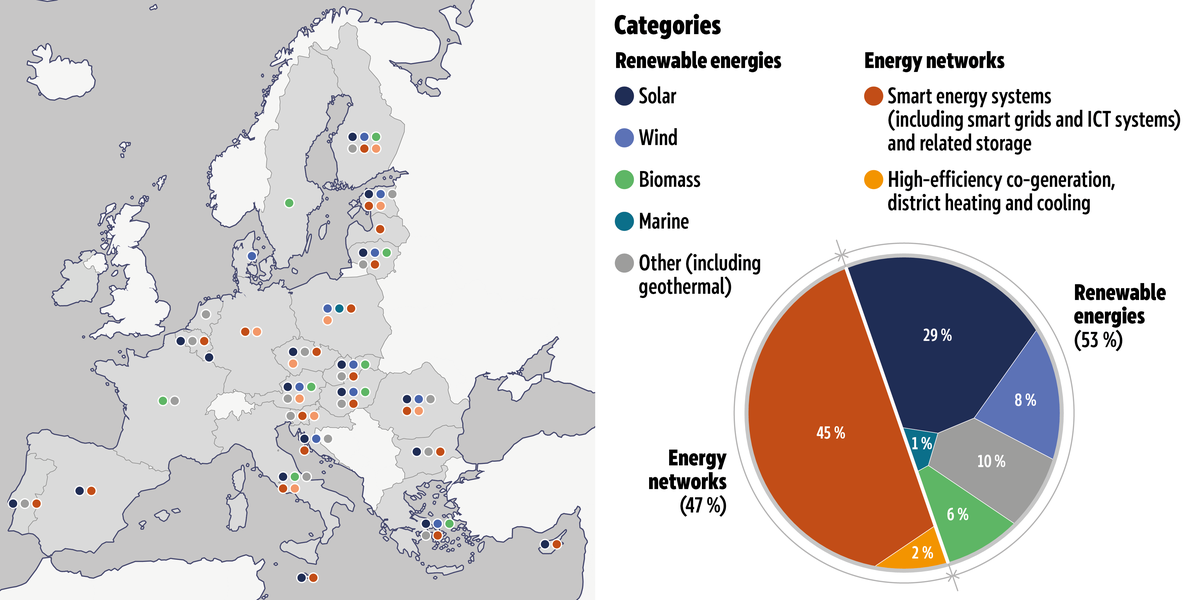
Analysing the breakdown of resources by intervention field (Figure 2), renewable energy obtains a slightly bigger share than energy networks (53 % vs 47 %); however, the gap between the two macro-categories has been significantly reduced as compared with the plans' initial versions (69 % vs 31 %). This trend suggests that the reinforcement of the plans' energy-network dimension has been proportionally stronger, which is in line with the Draghi report recommendation on reinforcing the EU focus on grids that are essential to unlock the potential of clean energy. The map shows that, with 20 Member States investing in at least one measure devoted to 'Smart energy systems and related storage', this is the intervention field with the broadest geographical coverage, followed by 'Solar energy' (financed by 18 Member States). Many Member States distribute their clean-energy resources across a high number of intervention fields, including Finland (six, i.e. all but 'Marine energy'); and Austria, Estonia, Greece, Italy, Lithuania, Romania and Slovakia (five each). At the other end of the spectrum, five Member States focus their clean energy resources on one intervention field only (Denmark, Latvia, Luxembourg, the Netherlands and Sweden).
Energy-network measures: How are the Member States doing?
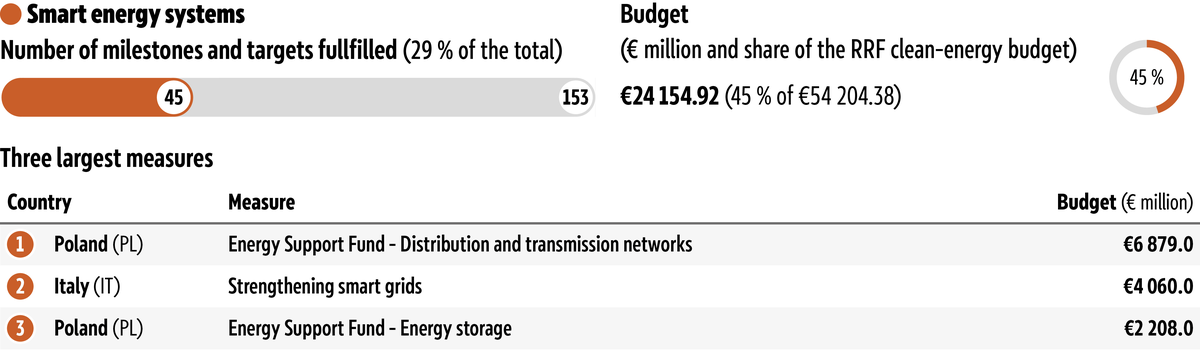
In addition to having the broadest geographical coverage (20 Member States), 'Smart energy systems (including smart grids and ICT systems) and related storage' (Figure 3) is the intervention field with the highest number of clean energy measures (31 % of the total), average budget per measure (€366 million) and, by far, the largest allocation of resources (€24.15 billion). Standing at 29 %, the share of milestones and targets assessed as fulfilled as of 8 June 2026 is below the policy area's already low percentage, suggesting that large infrastructure projects may require more time to complete and sometimes be at odds with the RRF's strict deadlines.
Source: Author's own calculations based on European Commission data; graphic by Samy Chahri, EPRS.
One of the few quantitative targets assessed as achieved thus far (12 %) is the 1 000-megawatt (MW) increase of the network capacity for renewable-energy distribution under Italy's 'Strengthening smart grids' measure, the second largest of the intervention field. The two measures from Poland's plan among the three largest of the intervention field consist of a public investment in a facility, the Energy Support Fund, to be managed by Bank Gospodarstwa Krajowego (BGK). The objective of that facility is to incentivise investment by providing loans to the private sector, as well as to public-sector entities engaged in similar activities, for investment in distribution and transmission networks, and energy storage. With this different delivery mode, the final steps of the Energy Support Fund are very different in nature from those of the Italian example, since to unlock relevant resources, Poland will have to prove in its final payment request that BGK has received €15 billion for the facility, and that it has entered into legal financing agreements with final beneficiaries for an amount necessary to use 100 % of the RRF investment into it. As a result, the actual investment on the ground can be carried out including after the final RRF deadline, and its impact materialise mainly after 2026. Examples of achievements planned under other measures in this intervention field relate to the installation of smart meters (Belgium); the reconstruction of sub-stations and replacement of electricity transformers on the high-voltage power-transmission system (Croatia); and the award of digitalisation projects to distribution companies (Spain).
The heterogeneity in the design of measures and their associated control steps shows that milestones and targets can give a flavour of results being achieved through the RRF, yet are not sufficient alone to assess the recovery plans' full impact. The European Court of Auditors (ECA) has made recommendations to improve comparability and assessment of impact in future EU performance-based instruments, and the Commission has proposed a new performance framework for the post-2027 EU budget.
As for infrastructure with a cross-border or transnational dimension, an example is provided by a measure in Latvia's plan; it concerns the commissioning of an energy storage system, with a view to increasing the security and stability of energy supply, while facilitating the synchronisation of the national electricity grid with the EU's electricity networks. However, a number of measures with a cross-border dimension have been removed during the NRRPs' revisions. For example, in November 2025, Cyprus removed the project of common interest 'EuroAsia Interconnector', which aimed to end energy isolation, because of unexpected delays in implementation. The same month, Italy decided to eliminate the cross-border electricity interconnection projects with Austria and Slovenia from its REPowerEU chapter due to objective circumstances.
From early on, the RRF has been criticised, including by the European Parliament, for supporting fewer cross-border projects than initially hoped for. Revisions of this kind appear to confirm that the RRF design was not optimal to finance such projects that have additional layers of complexity, requiring cross-border coordination and cooperation, since the national envelopes, the strict deadlines for meeting milestones and targets, and the risk of losing resources for factors partially in the remit of other implementing authorities may lead to favouring fully national projects. The European Parliament succeeded in introducing a 30 % funding target for cross-border projects in the REPowerEU chapters, yet is concerned by the broad interpretation adopted by the Commission for this target.
Source: Author's own calculations based on European Commission data; graphic by Samy Chahri, EPRS.
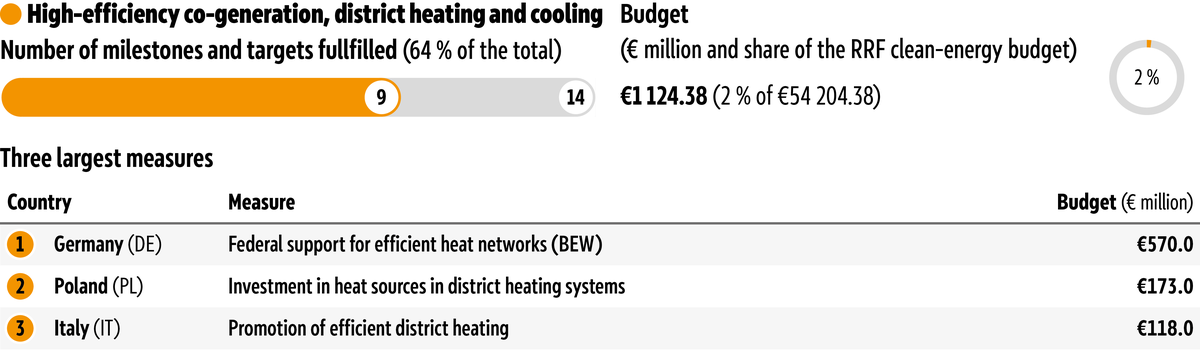
With €1.12 billion invested by nine Member States, 'High efficiency co-generation, district heating and cooling' is the other intervention field relating to energy networks (Figure 4). It is much smaller in size but more advanced in implementation in terms of the share of milestones and targets assessed as achieved (64 %). Included in Germany's plan, the largest measure under this intervention field aims to provide financial support for investment projects to decarbonise existing district heating systems, and construct new district heating networks, expanding the share of heat from renewable sources and waste heat. As of 8 June 2026, two out of the three targets associated with it had been achieved, with 200 grant decisions for district heating projects signed as part of the second instalment, and at least 50 feasibility studies and/or transformation plans completed as part of the third instalment. The final target for this measure, still to be assessed, is linked to the disbursement of at least €541.5 million for relevant projects. The heterogeneity in the design of control steps across different plans is confirmed in this intervention field, when looking at the still-to-be-assessed final target for Czechia's measure 'Modernisation of distribution of heat in district heating systems', for which project-specific energy audits have to demonstrate estimated primary energy savings of 245 327 gigajoules.
Renewable energy measures: How are the Member States doing?
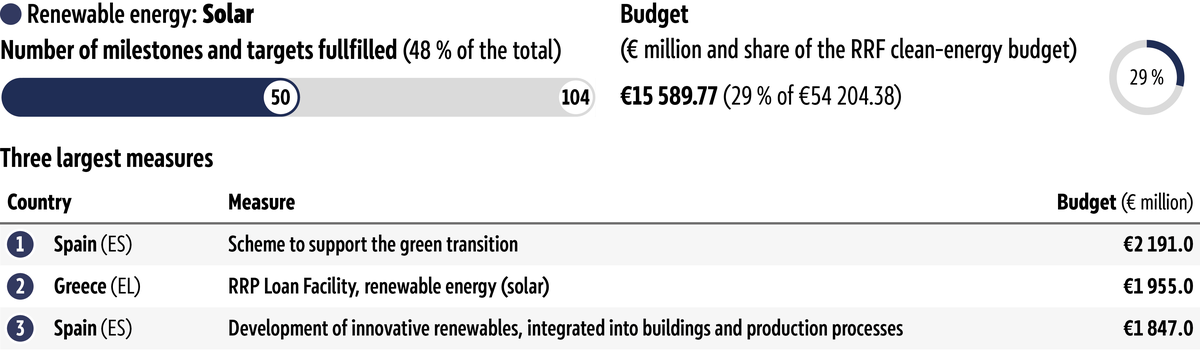
Overall, Member States have planned to invest €28.93 billion in 135 measures or sub-measures relating to renewable-energy generation through their NRRPs. Within this macro-category, 'Solar energy' (Figure 5) is the intervention field having the highest number measures (55 in 18 Member States) and attracting the largest total allocation (€15.59 billion, which is more than half of the total for measures on renewable-energy generation). Standing at 48 % as of 8 June 2026, the percentage of milestones and targets assessed as achieved is higher than for the intervention field 'Smart energy systems and related storage', but lags behind the progress in implementation of overall plans. Various Member States have multiple measures for solar energy in their plans, including Italy (seven), Greece and Spain (six each) and Romania (five).
Source: Author's own calculations based on European Commission data; graphic by Samy Chahri, EPRS.
The two largest measures are the Spanish scheme to support the green transition and Greece's RRP Loan Facility (solar energy compartment), both implemented through financial instruments. For the former, the final milestone requires that the implementing partner, Instituto de Diversificación y Ahorro de la Energía (IDAE), has published the final award resolutions or that the financing agreements with final beneficiaries for 100 % of the RRF investment have entered into force, and that Spain has transferred €2.19 billion to IDAE for the support scheme. Its achievement is planned for the final payment request of 2026. For the latter, the final milestone and target require that Greece has transferred the overall amount planned for the entire RRP Loan Facility to international financial institutions and commercial banks, and that the InvestEU Investment Committee has approved investment operations amounting to the overall amount of financing targeted. While milestones and targets included in already assessed payment requests showed the intermediary targets had been reached, thereby triggering related payments, the final implementing steps are to be included in the final payment request of 2026.
Examples of other achievements planned for solar energy measures are: the installation of 35 000 photovoltaic systems up to 20 kilowatt peak (kWp) in Austria (17 500 already assessed as installed); the equipment of 100 public buildings and 1 532 social-housing units with solar panels in Belgium (to be assessed with the final payment request); the delivery and installation of photovoltaic equipment at the Larnaca Wastewater Treatment Plant (Cyprus) generating power of at least 700 kW (already achieved); the disbursement of 61 000 vouchers to accelerate the deployment of renewable-energy sources by households in Romania, with acceptance certificates confirming the installation of solar panels with a net capacity of at least 3 kW (to be assessed with the last payment request).
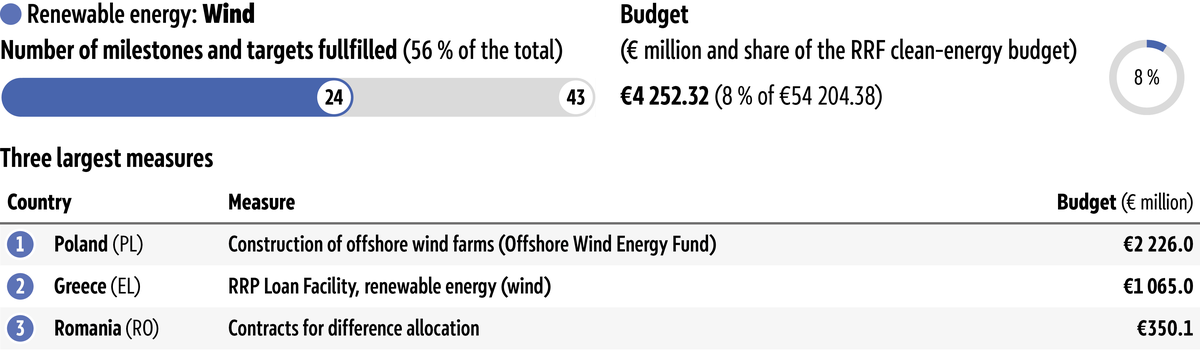
Wind energy, the second largest intervention field for renewable energies when excluding the miscellaneous category 'Other renewable energies', is projected to obtain investment worth €4.52 billion (Figure 6), which represents slightly more than one fourth of the resources earmarked for solar energy measures. Overall, 10 Member States have included 20 measures relating to wind energy in their NRRPs, with a higher completion rate of milestones and targets (56 %) compared with intervention fields with larger allocations.
Source: Author's own calculations based on European Commission data; graphic by Samy Chahri, EPRS.
As for solar energy, the two largest wind-energy measures are channelled through financial instruments, in the case of Greece the €1.06 billion wind-energy compartment of the same RRP Loan Facility (see above for the assessment of achievements so far). Poland has set up a dedicated facility for the construction of offshore wind farms (Offshore Wind Energy Fund), which aims to provide initially at least €2.22 billion of financing, and is managed by Bank Gospodarstwa Krajowego (BGK), the same implementing partner that is in charge of managing the Energy Support Fund through which Polish investment in smart energy systems and storage is channelled (see above). The measure's final target was assessed as achieved in May 2026, with BGK having entered into legal financing agreements with final beneficiaries for an amount necessary to use 100 % of the RRF investment into the facility.
Deliverables for other wind-energy measures include, in the Estonian plan, support for 20 local authorities to improve administrative procedures, not least permitting, for wind-energy development and the lifting of the height restrictions on offshore wind turbines in the Gulf of Riga and Estonian islands (both still to be assessed). Examples for Denmark are the preparation and publication of at least one call for tender for a 4-gigawatt (GW) expansion of offshore wind energy (positively assessed under the fourth payment request), and the publication of a report on the screening of areas for offshore wind in the country (to be assessed as part of the final payment request), including a sensitivity mapping, an assessment of the cumulative effects of large-scale offshore wind deployment, and an assessment of the opportunities for coexistence between offshore wind and other activities at sea.
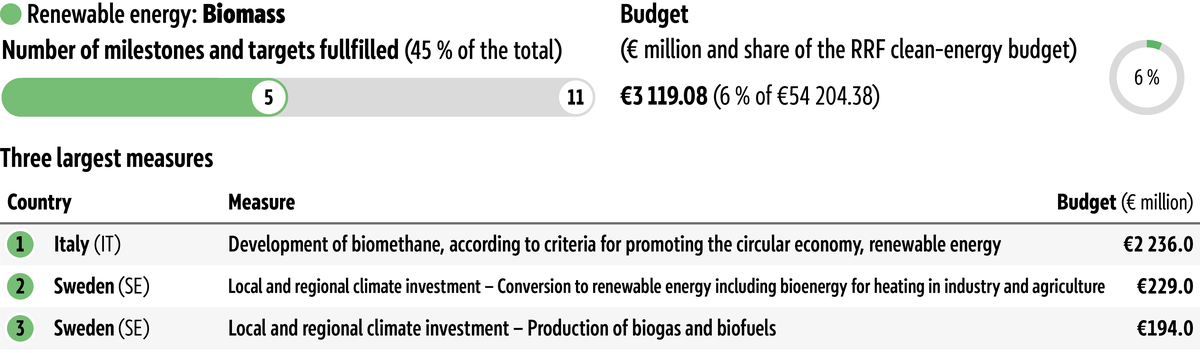
As regards 'Biomass for energy' or bioenergy, nine Member States invest in 17 measures jointly worth €3.12 billion, with 45 % of the related milestones and targets assessed as completed as of 8 June 2026 (Figure 7). The largest measure, Italy's investment in the development of bio-methane, according to criteria for promoting the circular economy, accounts for almost three quarters of the resources. It consists of a public investment in a grant scheme that aims to improve access to finance in Italy's biomethane production, providing grants directly to the private sector. The milestone associated with the measure, planned to be assessed in the final payment request, requires that the implementing partner, Gestore dei Servizi energetici (GSE), has entered into legal grant agreements with final beneficiaries for an amount necessary to use 100 % of the RRF investment into the scheme, and that Italy has transferred the related €2.24 billion to GSE.
Source: Author's own calculations based on European Commission data; graphic by Samy Chahri, EPRS.
The two clean energy-investment measures in Sweden's plan come under this intervention field, and are implemented under the 'Climate Leap' investment scheme that aims to finance local and regional activities to reduce emissions of carbon dioxide and other gases affecting the climate through projects on the conversion to bioenergy for heating in industry and agriculture, and projects on the production of biogas. The first target – the award of projects jointly expected to reduce carbon dioxide emissions by 300 000 metric tonnes per year over a 16-year period – was achieved as part of the first payment, while the final implementing step – awarding additional projects to bring the total expected reduction to 785 000 metric tonnes per year – has not yet been assessed.
The only measure that the climate tracking methodology includes in the 'Marine energy' intervention field is Poland's project for the construction of offshore terminal infrastructure (Figure 8). The €350-million investment aims to facilitate the development of offshore wind infrastructure, supporting the construction of a new terminal for offshore wind installations, and upgrading facilities in the ports of Łeba, Ustka and Darłowo for servicing and maintenance of offshore wind installations. The milestone and the target associated with the measure, planned to be included in the final payment request, will check the execution of relevant works and the conclusion of legally binding agreements for the use of the terminal and the facilities.
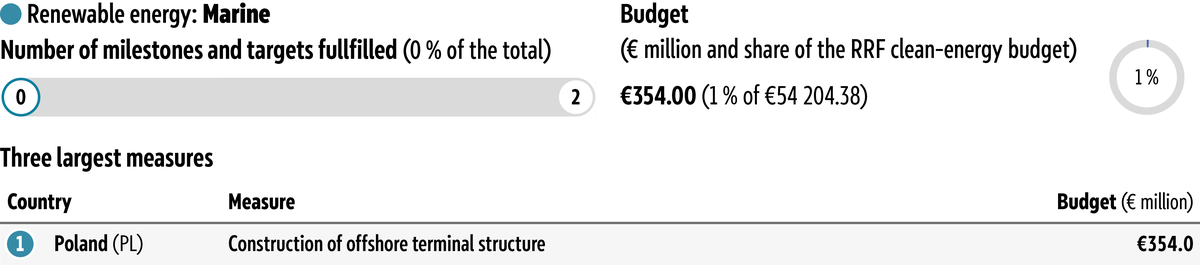
Source: Author's own calculations based on European Commission data; graphic by Samy Chahri, EPRS.
The residual intervention field 'Other renewable energy (including geothermal)' has a total of 42 measures worth €5.61 billion across 17 NRRPs (Figure 9). Compared with the overall 'Clean energy' policy area, it is characterised by a relatively limited average budget per measure (€133.6 million vs €256.9 million), with a significant variation between the smallest (€260 000) and the largest (€1.27 billion). The share of objectives assessed as achieved by 8 June 2026 is slightly below that of the overall policy area (38 % vs 40 %).
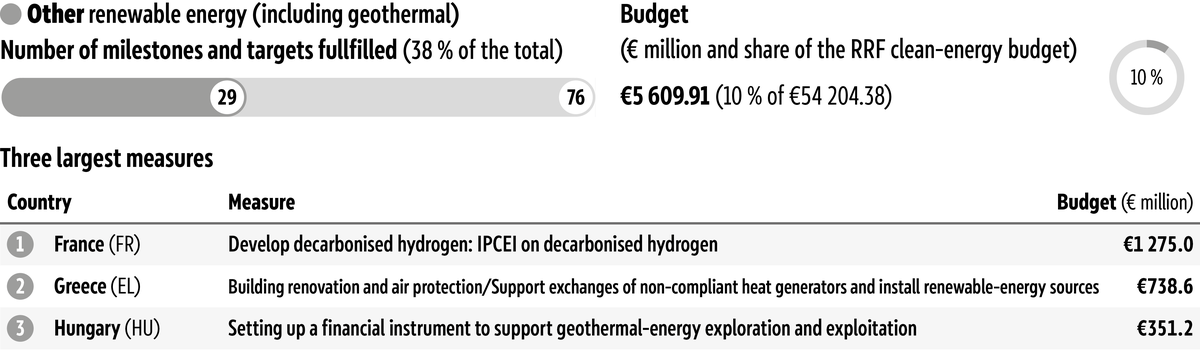
Source: Author's own calculations based on European Commission data; graphic by Samy Chahri, EPRS.
Many measures in this miscellaneous intervention field relate to hydrogen, including the largest, which is found in France's plan. The €1.27-billion 'Develop decarbonised hydrogen' investment seeks to enhance French value chains for the production of renewable and low-carbon hydrogen, and support its use in downstream sectors, such as transport and industry. Providing financial support in the context of the important projects of common European interest (IPCEIs) on hydrogen, the measure is associated with one milestone (the already positively assessed signature of the Public Bank of Investment's decision to attribute financial support to private promoters for 10 projects) and one target (the commissioning of a maximum production-line capacity of at least 140 MW-equivalent per year of electrolysers, to be assessed as part of the final payment request). Other Member States investing in hydrogen-related measures in their NRRPs include Belgium, Estonia, Greece, Italy, the Netherlands and Portugal.
Several measures concern geothermal energy, although it should be noted that the largest of this kind, Hungary's €351-million financial instrument to support its exploration and exploitation, does no longer appear in the revised plan still to be approved by the Council at the time of writing (see above). The amended plan would instead include a reform removing legal and administrative barriers to geothermal exploration and exploitation activities. Finland's investment providing grant support for projects with a focus on new clean technologies for energy production, use or storage has €36 million earmarked for geothermal energy. Intermediary milestones have already been greenlighted, while the final target is planned to be included in the final payment request (at least four project-completion notices or project reports across all the technologies supported for an increase in new renewable-energy capacity, use or storage capacity of at least 112 MW).
Impact so far and further results expected
Over the 2021-2027 period, the RRF is significantly boosting EU financial support for clean energy and network measures. For example, the European Court of Auditors estimates that EU funding available for grid investments is 5.5 times higher than in the previous programming period (2014-2020), mainly thanks to the temporary support coming from the RRF. However, the overall amount still represents a fraction of the total grid investment needs across the EU. An EPRS briefing shows that, in recent years, significant progress has been made in increasing the generation capacity of renewables in the EU, in particular since the launch of the REPowerEU initiative.
In November 2025, a European Commission factsheet estimated a series of results expected for renewable-energy generation, storage and grids from the clean-energy investment measures in the NRRPs once completed, including: 61 GW of new installed capacity for renewables (accounting for one third of all new renewable capacity deployed in the EU between 2021 and 2024); 7 GW of additional storage capacity contributing to grid flexibility and renewable-energy integration; and more than 10 000 kilometres of transmission and distribution lines reinforced or constructed. The new installed capacity would be capable of producing enough clean electricity to cover the needs of around 40 million households in the EU. With a data cutoff of March 2025, these estimates do not take into account the various revisions of the NRRPs that have been adopted since, reducing the overall financial resources available for the plans by around €73 billion, and modifying various relevant measures. In June 2026, the RRF Scoreboard reported 27 GW of additional operational capacity installed for renewable energy under common indicator 2 as of December 2025, which corresponds to 44 % of the projected total estimated by the factsheet.
Data from the NGEU Green Bonds Allocation and Impact report of December 2025 confirm that progress in the implementation of clean-energy and network measures has been slower than in other policy areas, showing that only 9 % of relevant expenditure had been reported as executed as of August 2025, compared with 25 % for overall NGEU Green Bond-eligible expenditure, and even higher execution rates for other categories with sizeable allocations (respectively 37 % and 32 % for energy-efficiency and clean-transport measures). The bulk of the clean-energy and network expenditure reported as executed at that point in time came from Greece (for solar power, smart energy systems and wind power) and Italy (for smart energy systems). Based on the assumption of full implementation of quantifiable milestones and targets, the report estimates that RRF clean-energy and network measures will reduce the EU's greenhouse gas emissions (GHG) by 19.9 million tonnes of CO₂ per year, representing approximately 0.6 % of the EU's annual GHG emissions for the year 2022 .and 37 % of the overall reduction expected from the RRF. Among the individual intervention fields, investments in solar and wind power are expected to make the highest contributions to the projected reduction triggered by clean-energy and network measures. When looking at the impact already realised as of August 2025, clean energy and network was at 2.4 million tonnes of CO₂ per year (or 12 % of the total projected impact from the category), while clean transport stood at 10 million tonnes of CO₂ per year (59 %).
Based on a subset of measures that can be quantified, a June 2026 European Commission paper presents separate estimates of emissions reductions from RRF investments and reforms respectively. The paper concludes that RRF-supported investments in clean energy can generate around 8 million tonnes of CO₂ equivalent (MtCO₂e) of annual emissions savings (15 % of the total projected emissions reductions from RRF investments). At the same time, RRF-supported reforms in clean energy can generate approximately 48 MtCO₂e of annual emissions savings (around 1.3 % of EU emissions in 2021), which accounts for the bulk (93 %) of the total annual emissions reductions expected from RRF reforms. The authors note that not all the measures can be quantified, notably giving examples of the methodological issues posed by measures implemented through financial instruments that are a sizeable delivery method in the policy area of clean energy and networks (see above). Overall, the paper points to a substantial contribution from the RRF to the broader energy transition, including for clean energy and networks.
With 60 % of clean-energy objectives yet to be achieved or assessed as such, the second half of 2026 will be crucial to determine whether the RRF's estimated benefits in terms of enhanced energy infrastructure, deployment of renewables and emissions reductions can entirely materialise, since major deadlines are approaching fast (31 August and 30 September respectively for Member States to meet milestones and targets and submit final payment requests, and 31 December for the Commission to disburse the final payments). In addition, the fact that major RRF investments in clean energy are channelled through financial instruments suggests that part of the resources will reach the economy only after 2026 and may leverage private investment, with a further impact that is not captured by the above-mentioned estimates.
While acknowledging that significant public funds are available to meet green-investment needs, primarily through the RRF and the EU budget, a European Central Bank (ECB) paper warns about a persistent public funding gap that is expected to increase once the RRF expires at the end of 2026. In the Commission proposal for the EU's 2028-2034 multiannual financial framework (MFF), various tools are expected to support the energy transition, often among other objectives. In addition to a dedicated strand with a proposed allocation of €29.9 billion for energy infrastructure and cross-border projects in the field of renewable energy under the Connecting Europe Facility (CEF), national and regional partnerships plans (NRPPs), the European Competitiveness Fund, the Horizon Europe framework programme for research and the Global Europe Instrument could also support energy-related projects. In its interim report on the MFF proposal, the European Parliament identified the energy sector as one of the priority areas for strategic EU investment, underlining the CEF's importance and calling for reinforcements of allocations of this and other relevant tools to ensure adequate support.
Main references
- D'Alfonso, A., Energy policy in the national recovery and resilience plans, EPRS, European Parliament, 2022.
Endnotes
Classification
Policy areas: Budget | Energy | Budgetary Control | Economics and Monetary Issues
Regions: European Union
Committees: Budgets (BUDG), Budgetary Control (CONT), Economic and Monetary Affairs (ECON), Environment, Climate and Food Safety (ENVI), Industry, Research and Energy (ITRE)
Disclaimer
This document is prepared for, and addressed to, the Members and staff of the European Parliament as background material to assist them in their parliamentary work. The content of the document is the sole responsibility of its author(s) and any opinions expressed herein should not be taken to represent an official position of the Parliament.
Copyright
© European Union.
The reuse of this document is authorised under a Creative Commons Attribution 4.0 International (CC-BY 4.0) licence.

https://creativecommons.org/licenses/by/4.0/deed.en
To use or reproduce elements that are not owned by the European Union, permission may need to be sought directly from the respective rightsholders.