
Article page checkbox is not checked in page info.
European Peace Facility
European Peace Facility Funding EU partner countries' armed forces and the common costs of EU military operations and missions
Bruno Bilquin, Members' Research Service

Summary
With an extra-budgetary financial ceiling of more than €17 billion for the period 2021-2027, made up of contributions from the EU Member States, the European Peace Facility (EPF) was created in March 2021 to provide assistance to EU partner countries' armed forces, and to finance the common costs of EU military operations and missions. Since 25 April 2025, the Council of the EU has mobilised the EPF for the armed forces of 15 partner countries, not comprising Ukraine, while the instrument continues to fund the common costs of the eight existing EU military operations and missions abroad, as well as the military component of a hybrid civilian–military initiative.
EPF funding of assistance measures for EU partner countries' armed forces
Funding for 18 measures for the armed forces of 15 countries, not comprising Ukraine
Between 25 April 2025 and 26 June 2026, the Council of the EU adopted 18 assistance measures (AMs) worth €357.5 million, funded from the assistance pillar of the European Peace Facility (EPF), in non-lethal equipment, services and training for the armed forces of 15 partner countries; none benefited Ukraine (see overview in Table 1). The Council adopted the latest EPF-funded AM for the Ukrainian Armed Forces in November 2023; it was implemented by the EU Military Assistance Mission for Ukraine (EUMAM Ukraine). The EU has nevertheless continued to support Ukraine's defence, including with €60 billion in loans for the years 2026 to 2027 under the €90 billion Ukraine support loan package, which the European Parliament approved in February 2026.
On 8 June 2026, the High Representative/Vice-President of the Commission, Kaja Kallas, announced that Hungary had lifted its veto on €6.6 billion in EPF military support for Ukraine. The funds are intended to reimburse EU Member States for past weapons deliveries, finance joint procurement, and support the EUMAM Ukraine, which had trained more than 9 000 Ukrainian soldiers, by May 2026, mostly in Spain.
Direct EPF military support for Ukraine has been blocked since February 2023 by Hungary's veto of a €500 million tranche and later a €5 billion EPF top-up linked to the Ukraine Assistance Fund. While 90 % of windfall profits from frozen Russian assets were used for military support in 2024, only 5 % has been allocated to military assistance since 2025, with the remainder directed to reconstruction.
Of the 18 new EPF-funded AMs, seven are the first ever to provide support for the armed forces of the countries concerned, all of which are in Africa. These are (from west to east): Cabo Verde, Togo (two AMs), Benin, Côte d'Ivoire, Chad and Djibouti. The other 11 AMs complement previous AMs.
Eleven of the 18 new AMs support the armed forces of nine African partner countries:
-
five countries in West Africa: Senegal (two AMs), Cabo Verde, Togo (two AMs), Benin and Côte d'Ivoire, reflecting the region's strategic importance for the EU, which tries to counter, in the coastal states, the push of terrorist groups towards the Ocean; the AMs for Togo, Benin and Côte d'Ivoire complement the EU Security and Defence Initiative in the Gulf of Guinea, covering the three countries as well as Ghana;
-
two countries in Central Africa: Chad and the Democratic Republic of the Congo (DRC);
-
one country in the Horn of Africa: Djibouti;
-
one country in North Africa: Egypt.
Four of the new AMs support the armed forces of three EU accession countries in the Western Balkans:
-
Albania (two AMs);
-
North Macedonia;
-
Bosnia and Herzegovina.
Two of the new AMs support the armed forces of two Middle Eastern countries:
-
Jordan, which on 8 January 2026 hosted the first EU–Jordan Summit, marking the first anniversary of the EU–Jordan Strategic and Comprehensive Partnership, with security and defence as one of its five pillars;
-
Lebanon, with the most recent and the best-funded AM, worth €100 million.
Finally, one of the new AMs supports the Armenian armed forces. An Armenia–EU Comprehensive and Enhanced Partnership (CEPA) has been in force since 2021 and was re-invigorated through the first EU–Armenia summit held in Yerevan on 5 May 2026, signalling stronger cooperation in defence and a clear shift away from Russia. An EU Hybrid Rapid Response Team was sent to Armenia before the 7 June parliamentary elections, which saw the victory of Prime Minister Nikol Pashinyan's pro-EU party.
| Council
decisions (2025-2026, date ascending) | Amount | Purpose | |
|
North Macedonia |
25 April 2025 |
€15 million |
Provision of intelligence, surveillance, reconnaissance, and electronic warfare; mobility and engineering vehicles; communication and information systems; combat training equipment; related supplies and services, including operational training |
|
8 July 2025 |
€10 million |
Provision of equipment and operational infrastructure for day-and-night land and river surveillance, intelligence gathering and force protection; EU and Senegal's integrated response to counter insecurity from the Sahel to other West African countries |
|
|
8 July 2025 |
€12 million |
Provision of equipment and services for patrolling and surveillance, including delivery of an ocean patrol vessel and training activities |
|
|
18 July 2025 |
€10 million |
Provision of equipment to support the deployment and organisation of the armed forces; individual protection and life support equipment; equipment for combating explosives; related supplies and services, including technical training for the equipment provided |
|
|
25 July 2025 |
€10 million |
Enhancement of the navy's operational readiness, including the development and maintenance of assets to deliver full and sustainable operational capabilities, increased maritime domain awareness and enhanced presence in the Red Sea; provision of an integrated and coherent response to the increased insecurity |
|
|
25 July 2025 |
€15 million |
Provision of light armoured multi-purpose vehicles, tactical and engineering vehicles, and related supplies and services, including operational and maintenance training |
|
|
24 November 2025 |
€35 million |
Provision of short-range radars and a local command and control system, and related supplies and services, including operational and maintenance training |
|
|
24 November 2025 |
€10 million |
Provision of equipment to facilitate command and control, improve deployment conditions and medical support, and enable the conduct of surveillance patrols along river borders |
|
|
24 November 2025 |
€14.5 million |
Renovation and refurbishment of the Koundoul National Academy for non-commissioned officers: infrastructure works, provision of educational equipment, and redesign of the Academy's curriculums, including to comply with international humanitarian law and international human rights law |
|
|
8 December 2025 |
€20 million |
Provision of intelligence, surveillance and reconnaissance equipment; individual combat parachutes; related supplies and services, including technical training for the equipment provided |
|
|
29 January 2026 |
€20 million | Enhancement of logistical capacities and protection of civilians in crisis and emergency situations (existing deployable tent camp scaled up to brigade-size); enhancement of resilience and interoperability of the armed forces that might participate in international and EU military missions and operations | |
| Benin | 30 March 2026 | €10 million | Provision of individual protection equipment, camouflage nets, radios and metal detectors; specialised equipment to collect and analyse intelligence of military interest; single-engine training aircraft and a generic multimodel aircraft simulator, as well as instructor-level training for pilots and maintenance personnel; related supplies and services, including training |
| Senegal | 5 May 2026 | €15 million |
Provision of equipment to strengthen the capabilities of the navy in naval operations, naval education and naval command support |
| Bosnia and Herzegovina | 12 May 2026 | €15 million | Improvement of the interoperability and operational readiness of the armed forces and their potential to contribute to the EU's common security and defence policy (CSDP) operations and missions and to any international coalitions |
| Albania | 22 May 2026 | €21 million |
Strengthening of the armed forces' defence capacities and capabilities |
| Lebanon | 4 June 2026 | €100 million | Financing of equipment and training for territorial control (creation of the 5th Land Border Regiment to be deployed along the border with Syria); multi-domain awareness (creation of a joint intelligence, surveillance and reconnaissance capacity with an operational drone system); maritime security (maritime command and control system); protection of critical military sites; medical equipment; all this including training where needed |
| E g ypt | 8 June 2026 | €20 million |
Strengthening of the armed forces' capacities to enhance Egypt's national security and stability as well as the protection of civilians; increasing the capabilities of the armed forces to ensure maritime security in the Mediterranean and Red Seas |
| Togo | 26 June 2026 | €5 million |
Provision of equipment for the navy: surveillance and communication capacities, maintenance and support equipment, and intervention assets |
Data sources: Council of the EU, Timeline – European Peace Facility, website (including the country-specific press releases and Council decisions); European Commission/Service for Foreign Policy Instruments (FPI), The EPF factsheet – Assistance measures, March 2026.
EPF funding of the common costs of EU military operations and missions
Funding for the eight existing EU military missions and operations, as well as a hybrid (civilian–military) initiative
The EPF is also used to finance the EU common costs (a small part, estimated at between 5 % and 10 % of the total costs) of the eight EU military missions and operations, as well as a hybrid (civilian and military) initiative (under the CSDP) that have so far been deployed: in the EU's Eastern Neighbourhood; the EU itself (for the above-mentioned EUMAM Ukraine, based in Poland and Germany, with 24 Member States providing training modules and staff); the South Caucasus, the Western Balkans; the Middle East; and Africa (see Map 1).
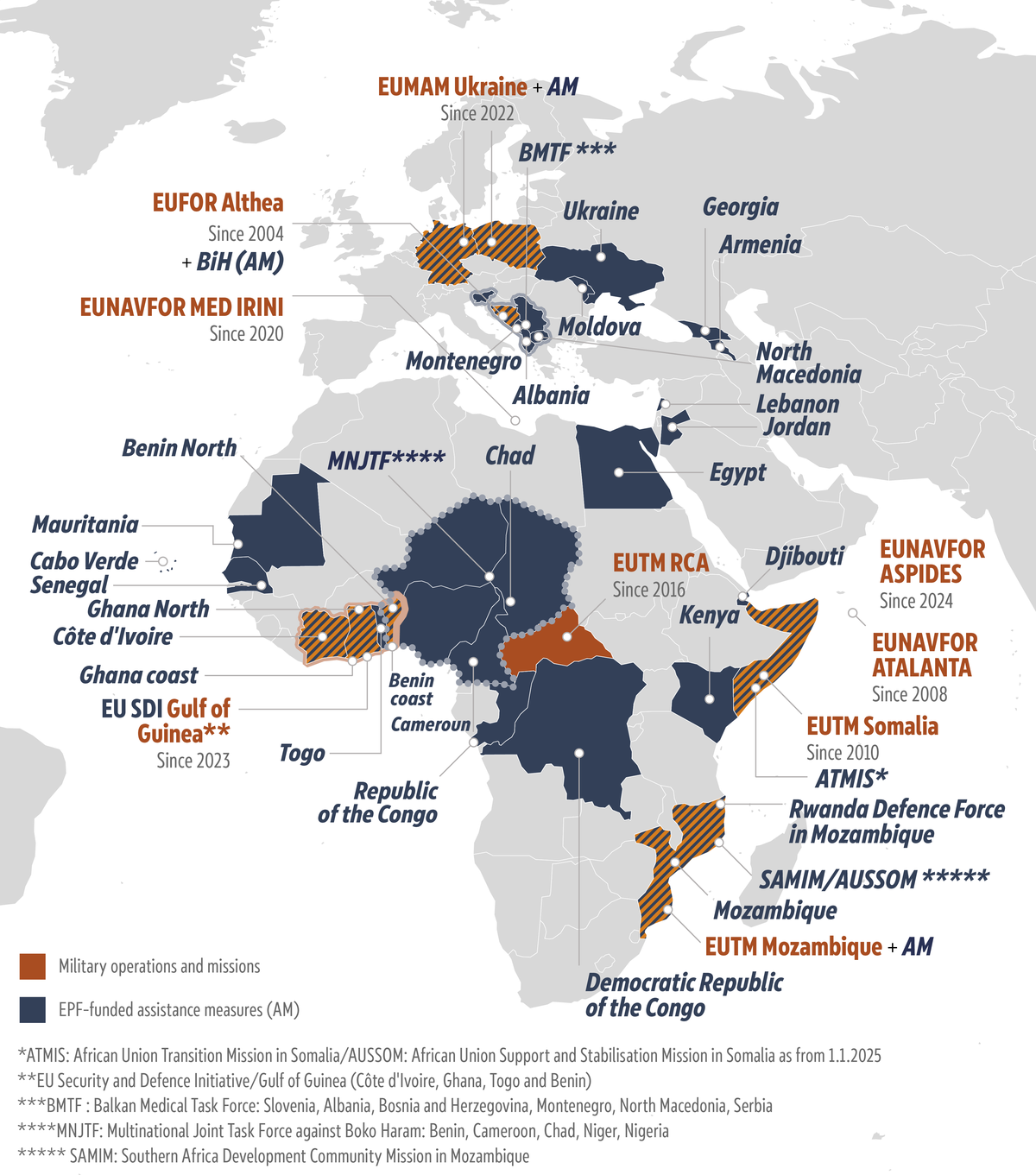
Source: Compiled by the author; graphic by Lucille Killmayer, EPRS, 2026.
Classification
Policy areas: Foreign Affairs | Security and Defence
Regions: Non-EU Europe and the North, Mediterranean and Middle East, Sub-Saharan Africa
Committees: Foreign Affairs (AFET), Security and Defence (SEDE)
Disclaimer
This document is prepared for, and addressed to, the Members and staff of the European Parliament as background material to assist them in their parliamentary work. The content of the document is the sole responsibility of its author(s) and any opinions expressed herein should not be taken to represent an official position of the Parliament.
Copyright
© European Union.
The reuse of this document is authorised under a Creative Commons Attribution 4.0 International (CC-BY 4.0) licence.

https://creativecommons.org/licenses/by/4.0/deed.en
To use or reproduce elements that are not owned by the European Union, permission may need to be sought directly from the respective rightsholders.