
Article page checkbox is not checked in page info.
The Board of Peace
The Board of Peace
Armin Wisdorff, Members' Research Service
Summary
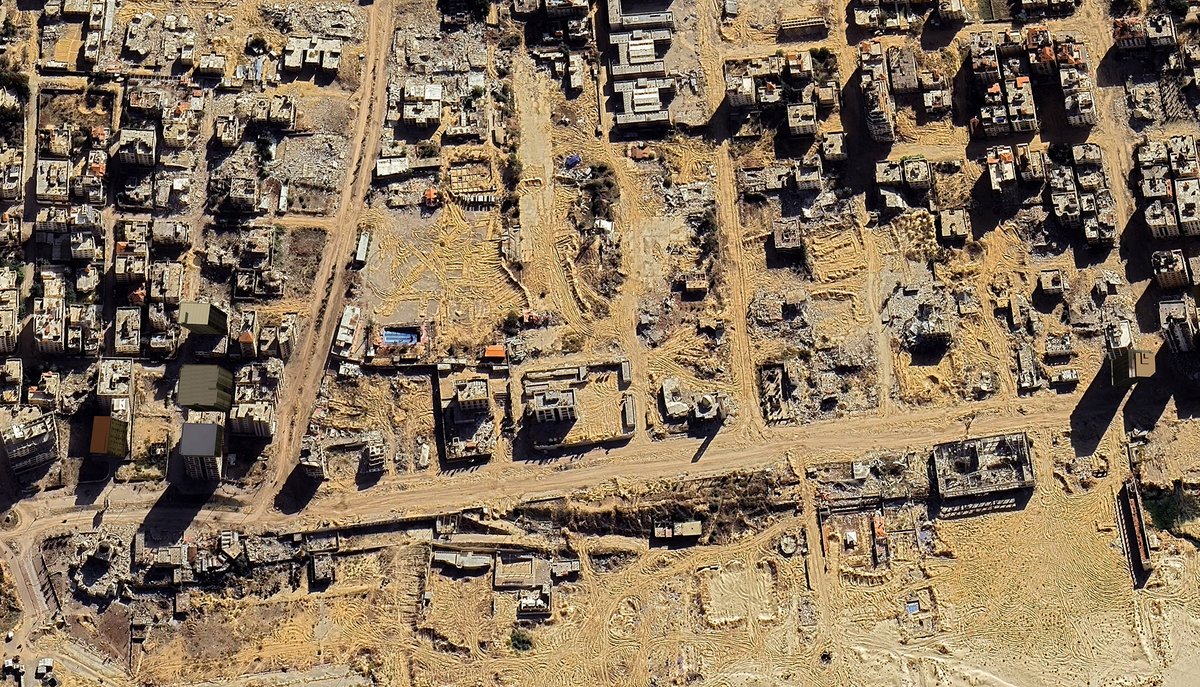
The Board of Peace (BoP) is a United States-led international organisation, initially endorsed by a UN Security Council Resolution in November 2025 as a transitional administration to oversee the redevelopment of Gaza. However, the BoP was subsequently established as a permanent international organisation with global peace-building aims under the lifelong chairmanship of Donald Trump, prompting legal and political controversy. The EU has refrained from joining the Board due to concerns over its compatibility with the UN Charter and international law. Among the EU Member States, Hungary and Bulgaria have joined the BoP as full founding members, with Bulgaria's status not confirmed.
Origins and institutional architecture
Donald Trump's 20-point 'Comprehensive Plan to end the Gaza Conflict' of September 2025, whose first phase established a US-brokered ceasefire in October, was swiftly endorsed on 17 November by UN Security Council Resolution (UNSCR) 2803. The plan framed the BoP as a transitional administration for Gaza's redevelopment until the Palestinian Authority (PA) has completed its reform programme. It sets Palestinian self-determination and statehood as stated goals. Yet in January 2026, the White House unveiled a complex, multi-layered BoP structure exceeding the original plan's scope, its charter granting the chairman, Trump, sweeping, unchecked powers, while omitting any reference to Gaza or Palestinian self-determination, and delegating 'operationalisation' to a separate executive board. Israel is a member of the BoP, but there is no Palestinian representative.
Despite these structural and representational concerns, some argue the BoP remains the only viable framework currently on the table, providing a concrete operational structure for transitional governance with UNSCR-backed international legitimacy, considering the lack of alternatives offering comparable political leverage and potential resources. The EU and several Islamic nations pragmatically support UNSCR 2803, calculating that engagement is the best way to increase humanitarian aid and keep the door open for eventual Palestinian statehood. Furthermore, key regional powers like Saudi Arabia, the United Arab Emirates and Egypt have officially joined the Board, backing it as a necessary transitional administration that can consolidate a permanent ceasefire, drive reconstruction, and ultimately advance the right to Palestinian self-determination.
For Gaza itself, a dedicated 'Gaza Executive Board' directs governance and reconstruction. Its High Representative, Nickolay Mladenov, a former Bulgarian minister, diplomat and Member of the European Parliament, serves as link between the BoP and the 'National Committee for the Administration of Gaza' (NCAG) – a technocratic body led by former PA deputy minister Ali Shaath, tasked with restoring public services and civil institutions.
An International Stabilisation Force (ISF) is tasked with securing border areas, stabilising the security environment via demilitarisation, protecting civilians, training Palestinian police forces, coordinating humanitarian corridors, and assisting in monitoring the ceasefire in Gaza. Indonesia, Morocco, Kazakhstan, Kosovo*1 and Albania have pledged to send troops. Indonesia's pledge was the largest, but was put on hold after the US and Israel attacked Iran. At the time of writing, the force is not yet operational.
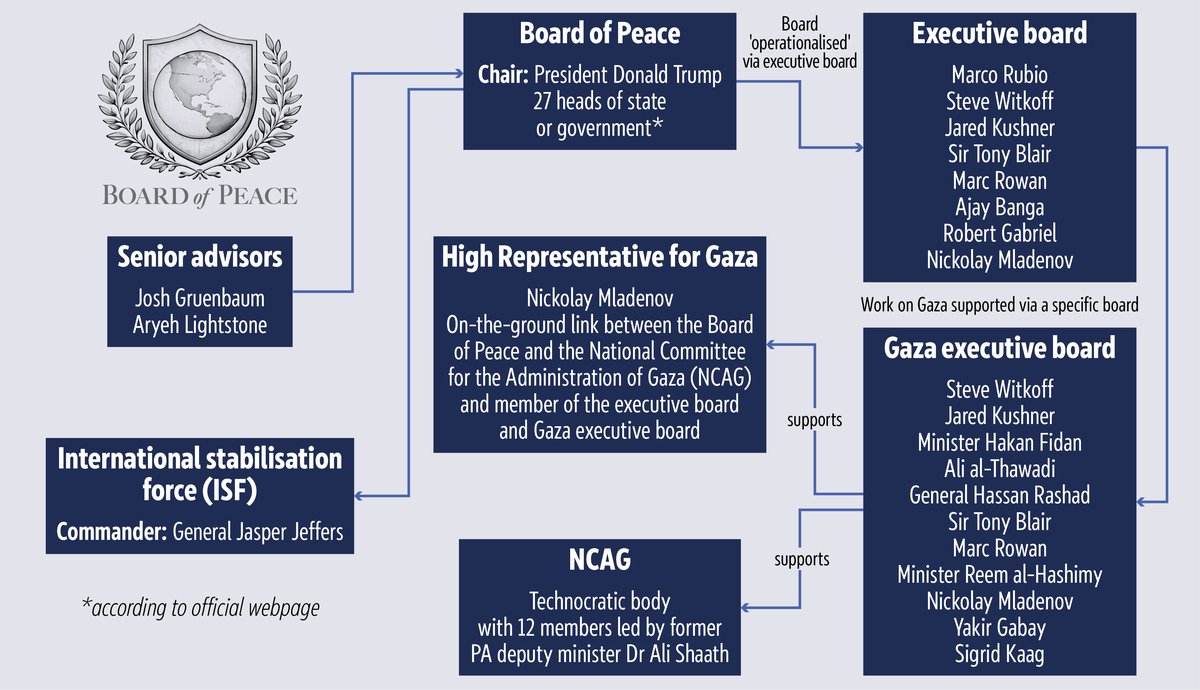
Source: White House statement. Graphic by Samy Chahri, EPRS, 2026.
Implementation and political challenges
Implementation of the Board's mandate for Gaza has stalled amid funding shortfalls and regional military escalation. Some US$17 billion (€14.5 billion) in pledges – US$10 billion (€8.5 billion) from the US, and US$7 billion (€6 billion) from other states, predominantly in the Gulf was secured at its February 2026 Washington inaugural meeting. However, disbursements remain negligible, leaving the NCAG stranded in Egypt, unable to deploy to Gaza due to financial constraints, security risks, and, reportedly, Israeli refusal. In June 2026, the US mission to the UN urged UN member states to fund the BoP instead of UNRWA. The election period in Israel and its troops being present in at least 60 % of the territory – instead of the 53 % agreed – also hamper progress.
Disarmament talks between Hamas and BoP envoys began in March 2026 in Cairo. As of July 2026, these are still deadlocked and have taken a backseat, with the focus being on the Iran war and subsequent US-Iran negotiations. In his report to the UN on 15 May 2026, Mladenov urged the immediate disbursement of financial pledges, naming Hamas' refusal to decommission weapons as the 'principal obstacle' to the full implementation of the peace plan. Hamas rejected the report, arguing that it absolves Israel of responsibility for daily ceasefire violations and pointing to restrictions on the delivery of reconstruction materials. The report also announced a 15-point-roadmap to complete the implementation of the peace plan.
Structural and legal concerns regarding the Board are profound. Analysts note that the chairman's unchecked authority over the budget lacks standard financial oversight, conflict-of-interest safeguards, or accountability mechanisms. The World Bank's Financial Intermediary Fund for Gaza Reconstruction and Development exacerbates these risks, as the Bank acts merely as a 'limited trustee', without responsibility or accountability, leaving BoP expenditure unchecked. Moreover, it is reported that the operational plan sidelines the PA, ignores existing Palestinian development strategies, and imposes opaque vetting criteria for aid recipients, fuelling concerns of the 'demographic re-engineering' and recolonisation of Gaza. In June 2026, US Secretary of State Marco Rubio announced that the Board will be transformed from a public international organisation into an international nongovernmental organisation (INGO), which critics believe is a move to avoid US congressional oversight and keep much of its activity opaque. Furthermore, the BoP reportedly intends to shield its members and security forces from potential prosecution for work in Gaza.
The EU and the Board of Peace
Kaja Kallas, Vice-President of the Commission and High Representative of the Union for Foreign Affairs and Security Policy, considers joining the BoP 'impossible', with the European Council and Commission citing 'serious doubts' about its charter, governance, and compatibility with the UN Charter. Nonetheless, the Commission took a pragmatic, though legally and politically controversial stance, sending Commissioner for the Mediterranean Dubravka Šuica as an observer to the inaugural Washington meeting to ensure the EU – Gaza's largest donor – remains part of key recovery discussions. Only Hungary and Bulgaria have joined the BoP as full founding members, with Bulgaria's status not confirmed. While 12 other EU states attended the meeting as observers, some were critical of EU representation.
The EU's priorities focus on securing humanitarian access, preventing displacement of Palestinians, and preserving Gaza's territorial and political ties with the West Bank. It will coordinate support through mechanisms like the Palestine Donor Group. High Representative Kaja Kallas reaffirmed the EU's backing for the Gaza peace plan under UNSCR 2803, but stressed that recovery must lead to a reformed PA's return to Gaza and a clear path to a two-state solution.
European Parliament's position
The European Parliament insists on a negotiated two-state solution, in line with international law, and the empowerment of a reformed PA as the EU's main interlocutor in Palestine and the only governing force in Gaza.
Parliament's recent resolution stresses that any reconstruction in Gaza must be strictly and unequivocally conditional on robust international monitoring, auditing, and enforcement mechanisms. Parliament also demands that all financial assistance and infrastructure support be fully safeguarded to prevent any diversion to terrorist organisations.
Endnotes
Classification
Policy areas: Foreign Affairs
Regions: Mediterranean and Middle East
Committees: Foreign Affairs (AFET)
Statement on the use of AI
Any AI-generated content in this text has been reviewed by the author. GPT@EC and NotebookLM were used to improve the readability of the text and broaden the range of sources available to the author.
Disclaimer
This document is prepared for, and addressed to, the Members and staff of the European Parliament as background material to assist them in their parliamentary work. The content of the document is the sole responsibility of its author(s) and any opinions expressed herein should not be taken to represent an official position of the Parliament.
Copyright
© European Union.
The reuse of this document is authorised under a Creative Commons Attribution 4.0 International (CC-BY 4.0) licence.

https://creativecommons.org/licenses/by/4.0/deed.en
To use or reproduce elements that are not owned by the European Union, permission may need to be sought directly from the respective rightsholders.