
Article page checkbox is not checked in page info.
European cultural heritage
European cultural heritage
Alina-Alexandra Georgescu with Luca Ballico, Members' Research Service
Summary
European cultural heritage is a broad and evolving concept that includes the tangible, intangible, and digital vestiges of the continent's multifaceted history. While definitions vary across Member States, EU institutions, UNESCO and the Council of Europe, all stakeholders share a common commitment to preserving it as a public good of enduring cultural, social, and economic value.
Cultural heritage is a unique, non-renewable, non-replaceable and non-interchangeable resource that plays a vital role in societal development, strengthens social cohesion and preserves the culture of peoples across generations. It can also serve as an educational tool and as a source of economic opportunity, particularly for peripheral regions, where heritage-led development may support tourism, employment and local regeneration. At the same time, European cultural heritage faces important challenges linked to cultural, environmental, social, economic and technological transformations. Managing these challenges requires not only better protection but also a more balanced approach towards sustainability that reduces overcrowding in the most heavily visited destinations and gives greater visibility to lesser-known places with significant cultural potential.
The Culture Compass for Europe further advances this agenda by promoting stronger protection, wider accessibility, regional cooperation and a more sustainable approach to heritage governance. To provide a comprehensive overview, this briefing examines prominent examples of cultural heritage, including UNESCO's World Heritage List, the Europa Nostra Awards, the European Heritage Label and other key EU initiatives currently shaping this domain. In addition, both the European Parliament and the Council have played an important role in advancing EU-level discussions on cultural heritage, particularly as part of the legacy of the European Year of Cultural Heritage in 2018.
International definitions
UN Educational, Scientific and Cultural Organization (UNESCO)
UNESCO is the world's most famous organisation dealing with cultural heritage. The definition of it gave to cultural heritage dates from its 1972 Convention concerning the protection of the world cultural and natural heritage (the World Heritage Convention), covering architectural works, sculptures, paintings, archaeological structures and inscriptions, cave dwellings, groups of buildings and sites comprised of the works of humans, or of humans and nature, of outstanding universal artistic, historic, scientific, anthropological, ethnological or aesthetic value (Article 1). Besides cultural heritage, this convention also covers natural heritage, including physical and biological formations of outstanding universal value from the aesthetic or scientific point of view, 'geological and physiographical formations and precisely delineated areas which constitute the habitat of threatened species of animals and plants of outstanding universal value from the point of view of science or conservation' and natural sites or 'precisely delineated natural areas of outstanding universal value from the point of view of science, conservation or natural beauty' (Article 2).
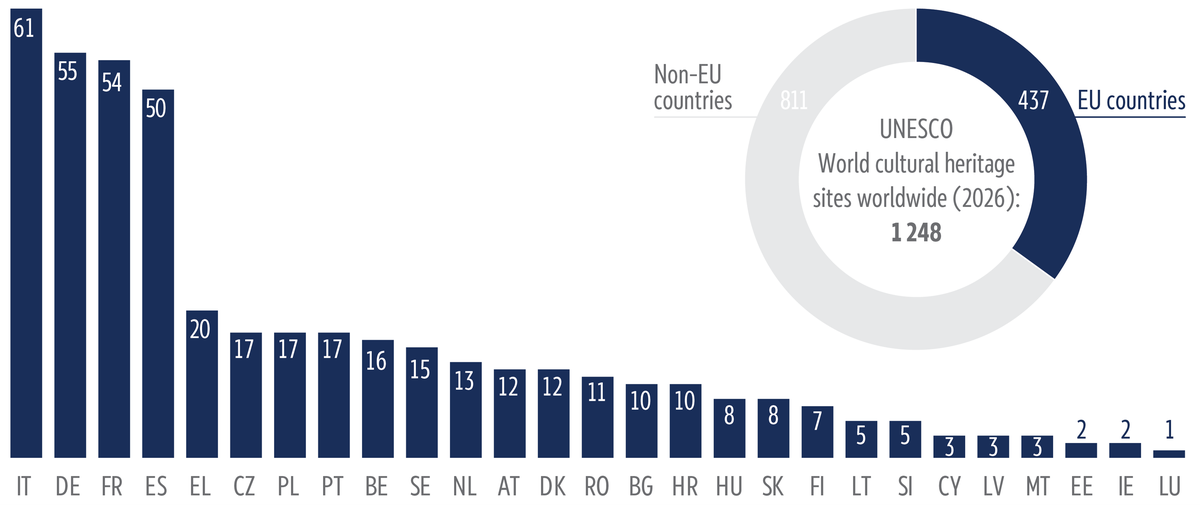
Data source: UNESCO world cultural heritage sites. Compiled by Luca Ballico; graphics by Giulio Sabbati, EPRS, 2026.
After adopting the 1972 Convention, UNESCO drew up the World Heritage List including outstanding heritage in need of protection. The EU hosts 35 % of these sites (437).
In its 1980 Recommendation for the safeguarding and preservation of moving images, UNESCO also recognised audiovisual heritage as part of cultural heritage, as it represents the expression of the cultural identity of peoples. UNESCO's 2001 Convention on Underwater Heritage focused on the protection of sites that bear 'traces of human existence having a cultural, historical or archaeological character which have been partially or totally under water, periodically or continuously, for at least 100 years'.
UNESCO's 2003 Convention for the safeguarding of the intangible cultural heritage added a new aspect pertaining to human traditions and ways of living. Intangible cultural heritage refers to 'practices, representations, expressions, knowledge, skills – as well as the instruments, objects, artefacts and cultural spaces associated therewith' that communities, groups and individuals recognise as part of their cultural heritage. Therefore, its recognition and definition rests with the communities, groups and individuals that create, maintain and transmit that heritage. Intangible cultural heritage includes oral traditions, performing arts, crafts and rituals.
UNESCO also recognises the threat that armed conflicts pose to cultural heritage. To address this risk, the 1954 Hague Convention for the protection of cultural property in the event of armed conflict and its two protocols establish an international legal framework for the protection of cultural property during armed conflict. Additionally, the 2003 UNESCO Charter on the Preservation of Digital Heritage recognises digital heritage as an important resource for preserving human knowledge and cultural expression across time.
Cultural heritage could therefore be classified into the following categories:
-
tangible heritage:
-
movable heritage such as sculptures, paintings, coins and manuscripts;
-
immovable monuments, archaeological sites and others;
-
-
intangible heritage: oral traditions, performing arts, skills and rituals;
-
natural heritage: cultural landscapes, geological, biological and physical formations;
-
digital heritage: digitised artefacts and 'born-digital' items.
Council of Europe
The Council of Europe (CoE), with its 47 European member countries, focuses its action on human rights and the rule of law and democracy, with the latter including culture and cultural heritage as elements of democratic governance. In addition to the global standards set by UNESCO, the Council of Europe, at its 2005 Faro Framework Convention on the value of cultural heritage for society, defined cultural heritage as 'a group of resources inherited from the past which people identify, independently of ownership, as a reflection and expression of their constantly evolving values, beliefs, knowledge and traditions. It includes all aspects of the environment resulting from the interaction between people and places through time' (Article 2). The convention also highlights the social and economic benefits of preserving cultural heritage as a prerequisite for sustainable development. It broadly defines the common European heritage as covering all forms of cultural heritage, viewing them as a shared source of remembrance, understanding and identity. Furthermore, it emphasises the contribution of this heritage to creativity, social cohesion and ideals, principles and values derived from past conflicts and efforts toward progress. Finally, the convention underscores the link between cultural heritage and the development of a peaceful and stable society, founded on respect for human rights, the rule of law and democracy.
Examples of cultural heritage in the EU
In the realm of tangible cultural heritage, notable examples include the Acropolis in Athens, Greece, the cradle of democracy and the birthplace of the philosophical traditions that laid the foundations of European thought. Similarly, the Aachen Cathedral in Germany serves as a testament to the shared spiritual and political roots of the continent.
In the sphere of intangible cultural heritage, a notable example is the French baguette, as it transcends its function as a mere food to embody the preservation of artisanal know-how and a way of life centred on local traditions, craftsmanship and everyday social interaction. The mărțișor (Romanian) / martenitsa (Bulgarian) / martis (Greek) is a small adornment made with white and red yarn that is worn to welcome spring and invite good health. This symbol reminds of the constant cycle of life and death, the balance of good and evil, and the sorrow and happiness in human life.
Lastly, digital cultural heritage represents a critical pillar for preservation and innovation. One primary example is the NewsEye project that utilises AI-powered technology to improve the accessibility and the scholarly analysis of historical newspapers from the 1850-1950 period. Additionally, the Gallica project digitalised more than 10 million artworks of the French National Library, providing free and open access to thousands of years of history.
European Union
Cultural heritage has been a fundamental element of European integration and development. Europe's rich cultural heritage reflects centuries of interaction among diverse languages, architectural currents, traditions, practices and shared values, which together have shaped its identity. On the European Commission's site dedicated to cultural heritage, the latter is presented as 'a rich and diverse mosaic of cultural and creative expressions, an inheritance from previous generations of Europeans and a legacy for those to come. It includes natural, built and archaeological sites, museums, monuments, artworks, historic cities, literary, musical and audiovisual works, and the knowledge, practices and traditions of European citizens'. On the site dedicated to the EU policy for cultural heritage, the latter is presented as 'a shared source of remembrance, understanding, identity, dialogue, cohesion and creativity. It encompasses a broad spectrum of resources inherited from the past in all forms and aspects, which can be:
-
tangible (castles, museums, works of art)
-
intangible (songs, traditions, etc.
-
digital (born-digital and digitised)'.
This is rather close to the definition found in the Decision of the European Parliament and the Council of 17 May 2021 on a European Year of Cultural Heritage (2018) which mentions the Council conclusions of 21 May 2014, where cultural heritage is described as 'consist[ing] of the resources inherited from the past in all forms and aspects tangible, intangible and digital (born digital and digitized), including monuments, sites, landscapes, skills, practices, knowledge and expressions of human creativity, as well as collections conserved and managed by public and private bodies such as museums, libraries and archives. It originates from the interaction between people and places through time and it is constantly evolving. These resources are of great value to society from a cultural, environmental, social and economic point of view and thus their sustainable management constitutes a strategic choice for the 21st century'.
EU Member States' definitions of cultural heritage
While EU Member States generally consider cultural heritage a broad and multifaceted concept, they differ in the emphasis they place on the tangible, intangible, movable, immovable and natural dimensions of this concept. Some adopt a more explicitly temporal view, presenting heritage as a legacy inherited from the past, sustained in the present and safeguarded for the future; others, however, choose not to focus on this temporal dimension. From another perspective, some Member States define cultural heritage as an evolving expression of values, beliefs, knowledge and traditions, encompassing all elements resulting from the interaction of people, place, history, and nature over time. Generally, all recognise the importance of objects, sites and places with historic or artistic value, but they vary in the extent to which they explicitly include landscapes, natural environments, documentary materials and living traditions.
Legal basis for cultural heritage at international and EU level
Access to culture is a fundamental human right according to the UN's Universal Declaration of Human Rights. Article 22 states that cultural rights are indispensable for the dignity and the free development of the personality and Article 27 underlines that 'everyone has the right freely to participate in the cultural life of the community, to enjoy the arts and to share in scientific advancement and its benefits'. Article 13 of the Charter of Fundamental Rights of the EU foresees that 'the arts and scientific research shall be free of constraint' and Article 22 underlines that 'The Union shall respect cultural, religious and linguistic diversity'.
EU objectives and competence in the area of culture and cultural heritage
The preamble of the Treaty on European Union (TEU) draws its inspiration from the cultural, religious and humanist inheritance of Europe. The overarching objective of the EU in the area of culture is to 'respect its rich cultural and linguistic diversity' and 'to ensure that Europe's cultural heritage is safeguarded and enhanced' (Article 3 TEU). While culture is a competence of the EU Member States, the EU can encourage cooperation between them and support or supplement their actions (Article 6 of the Treaty on the Functioning of the European Union, (TFEU)). Additionally, the EU must 'contribute to the flowering of the cultures of the Member States while respecting their national and regional diversity' and highlighting the common cultural heritage (Article 167 TFEU).
European identity is directly linked with its cultural heritage, and this represents a living source of remembrance, understanding, creativity, dialogue and cohesion for Europe. According to Article 2 of Regulation (EU) No 1295/2013 establishing the Creative Europe Programme, 'the cultural and creative sectors include inter alia architecture, archives, libraries and museums, artistic crafts, audiovisual (including film, television, video games and multimedia), tangible and intangible cultural heritage, design, festivals, music, literature, performing arts, publishing, radio and visual arts'.
The role of culture and cultural heritage in shaping European identity
Culture enhances European identity by fostering a sense of shared belonging and interconnectedness across borders. European culture and heritage are central to EU values and identity, providing a space for dialogue, reflection and civic engagement. Cultural activities and heritage sites bring people together, fostering community life, social interaction and cultural exchange. They offer opportunities to challenge assumptions, stimulate imagination and engage with new ideas and perspectives. In doing so, they shape our understanding of the world and of life in all their diversity and richness.
Venice: A paramount symbol of cultural heritage
Venice and its lagoon constitute one of the world's most distinctive cultural heritage sites. Originally established as a fishing settlement, Venice exemplifies a remarkable process of human adaptation to a hostile maritime environment, gradually transforming a marshy archipelago into a major maritime and commercial power that served for centuries as a vital cultural bridge between Europe and the East. Its uniqueness stems not only from iconic architectural landmarks such as Saint Mark's Square and the Rialto Bridge and from the extraordinary concentration of artistic masterpieces by renowned artists such as Bellini, Giorgione, Titian and Tintoretto, but also from the city's canal system, which forms an essential part of its historical identity. The engineering foundations of Venice are equally remarkable, having been constructed more than a thousand years ago on wooden piles pounded into the ground, allowing the city's heavy stone buildings to remain in place for centuries. Despite contemporary threats, such as rising sea levels, Venice remains a living historic site of immense cultural value, continuing to attract nearly six million overnight visitors each year.
Culture and heritage can also help promote peace, sustainability, tolerance, human dignity, freedom, democracy, equality and the rule of law. By raising awareness of social and global challenges, cultural activities can encourage informed public debate and foster a deeper understanding of complex issues. They can also provide a space in which societal tensions, competing interests and difficult questions can be explored and discussed.
Cultural heritage and the Culture Compass for Europe
The Commission's 2024-2029 political guidelines and priorities identify what constitutes 'our European way of life: our culture and our history' and stress the need to make it 'easier for people – especially younger generations – to benefit from Europe's rich and diverse cultural heritage'. The Commission's newly adopted Culture Compass for Europe provides a comprehensive and ambitious strategic framework for culture.
The Culture Compass outlines four long-term directions for EU cultural policymaking. One of these directions focuses on cultural heritage: drawing on culture and cultural heritage to become more competitive, resilient and cohesive. Digital technologies play an important role; AI, in particular, is changing how culture is created, accessed and experienced. It offers new opportunities for innovation and audience engagement, including supporting cultural heritage through restoration, reconstruction, and preservation. At the same time, AI also presents new challenges, particularly concerning copyright (such as the unauthorised use of copyright-protected content to train generative AI models), ethical considerations, cultural diversity, job displacement, fair remuneration for creators and emerging skills needs. The Compass notes that the EU is committed to creating a forward-looking and enabling regulatory environment that supports creators by protecting creative content, ensuring fair remuneration, and setting standards for trustworthy and human-centric AI.
UNESCO has likewise addressed the implications of AI through its normative work, including the 2021 Recommendation on the Ethics of Artificial Intelligence. The recommendation presents AI as a technology with major benefits, but also one that can deepen inequalities and raise ethical risks around bias, transparency, misinformation and human rights. It also places a strong emphasis on education, digital skills and AI ethics training, and calls on UNESCO to support its member states through capacity-building materials, impact-assessment methodologies and other tools for implementation of policies on AI ethics.
Similarly, in 2024 the Council of Europe published its Guidelines given the latest technological developments, such as AI, complementing Council of Europe standards in the areas of culture, creativity and cultural heritage. The guidelines recognise that AI is already transforming culture, creativity and cultural heritage, with significant potential to enhance creativity, efficiency, accessibility, preservation and international cooperation. At the same time, it identifies important challenges, including weak transparency, the production of fake or illicit content, copyright disputes, cultural bias and stereotypes, and pressures on artists, creators and the wider cultural labour market.
The 18 June 2026 interinstitutional joint declaration – 'Europe for Culture – Culture for Europe', which accompanies the Culture Compass, lists 12 principles for cultural policies, four of which refer to cultural heritage:
-
Ensuring access to culture and cultural heritage for everyone, especially young people and persons with disabilities, marginalised and disadvantaged groups, and people living in rural, remote or disadvantaged areas.
The Compass underlines that cultural participation and access to cultural activities are vital to promoting active citizenship and are a fundamental pillar of any democratic and inclusive society. Efforts have been made by the Member States and the Commission to promote access to culture, especially for young people, and the Commission will support Member States in increasing the participation of and support to persons with disabilities in culture.
-
Protecting, safeguarding and promoting Europe's rich natural and cultural heritage, both tangible and intangible, and supporting intergenerational exchange to ensure the transmission of cultural heritage and knowledge from older to younger generations.
This is a key priority of EU policymaking and funding and is put into practice through the numerous initiatives briefly presented below, like the European Heritage Days, the European Heritage Label, the European Heritage Awards/Europe Nostra Awards, etc. The digitalisation and the digital transformation of the cultural heritage sector are supported through initiatives like Europeana, the Common European Data Space for Cultural Heritage and the Cultural Heritage Cloud, also presented below.
-
Harnessing culture and cultural heritage to foster regional and territorial development, resilience, social cohesion and convergence between Europe's regions.
The Culture Compass notes that culture and cultural heritage promote regional, territorial and local development. It also points out that cultural opportunities and infrastructure must be spread equitably across Member States, regions and territories, even in rural, remote and disadvantaged areas facing depopulation, ageing demographics and other challenges. Cultural tourism plays a crucial role in preserving and promoting Europe's cultural heritage, and the Commission is preparing an EU sustainable tourism strategy to further promote sustainable cultural tourism as a catalyst for heritage protection, social cohesion, environmental sustainability, and economic competitiveness.
-
Promoting the contribution of culture, including cultural heritage to the shift towards environmental sustainability.
The shift towards environmental sustainability helps to make culture and cultural heritage more competitive, resilient and cohesive, and the Culture Compass argues that cultural stakeholders should lead the green transition. The Commission intends to strengthen the dialogue between cultural and environmental stakeholders and to organise a workshop on the role of culture and the arts for sustainable living. Initiatives like the New European Bauhaus (NEB) remain important, and the Commission will adopt a communication and a proposal for a Council recommendation on the future of the NEB and seek to further support culture through related initiatives. The cultural and creative sectors need to address issues like energy efficiency, and, when this concerns heritage, it must respect the integrity of the heritage.
Key European initiatives on cultural heritage
European Capitals of Culture
The European Capitals of Culture is one of the most successful and well-known cultural initiatives in the EU. So far, 75 cities across Europe have been nominated to hold the title of European Capital of Culture, including those designated for 2026. The initiative seeks to promote Europe's cultural diversity, foster a stronger sense of belonging and contribute to the development of the cultural sector, while also widening access to culture in the cities concerned. Its current rules and procedures are set out in a 2014 joint decision of Parliament and the Council, establishing an EU action for the European Capitals of Culture for the period 2020 to 2033. In general, two cities from two different countries are selected each year, with participating countries allocated on a rotating basis. The selection is made six years in advance to allow the host cities to plan and prepare. Each country, through its Ministry of Culture, is responsible for selecting the city to be put forward. Originally limited to EU Member States, the initiative expanded in 2014 to include candidate and potential candidate countries, followed by members of the European Free Trade Association and the European economic area in 2017. A notable example of this inclusive reach is the selection of Novi Sad, Serbia, as a 2022 Capital of Culture. The European Capitals of Culture for 2026 are Oulu, Finland, and Trenčín, Slovakia, following the 2025 cities: Chemnitz, Germany, and the cross-border partnership of Nova Gorica, Slovenia, and Gorizia, Italy.
European Heritage Days
The European Heritage Days is a Council of Europe initiative launched in 1985 and formally joined by the Commission in 1999. As of March 2022, the programme involves 46 countries that are signatories to the European Cultural Convention. Each year, mainly in September, museums and historical sites across Europe, typically closed to the public, open their doors for free, offering citizens the opportunity to connect directly with Europe's shared cultural heritage. The purpose of the initiative is to foster a sense of belonging among European citizens by raising awareness of, and cultivating appreciation for, the continent's cultural richness and diversity.
To ensure thematic coherence across participating countries, a central theme is announced each year, serving as a guiding framework for organisers coordinating events throughout Europe. The theme selected for 2025 was Heritage and Architecture, chosen to coincide with the 50th anniversary of the European Architectural Heritage Year. Its stated purpose was to emphasise 'the artistic and technical achievements of architecture, showcasing everything from grand monuments in bustling cities to vernacular buildings in rural areas'. Beyond celebrating the tangible heritage, the theme invited participants to explore the diverse architectural styles of the past and, in doing so, to reflect on the crucial intangible heritage that underpins them.
European Year of Cultural Heritage 2018
Parliament and the Council jointly designated 2018 as the European Year of Cultural Heritage, marking both the centenary of the end of World War I and of the independence of several eastern EU Member States. As its official motto – 'Our heritage: where the past meets the future' – implies, the initiative was intended to encourage people of all ages, particularly older citizens, who symbolise the past, and younger citizens, who symbolise the future, to engage more actively with Europe's cultural heritage through events such as exhibitions, public campaigns and educational activities. It also sought to promote values, such as diversity, intercultural dialogue and mutual understanding, while also raising awareness of the importance of Europe's rich and diverse historical and cultural legacy. All EU institutions committed themselves to organising public events throughout the year, and the participating countries, 28 EU Member States and 9 associated countries, supported the initiative at the national level together with a wide range of stakeholders. The initiative was widely regarded as successful: 12.8 million people participated and 23 000 events were organised across all 37 participating countries. Building on this success, the framework for action on cultural heritage was published to provide guidance to cities, regions and cultural heritage organisations in developing their own concrete cultural heritage actions.
European Heritage Label
The European Heritage Label is an EU initiative that designates historical sites that embody and promote European ideals, values, history and integration. By recognising sites of shared cultural significance, the programme seeks to enhance citizens' appreciation for their common, yet diverse heritage, thereby strengthening the sense of belonging to the EU and reinforcing intercultural dialogue. It was formally established through a 2011 joint decision of Parliament and the Council establishing a European Union action for the European Heritage Label. This decision built upon the 2008 Council conclusions on the creation of a European heritage label, which proposed transforming the intergovernmental scheme, originally launched in 2006 by three Member States into a formal EU action. To date, 80 sites have been selected, in line with the principles of inclusion and diversity. In 2026, the initiative's fifteenth anniversary, a record 13 sites have been selected. The selection process operates on a biannual cycle with individual Member States first pre-selecting up to two candidate sites at the national level. These candidates are subsequently evaluated by an independent EU-level panel based on the principles of inclusion and diversity. The panel then recommends the sites to the European Commission for the attribution of the European Heritage Label title.
A 2025 addition to the Label is Bosco delle Querce in Italy, which stands as a European symbol of environmental accountability. This park emerged from the remediation of land contaminated by a 1976 chemical disaster; it also represents collective resilience and the capacity to transform an industrial ruin into an educational space and a place of collective memory and environmental regeneration. Another example from the 2025 list is Places of Europe, a transnational European heritage site linking countries associated with the signing of major peace treaties. In this respect, the site functions as a powerful symbol of European peace and coexistence. St Paul's Catacombs in Malta, meanwhile, is an example of religious tolerance, as the catacombs contain Polytheistic, Christian, and Jewish burial sites, thereby reflecting the coexistence of different faith traditions within a shared historical site.
The European Heritage Label resembles the UNESCO's World Heritage List, but a close reading of their admission criteria shows that they serve distinct purposes: the European Heritage Label is awarded not primarily based on aesthetic or architectural value, but for a site's symbolic significance in European history and the selected sites are expected to have an educational dimension within a pan-European perspective. In addition, cooperation among sites is strongly encouraged. The sites may meet the criteria of both schemes, as in the case of the Acropolis in Athens, which stands as an outstanding example of European culture and UNESCO's universal value.
European Heritage Awards/Europa Nostra Awards
The European Heritage Awards/Europa Nostra Awards is an important initiative of European Commission, managed by the civil society organisation committed to safeguard and promoting European heritage, Europa Nostra, since its launch in 2002. This prestigious prize is awarded to European projects that demonstrate excellence and best practices in the conservation and enhancement of tangible and intangible cultural heritage. Each year, a maximum of 30 winners are selected. Among these winners up to five receive the Grand Prix, accompanied by a €10 000 prize. Furthermore, a Public Choice Award, also worth €10 000 is given to the project that secures the highest share of online votes from the public. The winners are organised into five categories, reflecting the broad spectrum of activities within the cultural heritage sector. Notable examples from these categories include:
-
Conservation and Adaptive Reuse: The transformation of a former factory in Łódź, Poland, into a vibrant cultural complex illustrates how industrial remains can be successfully repurposed to serve contemporary community needs.
-
Citizens' Engagement and Awareness-Raising: The Baltic Sea Wrecksite Ontology in Finland has revolutionised maritime archaeology by establishing a vast, publicly accessible digital collection of 3D shipwreck models.
-
Education, Training, and Skills: The ASTRA Centre in Sibiu, Romania, serves as a vital hub for preserving traditional craftsmanship through specialised training and certification.
-
Research: The Heritage Tree Project in Flanders, Belgium, addresses environmental challenges by engaging the public in safeguarding monumental trees against climate change, preserving the landscape in the region.
-
Heritage Champions: Projects such as Saving Ukrainian Heritage Online are of critical importance in protecting digital cultural heritage amidst the ongoing war. By archiving thousands of documents and web pages, the initiative ensures that Ukraine's cultural legacy is protected from the risk of permanent destruction.
European Heritage Hub
The European Heritage Hub is an EU co-funded project established in 2023. It is designed to bring together cultural heritage stakeholders across the EU and neighbouring countries in order to facilitate knowledge exchange and pool resources in support of a stronger culture-driven network. The project seeks to improve coordination among cultural heritage initiatives, particularly across cities and regions, while also encouraging citizens' engagement with cultural heritage. Special attention is given to attracting young cultural professionals, capitalising on 2022 European Year of Youth success, which reached 91.4 million citizens on social media and saw more than 13 000 events organised all over the world. To make heritage-related knowledge more accessible, the Hub has developed two digital tools:
-
The European Heritage Policies Monitor, an online tool that maps cultural heritage initiatives and policy developments across Europe.
-
The Heritage Library, a digital repository that provides access to relevant research and policy papers in a more comprehensive and accessible format.
Europeana and Common European Dataspace for Cultural Heritage
Europeana is a project launched by the European Commission in 2008 with the aim of preserving Europe's digital cultural heritage through an online archive of more than 63 million items, including works of art, books and music from cultural institutions across Europe. By bringing together such a vast and varied collection in a single digital space, Europeana seeks to support free public access to Europe's historical and cultural record, while also encouraging to explore the continent's rich and diverse heritage. In this way, the project not only supports research and learning, but also promotes a broader appreciation of Europe's cultural legacy among the public. The platform works in close collaboration with Common European Dataspace for Cultural Heritage, a key EU initiative that provides a digital infrastructure with tools and guidelines to support cultural heritage professionals across the EU. The dataspace's Strategy 2025-2030 sets a long-term vision for integrating digital heritage part of the EU priorities relating to data, AI and digital transformation. The strategy places particular emphasis on the development of a robust and interoperable infrastructure capable of making cultural heritage data accessible and reusable, while also supporting the digital transformation of cultural heritage field more broadly.
Cultural Heritage Cloud
The Culture Heritage Cloud, or European Collaborative Cloud for Cultural Heritage, is an EU initiative funded under Horizon Europe. It aims to strengthen connections among cultural heritage institutions and professionals across Europe, which will work closely with the European Data Space for Cultural Heritage. As a shared digital infrastructure, it is designed to facilitate collaboration, support the exchange of good practices, and foster a more coordinated and innovative heritage sector. By providing collaborative digital tools, the cloud seeks to accelerate innovation, promote common understanding across institutions, and reduce barriers to participation, especially for smaller organisations and those in remote areas. It is also intended to support preservation, conservation, restoration, and enhancement efforts through advanced digital technologies, including the digitisation of artifacts and the research of artworks.
PROCULTHER and the READY project
PROCULTHER and the READY project are two EU initiatives led by the International Centre for the Study of the Preservation and Restoration of Cultural Property, designed to protect cultural heritage from the consequences of natural disasters. While the EU Civil Protection Mechanism provides the wider operational framework for disaster response across Member States, PROCULTHER and READY project address different stages in time regarding heritage protection. PROCULTHER is an emergency-response initiative launched in 2019 to help authorities rescue cultural heritage during natural disasters through common procedures and coordinated action. READY, launched in 2025, by contrast, is preventive: it focuses on reducing the risk of damage to cultural heritage from climate change and complex emergencies, especially through training for professionals and communities before disasters strike. More specifically, it provides a common framework of procedures for the rescue of cultural heritage during emergencies, enabling swift and coordinated action by the competent authorities. PROCULTHER brings together a diverse partnership, including public authorities with disaster-management competences in Italy, Spain, France and Türkiye, as well as two private technical experts, to share experience and develop coordinated approaches to emergency response. It has passed through different phases, and the current one has expanded its geographic scope to include Romania and Poland while shifting toward a multi-stakeholder approach that engages citizens, civil society, the private sector, and the scientific community. Its broader objective is to ensure that these common procedures can ultimately be implemented at national level, particularly in the countries involved that are highly exposed to natural hazards and that possess exceptionally rich cultural heritage, collectively accounting for approximately 17% of the sites on the World Heritage List.
Aside from all these main EU initiatives, groundbreaking research in cultural heritage is also supported through Horizon Europe, the EU's Research and Innovation funding programme, while the Commission has gained practical experience through its support for Ukraine's cultural heritage and artists. In addition, the EU action plan against trafficking in cultural goods, the regulation on the introduction and import of cultural goods, the anti-money-laundering directive, and several EU-funded research projects have together established a solid framework for coordinated action in this field, both now and in the future.
Council's position
The Council's conclusions of 26 May 2020 on risk management in the area of cultural heritage recognises climate change as a major and growing threat to cultural heritage, encompassing both tangible and intangible heritage assets. It invites Member States to identify, protect and conserve European cultural heritage, including by integrating heritage considerations into disaster-risk prevention, preparedness and response policies at local, regional, national and EU levels. In doing so, the Council shifts the focus from reactive preservation to anticipatory risk governance, treating heritage protection as part of broader resilience planning rather than as a separate conservation concern. In its conclusions of 13 December 2024 on improving and fostering access to culture, the Council reiterates that access to culture is a fundamental human right and that cultural heritage must therefore be both protected and made more accessible. The conclusions stress that inclusive and accessible technologies are essential not only for the preservation of cultural heritage, but also for ensuring free, rapid and affordable access to cultural activities. At the same time, they emphasise that accessibility strategies for cultural heritage sites and monuments must be carefully designed so that they do not compromise the authenticity, integrity or uniqueness of the place. More broadly, the text promotes a more integrated policy approach, linking cultural heritage with regional development, innovation, community integration and urban regeneration, and thereby positioning heritage as an active driver of social unity and territorial development.
Building on this framework, the Council's conclusions of 10 December 2025 on the strategic role of culture, cultural heritage and audiovisual works in upholding European values and democratic resilience, elevating heritage to the status of a strategic resource for safeguarding democratic societies. The conclusions place particular emphasis on proactive crisis planning, the prevention of destruction and looting, and sustained support for the protection and recovery of cultural heritage in Ukraine. It also highlights the role of cultural initiatives in reinforcing democratic values across the Union, suggesting that cultural heritage is not only something to be preserved, but also a means of strengthening civic identity, social resilience and collective memory in the face of political instability and conflict.
Parliament's position
In its resolution of 20 January 2021 on the legacy of the European Year of Cultural Heritage, the Parliament presented Europe's tangible, intangible, natural, and digital heritage as interconnected public goods and as essential components of historical memory, social cohesion, and civic identity. The resolution went beyond a celebratory framing of heritage and called for a more systematic policy approach, emphasizing the need for stronger education, intergenerational skills transmission, digitisation, conservation, and professional training. It also underlined that heritage policy should be better integrated into broader EU action, including cultural policy, education, research, regional development, and tourism, while warning against overexploitation, neglect, and the unequal distribution of resources that can place heritage sites and practices at risk.
In 2022, however, the parliamentary discourse shifted decisively toward emergency response and cultural protection in conditions of conflict. Through its resolution on the destruction of heritage in Nagorno-Karabakh and its resolution on cultural solidarity with Ukraine, Parliament recast cultural heritage as a matter not only of preservation but also of security, human rights, and democratic resilience. These resolutions framed the loss, damage, or appropriation of cultural assets as part of wider efforts to erase memory and identity, and called for stronger EU engagement in documentation, digital preservation, restoration, and the safeguarding of sites and collections exposed to war or occupation. They also stressed the importance of international cooperation, accountability, and the use of available legal and diplomatic instruments to prevent unlawful destruction and to support the recovery of endangered heritage. In 2024, the emphasis had widened again, this time toward institutional support and cultural restitution.
In its 2024 resolution on the Creative Europe programme, Parliament stressed that the programme should continue to support the cultural heritage field as a core part of the European cultural ecosystem, with attention to capacity-building, mobility, innovation, and access for smaller institutions and local actors. In parallel, the 2024 resolution on the return of the Romanian national treasure illegally appropriated by Russia connected cultural restitution to the protection of Europe's shared heritage, urging a stronger and more coordinated EU response to unlawfully removed cultural assets and reinforcing the principle that such objects are part of collective historical patrimony rather than mere diplomatic trophies.
Most recently, the resolution of 28 April 2026 on enhancing connectivity, preserving cultural heritage and driving local excellence in European tourism pivoted toward a model of sustainable connectivity and territorial balance. Rather than treating tourism success as a simple function of visitors' volume, the Parliament argued for a more strategic approach that channels tourist flows toward lesser-known destinations, reduces pressure on heavily visited sites, and supports the long-term viability of local communities. The resolution links heritage protection to transport policy, arguing that a more efficient and strategically planned network can help distribute tourism more evenly while preserving historic places from overuse. It also calls for a stronger EU governance framework, including a dedicated Directorate-General for Sustainable Tourism within the Commission, alongside a unified strategy built through cooperation with local authorities, destination management organisations, and other stakeholders. In this framing, heritage preservation is not an isolated cultural concern but part of a broader territorial, economic, and infrastructural policy for sustainable European tourism.
MAIN REFERENCES
- Pasikowska-Schnass, M., Cultural heritage in EU policies, EPRS, European Parliament, 2018.
- Pasikowska-Schnass, M., Celebrating European cultural heritage in 2018, EPRS, European Parliament, 2017.
- Pasikowska-Schnass, M., European Heritage Days – Women's contribution, EPRS, European Parliament, 2020.
- Macedo, G., The European Heritage Label, Policy Department Structural and Cohesion Policies, European Parliament, 2010.
- City of Venice, Yearbook of Tourism data 2023, Tourism Department, 2024.
Classification
Policy areas: Culture
Regions: European Union
Committees: Culture and Education (CULT)
Statement on the use of AI
Any AI-generated content in this text has been reviewed by the author(s).
Disclaimer
This document is prepared for, and addressed to, the Members and staff of the European Parliament as background material to assist them in their parliamentary work. The content of the document is the sole responsibility of its author(s) and any opinions expressed herein should not be taken to represent an official position of the Parliament.
Copyright
© European Union.
The reuse of this document is authorised under a Creative Commons Attribution 4.0 International (CC-BY 4.0) licence.

https://creativecommons.org/licenses/by/4.0/deed.en
To use or reproduce elements that are not owned by the European Union, permission may need to be sought directly from the respective rightsholders.