
Clean corporate vehicles

Context
Corporate actors are central to the European automotive sector: they purchase 58 % of new cars and 90 % of new vans, use these vehicles two to three times more intensively than private owners, and typically sell them on the second‑hand market after three to four years, a segment where over 80 % of European citizens purchase their vehicles. Given these dynamics, corporate fleets have a pivotal role to play in accelerating the transition from internal combustion engine vehicles to zero‑emission vehicles (primarily battery electric vehicles), in both the new and second‑hand markets. However, the adoption of zero‑emission vehicles in corporate fleets remains limited. In 2025, only 17 % of corporate car registrations were zero‑emission, slightly below the overall EU average of 17.4 %.
On 16 December 2025, the European Commission presented a proposal for a regulation on clean corporate vehicles, as part of its automotive package. This proposal would introduce national targets for the registration of clean cars and vans by large companies for 2030 and 2035, aiming for an EU‑wide share of 69 % zero‑ and low‑emission cars (vehicle with tailpipe emissions of up to 50 g CO₂/km) by 2030, including 45 % strictly zero‑emission cars, and 40 % zero‑ and low‑emission vans, of which at least 36 % must be zero‑emission. Member States would not be allowed to provide financial support for the purchase, lease, rent, hire‑purchase, or operation of corporate vehicles that are not zero‑ or low‑emission vehicles. Additionally, financial support for the uptake of corporate cars and vans would be limited to vehicles 'made in the EU'.
The proposal is now in the hands of the co‑legislators. In the European Parliament, the Committees on Environment, Climate and Food Safety, and Transport and Tourism are jointly responsible for the file.
Legislative proposal
2025/0421(COD) – Proposal for a Regulation of the European Parliament and of the Council on Clean Corporate Vehicles – COM(2025)421, 16 December 2025.
Next steps in the European Parliament
For the latest developments in this legislative procedure, see the Legislative Train Schedule: 2025/0421(COD)
Issue
The automotive sector is a key European industry. In 2024, it provided direct and indirect employment to more than 13 million Europeans, 6.1 % of total EU employment. It contributes approximately €1 trillion to the EU's GDP, and accountes for one‑third of the EU's private research and development investment.
Road transport is the dominant transport mode in the EU. In 2023, it accounted for 52.6 % of total freight transport activity and 81.2 % of passenger transport activity. The road sector is also critical from a climate and environmental perspective, as it alone accounted for 22.6 % of EU greenhouse gas emissions in 2023 (around three quarters of the total transport emissions) and 36 % of total EU oxides of nitrogen (NOx) emissions.
Each year, around 10 million new cars and 1.5 million new vans are registered in the EU. Corporate actors purchase 58 % of the new cars and 90 % of the new vans, making them key players in the automotive market. The remaining vehicles are sold to private individuals. Corporate actors primarily include:
-
leasing companies (41 % of new car sales in 2024), which own large fleets and lease vehicles to businesses or individuals, often on long‑term contracts (2‑5 years), and often with a purchase option at the end;
-
companies (21 %), which provide vehicles to employees as a benefit‑in‑kind;
-
manufacturers (20 %), which self‑register vehicles for purposes such as showrooms or testing;
-
rental companies (15 %), which offer short‑term rentals (weeks or months) for tourism, business, or logistics;
-
'true fleets' (3 %), which are vehicles registered by companies for their own commercial activities, such as taxis, ride‑hailing services, car‑sharing, logistics, and delivery.
However, the uptake of zero‑emission vehicles (ZEVs), i.e. vehicles with 0 g CO₂/km tailpipe emissions, primarily battery electric cars, in corporate fleet registrations remains limited: in the first half of 2025, ZEVs accounted for close to 17 % of car registrations, 8 % of van registrations, and 3.7 % of lorry registrations. For cars, this corporate uptake is slightly below the EU average of 17.4 % in total registrations for 2025, indicating that private buyers (around 18 %) are currently driving the ZEV market more than businesses. This trend has persisted since 2020, though the gap between corporate and private buyers has narrowed significantly in recent years.
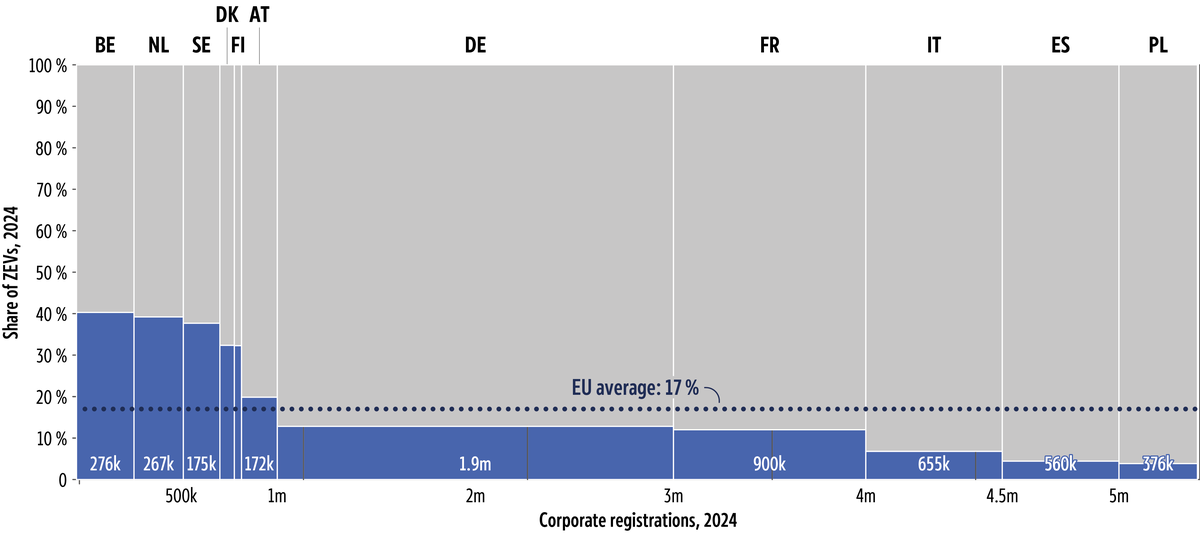
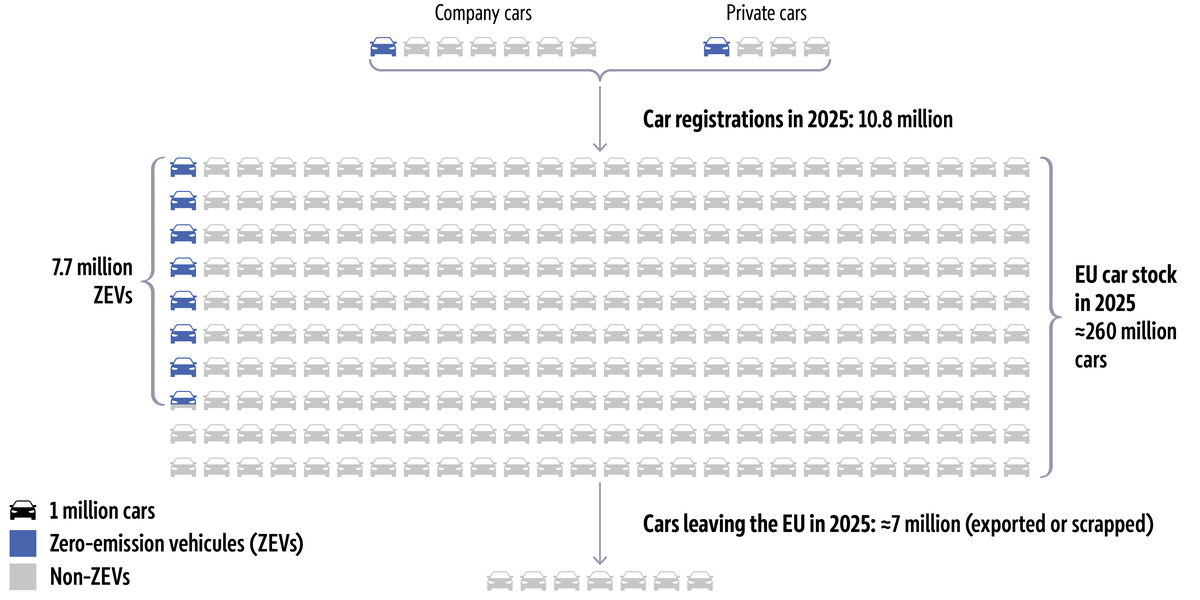
The low adoption of ZEVs among corporate actors is concerning for several reasons. First, the scale of the electrification challenge is significant: as of 2025, only around 7.7 million of the 260 million cars on EU roads were zero‑emission vehicles.
Second, corporate vehicles cover significantly more distance than private ones. In 2020, the average annual mileage for a corporate car was approximately 27 000 km per year against 12 000 km for a private one. Corporate cars drive more than twice as much on average each year, and thus may have significant greenhouse gas‑saving potential. This mileage disparity is even more pronounced for certain fleet vehicles, such as taxis, which can travel between 80 000 and 120 000 km each year. Corporate cars therefore account for a disproportionate share of emissions of newly registered vehicles, making the environmental benefit of their replacement by ZEVs even more significant.
Finally, corporate fleets play an important role in supplying the second‑hand car market, where 80 % of citizens purchase their car. As a result, the choices businesses make regarding their fleets indirectly influence the options available to private buyers. Companies typically sell their vehicles on the second‑hand market after three to four years of use, while leasing cars are usually sold after three to five years, and rental cars and manufacturer‑self‑registered vehicles enter the market in under a year.
Given that the average lifespan of a car in the EU is between 18 (in western Europe) and 28 (in eastern Europe) years, these corporate decisions have long‑lasting effects, extending far beyond the period of company use. Assessing the exact share of corporate vehicles in the second‑hand market is challenging due to the lack of harmonised transaction data at the EU level. However, estimates indicate that leasing companies alone account for 40 % of the cars offered for sale annually in this market.
This dynamic creates a ripple effect: limited adoption of ZEVs by companies reduces the supply and consequently the uptake of ZEVs among private consumers. Conversely, businesses could accelerate the transition by supplying the second‑hand market with nearly‑new ZEVs.
For all these reasons, corporate actors have a pivotal role to play in accelerating the transition from combustion engine vehicles to ZEVs, both in the new and second‑hand markets.
In this context, the European Commission presented its proposal for a clean corporate vehicles regulation (CCVR) in December 2025 as part of the automotive package.The automotive package is listed among the legislative priorities for 2026 in the Joint Declaration of the European Parliament, the Council of the EU and the European Commission.
Main points of the proposal
The proposal aims to speed up the adoption of ZEVs in corporate fleets. The proposal defines a ZEV as a passenger car or light commercial vehicle with tailpipe emissions of 0 g CO₂/km, in line with Article 3(1)(n) of the proposed revision of Regulation (EU) 2019/631. These are mainly battery‑electric vehicles, and fuel‑cell hydrogen‑powered vehicles. It also defines a zero‑ and low‑emission vehicle (ZLEV) as a passenger car or light commercial vehicle with tailpipe emissions of up to 50 g CO₂/km, as per Article 3(1)(m) of Regulation (EU) 2019/631.
The regulation would introduce two categories of minimum targets for Member States regarding the registration of corporate cars and vans by large companies operating within their territory. The first target concerns the share of ZEVs. The second target addresses the combined share of ZLEVs. These targets would be established for 2030 and 2035 and vary by Member State. The proposed targets for each country are outlined in the annex of the proposal (see Figure 3 for cars). At the EU level, these measures are projected to result in 69 % of cars registered by large undertakings being zero‑ or low‑emission by 2030, with 45 % of those being zero‑emission vehicles, and in 40 % of vans registered by large undertakings being zero‑ or low‑emission, of which at least 36 % must be zero‑emission.
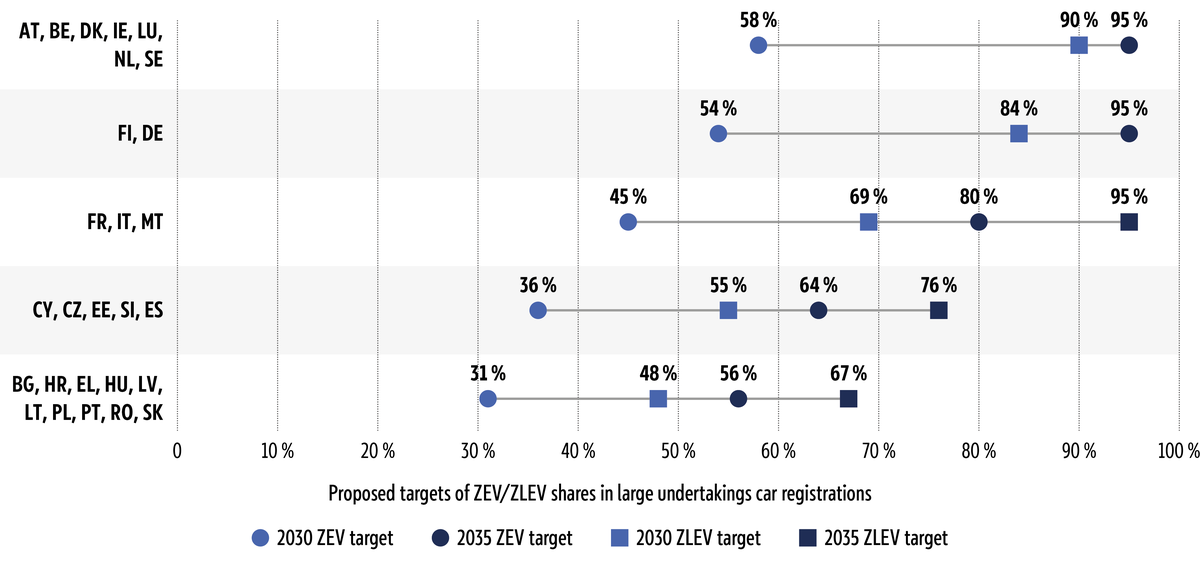
The term ‘large undertaking’ would refer to a large undertaking as defined in Article 3(4) of Directive 2013/34/EU. This includes undertakings that, on their balance sheet dates, exceed at least two of the following three criteria: a balance sheet total of €25 million, a net turnover of €50 million, or an average of 250 employees during the financial year. Transport & Environment (T&E) estimates that, while they make up only 0.16 % of all companies, these large undertakings represent 37 % of all new car registrations in the EU, that is 62 % of corporate car registrations.
The Commission justifies its decision to focus exclusively on large undertakings by highlighting the disproportionate financial burden that SMEs face due to the higher purchase costs of zero‑emission vehicles, reinforced by their limited access to financing. Additionally, the Commission explains its preference for setting mandatory targets at the Member State level rather than for individual companies, by noting that company‑specific targets could impose disproportionate negative impacts on certain businesses. Such an approach would also create unnecessary administrative burdens for both operators and public authorities, given the wide diversity of use cases, operational requirements, and economic performance across corporate vehicle fleets.
As of 2028, Member States would not be allowed to provide financial support for the purchase, lease, rent, hire‑purchase, or operation of corporate vehicles that are not ZLEVs.
Additionally, financial support for the uptake of corporate cars and vans would be limited to vehicles 'made in the EU'. The Commission would be empowered to adopt delegated acts to establish the criteria for determining whether a car or van qualifies as 'made in the EU'.
In March 2026, the Commission put forward a proposal for an Industrial Accelerator Act (IAA), which states that the 'made in the EU' criterion for providing financial support for the uptake of corporate cars and vans should comply with the criteria (set in Part II of Annex III of the IAA proposal):
-
The vehicle must be assembled within the EU.
-
At least 70 % of the ex‑works price of vehicle components (excluding the battery) must originate in the EU. Starting in the third year following adoption, 50 % of the ex‑works price of e‑powertrain components and of main electronic systems will also have to originate in the Union.
-
The vehicle's battery must contain at least three 'main specific components' (which are defined in Implementing Regulation (EU) 2025/1178), among them the battery cells, originating in the EU. This rises to five main specific components starting in the third year following adoption.
Furthermore, the 'Union origin' criterion refers to production limited to the EU (Article 7 of the IAA proposal), and not to the broader definition of Union origin 'equivalent' (Article 8 of the IAA proposal), which includes FTA partners (also known as 'made with the EU').
Additionally, Member States would need to submit a national plan every two years, starting in February 2028, outlining the measures they have in place and intend to implement to achieve the national targets.
Finally, the Commission would conduct a review of the Regulation by 31 December 2032, and amend it where appropriate.
Parliament's position
In the Parliament, the file has been allocated jointly to the committees on the Environment, Climate and Food Safety (ENVI) and Transport and Tourism (TRAN). Tiemo Wölken (S&D, Germany) and François Kalfon (S&D, France) have been appointed rapporteurs. The rapporteurs published their draft report on 11 May 2026. It includes 51 amendments to the Commission proposal. For instance, for 2030 the co‑rapporteurs propose to increase the minimum targets for the share of ZEVs and the targets for the combined shares of ZLEVs in yearly new registrations of corporate cars by large undertakings. For 2035, they propose to retain only minimum targets for the share of ZEVs, and to remove targets for the combined shares of ZLEVs, as they consider that a target for ZEVs would provide a more specific incentive for the decarbonisation of corporate fleets at that time. A total of 560 amendments have been tabled by MEPs in the joint committee.
Council position
Discussions on the proposal began in the Council's Working Party on Land Transport in January 2026. According to a May 2026 progress report, Member States broadly support the objective of accelerating the adoption of ZEVs and strengthening the competitiveness of the EU automotive industry. However, Member States' views differ on the most effective regulatory approach to achieve these objectives. Some Member States have expressed concerns about the mandatory nature of the proposed targets, their proportionality in relation to the administrative burden they may create, and their possible impact on businesses (particularly SMEs). Questions have also been raised about the 'made in the EU' requirement and its possible implications, including the scope of the notion of 'financial support' (Article 4) and how it would interact with national support schemes.
Preparation of the proposal
The European Commission conducted a public consultation from February to July 2024, receiving 268 responses. The majority of participants agreed that the current pace of corporate fleet transitions was insufficient to achieve the Green Deal objectives. They also supported the idea that corporate vehicles should transition to zero‑emission options more rapidly than private vehicles. Regarding policy measures, respondents strongly preferred tax incentives, followed by targeted benefits. Voluntary commitments were widely viewed as less effective, while ZEV mandates were considered more impactful but administratively complex.
On 17 July 2025, a strategic dialogue brought together representatives from automotive industry associations, fleet operators, ride‑hailing platforms, component suppliers, and leasing companies to exchange views with the European Commission. Participants expressed opposition to binding legislative mandates for light‑duty vehicles at the company level. Instead, they emphasised the need for a comprehensive approach, combining fiscal incentives, infrastructure investment, and other enabling measures.
Between July and September 2025, the Commission launched a call for evidence to gather data for the impact assessment accompanying its proposal. The initiative received 490 responses from stakeholders. Additionally, targeted interviews were conducted from July to October 2025. Stakeholders widely agreed that the adoption of ZEVs in corporate fleets remains insufficient to meet EU sustainable transport objectives. They also emphasised the need for strong EU signals to reinforce the EU's industrial leadership in zero‑emission technologies.
Prior to the publication of the proposal (in March 2025), the European Commission adopted a communication entitled 'Decarbonise Corporate Fleets' (COM(2025) 96 final). The aim of this communication was to 'present an overview of the market for the companies and vehicles considered as corporate fleet and their challenges, opportunities and good practices that can help accelerate zero‑emission vehicles update in corporate fleets with the view to achieving the 2035 zero‑emission target'.
The communication also includes actions that Member States could take to increase the uptake ahead of the presentation of the legislative proposal.
The proposal was accompanied by an impact assessment (IA). In June 2026, EPRS published an initial appraisal of this document. Its overall assessment is as follows: the IA provides an informative problem definition, covering the political, legal and market context of the initiative, and identifies the problems and the problem drivers, even though it illustrates their scale only partially. Two groups of policy options are presented and clearly explained. In addition, the IA provides information on the discarded policy options. However, the retained options, which are limited only to introducing minimum targets and reporting and monitoring requirements, are not entirely alternative policy options, and the range of options is limited. Both policy option groups propose the same target measures for light‑duty vehicles; they differ only in the measures regarding lorries.
The IA assesses economic, environmental and social impacts, with the focus on the economic assessment. The analysis is largely based on modelling; the models used, and the assumptions and data sources, are explained in a dedicated annex. The initiative is relevant for small and medium‑sized enterprises (SMEs) and, consequently, an SME Test was carried out. The competitiveness dimension is embedded in the assessment, which also includes a competitiveness check annex. The IA transparently explains uncertainties in the assessment, which are largely linked to the fact that the policy options leave full flexibility to the Member States to decide on the measures to achieve the defined targets. This affects the impact analysis (costs/benefits) and the comparison of options (effectiveness/efficiency).
It is noteworthy that the IA does not select a preferred option (it only indicates a preferred policy option group) as it considers that the choice requires a political decision. The IA does not discuss in much detail the parallel initiative on the review of CO2 emissions performance standards of light‑duty vehicles (cars and vans), which is also part of the automotive package, even though an overall assessment of the package and the combined effects of these two complementary initiatives would have improved the analysis. The legislative proposal differs from the IA options, for example in terms of scope (lorries excluded) and target setting. It also defines rules for financial support for corporate vehicles.
European Economic and Social Committee
In its opinion adopted in March 2026, the European Economic and Social Committee (EESC) recommends that the regulation maintain a clear signal for ZLEVs. The EESC highlights that national targets should not fall below current market delivery levels. The targets should not be transformed into company‑based obligations during transposition, and should be accompanied by the effective deployment of charging infrastructure and sufficient electricity grid capacity to preserve business competitiveness. Furthermore, the EESC urges Member States to consider tax incentives for decarbonising corporate fleets, including the removal of direct and indirect advantages for fossil‑fuel company cars. It reaffirms the principle of technological neutrality in decarbonising road transport. Finally, the EESC calls for EU‑level oversight of national plans. This oversight should evaluate the completeness and progress of national plans against established targets, facilitate structured comparisons, and support corrective follow‑up and shared learning.
Points of view
T&E supports the proposed regulation's design, specifically its use of binding targets at the Member State level rather than for individual companies, and the flexibility granted to national governments. However, T&E argues that the current level of ambition is insufficient. The NGO stresses that the proposed targets merely encourage large companies to maintain business‑as‑usual practices and align with market averages, rather than positioning them as leaders in sustainability. T&E calls for a revision of the proposed EU‑wide 2030 target (69 % ZLEV, with a minimum 45 % ZEV), which it notes falls below even the least ambitious scenario in the impact assessment. Instead, T&E advocates a 69 % ZEV‑only target. Additionally, T&E urges the exclusion of plug‑in hybrid electric vehicles (PHEVs) from the proposal's scope, stressing that their real-world emissions are comparable to those of conventional hybrids and combustion‑engine vehicles. T&E warns that the current 2030 targets risk slowing progress in Member States that have already made significant strides in electrifying their corporate fleets between 2021 and 2025, such as Belgium, Denmark, Finland, Luxembourg, the Netherlands, Portugal, and Sweden. Finally, T&E fully endorses Article 4 of the proposal, which seeks to phase out public financial support for fossil fuel company cars and introduce 'made in the EU' criteria for any financial incentives related to corporate electric vehicles.
Fleet operators and lessors have expressed strong opposition to the introduction of binding targets. Leaseurope, which represents 46 national leasing and vehicle rental associations, argues that such targets are the wrong instruments and instead calls for incentive‑based frameworks. The organisation emphasises that the primary barriers to accelerating the corporate adoption of ZEVs across the EU are the high total cost of ownership for fleet management and the insufficient charging infrastructure, both of which contribute to low consumer demand. Prior to the proposal, Leaseurope, along with major leasing companies (Arval, Ayvens) and several car rental firms (Sixt, Hertz, Europcar), had already submitted a joint letter to the Commission advocating this position.
Vehicle manufacturers globally oppose the use of ZEV mandates to green corporate fleets. The European Automobile Manufacturers' Association (ACEA), which represents Europe's 17 major vehicle manufacturers, argues that such mandates risk undermining market dynamics and instead advocates for an incentive‑based approach. Prior to the proposal, several companies had already expressed similar concerns, including Mazda Motor, Volkswagen's heavy‑duty truck subsidiaries MAN and Scania (during the Commission's public consultation), as well as BMW and Toyota in a joint letter published in December 2025. Notable exceptions include Volvo Cars, which supports ambitious targets for ZEV adoption, alongside incentives to stimulate demand for ZEVs in the second‑hand market.
The electric mobility sector has widely welcomed the proposal. E-mobility Europe, which represents 80 members, including electric vehicle manufacturers such as Tesla and Volvo Cars, infrastructure providers, and other e‑mobility stakeholders, expressed satisfaction with the proposal and supported the introduction of binding targets. However, the organisation highlighted the exclusion of heavy‑duty vehicles from the proposal's scope as a missed opportunity, with the industry calling for a more robust demand pathway for e‑trucks. Similarly, Eurelectric, the federation representing the European electricity industry, also expressed extensive support for the proposal's design.
The European fuel manufacturers association (FuelsEurope) argues that the proposal should be fundamentally reconsidered, citing serious concerns about its alignment with the principles of technological neutrality and industrial realism. The organisation regrets that vehicles powered exclusively by renewable fuels are not included, thereby excluding other low‑carbon and renewable solutions that are essential for a 'balanced and resilient decarbonisation pathway'.
In a joint letter published in October 2025, several major companies managing significant corporate fleets (including IKEA, Maersk, PepsiCo, Nestlé, and Tesco) advocated for binding zero‑emission targets for large shippers and buyers of transport services.
Supporting analyses
- M. Tuominen, Clean corporate vehicles – Initial Appraisal of a European Commission Impact Assessment, EPRS, European Parliament, June 2026.
- G. Ragonnaud with R. Wainstain, EU automotive omnibus, EPRS, European Parliament, April 2026.
- J. Lopez Hernandez, Revision of CO2 emission performance standards for new light-duty vehicles and vehicle labelling, EPRS, European Parliament, February 2026.
- N. Sarris, CO2 emission standards for cars and vans, EPRS, European Parliament, April 2026.
- A. Widuto, Industrial Accelerator Act, EPRS, European Parliament, April 2026.
Classification
Policy areas: Industry | Environment
Regions: European Union
Committees: Industry, Research and Energy (ITRE), Environment, Climate and Food Safety (ENVI)
Statement on the use of AI
Any AI‑generated content in this text has been reviewed by the authors. Mistral Vibe and Claude Anthropic were used to improve the readability of the text and broaden the range of sources available to the authors.
Disclaimer
This document is prepared for, and addressed to, the Members and staff of the European Parliament as background material to assist them in their parliamentary work. The content of the document is the sole responsibility of its author(s) and any opinions expressed herein should not be taken to represent an official position of the Parliament.
Copyright
© European Union.
The reuse of this document is authorised under a Creative Commons Attribution 4.0 International (CC-BY 4.0) licence.

To use or reproduce elements that are not owned by the European Union, permission may need to be sought directly from the respective rightsholders.