
Article page checkbox is not checked in page info.
Towards NATO's 2026 Ankara Summit
Towards NATO's 2026 Ankara Summit
Linda Tóthová, Members' Research Service
Summary
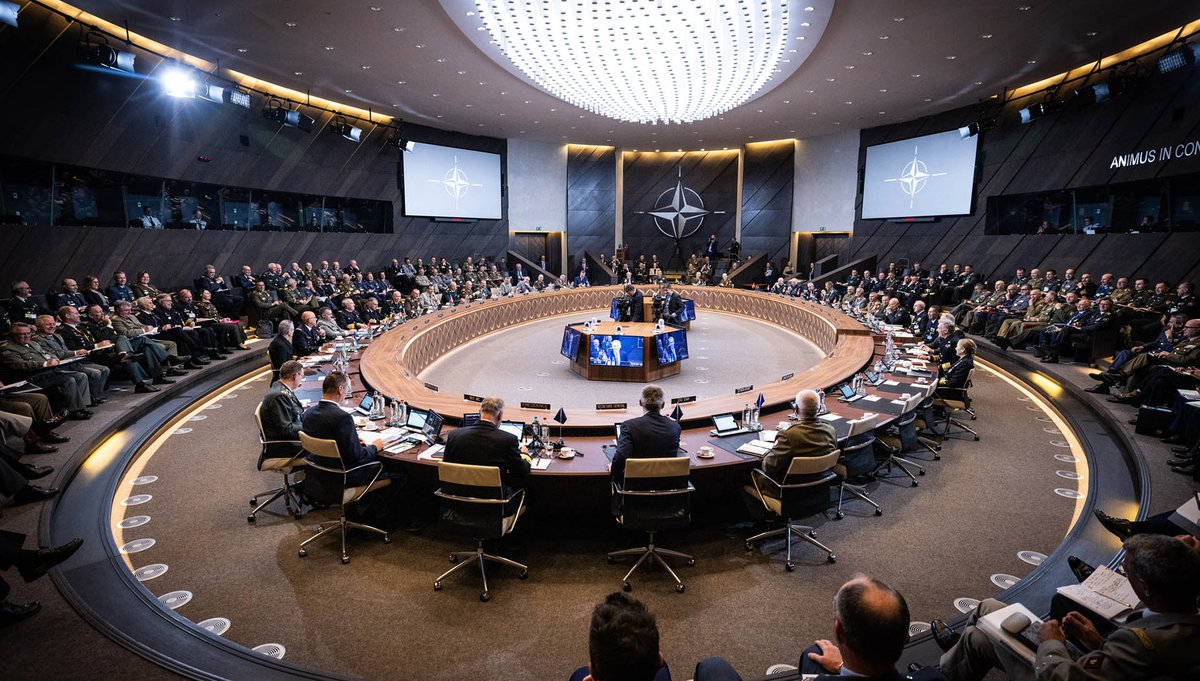
The NATO Summit, taking place on 7-8 July 2026, will be hosted by Türkiye at Ankara's Beştepe Presidential Compound. This marks the second time that Türkiye hosts a NATO Summit, following Istanbul in 2004. The summit is expected to be a key moment for demonstrating Allied unity amid evolving geopolitical dynamics in the Middle East, the war in Ukraine, and calls for Europe to assume a stronger role in its security. Agenda items will likely include defence planning, spending targets, burden-sharing, and support for Ukraine. The summit will consist of a formal leaders' meeting and a parallel defence industry forum.
Background
The summit in Ankara will mark the second time Türkiye has hosted a NATO Summit since joining the Alliance in 1952. However, the summit will take place against the backdrop of US President Donald Trump's continued questioning of the Alliance's value, US efforts to assert control over Greenland, recent announcements on troops and equipment drawdown, war in Ukraine, and instability in the Middle East, including US criticism of Europe's limited support for US action against Iran. At the same time, EU Member States have begun increasing defence spending, enhancing readiness and deterrence, strengthening bilateral cooperation, operationalising Article 42(7) TEU, and developing a new European security strategy reflective of the complex security environment.
With the second-largest armed forces in NATO, Türkiye forms a key pillar in the Alliance's defence architecture. It hosts the NATO Rapid Deployable Corps in Istanbul, a high-readiness headquarters capable of rapid deployment to command NATO operations within or beyond Allied territory, NATO's Allied Land Command in İzmir, and an early-warning radar facility in Kürecik. Ankara also hosts the NATO Centre of Excellence for Defence Against Terrorism and the Partnership for Peace Training Centre, which supports training and interoperability with NATO's partner countries. In October 2025, Türkiye assumed command of the Kosovo Force peacekeeping mission. In the Black Sea, Türkiye has deepened cooperation with Romania and Bulgaria through joint mine-clearing operations. Reflecting NATO's evolving priorities, Turkish presidential advisor Çağrı Erhanv expects the upcoming summit to focus on Ukraine and the Middle East, defence spending, and NATO's ongoing structural and conceptual transformation.
NATO's defence budgets
The 23 EU Member States that are also NATO Allies have long been guided by NATO's 2 % of GDP defence spending commitment, formalised at the 2014 Wales Summit – a benchmark that most NATO Allies now appear to meet, although with some challenges to sustaining it in 2026. At the June 2025 Hague Summit, Allies (apart from Spain) pledged to invest 5 % of GDP annually in defence requirements and security-related spending by 2035. Specifically, Allies agreed to allocate at least 3.5 % of GDP to core defence requirements and to meet NATO Capability Targets, and up to 1.5 % of GDP to areas such as cyber, infrastructure protection, resilience, preparedness, innovation and reinforcing of the defence industrial base. The balance of spending will be reviewed in 2029. Notably, the Hague Summit broadened the concept of defence beyond military capabilities to include areas in which the EU possesses significant policy and regulatory strengths. The European Defence Agency (EDA) estimates that a commitment to meet the 3.5 % of GDP target would bring total EU defence expenditure to approximately €635 billion, up from €381 billion in 2025.
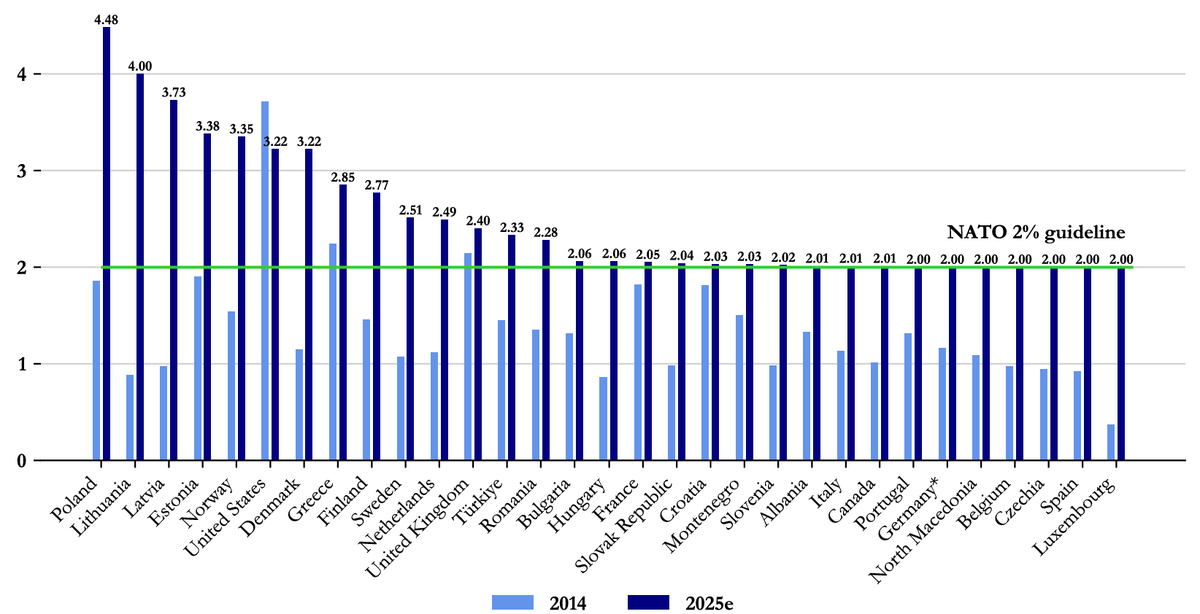
Source: NATO, Defence Expenditure of NATO Countries (2014-2025), Press Release, 2025.
Burden-sharing
The balance of responsibilities within NATO has become a prominent issue. Addressing the Parliament's Foreign Affiars (AFET) and Security and Defence (SEDE) Committees in January 2026, NATO Secretary-General Mark Rutte underscored the US's role in European security while cautioning that efforts to bolster the 'European pillar' of NATO should not undermine transatlantic cohesion. Meanwhile, in February 2026, US Undersecretary of War Elbridge Colby called for a 'NATO 3.0' that would see Europeans assume more responsibility. In early June 2026, US Army Command Europe indicated that Washington would 'rightsize' US contributions to the NATO Force Model.
Ahead of the summit, US Secretary of War Pete Hegseth announced a review of US force posture and basing in Europe, due by the end of 2026. The US also reportedly expects European Allies to assume primary responsibility for most of NATO's conventional defence in Europe by 2027. The announcements followed reports of possible reductions in US military presence in Europe and a classified list of NATO-assigned US capabilities which could be withdrawn. These developments highlight Europe's continued reliance on US strategic enablers, including intelligence, surveillance and reconnaissance (ISR), air-to-air refuelling, strategic airlift, command and control and long-range strike – some of which, experts estimate, could be developed within the next 5-10 years.
Defence industry
NATO's role in the defence industrial domain remains limited, focusing primarily on standards, interoperability and capability coordination rather than acting as a direct driver of industrial policy. Defence industry, once characterised as 'not core NATO business', is an area where the EU instead plays a role in shaping industrial capacity, investment frameworks and supply-side support. As Allies seek to accelerate production, expand procurement and meet NATO Capability Targets, the leaders are reportedly considering a revision of NATO's 2013 Framework for NATO Industry Engagement, which governs relations between the Alliance and the defence sector. Proposed changes could include greater industry participation in NATO exercises or the introduction of NATO certification mechanisms for innovative technologies.
These proposals build on NATO's Rapid Adoption Action Plan, agreed at the Hague Summit, which seeks to reduce the time required to adopt new technologies to a 'maximum of 24 months'. Additional proposals aimed at industry could include making some NATO requirements available to industry and sharing classified standards with trusted firms. In parallel, the EU has intensified efforts to strengthen its defence industrial and innovation base through initiatives such as the Defence Readiness Roadmap 2030, the €1.5 billion European defence industry programme, the €115 million AGILE innovation programme, and the first disbursements of loans under the €150 billion SAFE framework. This has been complemented by activating national escape clauses for 18 Member States to support defence investment, 17 of which are NATO Allies. Taken together, these initiatives may help demonstrate to Washington that European Allies are assuming a greater share of the investment burden, albeit through an increasingly pronounced 'buy European' approach to procurement.
Support for Ukraine
Since Ukraine's September 2022 bid for fast-track NATO membership, Allies have continued to provide substantial military and financial support, building on assistance that predated Russia's full-scale invasion. Support has been coordinated through several mechanisms including the Ukraine Defence Contact Group and the Prioritised Ukraine Requirements List (PURL), under which participating states have pledged over US$6.5 billion for military equipment from US stockpiles, including about US$2 billion from NATO Allies, with further commitments expected in Ankara. In early June, Allies discussed a new €70 billion military assistance package to be announced at the summit, under which around €30 billion could come from the EU's €90 billion loan.
According to the Kiel Institute, European countries allocated €2 billion per month in military aid to Kyiv between January and April 2026. Ukraine received approximately US$45 billion in security aid from its partners in 2025, nearly 30 % more than in 2024, covering, inter alia, ammunition, air and missile defence systems, procurement, training and logistics. Speaking alongside NATO Secretary-General Rutte in June, Ukrainian President Volodymyr Zelenskyy, who is expected to attend the Ankara Summit, urged Allies to supply additional air-defence interceptors and said that Ukraine had secured agreements with 'several countries' to take their place in the queue for delivery of US Patriot missiles.
Expert views
Former NATO spokesperson Oana Lungescu argues that the summit is intended to project transatlantic unity and reaffirm Allies' commitment to higher defence spending. The Center for Strategic and International Studies says that the summit should call for a clearer division of roles, effective conversion of defence spending into deployable capabilities and sustained support for Ukraine. According to the director of the EU Institute for Security Studies, the summit should explore options for a gradual European takeover should the US withdraw key capabilities. On defence industry, former NATO Assistant Secretary-General Camille Grand, now at ASD Europe, calls for expanded defence production capacity, assessments of industrial readiness, EU-NATO classified information-sharing and public-private cooperation.
European Parliament position
In June 2026, Parliament's Delegation to the NATO Parliamentary Assembly (PA) participated in its spring session in Vilnius, focusing on defence strengthening, innovation, Allied unity and support for Ukraine. DNAT holds 10 seats across five NATO PA committees and participates as a 'Partner for Comprehensive Security'. In its 2026 resolution on Implementation of the common security and defence policy – annual report 2025, Parliament stressed EU-NATO cooperation on weapons deliveries to Ukraine, called for greater intelligence-sharing, interoperability and planning synergies, noted the 'ambiguous behaviour [of Türkiye] through its lack of sanctions against Russia' and pointed to 'growing unpredictability' in US foreign policy. In February 2026, Parliament called for more joint exercises, staff-to-staff cooperation, 'EU-NATO ministerial consultations', stronger commitments by EU NATO members, and greater standardisation to improve resource efficiency.
Classification
Policy areas: Foreign Affairs | Security and Defence
Committees: Foreign Affairs (AFET), Security and Defence (SEDE)
Disclaimer
This document is prepared for, and addressed to, the Members and staff of the European Parliament as background material to assist them in their parliamentary work. The content of the document is the sole responsibility of its author(s) and any opinions expressed herein should not be taken to represent an official position of the Parliament.
Copyright
© European Union.
The reuse of this document is authorised under a Creative Commons Attribution 4.0 International (CC-BY 4.0) licence.

https://creativecommons.org/licenses/by/4.0/deed.en
To use or reproduce elements that are not owned by the European Union, permission may need to be sought directly from the respective rightsholders.