
Article page checkbox is not checked in page info.
Outlook for the European Council, 18-19 June
Outcome of the European Council meeting, 18‑19 June 2026
Ralf Drachenberg, Annastiina Papunen and Rebecca Zamponi, European Council Oversight Unit
Summary
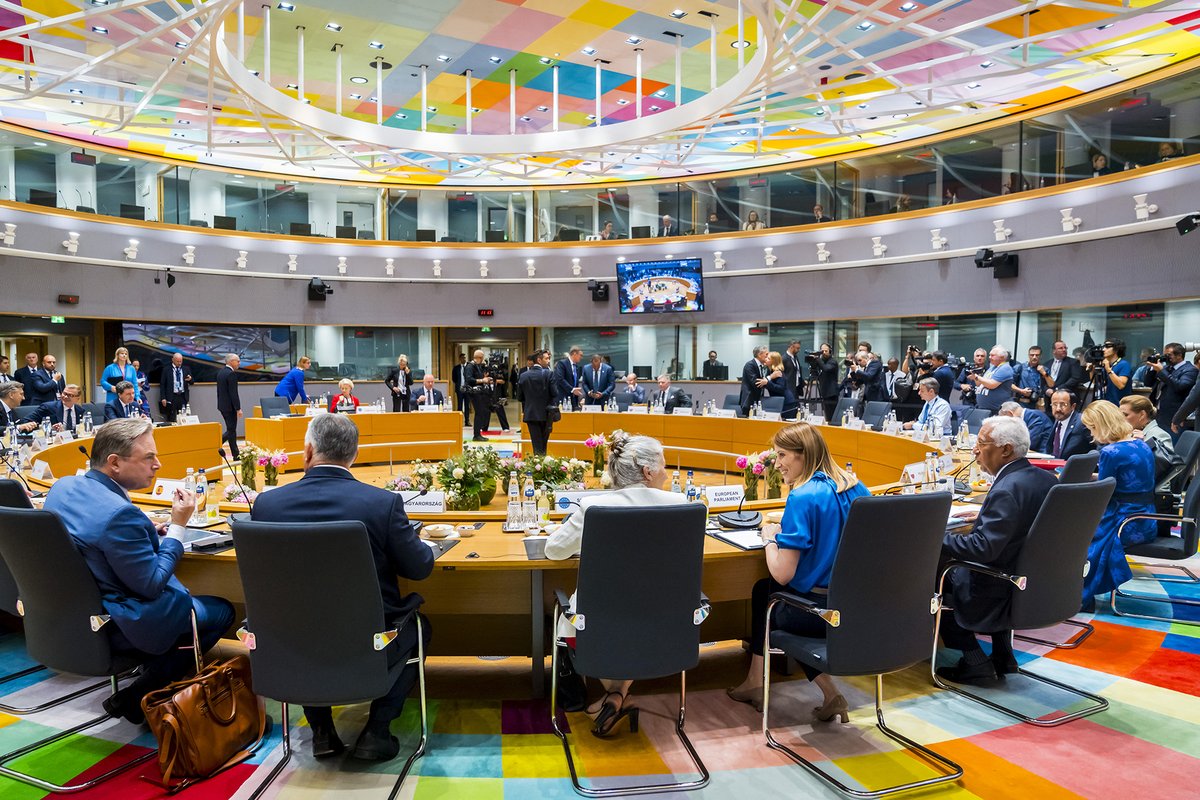
Ukraine, competitiveness and global economic challenges, the EU's next budget and the situation in the Middle East were the main discussion points at the 18‑19 June 2026 meeting of the European Council. On Ukraine, EU Heads of State or Government adopted joint conclusions of all 27 Member States for the first time since March 2025, and stressed their determination to increase pressure on Russia – signalling it with the agreement to roll over the sanctions for 12 rather than the previous six months. This was coupled with a marked welcome for the opening of the first negotiation cluster for Ukraine and Moldova, and a sense of new momentum on enlargement, also for the countries of the Western Balkans.
Regarding competitiveness and global economic imbalances, EU leaders requested the Commission sharpen the EU's trade defence tool box and possibly complement it with new instruments, thereby pursuing a path of diversification and de-risking of the EU's trade relationships. The discussion on the next multiannual financial framework was seen as a step towards an agreement by the end of 2026, with the incoming Irish Presidency being called on to present a revised negotiation box for the October meeting; in parallel, further work will be carried out on options for new own resources. Regarding the situation in the Middle East, the European Council welcomed the memorandum of understanding between the US and Iran, but expressed serious concern about the situation in Lebanon, Gaza and the West Bank. Other topics mentioned in the conclusions were Ebola, Armenia, upholding international law, and Islands and coastal communities.
1. General
As usual, the European Council meeting was preceded by meetings of different European political families, gathering their affiliated EU leaders. Other meetings of EU leaders took place prior to the European Council meeting: EU leaders belonging to the 'Friends of Cohesion' group met for the first time in this round of MFF negotiations, hosted by Romanian President Nicușor Dan and Italian Prime Minister Giorgia Meloni. Likewise, leaders from the Visegrád countries (Czechia, Hungary, Poland and Slovakia) had their first meeting since 2024 in the margins of the European Council; this 'V4 alliance' traditionally met ahead of European Council meetings, but these meetings were suspended due to the previous Hungarian government's stance on Russia's invasion of Ukraine. The group of like-minded EU leaders on migration met in the morning of the second day of the European Council meeting.
The European Council meeting itself started as usual with the opening address by the President of the European Parliament, Roberta Metsola. In addition to the main agenda points, she presented Parliament's position on proxy voting for female Members of the European Parliament, as well as on preventing and combating child sexual abuse.
2. European Council meeting
Ukraine
EU leaders unanimously agreed conclusions on Ukraine for the first time since March 2025. They welcomed the Intergovernmental Conferences on the accession of Ukraine and Moldova and the opening of the fundamentals cluster. The opening of further clusters during the incoming EU Council presidency is increasingly likely, as underlined by the Irish Taoiseach, Micheál Martin. During his customary exchange of views with EU leaders, Ukrainian President Volodymyr Zelenskyy called, in particular, for fast-tracked accession for Ukraine.
While condemning Russia's 'recent serious escalation' as well as its 'increasingly aggressive, reckless and irresponsible behaviour towards EU Member States', the European Council highlighted the importance of accelerating the production and delivery of priority military equipment and of enhancing defence industrial cooperation between the EU and Ukraine. EU leaders also welcomed the imminent first release of funds to Ukraine as part of the EU's €90 billion support loan, as well as the upcoming Ukraine Recovery Conference in Gdansk on 25-26 June 2026.
The European Council signalled its support for diplomatic efforts to bring the war to an end, emphasising the EU's readiness to get involved in peace negotiations eventually – as suggested in Zelenskyy's open letter to Russian President Vladimir Putin; the EU could also contribute to security guarantees for Ukraine, notably through the Coalition of the Willing. Contacts made by European Council President António Costa's cabinet with Russian officials to establish a diplomatic channel triggered a lengthy discussion on the appropriate representation of the EU in the event of peace talks – although the overall view was that the debate was premature considering the lack of openness on the side of Russia. Costa, who felt compelled to justify his move, emphasised that the EU did not intend to be a mediator, since the EU was on the side of Ukraine, but that in peace negotiations the EU institutions would need to defend the EU's interests in accordance with the Treaties.
In line with their determination to further increase pressure on Russia's war economy, EU leaders called for the swift adoption of the 21st sanctions package, and agreed on the roll-over of the existing Russian sanctions for 12 months instead of only six, as had been the practice up until now. French President Emmanuel Macron underlined that the EU shared the commitment of pressuring Russia with all G7 partners since the meeting in Evian just a few days before, stressing that this joint positioning created new dynamics. Considering the potential threat posed to the EU's internal security by Russian ex-combatants involved in Ukraine, EU leaders encouraged further technical work on the proposed ban on their entry into the EU. Finally, following recent controversies, EU leaders expressed the view that, as long as there was no peace with Ukraine, Russia's participation in international sports and cultural events should not be normalised.
Middle East
Following the signature of the memorandum of undertanding (MoU) between the US and Iran in Versailles, the European Council welcomed the opportunity for regional stability and restoration of freedom of navigation in the Strait of Hormuz. EU leaders reiterated that 'Iran must never be allowed to acquire a nuclear weapon' and called on the country to end its destabilising activities, notably its ballistic missile programme, an issue not covered by the MoU. EU Member States also reiterated their commitment to cooperate in preventing and countering the threat from the Iranian intelligence services.
EU leaders expressed grave concern over the worsening situation in Gaza and the West Bank. While reiterating previous conclusions on Gaza relating to i) the unimpeded access to and work of UN and humanitarian organisations in Gaza, ii) the urgent release of all clearance revenues withheld by Israel, iii) the support to the Palestinian Authority and iv) the repeal of Israel's death penalty law, they stressed their concern at the lack of progress in the implementation of UNSCR 2803, notably on the disarmament of Hamas and the withdrawal of Israeli forces from Gaza. They also strongly condemned Israel's intention to control 70 % of Gaza as well as the mistreatment of detainees from the Global Sumud Flotilla.
On Lebanon, EU leaders reiterated calls for a permanent end to hostilities – a constitutive element of the US-Iran MoU – and expressed concern about continued ceasefire violations, noting the EU's readiness to support the implementation of the ceasefire. While condemning attacks by Hezbollah on Israel and calling for its disarmament, EU leaders urged Israel to respect the sovereignty and territorial integrity of Lebanon in line with UNSCR 1701. They also stressed the importance of a continued UN presence in Lebanon in a post-UNIFIL context, reaffirming the EU's readiness to contribute in this regard in 2027.
Next multiannual financial framework
EU leaders had an in-depth exchange of views on the next MFF. However, the conclusions on the topic were brief, and did not include any specific details. Despite the absence of any clear results, Costa concluded that the EU was now 'one step closer to a new European budget from 2028 that matches [its] ambitions]'. He also stressed again the need to find an agreement by the end of 2026, and was supported in this objective by many leaders, including German Chancellor Friedrich Merz.
So far, EU leaders have repeated their known positions. While some argued that the budget needed to be ambitious (e.g. Spanish Prime Minister Pedro Sánchez and Romanian President Nicușor Dan), others said that the budget needed to be smaller (e.g. Merz, Danish Prime Minister Mette Frederiksen and Austrian Chancellor Christian Stocker). Some EU leaders called for a modern budget, focused on competitiveness as well as security and defence investments (e.g. Frederiksen and Dutch Prime Minister Rob Jetten), while others warned against reducing funding for the traditional policy areas of cohesion and agriculture (e.g. Maltese Prime Minister Robert Abela, Stocker, and Greek Prime Minister Kyriakos Mitsotakis). Some stressed the importance of both traditional policies and more modern ones, such as artificial intelligence (e.g. Macron, Sánchez and Meloni).
In the run-up to the European Council meeting, EU ministers had already agreed on key elements of the new architecture of the 2028-2034 MFF, as proposed by the European Commission, which President Ursula von der Leyen considered to be an important step in the MFF negotiations. Thus, EU leaders will continue their discussions at the 15 October 2026 European Council meeting, based on a revised negotiation box to be put forward by the incoming Irish Presidency.
The Irish Presidency is also expected to put forward an ambitious and balanced package of new own resources. Most EU leaders were constructively open towards additional resources to complement national GNI contributions, and also towards the European Parliament's proposals, but none of the options are commanding consensus as yet. Thus, further technical work will be required and von der Leyen indicated that 'there needs to be a shared understanding how to finance the next MFF'at the next European Council meeting.
Main message of the President of the EP: President Metsola stressed that, during the negotiations, 'Parliament will be constructive but will also defend its position'. She appealed to the EU leaders to make progress on the use of new own resources, as they can also help to overcome 'old dividing lines' such as between supporters of cuts versus increases. She also requested 'to involve MEPs as much and as early as possible' in the discussions on the MFF.
Competitiveness and global economic challenges
'Global macroeconomic imbalances' – a clear reference to China without explicitly mentioning it – was centre stage in the competitiveness discussion. The debate, which took place over dinner on Thursday night, resumed the discussions left off at the G7 meeting in Evian just days earlier. The EU has a long-standing trade deficit with China, with the largest ever trade deficit in 2025, €360 billion: 'That is a deficit of €1 billion per day', von der Leyen stressed after the meeting. Thus, EU leaders are worried that cheap state-subsidised imports from China will severely hurt EU industries and erode the EU manufacturing base, causing 'China Shock 2.0'.
EU leaders seemed to make progress towards a common position. Ahead of the meeting, France proposed creating a tool similar to the US Section 301, with which the EU could impose targeted tariffs or import quotas on countries that employ unfair trade practices. France also teamed up with Italy, Spain, the Netherlands and Lithuania to call for tougher trade measures. Even Germany, which has traditionally been reluctant to impose restrictions on China, stated that the EU must protect itself from trade distortions. However, the situation is complicated by the fact that the EU is also heavily dependent on China for many critical raw materials, imports which are crucial for the EU's digital and green transitions as well as for its rearmament efforts. In that context, concerns have been expressed as to the consequences of stronger EU action, which could trigger Chinese retaliation and create further problems for EU economies. Ahead of the discussion on Thursday, Sánchez, known as one of the friendliest EU leaders towards China, stated that the 'EU needs new friends' and needed to be pragmatic in the current fragmented and confrontational global politics.
The discussion behind closed doors did not produce concrete action points in the conclusions themselves; these just mention that: 'The European Council held a strategic debate on the issue of global macroeconomic imbalances'. However, according to reports and the post-meeting press conference, EU leaders clearly tasked the Commission with taking a twofold approach. On the one hand, the EU should pursue dialogue with Beijing – the policy line being to accelerate de-risking, but not to decouple, as von der Leyen underlined. On the other hand, the Commission was asked to sharpen the current trade defence toolbox and to 'eventually' develop further instruments, such as the diversification instrument, to help the EU to defend its interests. Countries in favour of quicker action were reportedly dissatisfied with the word 'eventually', preferring work to start imminently. The discussions are likely to continue in other settings, and the Commission will closely monitor the situation, also with global partners.
As part of the competitiveness discussion, the European Council took stock of the 'One Europe, One Market' agenda – and the corresponding roadmap – which was signed in the sidelines of the informal meeting in Cyprus in April, with Costa thanking the outgoing Cyprus Presidency for their excellent work on the economic action plan. According to Metsola, who participated in the EU leaders' discussions on this agenda point, 'regularly reviewing the progress we are making on this roadmap in our discussions here, would be an excellent way to map progress and focus on delivering'. In addition, EU leaders discussed energy and followed up on their March meeting, at which they decided to review progress in June. The upcoming review of the emissions trading system (ETS) was mentioned in a more prominent way than expected. The European Council took note of 'the Commission's intention to come forward with a concrete proposal by mid-July 2026' and of 'a separate proposal to address concerns expressed by some industrial sectors on ETS benchmarks'. EU leaders will resume their discussions on competitiveness at their next formal meeting in October 2026.
European defence and security
EU leaders agreed that Europe's defence readiness must be decisively brought forward by 2030, notably by reducing strategic dependencies and addressing critical capability gaps. They strongly condemned recent hybrid attacks and campaigns, with leaders calling for increased efforts to 'prevent, deter and respond' to hybrid attacks.
The European Council: welcomed: i) increases in defence expenditure in Member States; ii) progress in all priority capability areas; iii) the political agreement on the Defence Readiness Omnibus, calling on co-legislators to conclude the file by the end of 2026; iv) initiatives to learn from Ukraine's experience; and v) the work on the action plan on drone and counter-drone security. Security and defence issues will be again discussed by the European Council in October 2026, following the publication of the annual defence readiness report.
EU leaders called on: i) Member States to speed-up work in all capability coalitions; ii) Member States to strengthen engagement with the defence industry, ensuring close alignment between the capability and industrial dimensions; iii) the Commission, the Council, and the Member States to make full use of instruments regarding capability development and industrial reinforcement, and to take the further steps needed in the implementation of SAFE and European defence industry programme instruments; and iv) the co-legislators to agree on AGILE and the military mobility proposal by the end of 2026.
Migration
Due to time limitations, migration was only briefly discussed by EU leaders, albeit in a heated manner. Ahead of the meeting, 19 EU countries signed a letter calling for action on return hubs for migrants, suggesting in particular the use of EU funds to finance them. This proposal was strongly rejected by Macron and Sánchez.
Frederiksen called for a future European Council to discuss migration in more detail, and Costa suggested scheduling this discussion for October 2026, a point then confirmed in the conclusions.
Main message of the President of the EP: 'This week, the European Parliament passed the Return Regulation. With the Pact on Migration and Asylum in application, Europe now has the tools to address this challenge. We did our part. And we will deliver on the rest too. Like we managed to deliver on new Air Passenger Rights, thanks to the excellent cooperation between the institutions and the commitment of the rapporteurs, the Cyprus Presidency and everyone else involved.'
Fight against illicit drugs
As flagged up in the EPRS outlook, EU leaders discussed the fight against illicit drugs for the first time. The European Council took note of the Commission's intention to propose a new horizontal sanctions regime targeting transnational organised crime groups. EU leaders will return to this issue to assess progress.
European Semester
As usual, EU leaders discussed the tailored country-specific recommendations, based on a horizontal note, which allowed the European Semester to be concluded. The Commission had published the spring package on 3 June.
Disclaimer
This document is prepared for, and addressed to, the Members and staff of the European Parliament as background material to assist them in their parliamentary work. The content of the document is the sole responsibility of its author(s) and any opinions expressed herein should not be taken to represent an official position of the Parliament.
Copyright
© European Union.
The reuse of this document is authorised under a Creative Commons Attribution 4.0 International (CC-BY 4.0) licence.

https://creativecommons.org/licenses/by/4.0/deed.en
To use or reproduce elements that are not owned by the European Union, permission may need to be sought directly from the respective rightsholders.