
Article page checkbox is not checked in page info.
Alcohol labelling in the EU: Public health, consumer information and policy challenges
Alcohol labelling in the EU: Public health, consumer information and policy challenges
Ivana Katsarova, Members' Research Service
Summary
Labelling is intended to help consumers make informed choices about the food and beverages they consume. In the EU, food information is primarily governed by Regulation (EU) No 1169/2011. Yet alcoholic beverages remain partly exempt from standard labelling requirements, despite alcohol being linked to more than 200 health conditions and causing 656 deaths daily across the EU, which also has some of the world's highest consumption levels, with 77 % of adults consuming alcohol. Alcohol is also a major factor in injuries, road deaths, and premature mortality.
Despite these risks, EU labelling rules remain limited. Ingredient lists and full nutrition declarations are mandatory only for wine. Other alcoholic beverages – above 1.2 % alcohol – are exempt. Some information, such as alcohol strength and certain allergens, must be displayed, but broader transparency is often voluntary or provided digitally. Recent reforms for wine require ingredient and nutrition information, partly via QR codes, signalling a shift toward greater disclosure.
The World Health Organization advocates mandatory, standardised health warnings, including cancer risk information, to improve consumer awareness and reduce harmful consumption. Evidence suggests such labels can influence behaviour, though impacts vary depending on design and context. Calorie labelling is generally supported by consumers but shows mixed effects on purchasing and consumption.
National approaches differ, with only a few EU countries mandating health warnings. Ireland is set to become the first country in the EU to require cancer warnings on labels from September 2028. Industry-led self-regulation has improved information availability, particularly for beer and spirits, but remains inconsistent. Overall, clearer labelling – combined with broader policy measures – can play a meaningful role in reducing alcohol-related harm, but stronger, harmonised EU action is still needed.
This is an update of a briefing originally published in May 2025.
Why clear alcohol labelling matters
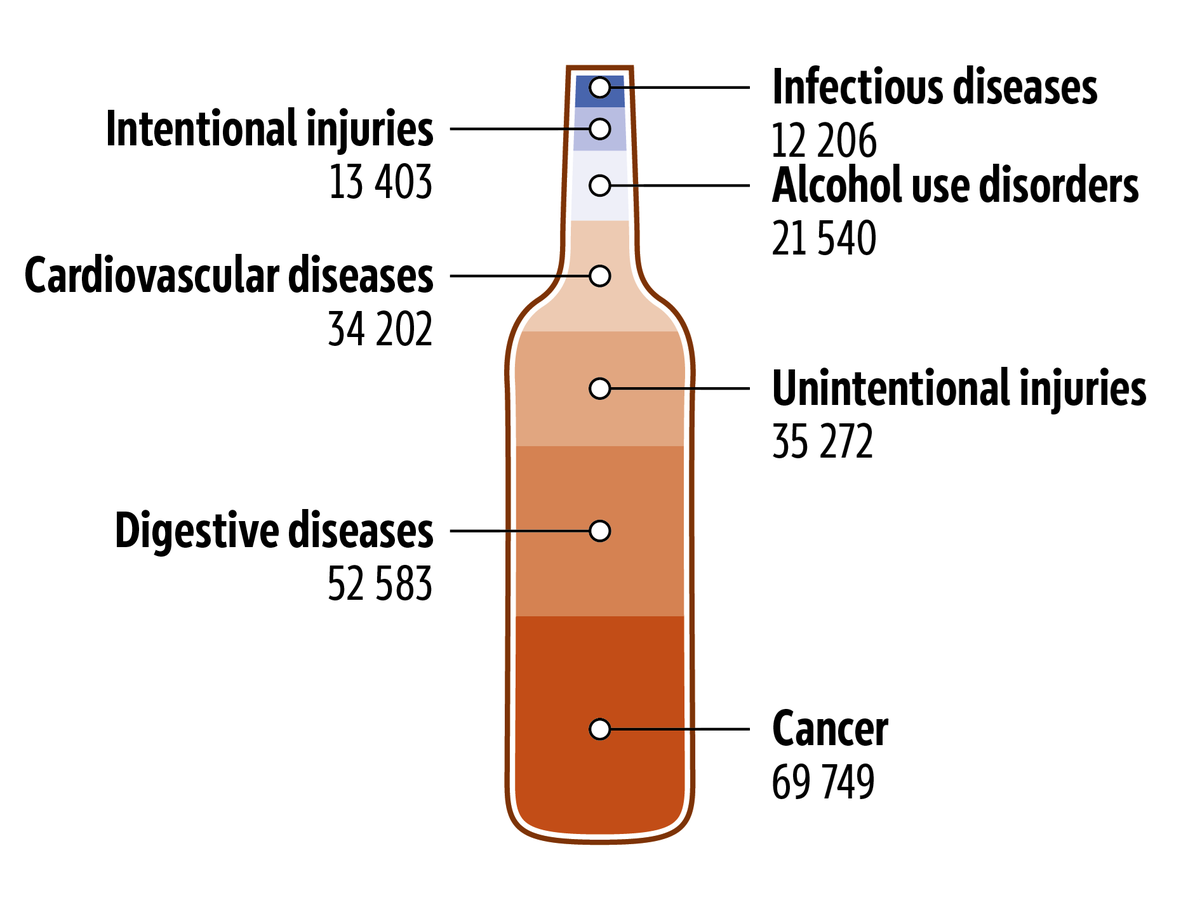
Data source: WHO, Alcohol, health and policy response in the EU, 2024. Graphic: Samy Chahri, EPRS.
In the European Union (EU) 656 people die every day from alcohol-related causes (see Figure 1). The latest World Health Organization (WHO) statistics on alcohol consumption show that, worldwide, 2.6 million deaths were attributable to alcohol consumption in 2019, of which 2 million were among men and 0.6 million among women. The highest levels of alcohol-related deaths per 100 000 persons are observed in the WHO European region – comprising 53 countries across Europe and Central Asia – with nearly 53 deaths per 100 000 people.
In February 2025, the WHO reiterated that clearly visible, compulsory, standardised health warning labels on alcoholic beverages are essential for making consumers aware that drinking alcohol can lead to cancer. Clear labels can also help tackle irresponsible drinking behaviour and excessive energy intake from alcohol, making them a major policy measure in the strategy to curb unhealthy dietary patterns and obesity.
What is a 'standard drink'?
A standard drink is a measure of alcohol that contains a fixed amount of pure alcohol. Standard units are generally proposed within low-risk drinking guidelines as a means to monitor and limit own alcohol consumption.
There is no international consensus on how much pure alcohol is contained in a standard drink. Among EU countries, the most frequent value is 10 g of pure alcohol, followed by 12 g (though they range from 8 g to 20 g).
The WHO has repeatedly emphasised the connection between alcohol consumption and over 200 health conditions, including seven types of cancer. Any alcoholic beverage can potentially cause cancer because the ethanol it contains and the acetaldehyde it produces in the body are carcinogenic.
The risk of developing alcohol-related cancer increases over time: the more alcohol a person drinks, the greater their chances of developing breast, liver, mouth, throat, oesophagus, or colon cancer.
In 2019 (data released in 2024), 4.4 % of cancers diagnosed globally and 401 000 cancer deaths were attributed to alcohol consumption. Similarly, an estimated 474 000 deaths from cardiovascular diseases were caused by alcohol consumption in 2019.
WHO statistics from 2019 show that 56 % of the global adult population (aged 15 and over) does not consume alcohol. In the EU, the situation is quite the opposite: 77 % of the population – 69 % of women and 84 % of men – consume alcohol.
The EU is home to the heaviest drinkers in the world, with seven of the top 10 countries in terms of per-capita alcohol consumption located in the EU. Moreover, heavy episodic drinking (defined as consuming six or more standard drinks of alcohol,1 or 60 g of pure alcohol, on a single occasion) is common in the EU, with about 30 % of adults engaging in this drinking pattern, compared to a global average of 18 % (see Figure 2).

Data source: WHO, Alcohol, health and policy response in the EU. Graphic: Samy Chahri, EPRS.
In 2019, the average yearly total per-capita consumption among adults in the EU was 11 litres of pure alcohol, roughly double the global average of 5.5 litres (see Figure 3). Men consumed 3.6 times more alcohol (17.4 litres) than women (4.9 litres). In the same year, there were some 290 million drinkers in the EU, with an average of nearly four out of every five adults consuming alcohol (77 %), compared to 56 % globally.
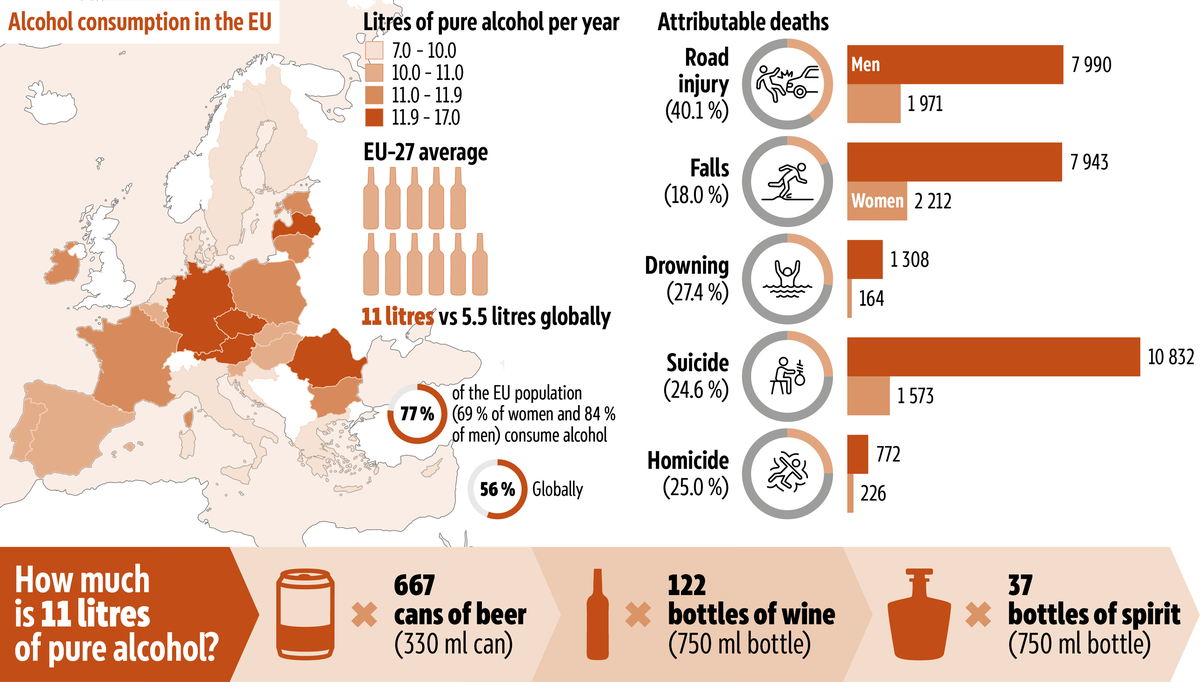
Data source: WHO, Alcohol, health and policy response in the EU. Graphic: Samy Chahri, EPRS.
Drinking was more common among men (84 %) than women (69 %). Among current drinkers only, excluding lifetime abstainers and former drinkers, the average consumption per adult was 14 litres of pure alcohol, with men consuming 20 litres and women 7 litres.
In 2019, alcohol was responsible for almost one in every four injury deaths (23 %), as well as homicides and suicides (25 %). Alcohol was also the main cause of two in every five road deaths (40 %), see Figure 3.
Since 2010, the EU has seen a minimal reduction in per capita alcohol consumption, decreasing by less than 1 % from 11.1 to 11.0 litres of pure alcohol. This falls significantly short of the 10 % reduction target outlined in the WHO European Framework for Action on Alcohol 2022-2025 .
Despite the minimal overall decline, six EU countries – Latvia, Bulgaria, Poland, Spain, Malta and Italy – experienced an increase in consumption, while five others – Lithuania, Estonia, Finland, Cyprus and Greece – achieved reductions exceeding 10 %.
Beer is the most consumed alcohol (41 %) in the EU, followed by wine (37 %) and spirits (22 %).
Alcoholic beverages and their particularities
Alcoholic beverages are drinkable liquids containing ethanol (ethyl alcohol C2H5OH). As ethanol is the main type of alcohol found in alcoholic beverages, the term 'alcohol' is used as a synonym for ethanol and, by extension, for alcoholic beverages. These beverages vary in their alcohol content, typically expressed as a percentage by volume, representing the millilitres of pure ethanol contained in 100 millilitres of the beverage measured at 20°C.
Alcoholic beverages can be broadly divided into fermented and distilled drinks. Fermented beverages include beer, wine and cider, produced when yeast converts sugars into ethanol through fermentation. Because yeast generally ceases to function at alcohol concentrations of around 10‑15 % by volume, beverages with higher alcohol content usually require distillation. Distillation is a process that concentrates alcohol by separating it from the fermented liquid, producing spirits with a significantly higher alcohol concentration.
As alcoholic drinks are made from natural sources of sugar and starch, their energy value depends on the fermentation and distillation processes. One gram of pure alcohol has 7 kilocalories (kcal) and any residual sugar after fermentation adds a further 4 kcal/gram. This is more than protein and carbohydrates/sugars, which both have 4 kcal/gram, but less than a gram of fat, which has 9 kcal.
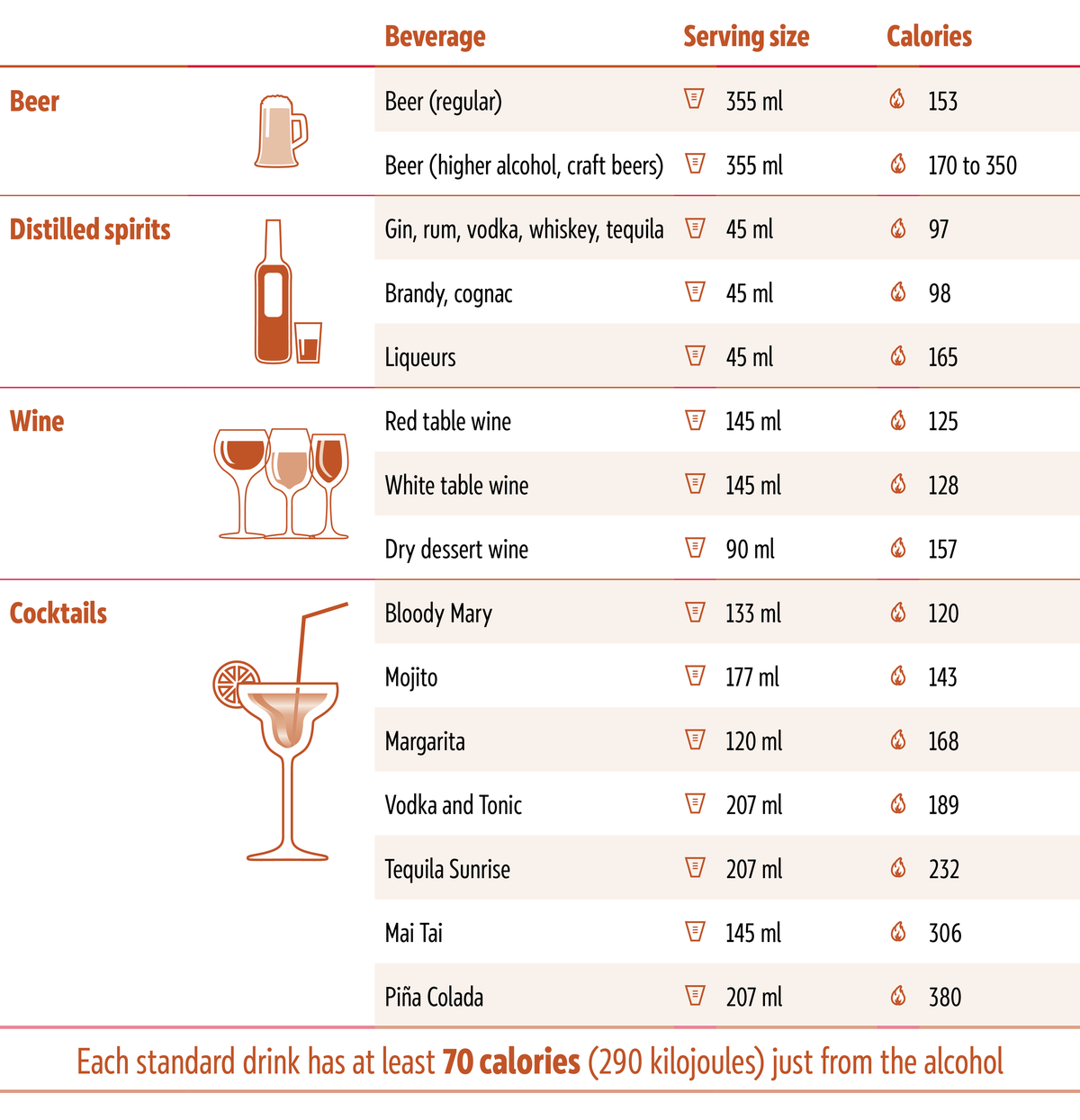
Data source: US National Library of Medicine, Calorie count of alcoholic beverages, 2024. Graphic: Samy Chahri, EPRS.
The number of calories in alcoholic drinks varies depending on the size of the drink, the percentage of alcohol and the amount of other ingredients (see Figure 4). A 'standard drink' containing 10 g of pure alcohol – approximately a bottle of regular beer, a small glass of wine or a shot of spirits – would contain at least 70 kcal. Ready-to-drink spirits containing sweetened mixers and drinks that include cream, such as cocktails, have additional calories from fat. Despite their high energy value, alcoholic drinks have very few nutrients, such as protein or vitamins and minerals.
EU legal framework
The main EU food labelling legislation is Regulation (EU) No 1169/2011 on the provision of food information to consumers (the 'FIC Regulation'), which requires certain mandatory information to be provided on the labels of prepackaged foods and drinks. This information includes the name of the food; net quantity; and the name and address of the company marketing the food. Additionally, consumers must be provided with a list of ingredients and a nutrition declaration, which includes the energy value as well as the amount of fat, carbohydrates, sugar, protein and salt.2
The FIC regulation exempts producers of alcoholic beverages containing more than 1.2 % by volume of alcohol from the obligation to provide a nutrition declaration and a mandatory list of ingredients. By contrast, this information must be included on the packaging of low-alcohol drinks.
Article 16(4) requires the Commission to produce a report addressing whether alcoholic beverages should be covered by the requirement to provide the energy value in the future, as well as the reasons justifying possible exemptions. Published in 2017, the report concluded that there were no objective grounds justifying the absence of such information (see next section).
The legislation further requires the indication of alcoholic strength by volume (% vol.) on labels (Article 9).
Article 21 also mandates the labelling of the most common allergens found in alcoholic beverages, including sulphites, eggs and milk products in wine. However, this provision applies only to the 14 allergens listed in Annex II, meaning that less common allergens may remain undisclosed in the absence of a full ingredient list.
In addition, beverages containing more than 10 % alcohol by volume are exempt from the requirement to indicate a date of minimum durability.
Article 41 allows EU countries to maintain national measures regarding ingredient listing for alcoholic beverages pending the adoption of harmonised EU rules. Food business operators may also provide ingredient information voluntarily. Similarly, where nutrition declarations are provided voluntarily for alcoholic beverages, they may be limited to the energy value alone.
Several other EU legal acts also contain provisions relating to the labelling of alcoholic beverages.
Regulation (EU) 2019/787 defines the categories of spirit drinks – such as rum, gin and liqueur – and requires labels to indicate the agricultural raw material used to produce the ethyl alcohol they contain. It also lays down rules on the indication of maturation periods and on the protection of geographical indications for spirit drinks.
Under Regulation (EC) No 1924/2006 on nutrition and health claims made on foods, alcoholic beverages containing more than 1.2 % alcohol by volume may not bear health claims. Only nutrition claims referring to low alcohol levels, reduced alcohol content or reduced energy content are permitted.
Rules governing the definition, description, labelling and protection of geographical indications for aromatised wines, wine-based drinks and wine-product cocktails – such as sangria and Glühwein – are set out in Regulation (EU) 2021/2117 establishing a common organisation of the markets in agricultural products, as amended by Regulation (EU) 2021/2117 under the common agricultural policy reform package. The revised rules have applied since 6 December 2021 (see text box below).
New labelling requirements for wine
Regulation (EU) 2021/2117 fundamentally changed EU wine labelling rules by requiring, for the first time, that wines and aromatised wine products marketed in the EU carry both a nutrition declaration and a list of ingredients, bringing the sector closer to the general food-labelling regime under the Food Information to Consumers Regulation.
Since 8 December 2023, wine labels must display at least the energy value (in kJ and kcal per 100 ml) on the physical label, while the full nutrition declaration and ingredient list may either appear on the label itself or be provided electronically, typically via a QR code or other e-label solution.
However, allergens and intolerances such as sulphites, egg or milk derivatives must always remain visible on the physical label.
The Regulation also imposes strict conditions on electronic labelling: the linked page may contain only mandatory consumer information, without marketing content, e-commerce functions or user tracking.
These rules apply to EU and import wines alike and aim to improve consumer transparency while preserving practical flexibility for producers faced with multilingual labelling constraints.
Industry self-regulatory commitments
A 2017 European Commission report on mandatory labelling of the list of ingredients and nutrition declaration of alcoholic beverages concluded that there were no objective grounds that would justify the absence of such information and invited the industry to present 'a self-regulatory proposal that would cover the entire sector of alcoholic beverages'.
In 2018, the European alcoholic beverages sectors submitted a self-regulatory proposal together with sector-specific annexes for beer, spirits, wine, cider and fruit wine. The proposed labelling information included ingredients, energy and nutrition information (energy, total fat, saturated fat, carbohydrates, sugars, protein and salt) per portion size as well as per 100 ml. The proposal allowed for this information to be provided either on the label or off-label through a web link, QR code, bar code, or other smart technologies. The sectors promised to report on implementation progress by 2021, but did not advocate for a common legally binding deadline.
Brewers of Europe – including 28 national brewers' associations and five corporate members – pledged to include ingredients and nutrition information on labels by 2022. Information provided on their website claims that, by October 2022, an estimated 95 % of beer volumes sold in cans and bottles provided information on ingredients and an estimated 88 % of beer cans and bottles displayed nutrition or energy values.
In 2019, the representatives of the spirits industry signed a memorandum of understanding (MOU) committing to providing the energy value on the physical label and the list of ingredients as well as full nutritional values off-label by 2022. As part of the MOU, spiritsEUROPE – the European representative body for producers of spirit drinks, which comprises 30 national associations and 11 leading spirits producing companies – committed to publishing three annual implementation reports. Although the initial implementation phase of the MOU ended on 31 December 2022, spiritsEUROPE decided to continue reporting on the rollout progress annually. Therefore, four implementation reports on self-regulatory commitments were made available respectively in 2021, 2022, 2023 and 2024. The latest report showed that, by the end of 2024, over 70 % of the total EU market had spirits with on-label energy information.
In 2019, spiritsEUROPE launched the responsibledrinking.eu website and the national information websites (scroll down to 'Country information') to which it links. The website provides information on responsible drinking and on how to assess calories in alcoholic beverages. It also offers nutrition information, lists of ingredients and production process information. In 2024, spiritsEUROPE, along with 20 European trade associations representing a diverse range of industries and services, called on policymakers to adopt a coordinated approach to product information through digital means.
National measures: Health information on alcohol labels
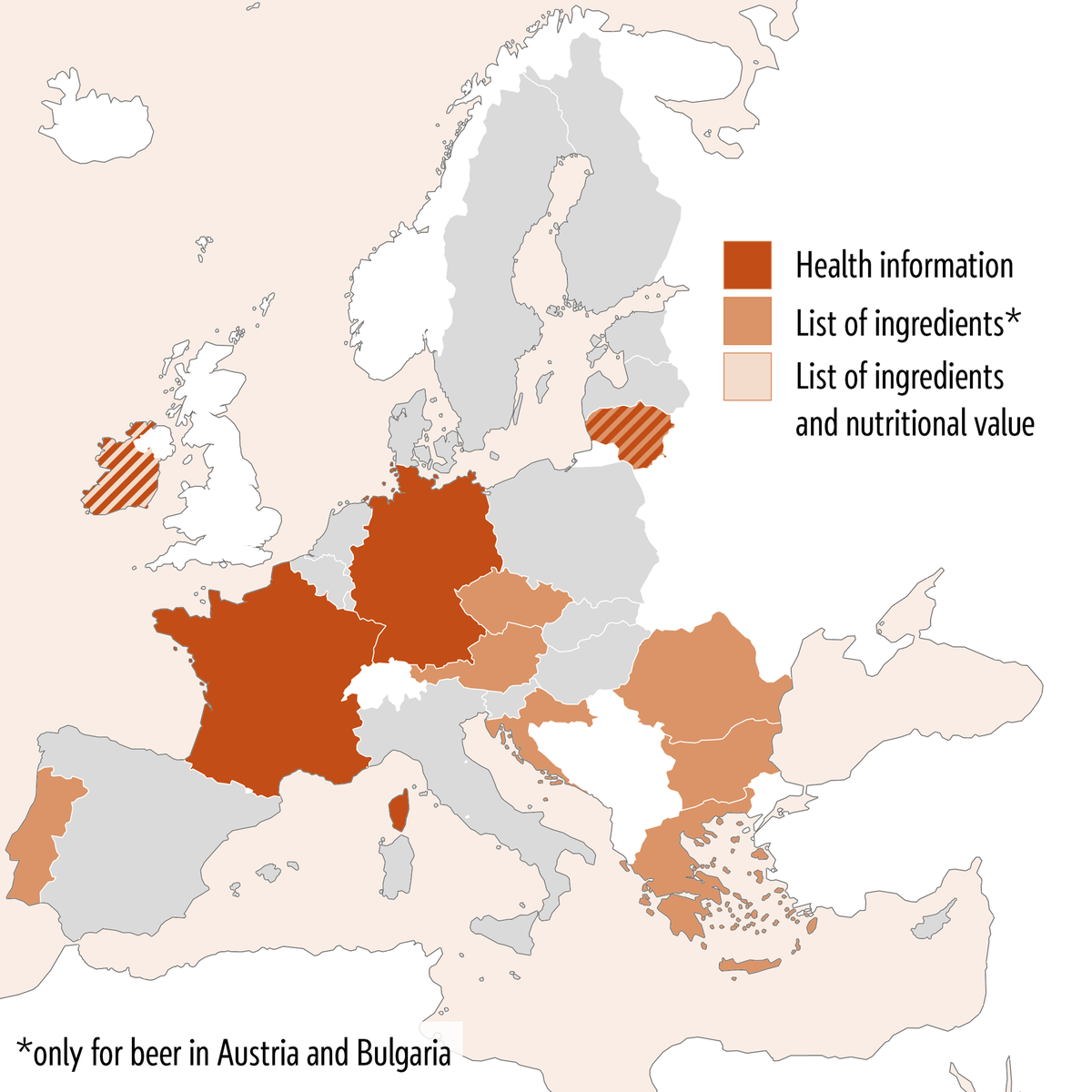
Data source: WHO, Health evidence network synthesis report, 2020. Graphic: Samy Chahri, EPRS.
EU countries may adopt additional labelling requirements following a specific notification procedure and a positive assessment from the European Commission. Four EU countries – France, Germany, Ireland and Lithuania – have legislation on health information (e.g. warnings about drinking while pregnant, driving, or underage, or general health risks). (See Figure 5.)
Nine EU countries – Austria, Bulgaria, Croatia, Czechia, Greece, Ireland, Lithuania, Portugal and Romania 3 – have some legislation in place on ingredient listing and only one – Ireland – has a requirement for listing the nutritional value.
Ireland is set to become the first EU country – and the second worldwide after South Korea – to require cancer warnings on alcohol labels. Although the measures were initially due to apply from May 2026, press reports in July 2025 indicated that implementation had been postponed following pressure from the alcohol industry and concerns over international trade implications. Under the Irish legislation, alcoholic beverages would have to display three health warnings: on the dangers of alcohol consumption, the risks of drinking during pregnancy, and the direct link between alcohol and cancer.
Research evidence on alcohol labelling
Energy value labelling
Several studies have revealed that the general public are widely supportive of energy value labelling for alcoholic beverages and rate calorie content as one of the most important components of an alcoholic beverage label. However, some experts have raised concerns about implementing calorie labelling as a public health policy. They argue that focusing on calories may adversely affect individuals with eating disorders, that the policy may interfere with or restrict personal choice (referred to as 'nanny statism') or that most consumers will simply ignore the information.
Empirical evidence on the impact of alcohol calorie labelling is limited and somewhat equivocal. A 2022 study showed that having alcohol calorie labels led to slight reductions in intended drinking compared to not having labels. A similar 2023 study looked at alcohol calorie labels on beverages in an online supermarket setting. Participants were asked to buy actual beverages with the intention of consuming them. The results showed no evidence that exposure to alcohol calorie information influences alcohol purchasing habits. Nevertheless, among participants who bought alcohol, those in the calorie labelling group bought approximately 20 % fewer calories than those in the no labelling group.
In a randomised controlled trial, university students in Canada viewed a restaurant beverage menu with or without calories and were asked to hypothetically order beverages under the scenario that they were in a pub drinking with friends.
Even though exposure to menus with calorie information helped consumers accurately estimate calories in alcoholic beverages, there was no difference in the number of alcoholic beverages ordered or the total number of calories ordered. Authors suggest that alcohol energy labelling may have limited impact on obesity as a standalone policy due to the unclear effect that alcohol has on obesity, the modest contribution of calories from alcohol to daily energy intake, and the limited impact that nutritional labelling policies tend to have on behaviour. However, several questions need to be answered by future research to make definitive conclusions on the potential for alcohol energy labelling policies to reduce obesity.
Health warnings
To date, there has been limited assessment of the impact of mandatory health warnings on labels in Europe. Existing studies have analysed data from only a few English-speaking countries.
The first systematic review (2024) examining different types of alcohol container labels found that health warnings and rotating messages can influence several consumption-related behaviours, both in real-life settings and in experimental studies. However, alcohol labelling measures are often introduced alongside broader policy actions, media attention and growing public awareness of alcohol-related health risks, making it difficult to isolate the specific impact of labels alone. To address this, the authors sought as far as possible to distinguish the effects of labelling from those of other simultaneous influences.
Even after accounting for these broader influences, the review found evidence that alcohol labels can contribute to behaviour change. The authors therefore concluded that labelling can be a meaningful component of alcohol harm-reduction policies and suggested that real-world effects could be even stronger when labels are implemented alongside wider public health measures, in line with WHO and EU recommendations for comprehensive alcohol container labelling.
While alcohol labels primarily serve to provide information, the review found that their effectiveness in raising awareness of alcohol-related risks varied considerably. Given the wide range of label designs examined, the findings suggest that the real-world impact of alcohol labelling depends in part on how labels are designed and implemented.
Complementary measures to reduce alcohol harm
Data from the WHO shows that in many EU countries, alcohol is more affordable today than it was 20 years ago, which has a negative impact on health. The WHO considers that increasing the price of alcohol through taxation and floor pricing is one of the most effective interventions for reducing alcohol-related harm. Research shows that a 10 % increase in alcohol prices can lead to a 5 % reduction in consumption.
Indeed, specific excise taxes – based on alcohol content rather than volume or value – are considered the most effective tax type because it directly targets the harmful substance and encourages the production of lower-strength beverages. Similarly, minimum unit pricing – which sets a legal 'floor price' per unit of alcohol – targets the cheapest, high-strength products favoured by heavy and underage drinkers. Finally, ad valorem taxes based on the product's value are less effective as they can be bypassed by consumers switching to cheaper brands.
Importantly, taxes must be adjusted regularly for inflation and income growth. If taxes remain stagnant while incomes rise, alcohol becomes more affordable, which often leads to increased consumption.
Opponents argue taxes may lead consumers to switch to illicit alcohol. However, WHO reports indicate there is no automatic link between higher taxes and increased illegal trade.
The application of taxes varies widely across EU countries, with different rates and coverage for different alcoholic beverages. Concerning wine, in the EU, 15 countries either do not impose excise taxes on wine or have a zero rate.
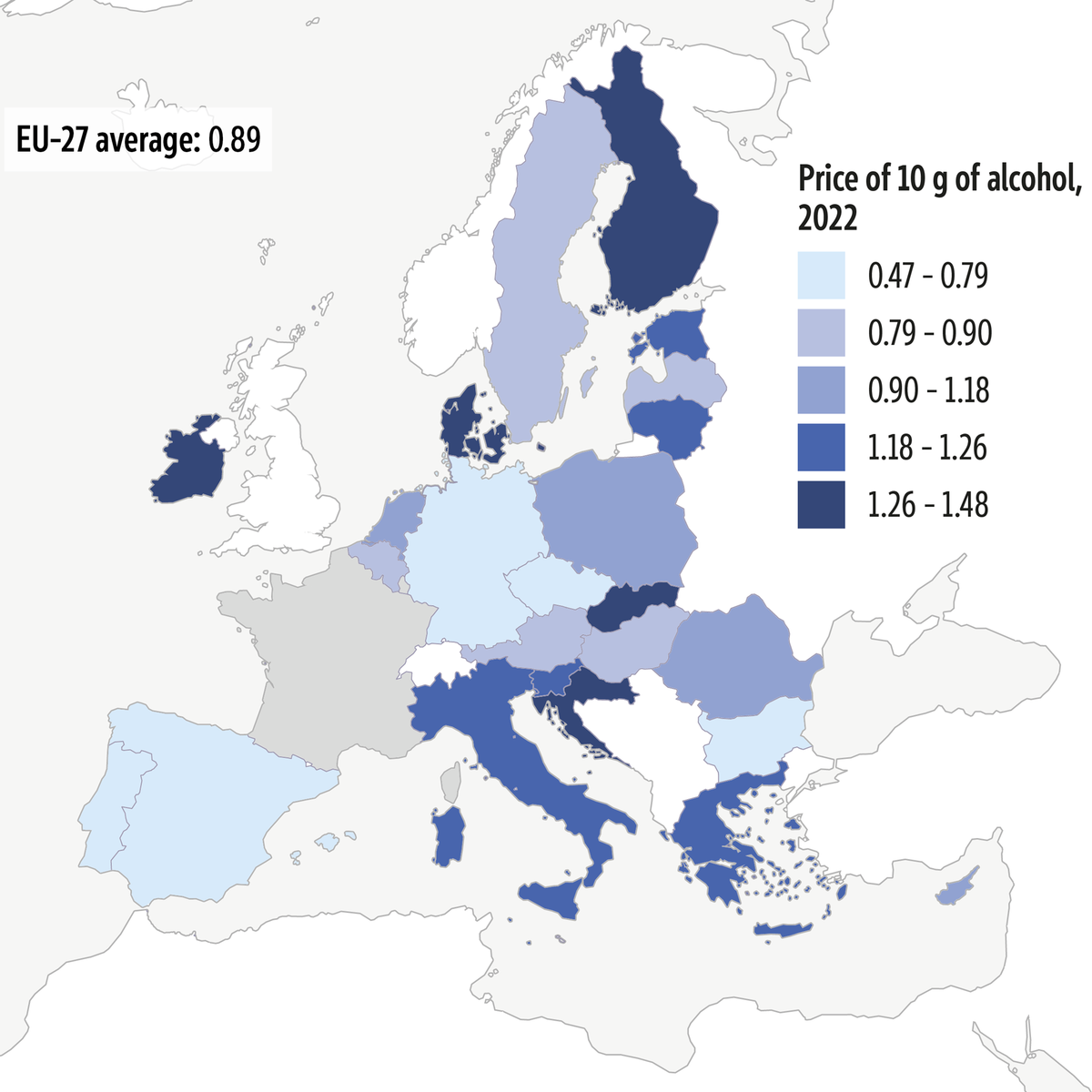
Data source: WHO, Alcohol, health and policy response in the EU, 2024. Graphic: Samy Chahri, EPRS.
Under the EU alcohol excise duty directive – last updated in 1992 – EU countries may apply a minimum excise duty rate of zero to wine.
In 2022 the average cost of 10g of pure alcohol in the EU, weighted for the proportion of different types of beverages consumed, was €0.89 (€0.73 for 10g of pure alcohol for wine, €0.88 for beer, and €1.06 for spirits) – see Figure 6.
In various EU countries, alcohol affordability has increased over recent decades because excise duties and prices have not been adjusted to reflect inflation over time. WHO data shows that consumers in the EU can now buy 76 % more wine, 46 % more beer, and 37 % more spirits with their national per capita income than the average consumer in the WHO European region.
Importantly, alcohol taxation contributes to government revenues and can be reinvested. Because alcohol demand is relatively inelastic – meaning that consumers generally reduce consumption less than proportionally to price increases – higher alcohol taxes can both lower consumption and increase government revenues.
The Nordic 'alcohol monopolies' – shops that have the exclusive right to sell most alcoholic beverages in Finland, Iceland, Norway, Sweden and the Faroe Islands – have contributed to relatively low alcohol consumption and have helped to maintain higher prices and lower the harm. Another case in point is Lithuania, where, following a major increase in alcohol excise taxes in 2017, recorded per capita alcohol consumption decreased substantially.
Lithuania's 2017 tax policy: A clear case for alcohol prevention
In March 2017, Lithuania implemented sharp excise increases: 112 % for beer, 111 % for wine and 23 % for spirits. The reform aimed specifically at reducing affordability. As a result, per capita consumption of legal alcohol dropped from 13 litres in 2015 to 11 litres in 2023, the lowest level in a decade. Adult per capita consumption was thus estimated to decrease by 10.3 % in the period immediately following the 2017 tax increase.
A study by the Centre for Addiction and Mental Health (CAMH) showed that the policy generated over €100 million in new tax revenue within a year – a 20 % increase – while the government spent only €320 000 to implement it. At the same time, Lithuania saw lower rates of premature death caused by alcohol, saving over €35 million in productivity losses. Healthcare costs dropped by nearly €4 million. Thus, for every €1 invested in implementing these taxes, the country gained €420 in economic returns.
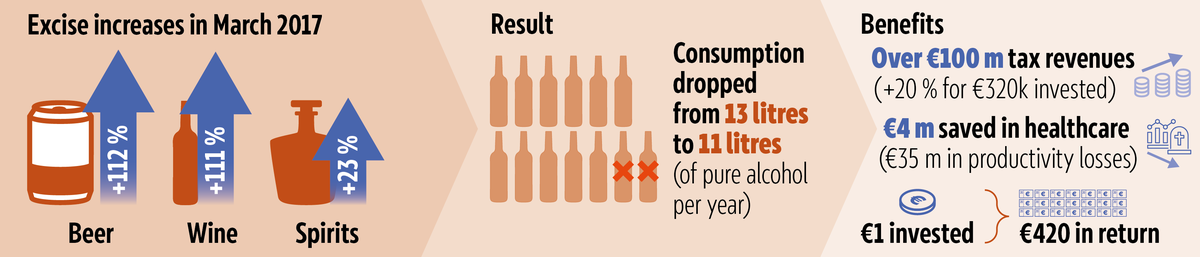
Data source: CAMH study. Graphic by: Samy Chahri, EPRS.
European Parliament position
The European Parliament has consistently supported harmonised alcohol labelling. In its 2023 resolution on non-communicable diseases, Parliament called for better information for consumers by improving the labelling of alcoholic beverages. More specifically, this involves providing information on moderate and responsible drinking, as well as introducing mandatory indication of the list of ingredients and nutrition information. Similarly, Parliament's 2022 resolution on the fight against cancer recalled that the lower the amount of alcohol consumed, the lower the risk of developing cancer. It also expressed support for the introduction of digital labelling.
Recent changes in wine labelling
A new regulation supporting the European wine sector was adopted by the Parliament and Council in February 2026.
Alcohol denominations
Regulation (EU) 2026/471 introduces a clearer and harmonised framework for low- and no-alcohol wine products across the EU. The reform mainly affects three areas: the authorised marketing denominations for de-alcoholised wines, the replacement of the previously debated 'light/alcohol-light' terminology, and updated rules for aromatised wine products such as Glühwein.
For de-alcoholised wines, the Regulation creates three standardised denominations:
-
'Alcohol-free' may be used for wines whose actual alcoholic strength does not exceed 0.5 % ABV.
-
'0.0 %' may appear in addition to 'alcohol-free' only where the alcohol content does not exceed 0.05 % ABV. This is intended to avoid misleading consumers about trace residual alcohol.
-
'Reduced alcohol' applies to wines above 0.5 % ABV that nevertheless contain at least 30 % less alcohol than the minimum alcoholic strength normally required for the relevant wine category before dealcoholisation.
The regulation also requires wines that have undergone total or partial dealcoholisation to indicate that fact on the label, typically through wording such as 'produced by dealcoholisation', ensuring transparency about the production method.
European Parliament 'wins' in wine labelling
During negotiations on Regulation (EU) 2026/471, the European Parliament secured several important concessions from the Council on wine labelling, the most visible being the replacement of the Council-backed terminology 'low-alcohol' or 'alcohol-light' with the more neutral expression 'reduced-alcohol' in the final text.
Legislators feared that consumers might associate the term 'light' with calories, taste intensity or general health claims rather than actual alcohol reduction, which, in turn, could create misleading health associations and conflict with EU consumer-information principles.
The final regulation therefore establishes harmonised EU categories and thresholds for 'alcohol-free', '0.0%' and 'reduced-alcohol' wines, reflecting Parliament's objective of combining consumer transparency with market harmonisation.
Parliament also largely succeeded in strengthening the framework for electronic labelling by supporting clearer EU rules for digital ingredient and nutrition disclosures while maintaining safeguards to ensure consumers continue to have accessible mandatory information.
Overall, the final compromise on labelling closely reflected Parliament's priorities of avoiding health-related messaging, ensuring legal clarity and creating a uniform EU-wide labelling regime for innovative wine products.
Regarding Glühwein , the reform updates the rules for certain traditional aromatised wine products protected under EU law. Previously, products such as Glühwein, Viiniglögi/Vinglögg/Karštas vynas and Pelin could only be produced from red wine. Regulation (EU) 2026/471 now allows these products to be made from rosé wine as well, reflecting evolving consumer demand and innovation in the aromatised wine sector.
The changes apply since 18 March 2026, while producers benefit from a transition period until 19 September 2027 for the new low-alcohol labelling rules. Products already labelled under the old regime may continue to circulate until stocks are exhausted.
Labelling requirements
Regulation (EU) 2026/471 further refines and simplifies the EU wine labelling framework introduced under the CAP reform. Its key labelling provisions focus on digital disclosure, export flexibility and harmonisation across EU countries.
The Regulation confirms that ingredient lists and nutrition declarations for wine may continue to be provided electronically – for example, via QR codes – while empowering the Commission to adopt harmonised rules on how those electronic means must be identified on labels, including potentially through language-neutral symbols or pictograms.
It also clarifies that mandatory particulars should appear only once on a given package, reducing duplication and administrative burden. In addition, wines produced exclusively for export outside the EU are exempted from the EU requirements to display ingredient lists and nutrition declarations, where third-country labelling rules differ.
The Regulation further enables future delegated acts governing the layout and presentation of electronic labels, with the objective of improving consumer accessibility while preventing divergent national practices in digital wine labelling.
When adopting the regulation, the Commission committed to 'use its best endeavours' to present the following, among others, to the relevant expert group or committee in 2026:
-
a draft amendment to Commission Delegated Regulation (EU) 2019/33, to define the EU system for identification on the package or the label of grapevine products of the electronic means referred to in Article 119(4) and (5) of Regulation (EU) 1308/2013;
-
a draft amendment to Commission Delegated Regulation (EU) 2019/934 to include, in the definition of 'coupage' ('blending') the possibility to blend de-alcoholised or partially de-alcoholised wines with still wines to produce partially de-alcoholised wines.
Outlook and public expectations
The outlook for mandatory alcohol labelling in the EU remains uncertain, reflecting ongoing debate over public health objectives, regulatory considerations and differing political priorities among EU countries. Europe's Beating Cancer Plan envisaged the introduction of mandatory ingredient lists, nutrition declarations and health information for alcoholic beverages by 2024-2025, but implementation at EU level has progressed more slowly than initially anticipated.
Regulation (EU) 2026/471 introduced harmonised labelling provisions for non-alcoholic and reduced-alcohol wines but did not include the broader alcohol health-warning measures – notably, cancer-related warnings – discussed during the previous Commission mandate under Europe's Beating Cancer Plan. Ireland, which had been expected to become the first EU country to require mandatory cancer warnings on alcohol products, has postponed the application of those rules until September 2028.
Meanwhile, industry-led initiatives have expanded alcohol labelling practices unevenly across product categories and information types. By the end of 2024, around 70 % of spirits marketed in the EU reportedly displayed energy information on labels, while ingredient lists and health warnings remained considerably less common.
Consumer research nevertheless points to growing public interest in alcohol-related health information. A 2024 online survey conducted across 13 EU countries and Norway found that many respondents regarded alcohol health warning labels as acceptable, relevant and potentially effective, with cancer-related messages receiving comparatively high relevance scores. The survey also reported broad support for including health warnings on alcohol labels.
The evidence on the effectiveness of alcohol labelling measures also continues to expand. A 2024 systematic review of alcohol warning labels found that such measures can increase awareness and perceptions of alcohol-related risks, while some studies also reported reductions in alcohol purchasing and consumption. The review further suggested that larger, more visible and rotating warning labels tend to have greater effects.
Overall, alcohol labelling is likely to remain part of wider EU discussions on consumer information, public health policy, subsidiarity and the respective roles of legislation and voluntary industry action. Future developments will likely depend not only on scientific evidence and public expectations, but also on political consensus among EU countries regarding the appropriate balance between harmonisation, national prerogatives and public health objectives.
Endnotes
Classification
Policy areas: Food Safety
Regions: European Union
Committees: Environment, Climate and Food Safety (ENVI)
Disclaimer
This document is prepared for, and addressed to, the Members and staff of the European Parliament as background material to assist them in their parliamentary work. The content of the document is the sole responsibility of its author(s) and any opinions expressed herein should not be taken to represent an official position of the Parliament.
Copyright
© European Union.
The reuse of this document is authorised under a Creative Commons Attribution 4.0 International (CC-BY 4.0) licence.

https://creativecommons.org/licenses/by/4.0/deed.en
To use or reproduce elements that are not owned by the European Union, permission may need to be sought directly from the respective rightsholders.