Article page checkbox is not checked in page info.
Current membership of the European Council
Current membership of the European Council
Ralf Drachenberg, European Council Oversight Unit
Graphic: Samy Chahri and Gyorgyi Macsai
Summary
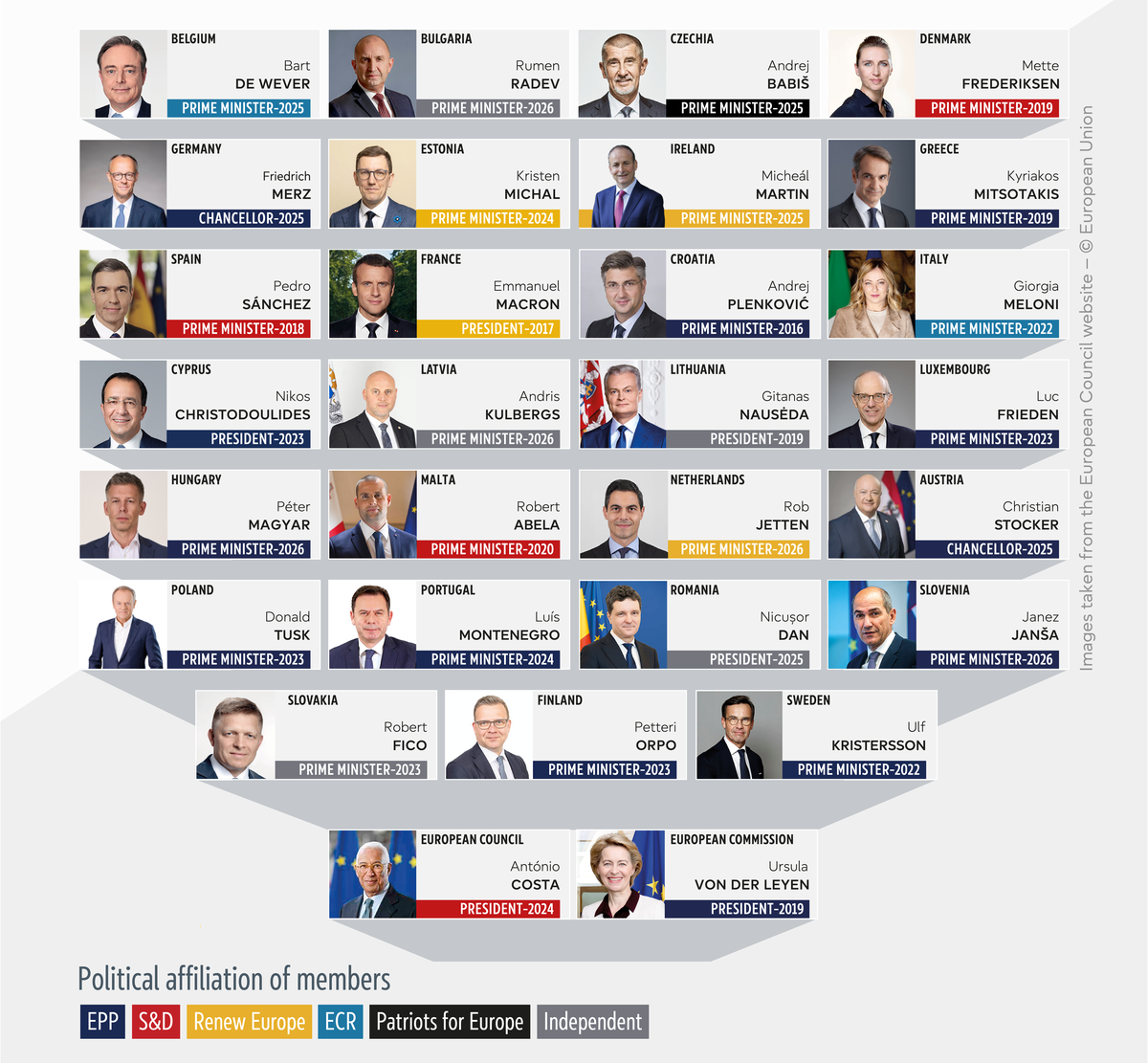
The European Council consists of the 27 Heads of State or Government of the EU Member States, who are voting members, together with the President of the European Council and the President of the European Commission, who have no vote (Article 15(2) Treaty on European Union). The chart shows the current members, the national office they hold, their most recent European political affiliation, and the year their membership began.
Members of the European Council
Images taken from the European Council website – © European Union
Recent developments
The duration of an individual Head of State or Government's membership of the European Council is not laid down in the EU Treaties, but is rather directly linked to changes in the composition of national governments within the EU Member States. There are thus significant variations between Member States, reflecting varying electoral cycles and frequency of leadership changes in these countries. As a result, some individual Heads of State or Government may be participating in their very first meeting of the European Council, while others might have participated for 10 years or more. In the period since February 2015, there have been changes in membership on average every two months. Since the previous edition of this publication in March 2026, national and European political developments have led to a number of changes in the European Council's membership, as set out below.
Changes in members and in their status
New members
Bulgaria
Rumen Radev and his new political party Progressive Bulgaria (not affiliated at EU level) secured an outright majority in the Bulgarian national elections of 19 April, gaining 131 out of 240 seats. On 8 May, Radev was elected as the new Prime Minister. He took over from the independent Andrey Gyurov, who had been caretaker Prime Minister since 12 February 2026. Radev was previously President of Bulgaria (2017-2026), and participated several times in European Council meetings because, according to the previous Bulgarian Constitution, a caretaker Prime Minister could not represent Bulgaria internationally.
Hungary
Péter Magyar's Tisza Party won a landslide victory in the national parliamentary elections in Hungary on 13 April 2026, gaining 141 seats out of 199. Magyar was sworn in as Prime Minister on 8 May, replacing Viktor Orbán, who had been Prime Minister of Hungary for 16 consecutive years. The Tisza Party MEPs are members of the European People's Party (EPP) group in the European Parliament.
Latvia
Latvia's Prime Minister, Evika Siliņa (New Unity), resigned on 14 May 2026 after the collapse of her coalition government. The coalition crisis followed her dismissal of the defence minister amid concerns over stray drones linked to the war in Ukraine entering Latvian airspace. On 28 May, Latvia's parliament approved a new coalition government led by Prime Minister Andris Kulbergs. While Kulbergs was elected to the Latvian Parliament for the United List, he does not belong to any political party. The four-party coalition is made up of United List (affiliated to the ECR), New Unity (affiliated to the EPP), the National Alliance (affiliated to the ECR) and the Greens and Farmers' Union (affiliated to the European Green Party). Latvia is expected to hold its next national parliamentary elections on 3 October 2026.
Slovenia
In Slovenia's parliamentary elections of 22 March 2026, the Gibanje Svoboda party of outgoing Prime Minister Robert Golob narrowly received most votes (28.63 %), just ahead of the Slovenian Democratic Party (27.95 %) led by Janez Janša. It was, however, Janša who was elected Prime Minister by the Slovenian parliament and who leads a new coalition government. The coalition is made up of the Slovenian Democratic Party (affiliated to the EPP), New Slovenia (affiliated to the EPP), the Slovenian People's Party (affiliated to the EPP), the Democrats (not affiliated at EU level) and Focus (not affiliated at EU level). Janša has previously been Prime Minister of Slovenia three times (2004-2008, 2012-2013 and 2020-2022).
Re-elected members
Denmark
In the elections of 25 March 2026, Prime Minister Mette Frederiksen's Social Democrats won the most votes (21.9 %), even if it was the worst result in the party's history. The new government, with Frederiksen as Prime Minister for the third time, took office on 3 June 2026. Her minority coalition government is made up of the Social Democrats (affiliated to PES), the Social Liberals (affiliated to ALDE), the Green Left (affiliated to the European Green Party) and the Moderates (affiliated to ALDE). Frederiksen has been Prime Minister since 2019, and is thus one of the longest-standing members in the current European Council.
Malta
The Labour party (affiliated to PES) of incumbent Maltese Prime Minister Robert Abela won the general elections of 31 May 2026 with 52 % of the votes. Abela was sworn in on 1 June for his third consecutive term as Prime Minister. Malta is one of the few national governments in the EU made up of a single party, alongside Greece, Bulgaria and Hungary.
Balance between political party affiliations
With Magyar replacing Orbán in Hungary, the number of EPP affiliates in the European Council increases by one and the members of Patriots.eu is reduced accordingly. The change in Latvia from Siliņa to Kulbergs adds one independent member and reduces by one the EPP members in the European Council. The leadership transition in Slovenia from Golob to Janša increases again the number of EPP members in the European Council, while reducing the number of liberal European Council members. The change in Bulgaria from Gyurov to Radev and the re-elections of Frederiksen and Abela did not have any impact on the balance.
The European Council now includes 12 members from the European People's Party, 4 from Renew Europe/ALDE, 3 from the Party of European Socialists (S&D/PES), 2 from the European Conservatives and Reformists (ECR), 1 from the Patriots for Europe/Patriots.eu (PfE) and 5 independent or non-affiliated members.
N.B. Nikos Christodoulides was elected for the office of president as an independent candidate and does not belong to any political party at national level. However, he previously was a member of an EPP-affiliated party (DISY), and still regularly attends EPP pre-European Council meetings.
Classification
Policy areas: EU Democracy, Institutional and Parliamentary Law | Democracy
Regions: European Union
Disclaimer
This document is prepared for, and addressed to, the Members and staff of the European Parliament as background material to assist them in their parliamentary work. The content of the document is the sole responsibility of its author(s) and any opinions expressed herein should not be taken to represent an official position of the Parliament.
Copyright
© European Union.
The reuse of this document is authorised under a Creative Commons Attribution 4.0 International (CC-BY 4.0) licence.
https://creativecommons.org/licenses/by/4.0/deed.en
To use or reproduce elements that are not owned by the European Union, permission may need to be sought directly from the respective rightsholders.