
Article page checkbox is not checked in page info.
EU civic engagement: The use of digital tools and AI to promote citizen participation in EU policymaking
The use of digital tools and AI to promote citizen participation in EU policymaking
David Kemp, Scientific Foresight Unit

Summary
There is a desire across EU institutions and civil society to strengthen democratic participation in EU policymaking, partly as a way to make this process more accessible to citizens. To this end, there has been growing interest in how digital participation tools can promote civic engagement in policymaking. This interest has recently been reinvigorated by developments in artificial intelligence (AI).
The study on 'The use of digital tools and AI to promote citizen participation in EU policymaking' provides evidence for how digital participation tools can support EU policymaking and the preconditions for doing so. Building on a comprehensive landscape analysis, the study clusters 94 distinct tools from around the world and empirical in‑depth assessment of 11 representative cases. This approach distinguishes between theoretical potential and practical utility, identifying the preconditions for successful engagement, and the ways in which different tool functionalities can support this.
It also gives empirical insights into the current state of digital tool usage, the associated advantages and limitations, and the trade‑offs that need to be considered when conducting participatory processes. There is a specific focus on the current uses of AI in digital participation tools, alongside an assessment of its potential and risks.
The study concludes with 10 concrete policy options ranging from governance prerequisites to procedural considerations and technical choices. These options define the safeguards required to operationalise the link between citizens' voices and institutional action, showing that digital participation tools can be integrated in a democratically sound and responsive way into the European legislative process if designed properly.
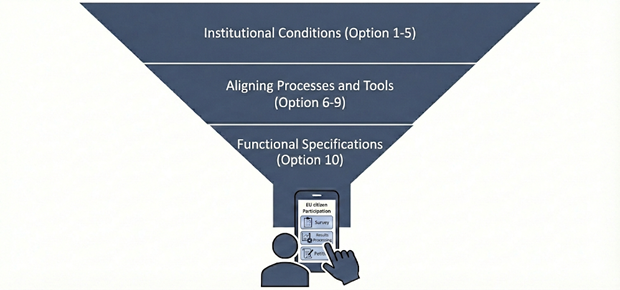
The policy options presented here take a progressive approach. The initial options set out the high‑level preconditions that form the basis for effective citizen participation (Institutional conditions: Options 1‑5). This is followed by a set of process‑based options (Aligning processes and tool(s): Options 6‑9), then a set of more specific functional options (Functional specifications: Option 10). Conceptually, the policy options are complementary rather than mutually exclusive.
Statement of purpose
This document is based on the STOA study 'The use of digital tools and AI to promote citizen participation in EU policymaking'. The study was written by Nicklas Bang Bådum, Sissel Fibecker Ladegaard, Bjørn Bedsted (Demx); Davy van Doren, Ulrich Hofmann, Bert Droste‑Franke (IQIB); Henriette Kirch, Christiana Schümmer; Mayke Wißler, Aurelia Beiküfner (DLR‑PT) at the request of the Panel for the Future of Science and Technology (STOA), and managed by the Scientific Foresight Unit, within the Directorate General for Parliamentary Research Services (EPRS), European Parliament. STOA administrator responsible: David Kemp.
Institutional conditions
Determine citizens' mandate and level of impact on policymaking
No tool or method can make citizen engagement work if the governance structures for taking it into account are not in place. This goes for both digital and face‑to‑face participation. Across the conducted case studies, interviewees highlight a responsive government structure as the main condition for meaningful citizen participation. From the citizens' point of view, participation does not make sense if the results have no impact on the policymaking process. If there is a lack of accountability for the impact of results, citizens are likely to protest, and the process will do more harm than good to public perceptions of the democratic quality of EU policymaking. The extent of that impact is a matter for careful consideration and specification, so that expectations can be both managed and met.
Advance citizen participation in EU policymaking
Several EU policies have already been adopted that make provisions for citizen participation. These range from constitutional mandates in Articles 10 and 11 of the Treaty on European Union (TEU) and the right to petition in Article 227 of the Treaty on the Functioning of the European Union (TFEU), to the operational frameworks established by the White Paper on European Governance and the Better Regulation Guidelines. Although these provisions have successfully introduced mechanisms for digital citizen participation, there is still significant scope to further institutionalise these practices and ensure their consistent integration into the formal legislative process.
Introduction of citizen participation in different phases of the policy cycle
Citizen participation can contribute meaningfully to policymaking in different ways and stages of the policy cycle, from the early phases of agenda setting to assessing draft policy proposals and evaluating implemented legislation.
Promote and adopt quality standards for citizen participation
Quality standards, principles, and best practices have already been developed by professionals in the field of citizen participation. One such set of standards is the OECD's good practice principles for citizen participation (OECD, 2020), which are often referred to in EU policy documents. These include the representativeness of participating citizens and informed deliberations between them.
As mentioned in Policy Option 2, EU policies have already been adopted to make provisions for citizen participation. However, more can be done to promote quality standards and increase the likelihood that they will be meaningful and achieve the desired impact. A trend towards demands for higher standards was also identified in the foresight workshop that was part of this study.
Inter‑institutional anchoring
A clear connection to policymaking is pivotal for any participation process, in the form of an explicit mandate and associated commitment. When integrating a digital participatory tool into the EU policy cycle, a central question to consider is whether the tool and the processes it is used for should be anchored in one or more of the institutions involved in the ordinary legislative procedure. Generally, there is a trade‑off between having a broad mandate with inter‑institutional legitimacy and flexibility across the policy cycle and an increased level of coordination and politicisation of the process.
Aligning processes and tools
Modes of participation
Digital participation tools offer three different modes of citizen engagement. These are not mutually exclusive, and can be combined, but each offers different possibilities and limitations. One mode of participation is fully online engagement through digital tools, a second is using digital tools to support face‑to‑face citizen engagement, and a third is to combine digital tools and face‑to‑face participation in either synchronous or asynchronous processes.
Focus on the scope of participation tools
While deciding which functionalities to incorporate is important, a more fundamental question is what purposes the tool should serve and the degree of flexibility this requires. There are four distinct strategic approaches to tool architecture that can help to navigate the inherent trade‑offs between system complexity and engagement flexibility. The implications of each approach for institutional resources and the citizen experience differ.
The first approach is to opt for a tool that offers only a few functionalities, providing limited possibilities for engagement but with a moderate need for development and maintenance. The second option is to have a tool with multiple functionalities that offers a single‑entry point for participation but which is more complex to build and maintain. The third approach is to aim for a modular tool that begins with limited functionalities but expands over time; this provides a single entry‑point for participation but can be more technically demanding to develop and maintain. The fourth and final approach is to have multiple tools with separate functionalities, which offer a large range of possibilities but are more complex to navigate. Generally, more functionalities increase development complexity and thus price, as well as the complexity of correctly applying the system, thereby requiring higher staff skills. However, they also enable greater flexibility in the modes of interaction.
Functionalities
The study describes how digital participation tools are agnostic to which topic is addressed, but that they determine how the topic can be addressed, based on the functionalities embedded in the tool. The study develops a typology of functionalities and shows how each category could be used by the EU to engage citizens in policy, what their strengths and weaknesses are, and what to be aware of when applying them.
Approaches to AI
The application of AI in participatory processes is still in its infancy, and most applications are back‑end features, though with a few notable exceptions. Technology has brought a wide range of innovations and has further potential given future technological and methodological advances. As technology cannot yet guarantee the perfect balance between efficiency and democratic integrity, policy officers must rigorously evaluate trade‑offs on a case‑by‑case basis. The key risks, such as algorithmic bias, 'black box' analysis, error propagation, misrepresentation, and the loss of human oversight, must be weighed against potential engagement gains to protect institutional transparency and legitimacy.
Functional specifications
Technical aspects
Device compatibility for citizen engagement tools depends on the process type, with web applications enabling deeper interactions and mobile apps offering flexibility but shallower engagement; compatibility with diverse browsers, OS and devices is essential, especially for hybrid or face‑to‑face setups to avoid exclusion. User identification balances accessibility against legitimacy, as eIDAs streamline verification but raise entry barriers and surveillance concerns, while lighter options risk multiple voting or external interference. GDPR compliance favours EU‑based hosting, tailored DPAs, privacy notices, and robust data rights procedures, as none of the platforms analysed are fully compliant 'out of the box', although they can be adapted.
Statement on the use of AI
This study explores digital tools, including those using AI, that can help citizens to better understand and engage with the EU policy making process and also sets out the conditions under which such tools can be successfully deployed to bridge the gap betwen rule takers and rule makers
Disclaimer
This document is prepared for, and addressed to, the Members and staff of the European Parliament as background material to assist them in their parliamentary work. The content of the document is the sole responsibility of its author(s) and any opinions expressed herein should not be taken to represent an official position of the Parliament.
Copyright
© European Union.
The reuse of this document is authorised under a Creative Commons Attribution 4.0 International (CC-BY 4.0) licence.

To use or reproduce elements that are not owned by the European Union, permission may need to be sought directly from the respective rightsholders.