
Article page checkbox is not checked in page info.
Women in agriculture in the EU
Women in agriculture in the EU
Guna Rudzīte, Members' Research Service
Summary
Women remain under-represented in EU agriculture, particularly as farm managers, while much of their contribution as spouses and unpaid family workers remains invisible and unrecognised. Around one third of EU farms are managed by women, but structural barriers persist in land ownership, inheritance, access to resources, and policymaking. Patrilineal land transfer patterns continue to limit women's access to farmland, EU common agricultural policy (CAP) subsidies, and decision-making roles.
Existing data, including Eurostat figures, capture female farm holders but overlook the scale of informal and unpaid labour performed by spouses (mainly women) on farms, resulting in an incomplete picture. Research highlights that the CAP remains largely gender-blind, despite EU commitments to gender equality.
The European Parliament has consistently addressed gender equality in agriculture through multiple resolutions, highlighting women's key role in rural economies while calling for more targeted support and better gender-disaggregated data.
The proposed multiannual financial framework for the years 2028 to 2034, with its new structure of bringing several sectoral rules under a single legislative framework, would elevate gender equality to a structurally embedded horizontal principle across several EU policy areas, including agriculture – a sector where gender mainstreaming has historically been treated as an afterthought.
State of play of women in EU agriculture
Women in the EU rural areas face specific challenges, particularly in agriculture, and tend to leave these areas, especially if they are remote. This is weakening the European countryside and creating a gender imbalance, as women are central to the sustainability of rural households and communities, improving rural livelihoods and overall wellbeing. The real impact of women on rural economies is hard to estimate, since their involvement through informal work is not statistically recorded and recognised. The imbalance is reflected in women's under-representation in decision-making bodies; the low share of female – particularly young female – farmers; hidden and informal female labour in agriculture; and limited employment opportunities. These challenges are compounded by broader difficulties linked to rural living conditions, including inadequate infrastructure, basic and social services, healthcare and connectivity.
Two groups of women can be considered in EU agriculture:
-
women formally recognised as farm holders under the common agricultural policy (CAP), eligible for CAP support; they account for roughly one third of farm holders in the EU (31 %) based on Eurostat, corresponding to some 2.9 million from the total of 9 million farm holders;
-
spouses and assisting family members contributing to agricultural work on the farm, thus sustaining family farm operations without formal recognition nor remuneration.
Although these two groups face different structural, economic and legal challenges, the EU's agricultural policy focuses almost exclusively on the former, and thereby fails to recognise and support a large portion of the labour force that keeps family farms operational. This invisibility perpetuates women's economic dependency, exclusion from social protection, and subordinate status, which translates directly into higher rates of old-age poverty for rural women.
Women participation in farming contributes to rural socioeconomic vitality. Women are more likely to engage in environmentally sustainable practices and in diversified on-farm activities such as direct marketing, short supply chains or agritourism. In doing so, they introduce innovative and more diversified business models that can enhance the resilience and sustainability of rural areas. Women's economic empowerment is good for business,1 since businesses benefit from their organisational performances.
The principle of equality between women and men has been embedded in the EU's legal framework since the 1957 Treaty of Rome, and was strengthened by the Charter of Fundamental Rights. Nearly seven decades later, many gender inequalities in the EU remain entrenched. The CAP – the EU's oldest and single largest spending programme at some €55 billion per year – still has no systematic mechanism to track or correct its gendered distribution. Therefore, the proposal for the post-2027 EU multiannual financial framework (MFF), currently debated in the European Parliament and the Council – with its new architecture combining several EU structural funds under the same financial and performance framework, including the CAP – provides an opportunity for a deliberate gender mainstreaming across several EU policies and EU funding possibilities.
Data on women in agriculture
According to Eurostat, the share of farms managed by women has increased modestly compared with 2010, from 27 % to 31.6 %, indicating a positive albeit limited trend. While the proportion of female farmers has increased in most Member States, it varies significantly across them, with the lowest share recorded in the Netherlands (6 %), followed by Germany, Denmark, Malta and Ireland with 11 % each. The countries with the highest proportion of female farm holders are in Latvia and Lithuania (45 % each), followed by Romania (38 %) and Austria (35 %). In absolute terms, two thirds of the EU's female-run farms are concentrated in Romania (38 %), Poland (16 %) and Italy (12 %); these are also the countries with the highest share of farms in general. While one third of EU farm holders are women, they receive only around 15 % of total CAP support, because women manage smaller farms, and CAP support is mostly linked to land area.
Data source: Eurostat (online data code: ef_m_farmang); graphic by Nadejda Kresnichka-Nikolchova, EPRS.
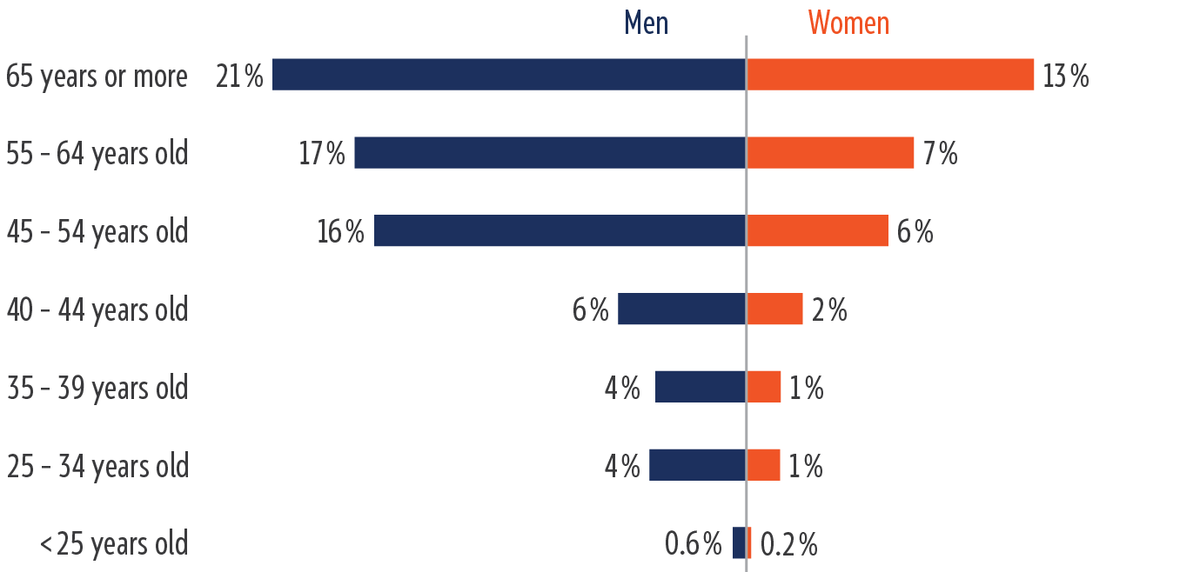
Europe's agricultural sector remains dominated by the older population (Figure 1), with 34 % of farm managers aged over 65 years of age. Around two thirds of women farm managers are aged over 55, while only a small proportion is under 40. Some experts indicate that older women are more likely to appear as farm holders, because inheritance and registration processes only recognise them formally later in life – often after a transfer event such as retirement or death of their spouse.2 Inheriting a farm is still the most common way to access the resources to farm, regardless of age or gender; however, exact numbers are not available, as Eurostat does not track farm successors.3 Recognising that the farming population is ageing, social security and pension prospects are particularly important, especially for women for whom the risk of old-age poverty is the highest.4 The gender gap persists among younger age groups, as well – farmers under 39 account for 8.6 % of male farmers and for only 2.2 % of female farmers – suggesting that structural barriers to entry and succession remain significant for women.
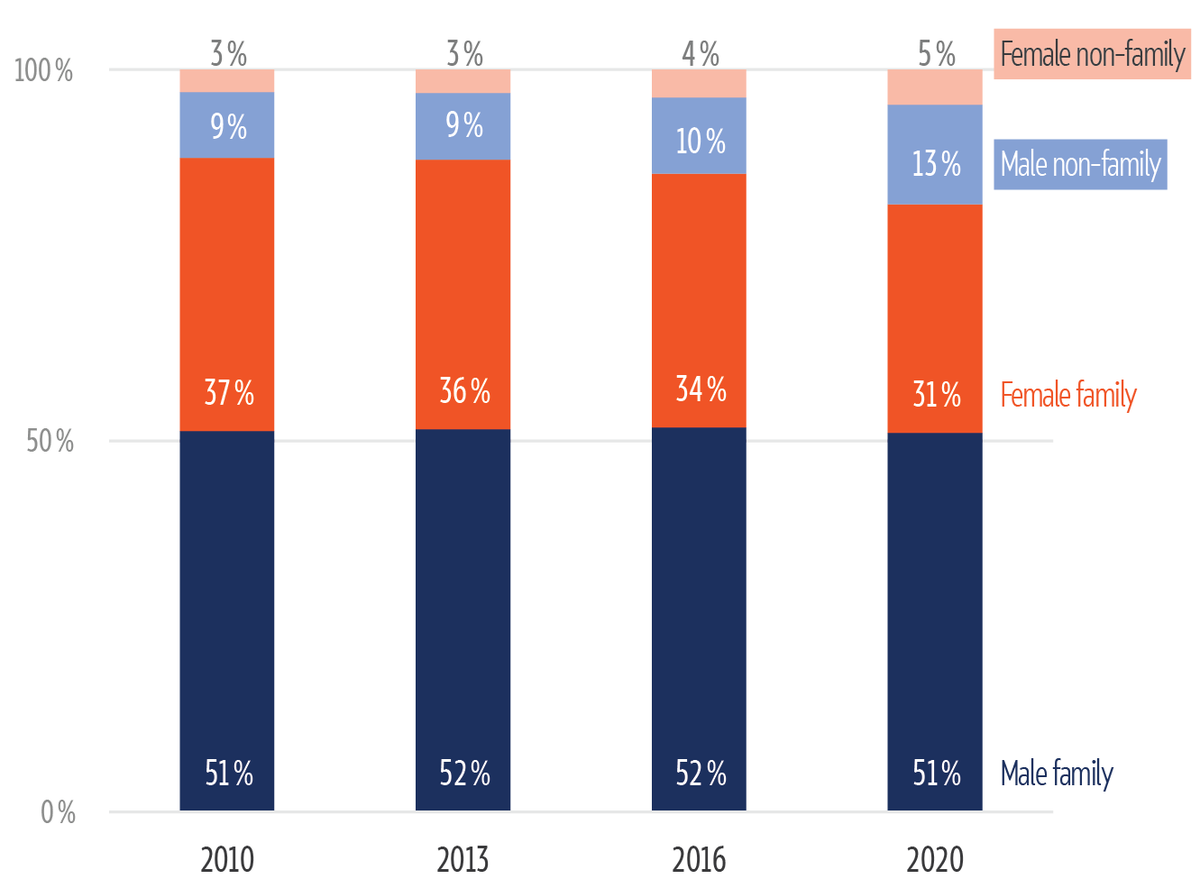
Family farms account for approximately 93 % of all agricultural holdings in the EU and remain heavily dependent on family-based labour (see Figure 2). Eurostat data indicate that family labour remains central to EU agriculture, with around 57 % of farms operated exclusively by family members, and a further 36 % relying predominantly on family labour for at least half of their total labour. Within this model, the contribution of spouses – mainly women – is substantial to the holding's day-to-day functioning. Data from a 2022 pan-German study on women in agriculture indicate that 83 % of them work on a farm and 72 % are involved in strategic business decisions, while 62 % are responsible for accounting, finances and paper work; however, despite their significant contribution, only 11 % of them own the farm, and 24 % own any farm assets.
This imbalance is further reinforced by the way agricultural labour is measured. Much of women's farm work is unpaid, irregularly recorded, or classified as 'assisting family labour'. It therefore does not necessarily generate independent income or social security entitlements, even if officially, it is indicated under annual work units required by CAP statistics.5 This is also confirmed by the data from the Farm Accounting Data Network on the EU agricultural labour force (measured in annual work units), which show that, from all annual work units in 2023, only 30 % were salaried, and 70 % non-salaried.
Data source: Eurostat (code ef_lf_leg), 2026; graphic by Nadejda Kresnichka-Nikolchova, EPRS. Note: Data refer to agricultural holdings above the survey threshold.
Figure 2 also shows that the relative share of female (spousal) labour tends to decline as the farm employs paid workers, who are more often male and non-family members. This pattern suggests that, while women's labour is central to the viability of family farms, particularly in smaller holdings, paid employment opportunities in agriculture remain gendered. The reliance on unpaid spousal labour, alongside a preference for male hired workers when remuneration is involved, points to persistent structural inequalities in the valuation of labour within family farming systems. Women's time spent on unpaid labour on farm severely limits their capacity to participate in independent income-generating activities.
A key limitation of gender-disaggregated data collection in EU agriculture is that Eurostat primarily gathers information on formally recognised farm managers, thereby overlooking the reality that many family farms operate based on shared responsibilities. Data on annual work units provide some insight into labour input on family farms by measuring working time and the number of people involved; however, they do not capture the scale or qualitative aspects of women's participation in agricultural decision-making, farm development, financial relations or access to social benefits. There is also a lack of gender-differentiated data on farm succession, farm size and farm income, as well as on EU-funded education and knowledge exchange activities in agriculture.
Women's access to farming and agricultural resources
Agricultural work is physically demanding and mentally challenging, often involving long working hours and a limited work–life balance. This can pose particular challenges for women, who may place greater value on flexible working arrangements than full-time farming typically allows. Farming is also relatively low-paid. Despite an increase over recent decades, the average agricultural income remains at only around 60 % of the average income in the EU, while barriers to entry into the sector continue to be high, in particular for women.
Studies have identified access to land, capital, knowledge and networks, alongside the general challenge of living in rural areas, as the main factors influencing women's decision to take up farming.6 Women continue to face highly gendered divisions of labour, and inherit land at a much lower rate than men – largely due to persistent gender norms about farming – and remain both less present and active in agricultural trainings and organisations. As regards training, an example from the Netherlands suggest that only 28 % of women farmers have received an agrarian education, compared with 82 % of Dutch male farmers. Most newcomers to farming, including women, experience difficulty in accessing the land in terms of its limited availability and the rising prices of buying or renting the land, as well as accessing financing. Female farmers also face greater challenges in accessing bank loans, and tend to rely more on private resources than male farmers. However, these issues fall primarily within the Member States' competence, meaning that the CAP alone is not able to address them if the Member States do not take action.
Awareness of barriers to women's access to farming
A 2025 study for the European Commission on the assessment of generational renewal strategies across EU Member States highlights a significant lack of awareness among male beneficiaries and potential beneficiaries of the CAP regarding the challenges women face when entering the agricultural sector. According to the data, 38 % of male respondents believe that women do not face greater challenges, while a further 23 % are unsure. Only 37 % of men recognise that female farmers encounter additional difficulties. By contrast, perceptions among female respondents differ markedly: 72 % agree that women face greater challenges, compared with 18 % who disagree and 9 % who are uncertain.
Another key factor lies in deeply entrenched social norms that position women as primary caregivers for children and elderly family members, placing a disproportionate burden on their ability to enter and remain in salaried work, be it farming or other. Eurostat data underline this imbalance: 82 % of those who reduce working hours for childcare are women, and 65 % of women provide care for dependent relatives, compared with 37 % of men. This also shows that, since women do most of the care work, they need easily accessible social support services and infrastructure in rural areas if they are to live there and take up farming. Therefore, encouraging women to enter farming requires providing them with better access to land, finance and knowledge, and easing their family responsibilities through adequate infrastructure for childcare and accessible social care services.
Current CAP framework and beyond
Several EU initiatives and policies aim to advance gender equality and support women's entrepreneurship in rural areas. Under the current CAP, gender has moved from being a cross-cutting issue of the CAP's second pillar in the 2014-2022 period to an overarching objective for the whole CAP, as defined in the CAP Strategic Plans Regulation specific objective 8 (SO8), which seeks 'to promote employment, growth, gender equality, including the participation of women in farming, social inclusion and local development in rural areas, as well as the circular bioeconomy and sustainable forestry'. This provides Member States with the policy, funding and legal framework for the design of specific interventions in favour of women. Member States are also required to improve the collection of gender-disaggregated data. In 2020, before the adoption of national CAP strategic plans, Commission recommendations said gender equality should be an integral part of the preparation, implementation and evaluation of CAP interventions. Issues such as the labour status and social security rights largely fall outside the scope of the CAP and remain a national responsibility.
Beyond the CAP, the Directive on equal treatment for self-employed men and women can also be applied to farmers and their spouses or partners involved in the business. It grants assisting spouses access, on request, to social protection, including maternity benefits, under conditions similar to those of self-employed workers. This is particularly relevant for family farms, where spouses often work without formal status. However, as Member States have discretion in implementing the directive, access to social protection varies across countries.
These legislative initiatives are complemented with several non-legislative ones. The new EU gender equality strategy 2026-2030 aims to advance gender equality across the EU in all policy areas. It envisions a 'Union of Equality' in which women and men, in all their diversity, benefit from equal rights, opportunities, and full participation in economic and social life. Agriculture features mainly in the form of measures addressing work–life balance and gender mainstreaming in rural policies. In the context of the strategy, the Commission plans to carry out a 'stress test' of the above-mentioned directive on self-employed workers, including farmers and assisting spouses, to assess why it remains under-used despite persistent gender inequalities.
The 2025 vision for agriculture and food , outlining the future of farming and food in the EU until 2040, announced a Women in Farming platform to attract more women to farming and promote exchange of experience. Launched in March 2026, the platform aims to strengthen women's engagement and equal opportunities in the farming sector by fostering dialogue and sharing good practices. Beyond this initiative, the vision refers to women merely in the context of attracting young farmers, without mentioning gender equality or gender mainstreaming.
Gender considerations in 28 CAP strategic plans
Under the CAP framework, most Member States, in their CAP strategic plans (CSPs), acknowledge the relevance of gender equality and the need to strengthen women's participation in agriculture, while also improving rural women's socioeconomic conditions. Nevertheless, only a few CSPs include measures specifically targeting women in agriculture. As shown in Table 1,7 gender-related measures are mainly addressed through LEADER8 and other rural-development instruments within the CSPs. Some Member States, including Czechia, Spain, Italy and Portugal , have introduced measures to encourage women's participation in farming, such as targeted support for young farmers. Many CAP Strategic Plans include representatives of women's organisations in monitoring committees – national bodies overseeing CSP implementation.
| Categories | Measures | Countries |
|---|---|---|
| 1.1. Family-oriented approach | Investments in social services: family-oriented, maternity and childcare measures | Austria, Portugal |
| 1.2 Women farmers | Strong focus on women farmers | Ireland, Portugal |
| 1.2 Women farmers | Financial aid, female-focused knowledge transfer groups, EIP themes | Ireland |
| 1.2 Women farmers | Facilitating access to land, promoting knowledge sharing, providing financial instruments and/or grants, enhancing market access, developing smart rural territories, and encouraging economic diversification | Denmark, Germany, Spain, France, Italy, Lithuania, Portugal |
| 1.3 Entrepreneurship | Promoting female entrepreneurship | Belgium (Wallonia), Estonia, Germany, Ireland, Italy, Romania, Slovenia |
| 1.4 LEADER and/or local action groups | Integrating gender-oriented strategies through LEADER in the framework of local action groups | Belgium (Flanders), Bulgaria, Czechia, Estonia, Greece, Cyprus, Latvia, Hungary, Malta, Netherlands, Austria, Poland, Portugal, Slovenia, Slovakia |
| 1.5 No measures addressed | - Finland recognises the gender imbalance, primarily caused by migration of young people, especially women, to urban centres. However, no measures to address this challenge are mentioned in the CSP.
- Croatia argues that there is a balanced gender representation across the country. It has a higher ratio of annual labour units per person, particularly for female agricultural workers. | Croatia, Finland |
Source: M Beck et al., Rural Areas – Levels of support and impact on competitiveness of farms, Policy Department for Structural and Cohesion Policies, European Parliament, 2024.
Spain is the only EU Member State that takes gender into account in all CAP's specific objectives, and provides direct payments targeted at women farm owners. One example is the complementary income support for female farmers that Spain has increased by 15 %. Ireland tries to encourage new female entrants into farming by allocating higher grant rates through the On Farm Capital Investment Scheme for female beneficiaries, raising them to 60 %. Portugal has introduced a gender approach within the cross-cutting CAP objective of modernising agriculture and rural areas, and is allocating a 15 % higher unit amount for complementary income support to young women farmers under specific conditions. Additionally, Ireland and Portugal support women farmers through financial aid and training linked to European Innovation Partnership (EIP) projects in agriculture.
Outside the CAP, Spain introduced a Shared Ownership Law for agricultural holdings in 2012, recognising both registered partners as co-holders, granting them access to agricultural aid, and ensuring individual social security contributions, thereby formally acknowledging spouses' work on farms. France provides a structured approach to recognising spouses' work in agriculture through specific legal status, such as 'conjoint collaborateur', which grants access to social security, pension rights and legal recognition. This framework recognises women's labour on a farm and strengthens their economic autonomy; however, it does not go as far as the rules in Spain, where co-holders are placed on an equal footing.
While Member States have made progress in addressing gender equality in their national CAP plans, a 2025 study by Wageningen University warns that real progress is unlikely, because these provisions are added to a fundamentally unchanged policy framework. The authors argue that, without stronger gender mainstreaming, clearer legal requirements, and robust monitoring mechanisms – including gender parity in advisory and decision-making bodies – the CAP is likely to reinforce, rather than reduce, gender disparities in European agriculture.
Perspectives for after 2027
Under the legislative proposal for a new MFF for the years 2028 to 2034, gender equality is set as a horizontal principle across EU policies and funding programmes, supported by better monitoring, gender-disaggregated indicators, and stronger mainstreaming. In the CAP proposal, presented in July 2025 under the MFF, Member States would be required to prioritise farmers most in need – including young and new farmers, women, family farmers, and small-scale farmers – in their national plans. It also marks the first time the CAP proposal explicitly obliges Member States to take concrete action to support women farmers through targeted interventions. In addition, the proposed regulation introduces the possibility of establishing farm relief services, inviting Member States – on a voluntary basis – to include such support in their strategic plans. These services would allow farmers to take temporary leave for reasons such as illness, childbirth, childcare or other care responsibilities, holidays or participation in training.
Implementation of the gender equality measures across Member States will be monitored through the legislative proposal on the MFF's budget expenditure tracking and performance framework placing gender equality as a horizontal principle across EU programmes. It requires Member States to assess and add a score for each activity's contribution to gender equality, including measures implemented under the CAP. However, despite limited gender references in agricultural indicators, the proposal sets no quantitative gender-equality target or dedicated budget-tracking mechanism, making it primarily a transparency and monitoring tool rather than a binding commitment to gender equality in future EU policies including agricultural policy, as highlighted by the European Parliament's Budgetary Support Unit's analysis of the 2028-2034 performance framework.
Next steps
The redesign of the agricultural policy from 2028 will set the legislative framework for the years ahead, both for agriculture in general and for women in agriculture in particular. Work on the CAP reform proposals in the European Parliament and the Council is ongoing.
European Parliament position
Gender equality in agriculture has been a recurring concern for Parliament, as reflected in its own-initiative resolution on the future of agriculture and the post-2027 CAP, adopted in September 2025, as well as earlier resolutions of March 2008, April 2011, May 2016 and April 2017. These recognise women's key role in rural economies while pointing to ongoing challenges of limited access to capital, credit, land, training, healthcare and social services in rural areas. Parliament calls for targeted support, in particular for young women, including better access to loans, training and financial assistance, as well as stronger participation in agri-food organisations and decision-making bodies, alongside greater integration of gender equality in national strategies and increased LEADER funding.
In April 2026, Parliament adopted an own-initiative resolution on women's entrepreneurship in rural and island areas and outermost regions, which complements earlier work by highlighting the need for improved data on women's roles in agriculture (including as farm holders and spouses) to support policymaking and better recognise women's contributions. In addition, it reinforces the call for action to address legal, fiscal, administrative and institutional barriers for women farmers.
Endnotes
Classification
Policy areas: Agriculture and Rural Development
Committees: Agriculture and Rural Development (AGRI)
Statement on the use of AI
Any AI-generated content in this text has been reviewed by the author. Elicit was used to improve the readability of the text.
Disclaimer
This document is prepared for, and addressed to, the Members and staff of the European Parliament as background material to assist them in their parliamentary work. The content of the document is the sole responsibility of its author(s) and any opinions expressed herein should not be taken to represent an official position of the Parliament.
Copyright
© European Union.
The reuse of this document is authorised under a Creative Commons Attribution 4.0 International (CC-BY 4.0) licence.

https://creativecommons.org/licenses/by/4.0/deed.en
To use or reproduce elements that are not owned by the European Union, permission may need to be sought directly from the respective rightsholders.