
Article page checkbox is not checked in page info.
State of play: EU support to Ukraine
State of Play: EU support to Ukraine
Tim Peters and Jakub Przetacznik with Ana Luisa Melo Almeida, Members' Research Service
Summary
In response to Russia's full-scale war of aggression against Ukraine, which started in February 2022, the European Union (EU) and its Member States have provided unprecedented financial, military and humanitarian support to Ukraine. According to European Commission figures, Team Europe, consisting of the EU and its Member States, has made available around €150 billion in support to Ukraine. This support encompasses macro-financial assistance, financial support through the Ukraine Facility, humanitarian aid and military assistance from Member States and the European Peace Facility, as well as support to Ukrainian refugees in the EU.
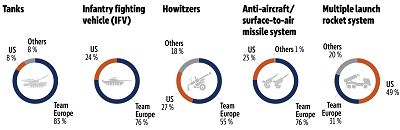
The overall support of Team Europe for Ukraine is now greater than the support provided by the United States (US), except in terms of military support allocation. However, Team Europe has provided 83 % of the tanks and 76 % of the air defence systems given to Ukraine since the start of the full-scale war.
The disbursement of EU payments under the Ukraine Facility is conditional on Ukraine implementing the Ukraine Plan – an ambitious reform and investment plan drafted by Ukraine's government and endorsed by the EU. The Commission and the Ukrainian government publish updates on the progress of the reforms and on the disbursal of payments.
In addition to the Ukraine Facility, the G7 have agreed upon a further €45 billion loan, with €18.1 billion to be financed by the EU. For this purpose, a Ukraine Loan Cooperation Mechanism has been established, which uses extraordinary revenues originating from Russian sovereign assets immobilised in the G7 member states to repay loans and associated interest costs. The rights, responsibilities and obligations provided for under the Ukraine Facility will apply to the G7 loan to ensure seamless management of both. The European Parliament has repeatedly called for confiscating the immobilised Russian sovereign assets to finance further support for Ukraine and the country's reconstruction, instead of just relying on extraordinary revenues. International financial institutions, such as the International Monetary Fund, play a key role in addressing external financing needs and supporting the country's macroeconomic stability.
EU support for Ukraine: State of play
Since the start of Russia's full-scale invasion of Ukraine in February 2022, the EU and its Member States have mobilised around €150 billion in financial, military and humanitarian assistance to support Ukraine, according to statistics provided by the European Commission (see Figure 1). A significant part of this support is provided through the EU budget, in the form of macro-financial assistance loans, payments through the Ukraine Facility, as well as EU-backed loans and guarantees from financial institutions. This financial assistance is drawn from multiple EU budget headings, with the largest proportion coming from Heading 6 'Neighbourhood and the world'.
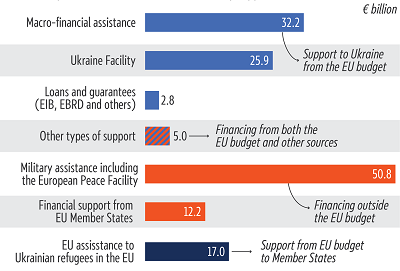
Data source: European Commission, EU Assistance to Ukraine, June 2025, Graphic by: Stephanie Pradier, EPRS.
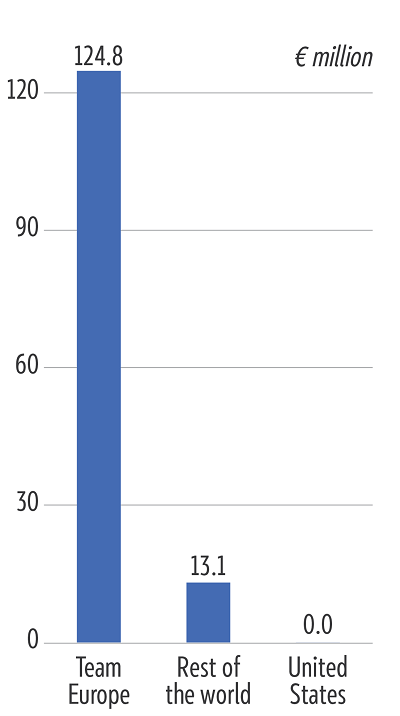
The EU has made available up to €17 billion to Member States hosting Ukrainian refugees through the reallocation of unspent cohesion funds. This assistance has been sourced from programmes under Heading 2a 'Economic, social and territorial cohesion' and Heading 4 'Migration and border management'. However, the Commission's statistics do not provide specific figures for what Member States have spent in support of Ukrainian refugees, which the Kiel Institute values at €124.8 billion in its latest analysis (see Figure 5).
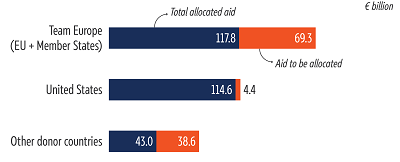
Data source: Trebesch et al., The Ukraine Support Tracker, Kiel Institute, April 2025. Graphic by: Stephanie Pradier, EPRS.
Pursuant to Article 41(2) of the Treaty on European Union, the EU budget cannot be used to finance operations having military or defence implications. Therefore, military support to Ukraine at the EU level is channelled through the off-budget European Peace Facility (EPF). Most of the military assistance from Team Europe to Ukraine comes directly from EU Member States. Overall, Team Europe has provided €50.8 billion in military support to Ukraine so far.
Recently, for the first time since the start of Russia's full scale invasion in 2022, Team Europe has overtaken the US as the overall largest donor of allocated financial, humanitarian and military support to Ukraine (see Figure 2).
Within the EU, Germany has been the largest contributor to Ukraine in terms of bilateral and EU support, followed by France, the Netherlands, Denmark and Italy. In relative terms, Baltic and Scandinavian Member States made the highest contributions as a share of their gross national income (GNI) (see Figure 3).
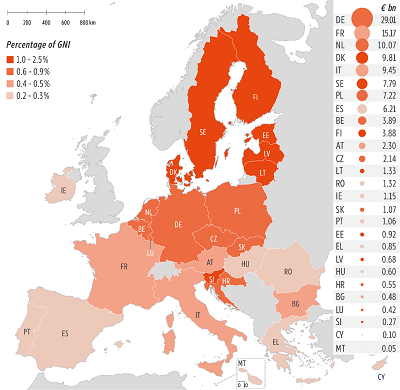
Data source: Trebesch et al., The Ukraine Support Tracker, Kiel Institute, April 2025 and AMECO database. Graphic by: Stephanie Pradier, EPRS.
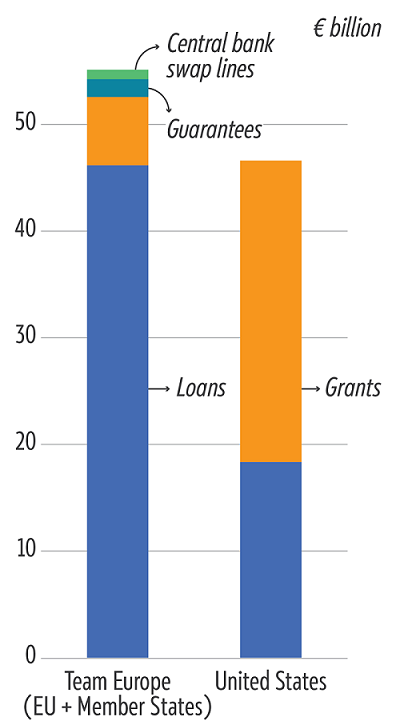
Team Europe provides financial assistance to Ukraine mostly in the form of loans, whereas US support mainly comes in the form of non-repayable grants (see Figure 4).
Data source: Trebesch et al., The Ukraine Support Tracker, Kiel Institute, April 2025. Graphic by: Stephanie Pradier, EPRS.
Data source: Trebesch et al., The Ukraine Support Tracker, Kiel Institute, April 2025. Graphic by: Stephanie Pradier, EPRS.
Grants make up a small portion of the EU financial support for Ukraine, due to the difficult requirement for unanimous agreement on changes to the multiannual financial framework (MFF) and limited fiscal space in many Member States. However, EU loans to Ukraine are provided on very favourable terms, including grace periods for repaying the principal. Additionally, the EU provides grants to finance Ukraine's interest rate payments. Repayment and interest rate payments for loans given under the G7 framework will be covered by windfall (unexpected) profits from immobilised Russian assets through the Ukraine Loan Cooperation Mechanism (ULCM).
Team Europe military support to Ukraine
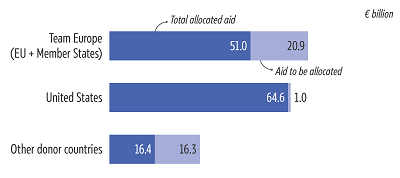
According to the Kiel Institute, military support allocated to Ukraine by Team Europe stood at €51 billion, with an additional €20.9 billion are still to be allocated. This brings the total value of EU pledges to €72 billion. The United States has allocated military support to Ukraine worth €64.6 billion, with new pledges totalling just under €1 billion (see Figure 6).
Data source: Trebesch et al., The Ukraine Support Tracker, Kiel Institute, April 2025. Graphic by: Stephanie Pradier, EPRS.
By the end of February 2025, Member States had allocated, among other things, 784 tanks, including 437 T-72 tanks and 229 Leopard tanks, 966 infantry fighting vehicles (IFVs), 408 howitzers, 59 air defence systems and 26 Multiple Launch Rocket Systems (MLRS). These allocations represent 83 % of tank allocations, 76 % of both air defence systems and IFVs, 55 % of howitzers and 31 % of MLRS delivered to Ukraine since the start of Russia's full-scale invasion (see Figure 7).
Data source: Trebesch et al., The Ukraine Support Tracker, Kiel Institute, April 2025. Graphic by: Samy Chahri, EPRS.
By the end of February 2025, Czechia had delivered all of its allocated equipment. Germany, which appears twice at the top of in terms of allocated equipment, was no longer in the top position when considering only deliveries. In absolute terms, Poland delivered the largest number of tanks, accounting for over 45 % of the tanks committed and delivered by Member States. The Netherlands was leading in the delivery of infantry fighting vehicles (see Figure 8).
When analysing or reporting on military support for Ukraine, it is important to acknowledge that some information may be intentionally obscured by donors as well as by Ukraine, due to security and strategic considerations.
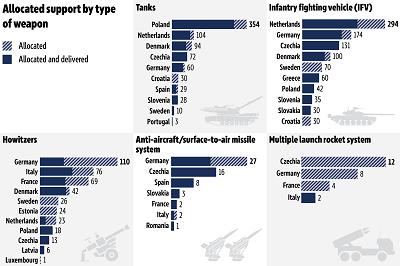
Data source: Trebesch et al., The Ukraine Support Tracker, Kiel Institute, April 2025. Graphic by: Samy Chahri, EPRS.
Tracking reforms and investments under the Ukraine Facility
The Ukraine Facility, established by Regulation (EU) 2024/792, is the EU's flagship programme supporting Ukraine's recovery, reconstruction and EU accession. The facility consists of three pillars and will allocate up to €50 billion between 2024 and 2027. The Ukraine Plan provides the foundation for support under Pillar I of the facility, outlining the necessary reforms and the framework for the disbursement of funds, as defined in Article 17 of Regulation (EU) 2024/792. All measures financed under Pillar II (Investments) and Pillar III (Accession assistance) should equally support the plan's objectives and implementation.
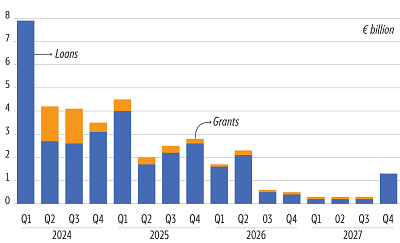
Data source: European Commission, Ukraine Facility, April 2025, Graphic by: Stephanie Pradier, EPRS.
Pillar I of the facility provides direct financial support to the Ukrainian government budget, totalling €38.27 billion (€33 billion in loans and €5.27 billion in grants). The grants are funded by the EU budget through a new special instrument, the Ukraine Reserve, established above the EU budget's expenditure ceilings. The loans are backed by a guarantee under the EU budget's 'headroom' (the single guarantee structure that covers the €33 billion in loans collectively).
Figure 9 shows the heavily front-loaded payment schedule for Pillar I grants and loans, with a large portion allocated in 2024 and 2025 and not leaving much for 2026 and 2027. On 1 April 2025, the Commission disbursed the third regular payment of nearly €3.5 billion under the plan, bringing the total payments under Pillar I of the facility to approximately €19.6 billion.
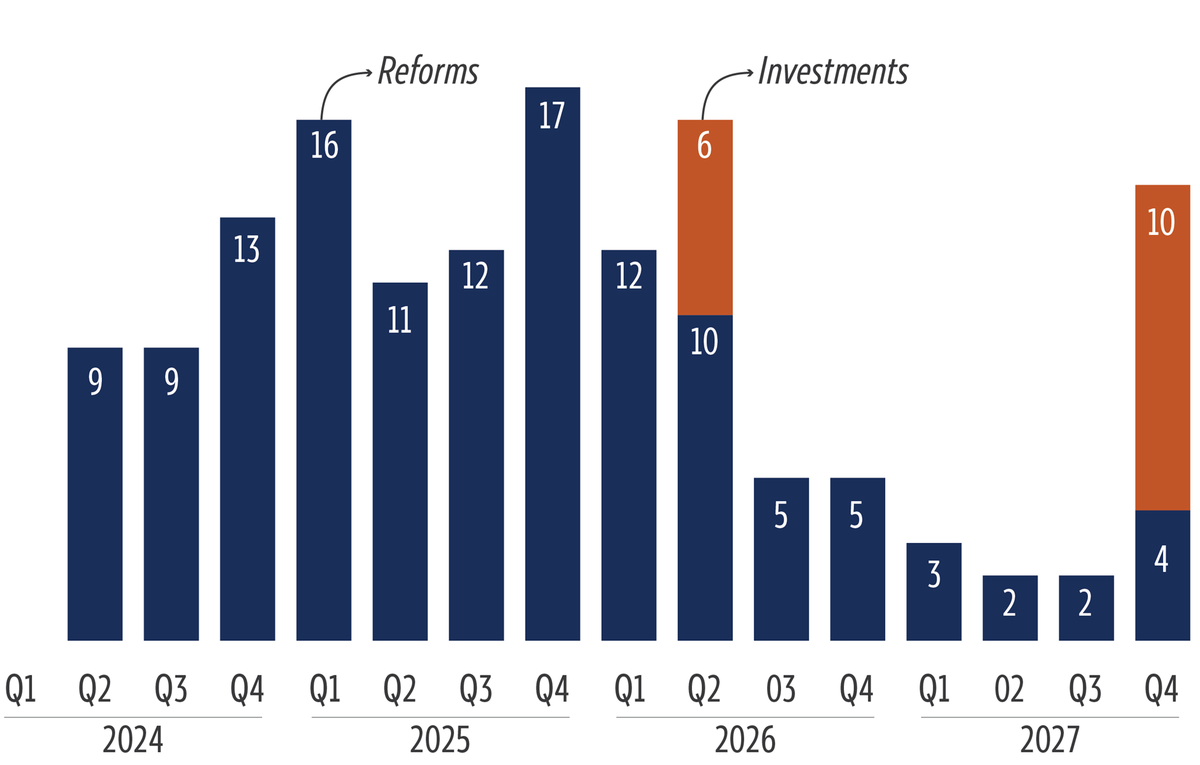
Data source: European Commission, Ukraine Facility, April 2025, Graphic by: Stephanie Pradier, EPRS.
Figure 10 illustrates the timeline of investments and reforms under the Ukraine Facility's Pillar I. The highest number of reforms, totalling 17, is expected in the last quarter of 2025. In line with the payment schedule, most reforms are to be implemented in 2024 and 2025.
The disbursement of payments under the Ukraine Facility is conditional on Ukraine implementing the Ukraine Plan, which includes 69 agreed reforms and investments based on the 130 reforms set out in the annex to the Council implementing decision.
According to the latest update from Ukraine's Ministry of the Economy on the implementation of the Ukraine Plan, as of April 2025, 52 steps had been completed, 56 are in progress, and 43 have not yet started (see Figure 11). Activities scheduled for the first half of 2025 are currently underway, while some planned for the second half of 2025 and beyond have already started. This demonstrates significant progress in the implementation of the Ukraine Plan.
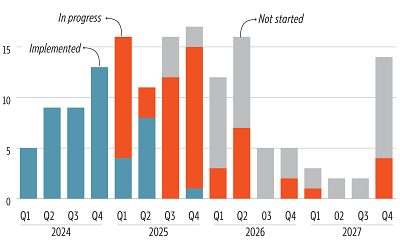
Data source: Ukraine's Ministry of the Economy, Ukraine Facility Plan Implementation Progress, April 2025, Graphic by: Stephanie Pradier, EPRS.
The implementation of the plan is also monitored through a scoreboard provided by the European Commission's Directorate General for Enlargement and Eastern Neighbourhood, in accordance with Article 21 of Regulation (EU) 2024/792.
Responsibility for the political oversight of the funding for Ukraine is shared between Ukraine's Verkhovna Rada, the country's parliament, and the European Parliament on behalf of the EU. The Ukraine Facility's Audit Board, an independent body set up to ensure transparency and effectiveness of the facility, cooperates closely with the European Court of Auditors and Ukraine's Accounting Chamber. Ukrainian authorities must cooperate closely with the European Public Prosecutor's Office and the competent authorities of Member States regarding criminal offences affecting the funds under the facility.
European Parliament's position on the post-2027 multiannual financial framework
On 7 May 2025, the Parliament adopted its position on the post-2027 multiannual financial framework (MFF), stressing the need for a modernised and more flexible long-term budget. The Parliament recognised that the current ceiling of the MFF, set at 1 % of the EU-27's GNI, was inadequate to address the increasing number of crises and challenges facing the EU. It therefore called for a significant increase in the size of the next MFF. In the area of defence, for example, the Parliament supported a substantial increase in spending to enhance the EU's security and defence capabilities. Parliament considered that joint borrowing through the issuance of EU bonds was a viable option to ensure that the EU had sufficient resources to address acute EU-wide crises such as the ongoing security and defence crisis.
In its abovementioned position, Parliament underlined that pre-accession support to Ukraine should be separate from, and supplementary to, financial assistance for macroeconomic stability, reconstruction and post-war recovery. These areas have significantly greater needs that necessitate a coordinated international approach, with support through the EU budget playing a crucial role. The Commission is expected to unveil its proposal by 16 July 2025.
Ukraine's external financing needs and debt sustainability
On 31 March 2023, the International Monetary Fund (IMF) approved a four-year Extended Fund Facility (EFF) for Ukraine, providing the country with access to SDR11.6 billion (about US$15.5 billion; SDR stands for Special Drawing Rights, the IMF's international reserve asset and unit of account) as part of a larger US$148.8 billion international support package. The programme is designed to address Ukraine's significant balance-of-payments needs. The EFF has two phases. The first phase focuses on stabilising Ukraine's economy during the war by strengthening fiscal, external, price and financial stability while implementing structural reforms.The second phase is aimed at supporting Ukraine's post-war reconstruction and EU accession.
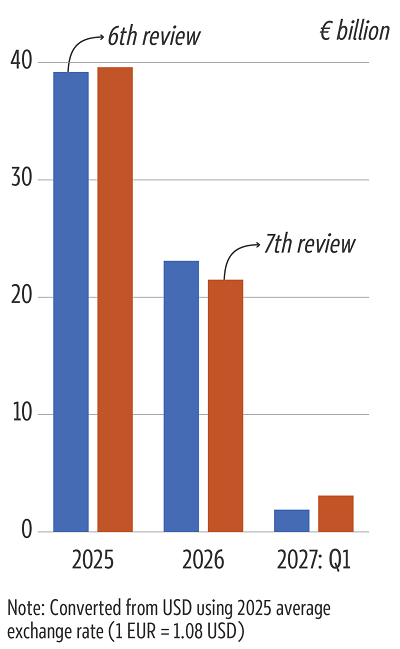
Data source: IMF, Ukraine Seventh Review, March 2025. *Note: Converted from US$ using the 2025 average exchange rate (€1 = US$1.08), Graphic by: Stephanie Pradier, EPRS.
On 28 March 2025, the IMF presented the report for the Seventh Review of the Extended Fund Facility for Ukraine, projecting a slight increase in the country's financing gap under the baseline scenario (see Figure 12). The baseline scenario assumes that the war will begin to wind down in the last quarter of 2025. Even under that scenario, the external financing needs will remain high, at US$23.2 billion. The IMF emphasises that both the baseline and downside scenarios remain subject to high uncertainty. The IMF's downside scenario for Ukraine, in the event of a prolonged war, projects a more severe economic contraction and higher financing needs than their baseline scenario. Specifically, the war is expected to last until mid-2026, with a shock to economic conditions beginning in the second quarter of 2025.
Ukraine's debt has been assessed as sustainable by the IMF in its seventh review. This assessment is based on the fiscal adjustment made under the IMF programme, the concessional financing commitments from donors, and the steps taken by the G7 to protect Ukraine from being burdened by meeting obligations arising from the extraordinary revenue acceleration (ERA) financing (see further details in the section below). Additionally, the assessment takes into account a credible ongoing debt restructuring process.
Use of immobilised Russian assets and the Ukraine Loan Cooperation Mechanism
In addition to the Ukraine Facility, Regulation (EU) 2024/2773 provides an exceptional macro-financial assistance (MFA) loan of up to €35 billion for Ukraine, as part of the G7 ERA initiative. Extraordinary revenues from Russian sovereign assets immobilised in G7 member states will be used to repay these loans and associated interest costs. According to the annex to the G7 agreement, the EU's share of the €45 billion G7 loan amounts to €18.1 billion, with the remaining amounts shared between the US, Canada, Japan and the UK (see Figure 13). The rights, responsibilities and obligations provided for in the framework agreement under the Ukraine Facility, as referred to in Article 9 of Regulation (EU) 2024/792, will apply to the MFA loan to ensure seamless political and financial management of both.
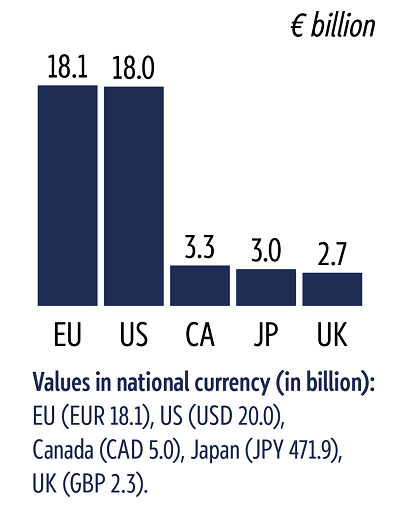
Source: EPRS, based on the agreement among the G7 finance ministers from October 2024, Graphic by: Samy Chahri, EPRS.
On 3 June 2025, the Commission adopted its Implementing Decision C(2025) 3674, approving a bilateral loan agreement between Ukraine and Japan as eligible. Therefore, all G7 lenders' bilateral loans have been approved as eligible. The Commission will now proceed with the adoption of the decision establishing the allocation of non-repayable financial support under the Ukraine Loan Cooperation Mechanism (ULCM) in accordance with Article 5(3) of Regulation (EU) 2024/2773. This decision will ensure that the first payment under the ULCM can take place in the summer of 2025.
Debate has started on whether the EU should confiscate the immobilised Russian sovereign assets as such – instead of just using the extraordinary revenues – to finance further support for Ukraine and the country's reconstruction. The Parliament has repeatedly called for the confiscation of these assets. On 13 June 2025, the Commission disbursed an additional €1 billion as the fifth tranche under the exceptional MFA loan for Ukraine, bringing the total provided so far in 2025 to €7 billion.
Classification
Policy areas: Budget | Budgetary Control | Foreign Affairs | International Trade
Regions: European Union, Non-EU Europe and the North
Disclaimer
This document is prepared for, and addressed to, the Members and staff of the European Parliament as background material to assist them in their parliamentary work. The content of the document is the sole responsibility of its author(s) and any opinions expressed herein should not be taken to represent an official position of the Parliament.
Copyright
© European Union.
The reuse of this document is authorised under a Creative Commons Attribution 4.0 International (CC-BY 4.0) licence.

https://creativecommons.org/licenses/by/4.0/deed.en
To use or reproduce elements that are not owned by the European Union, permission may need to be sought directly from the respective rightsholders.