
Article page checkbox is not checked in page info.
State aid in the EU: State of play
State aid in the EU: State of play
Marcin Cesluk-Grajewski, Members' Research Service
Summary
The European Union's (EU) economy depends on a single market where goods, services, and capital move freely, supported by the general prohibition of state aid – understood in the EU as government support to businesses that could distort competition or trade. However, state aid may be authorised under the Treaty for targeted policy goals, such as developing poor regions, achieving common EU goals, addressing market failures or fighting crises.
The European Commission, tasked with controlling state aid, ensures that any support aligns with EU law, establishing transparent frameworks and guidelines for Member States' policies. State aid policy has evolved from rigid anti-distortion principles into a flexible, target-oriented rulebook accommodating crises, sustainability and innovation. In recent years, state aid has become a tool, first to ward off economic crises and then to help foster the industrial policy needed to achieve the EU's climate goals and boost economic growth.
The Commission's latest priorities encompass competitiveness, social justice and environmental goals. Working towards these goals demands considerable investment, much of which must come from national governments as state aid, because the EU budget is too small to meet these needs. Balancing these priorities alongside concerns about market distortion in favour of wealthier EU countries guides the ongoing evolution of state aid policies, as seen in the Clean Industrial Deal State Aid Framework, published in 2025 and effective until 2030.
Introduction
This briefing offers an overview of the state of play in state aid policy, exploring its legal framework and evolution, as well as recent developments and the challenges involved in balancing economic equality with the need for strategic public intervention. The European Union's economy depends on the single market, where the prohibition of state aid – government support to businesses that could distort competition – is essential for companies to compete freely. However, possible failures of a free market and certain policy choices require a broader approach: there are exceptions to the state aid ban provided by treaties that help to achieve overarching EU goals, such as developing poor regions, achieving environmental sustainability, and promoting innovation. The exceptions may also help to remedy serious disturbances in the economy and overcome natural disasters or other exceptional events.
State aid rules are a cornerstone of EU competition policy, which aims to ensure a level playing field for businesses. When governments subsidise selected firms, be it through grants, tax breaks or cheap loans, they give them an advantage over their rivals, distorting the level playing field. While state aid can destabilise markets, it has played a major role in stabilising economies during crises like the COVID-19 pandemic and Russia's war on Ukraine. It has also advanced EU priorities such as the Green Deal and digital transformation. The European Commission, as the guardian of the EU Treaties, drafts and enforces state aid rules, assessing the compliance of state support with EU law. It applies pre-established conditions and criteria set out in guidelines or frameworks providing Member States with a transparent and reliable framework for planning state aid policies. The Commission's decisions can be challenged in the Court of Justice of the EU.
The EU state aid rules, interpreting Articles 107-108 of the Treaty on the Functioning of the EU (TFEU), have evolved significantly. Once a set of theoretically rigid anti-distortion principles, they have become a simplified, more flexible, target-oriented framework that can accommodate crises, sustainability and innovation. From 2021 to 2023, these rules focused on reviving economies from the downturns caused by the COVID-19 pandemic and soaring energy prices. More recently, they have increasingly focused on efforts to achieve EU environmental goals, such as decarbonisation, the large-scale deployment of renewable energy and the rollout of clean technologies.
The current Commission prioritises economic competitiveness, social justice and environmental goals, which requires massive investment programmes. The 2024 report by former Italian Prime Minister Mario Draghi, a guideline for the Commission in many areas, estimates that the EU needs to invest €800 billion annually to achieve a successful green and competitive transformation. Given the limited EU budget, much of this funding would have to come from national governments, including through state aid, and the private sector.
In 2024, total state aid spending amounted to €168.2 billion, after peaking at €237 billion in 2022, and compared to €136.5 billion in the pre-pandemic year of 2019. There are concerns that the single market could be skewed to the advantage of wealthier EU countries that can allocate more funds to state aid than other Member States. To address these concerns, the Commission has created incentives for directing state aid to multinational ventures and maintained provisions enabling more government support for the poorest regions. The absence of supranational fiscal resources for EU state aid policy forces EU policymakers to balance the need for subsidies to facilitate the green and other transitions with the imperative of minimising distortions of the single market.
A compromise between fairness, economic efficiency and policy goals is the guiding principle of the Clean Industrial Deal State Aid Framework (CISAF), the latest rulebook, published in June 2025 and valid until 2030 (see section below). While the framework continues to ease the provision of state aid for renewable energy by the Member States, it also facilitates the allocation of national subsides for the decarbonisation of heavy industries. Additionally, in December 2025 the Commission exempted Member States from the requirement to notify it of state aid allocated to affordable housing, expanding on the previous exemption, which only applied to state aid for social housing.
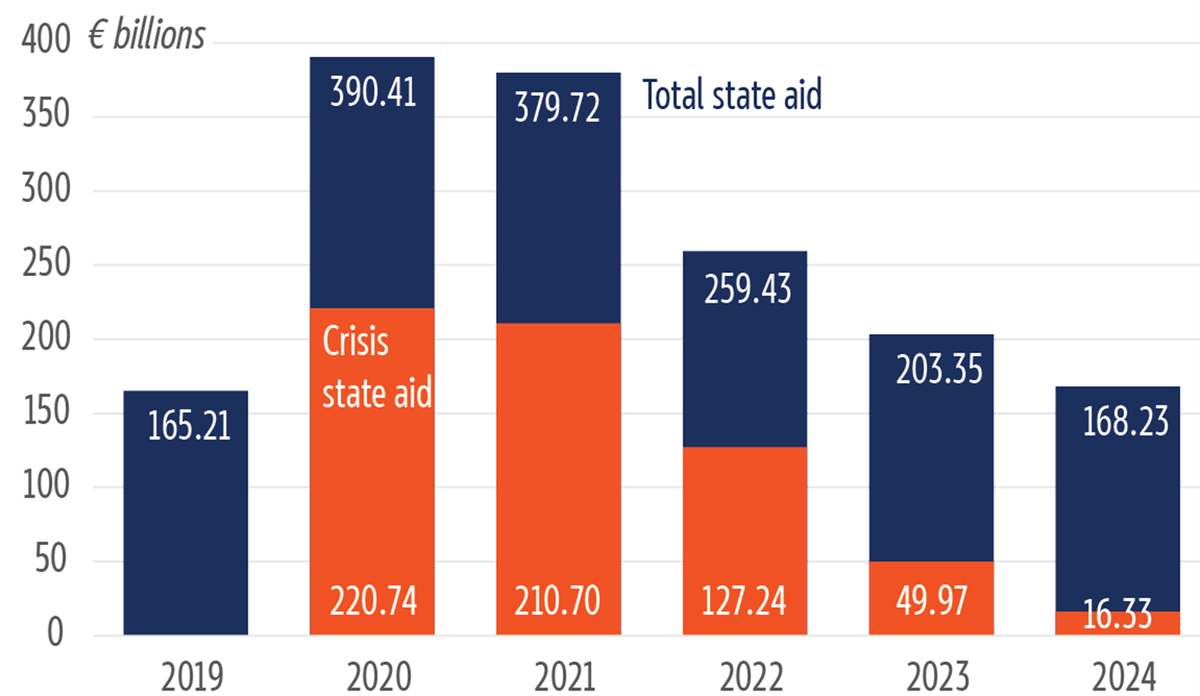
Source: State aid scoreboard 2025, European Commission. Graphics by Nadejda Kresnichka-Nikolchova, EPRS
Law and provisions on state aid
State aid policy in the EU is rooted in the TFEU, with Articles 107-108 providing its legal basis. Article 107 is key, as it sets out the conditions under which a measure constitutes state aid, describes the circumstances under which it is prohibited, and lists the exceptions and possible exceptions to the general prohibition. Article 108 empowers the Commission to manage state aid policy and to ensure its compatibility with the internal market. In practice, this makes the Commission the central authority responsible for approving or blocking state aid. Member States are therefore required to seek the Commission's approval before implementing any aid that could affect trade or distort competition between EU countries.
Article 107(1) states that:
Save as otherwise provided in the Treaties, any aid granted by a Member State or through State resources in any form whatsoever which distorts or threatens to distort competition by favouring certain undertakings or the production of certain goods shall, in so far as it affects trade between Member States, be incompatible with the internal market.
Article 107(2) sets out categories of aid that are automatically compatible with the internal market and therefore fall outside the prohibition in Article 107(1):
-
aid of a social character to individual consumers provided without discrimination of the products concerned;
-
aid to recompense for natural disasters or other exceptional occurrences.
-
aid for some part of Germany affected by its previous division. Its application has been significantly narrowed by court rulings and Commission oversight; it last applied in 2016.
Article 107(3) lists circumstances under which the Commission may deem state aid legal and therefore compatible with the internal market. These include aid:
-
to develop areas where the standard of living is low and unemployment is high;
-
for Important Projects of Common European Interest or to remedy a serious economic disturbance;
-
to facilitate the development of specific economic activities in certain areas, provided it does not harm trading conditions and the common interest;
-
to promote culture and heritage conservation;
-
and other aid approved by the Council based on a Commission proposal. This category has been used sparingly, encompassing only 32 cases, with the most recent application in 2020.
In addition to the Treaty provisions, several regulations further specify and operationalise the state aid rules. In particular, the General Block Exemption Regulation (GBER) lays down thresholds for state aid amounts that are exempted from prior notification to the Commission. More than 90 % of state aid is currently granted under the GBER, making it by far the most used state aid tool. The de minimis Regulation exempts small aid amounts from the scope of EU state aid control because they are deemed to have no impact on competition and trade in the internal market. Other regulations outline the Commission's procedural rules.
Article 346 TFEU, concerning the defence exception, is yet another important provision in state aid policy. It allows Member States to refrain from notifying the Commission of measures, the disclosure of which would run against the essential interests of its security, such as matters related to defence.
Political background
Although the rules on state aid are established by the Treaties, the practical exemptions, their scope, permissible support amounts and the control process may not always be immediately clear. The Commission provides guidance on these issues through communications and guidelines informed by consultations with Member States and other stakeholders.
Within the Council, debates on state aid have often pitted advocates of active industrial policies against supporters of strictly free-market solutions. Discussions have, at times, focused on the need to create EU industrial champions to enable the EU to compete with Chinese or US companies on the global stage. Such considerations have a bearing on state aid policies, which can be used to strengthen specific sectors and companies. Indeed, state aid can be a key tool in industrial policies, understood as government efforts to shape the economy by targeting specific industries, firms or economic activities through tools such as subsidies, tax incentives, infrastructure development, protective regulations and research and development support.
Traditionally, France and, to a lesser degree, Germany have advocated supporting industrial policies as a way to reinforce EU economic strength. A 2023 Franco-German policy contribution entitled ' For a European Green Industrial Policy ' proposed 'experimenting [with] targeted subsidies and tax-credits using fast-track and predictable umbrella schemes for key industrial sectors'. French President Emmanuel Macron has also called for a ' to counter foreign competition. In 2024, France, Germany and Italy backed a prolongation of the temporarily more flexible state aid rules. The Commission's CISAF of 2025 (see section below) largely accommodated these views by envisioning longer-term, increased and simplified state aid for clean-tech and decarbonisation.
Smaller EU Member States have been wary that excessively flexible state aid rules could fragment the single market because they have less fiscal capacity to support their firms than bigger countries. In 2023, Denmark, Finland, Ireland, Poland, Sweden, the Netherlands, Hungary, Latvia, Czechia, Slovakia and Belgium urged caution regarding the relaxation of state aid rules.
Some researchers view the Important Projects of Common European Interest (IPCEIs) cross-border projects backed by national governments as a compromise between the need for industrial policies and the necessity of preserving a level playing field within the internal market. However, the programme remains limited, with the total approved aid amounting to €92 billion for 11 projects.
Statistics show that Germany and France have accounted for more than half of approved state aid for their companies in recent years. The five Member States that spent the least were the two smallest and the three Baltic states: Malta, Cyprus, Latvia, Estonia and Lithuania. However, when state aid is measured as a share of national GDP, the rankings shift, with Hungary, Romania, France, Greece and Poland topping the list.
The European Parliament, which has a solely advisory role on competition policy in most cases, and the European Economic and Social Committee have repeatedly warned against fragmentation in the single market due to disparities in national state aid capacities.
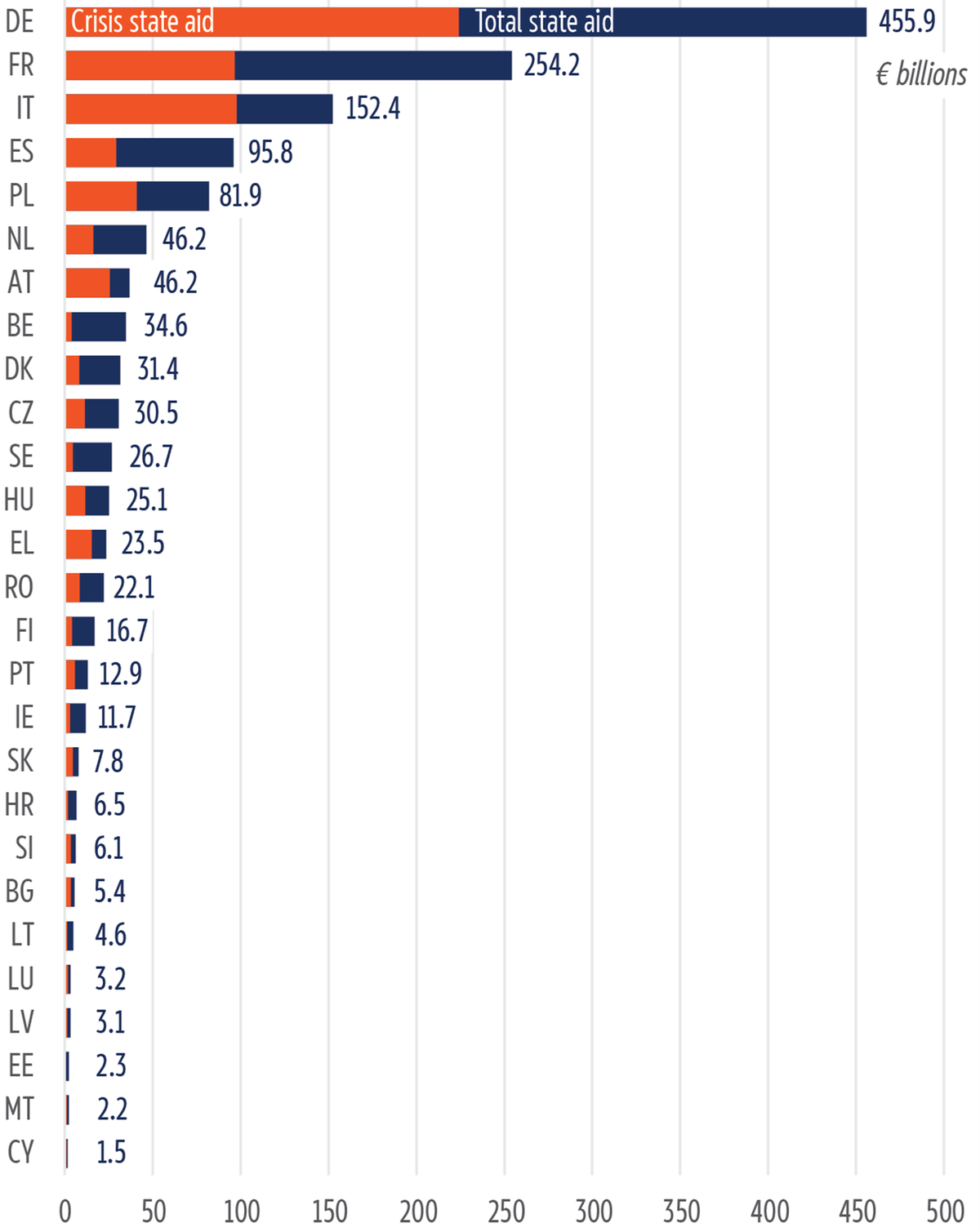
Source: State aid scoreboard 2025, European Commission. Graphics by Nadejda Kresnichka-Nikolchova, EPRS.
State aid in the wake of the pandemic and war
The outbreak of the COVID-19 pandemic in early 2020 and Russia's unprovoked attack on Ukraine in February 2022 shook the EU and the global economy, pushing many companies to the brink of bankruptcy and fracturing many supply chains. The pandemic initially froze mobility and choked consumer demand, while the war in Ukraine caused energy prices to surge. The Commission deemed both events to be exceptional circumstances causing serious economic disturbances that merited increased state aid to mitigate the crises. It subsequently adopted two dedicated state aid frameworks, in 2020 and 2022, which were updated and prolonged, often until the end of 2023. As a result, approved state aid measures increased significantly between 2020 and 2023.
COVID-19 pandemic
In response to the pandemic, the Commission tabled a set of crisis aid rules the Temporary Framework proposing economic support measures that included the possibility to provide state aid faster, in higher amounts and in a simpler way. This framework allowed for direct grants, selective tax advantages and advance payments. For example, subsidies could cover up to 100 % of wages for workers on short-time work, who could have otherwise been laid off. Reimbursement for losses incurred due to the pandemic (drops in revenue, costs from health measures) could be as high as 50 % of losses for most firms, with SMEs eligible for higher allowances (up to 80 %). Member States could establish schemes granting companies up to €800 000 to address urgent liquidity needs. The framework also permitted state guarantees for bank loans to companies, subsidised loans for firms, and safeguards for banks that channel state aid into the economy.
Furthermore, in 2021 the Commission widened the scope of the GBER, enabling the provision of increased state aid in specific areas without requiring notification. This expansion encompassed research and investment, territorial cooperation and state investment related to the InvestEU programme, which provided EU budget guarantees for projects promoting job creation and the green transition.
The GBER primarily covers state aid granted in support of:
-
regions
-
small and medium-sized enterprises (SMEs)
-
research, development and innovation
-
training aid and aid for workers with disabilities
-
environmental protection
-
remedying damage caused by certain natural disasters
-
social aid for the transport of residents of remote regions
-
broadband infrastructure
-
culture and heritage conservation
-
sport, as well as multifunctional recreational and local infrastructure
-
regional airports and ports.
Outside the scope of state aid, the EU launched an unprecedented joint stimulus NextGenerationEU for 2021-2026, which amounted to €806.9 billion in current prices. Under the Recovery and Resilience Facility , the centrepiece of the plan, the Commission issued bonds for Member States to finance reforms and prepare for the green and digital transitions.
According to a 2022 publication , the 26 Member States that responded to a survey had utilised approximately €729 billion in state aid between mid-March 2020 and the end of June 2021. This figure stands in contrast to the total of €3.01 trillion in aid approved for the same Member States during that period, suggesting that they retained considerable residual spending capacity under the implemented measures.
Russian invasion of Ukraine
In response to Russia's full-scale invasion of Ukraine in February 2022, the Commission adjusted its Temporary Framework in March 2022. It was renamed the Temporary Crisis and Transition Framework (TCTF) In March 2023, extending the flexibility under state aid rules – previously applied to pandemic-hit enterprises – to entities affected by the war. These rules focused on offsetting the impact of high energy prices, allowing Member States to partially compensate companies, in particular intensive energy users, for additional costs resulting from exceptional gas and electricity price increases.
This support could be granted in any form, including direct grants. The overall aid per beneficiary could not exceed 30 % of the eligible costs, up to a maximum of €2 million at any given point in time. When the company incurred operating losses, further aid could be granted to ensure the continuation of an economic activity. To that end, Member States could grant aid exceeding these ceilings: up to €25 million for energy-intensive users and up to €50 million for companies active in specific sectors such as those producing aluminium and other metals, glass fibres, pulp, fertilisers or hydrogen and many basic chemicals.
The Commission calculates that in the period between the adoption of the temporary crisis framework in March 2022 and the end of June 2023, of the nearly €729.72 billion in aid approved, €140.79 billion was actually granted to companies. This represents 19.3 % of all approved aid, corresponding to 0.6 % of the EU-27 GDP in 2022 and the first half of 2023. Member States therefore only granted a relatively small percentage of the amounts approved by the Commission. Of the aid granted, Germany provided €72.8 billion (52 % of the total), followed by Italy (€39.2 billion) and Spain (€12.1 billion).
State aid in the service of 'net-zero' emissions
In 2022, the Commission adopted its Guidelines on state aid for climate, environmental protection and energy (EEAG), aligning state aid policies with the Commission's overarching European Green Deal . These guidelines aimed to reduce greenhouse gas emissions, including through support for renewable energy and energy efficiency. They covered additional state aid for projects such as improving the environmental performance of buildings; acquiring and leasing clean vehicles; deploying recharging or refuelling infrastructure; transitioning towards a circular economy; preventing or reducing pollution other than that from greenhouse gases; ensuring the security of electricity supply; developing energy infrastructure; implementing district heating and cooling; reducing electricity levies for energy-intensive users; and closing of power plants using coal, peat or oil shale and of mining operations involving coal, peat or oil shale extraction.
These measures were deemed insufficient after the US adopted the Inflation Reduction Act (IRA) later that year; most of its provisions were later scrapped in 2025 by President Donald Trump. The IRA offered substantial subsidies to companies for the development of a net-zero economy,ensuring rapid disbursment through uniform oversight from the federal state. The bill allocated an estimated US$369 billion to be invested in energy security and climate change mitigation, which triggered concern within the EU that green investment could be diverted from Europe to the US. Partly in response to the IRA, the Commission approved the TCTF in March 2023, as mentioned above. The TCTF allowed for increased state support for green projects, aligning with the Green Deal industrial plan , which detailed the implementation of the European Green Deal.
The key new element of the TCTF was fostering support for sectors critical to the transition to a net-zero economy. New state aid provisions were designed to make it easier and faster to develop new capacities in batteries, solar panels, wind turbines, heat pumps, electrolysers and carbon capture usage and storage, as well as the production of key components and the production and recycling of related critical raw materials. To avoid distorting competition within the internal market, the aid was applicable until the end of 2025 and limited in scope. However, these aid limits could be lifted on a case-by-case basis, up to 100 % of the costs of a project, if the beneficiary could demonstrate the possibility of receiving an equivalent investment in a third country outside the European economic area. This clause aimed to prevent companies from locating investment in countries like the US, attracted by IRA subsidies, or to China. In other cases, the allowed aid intensity varied from 15 % to 60 %, depending on the method of support, type of company and region where it was located.
Clean Industrial Deal State Aid Framework
The Commission's Clean Industrial Deal State Aid Framework (CISAF), published in June 2025 and valid until 2030, places stronger focus on industrial decarbonisation than its predecessor, the TCTF. It is aimed at balancing the urgent need for industrial decarbonisation and deployment of clean technologies with fair competition. Designed to align with the EU's 2030 climate targets and the Fit for 55 package, the framework provides specific aid intensity caps and conditions to support the green transition.
The framework simplifies state aid in five areas:
-
the roll-out of renewable energy and low-carbon fuels, including blue and green hydrogen;
-
temporary electricity price relief for energy-intensive industries;
-
the decarbonisation of existing production facilities;
-
the development of clean tech manufacturing capacity in the EU;
-
the de-risking of investments in clean energy, decarbonisation, clean tech, energy infrastructure projects and projects supporting the circular economy.
The following limits on state aid are applied:
| Category | Aid limits (up to) | Comments/Examples |
|---|---|---|
| Hydrogen or hydrogen-derived fuels | Up to 60 % of investment costs, up to €200 million | The EU's priority is to develop renewable hydrogen produced using mainly wind and solar energy. |
| Clean energy rollout | 45 % and up to 100 % in some cases, with a competitive tender | Projects must integrate with EU grid infrastructure and demonstrate grid stability benefits. Competitive auctions are preferred for mature technologies (onshore wind) to ensure cost efficiency. |
| Schemes to support specific innovation fund projects | 25-55 %, depending on the region, up to €150-350 million | Must be positively assessed under the Innovation Fund. |
| Decarbonisation of industry |
60 % for investments enabling the use of hydrogen or hydrogen-derived fuels 45 % for investments in the production of renewable energy 35 % for investments enabling the use of low-carbon fuels 30 % for other technologies |
Must deliver a reduction in direct greenhouse gas emissions resulting from the activity concerned, which would not take place without the aid. For investments made by small enterprises, the aid intensities under can be increased by 10 percentage points, and for investments made by medium-sized enterprises the aid intensities can be increased by 5 percentage points. |
| Manufacturing projects to produce NZIA (Net Zero Industry Act) final products |
15-35 % of eligible costs depending on the EU region (assisted or non-assisted); maximum amount €150-350 million Matching aid of up to 100 % possible to avoid artificial diversion of investments due to third-country subsidies Tax incentives (accelerated depreciation) for companies to buy clean technology assets such as solar panels |
Batteries, solar panels, wind turbines, heat pumps, electrolysers, carbon capture, utilisation and storage are already included under the TCTF. The new framework extends this list to include production related to electricity grids, geothermal, nuclear energy and electric propulsion, as well as the production of new and recovered critical raw materials if they are used for net-zero purposes. Nuclear equipment that is covered by NZIA can also receive support under the section on clean-tech manufacturing. The aid intensity can be increased by 20 percentage points for aid granted to small undertakings and by 10 percentage points for aid granted to medium-sized undertakings. |
| Temporary electricity price support | 50 % maximum aid intensity on eligible consumption | Subsidised electricity price cannot be below €50/MWh and 50 % of aid received must be re-invested in decarbonisation. |
CISAF permits tax-based incentives, such as reduced VAT or excise duties, for green products but emphasises proportionality, requiring that measures do not exceed what is necessary to achieve their legitimate objectives. Although no fixed caps apply, tax incentives must not distort competition. For instance, accelerated depreciation for energy-efficient equipment may be allowed if it aligns with market standards. Financial instruments like subsidised loans or guarantees are also permitted. However, tax incentives cannot offset essential costs of energy services such as grid charges. Loan guarantees must prioritise passing benefits directly to final beneficiaries, not financial intermediaries.
To reduce administrative burdens, SMEs do not have to report aid up to €200 000 (de minimis aid) to the Commissions over three years for small-scale green investments such as energy audits or rooftop solar installations. This threshold is higher than the standard €100 000 cap under the general de minimis rule, reflecting the need to support SMEs in the green transition.
Housing
In December 2025, the Commission adopted a Decision on state aid in the form of public service compensation granted to certain undertakings entrusted with the operation of services of general economic interest (SGEI), stipulating that national subsidies for affordable housing would no longer be treated as state aid. Until then, this exemption only applied to national aid for social housing. The Commission justified this change by noting that nowadays more and more citizens – not only the most vulnerable but also lower-middle-income citizens – face growing difficulties in accessing quality housing at an affordable price. Therefore, the decision would facilitate support for affordable housing while also simplifying support for social housing. The decision and the accompanying communication set the conditions under which state aid in the form of public service compensation is compatible with the Treaty. Member States must meet these conditions to be exempt from notifying such compensation to the Commission. The SGEI framework establishes the rules for assessing SGEI compensations that still require notification.
Views on state aid
EU state aid policy has received mixed reviews in commentaries and papers from academia, think tanks, stakeholders and institutions. The debate reflects, to some extent, the division between advocates of industrial policies and those backing strict state aid control. Many acknowledge the difficulties the Commission faces in navigating between these two approaches.
'Ultimately, balancing ambitious industrial objectives with market fairness remains a core challenge for the EU's evolving governance architecture,' wrote Lena Hornkohl and Dionysios Pelekis in their paper, State aid control as a coordinating instrument for EU industrial policy in the internal market. They argue that the shift from a strict prohibition model towards a more flexible regime has enabled swifter resource mobilisation, but it has also raised concerns about the potential for deepening economic divergence between Member States.
The think tank Bruegel had supported ending the temporary measures that relaxed state aid, but that did not occur. In the briefing Not yet Trump-proof: an evaluation of the European Commission's emerging policy platform, Bruegel wrote: 'the Commission proposes a new state aid framework for national industrial policy rather than expansion of EU-level public investment funding. This runs the risk of weakening the single market and harming competition, with the unintended consequence of protecting incumbents and inhibiting structural change.'
The European Court of Auditors (ECA) gave a mixed assessment of the Commission's crisis state aid frameworks that addressed the impact of the pandemic and Russia's war on Ukraine, as well as subsequent measures to foster green transition. The ECA's Special report: State aid in times of crisis , dated October 2024, found that by adopting temporary frameworks, the Commission reacted swiftly to economic disturbances. However, the Commission faced difficulties in monitoring and assessing their impact on competition, stemming from the lack of reliable aid information from Member States. This was particularly true for national umbrella schemes, which enabled Member States to adopt many state aid measures without further notification but also posed a significant risk to the Commission's effective monitoring of state aid. Moreover, the ECA found that Member States did not always have effective control mechanisms in place and often relied on beneficiaries' self-declarations, making cross-checking compliance with cumulation rules challenging, especially in Member States that lack a central register for state aid.
Regarding the TCFT, which allowed for increased amounts of state aid for clean-tech industries and simplified procedures, the ECA said the Commission failed to produce a proper impact assessment and to include sufficient safeguards that aid is limited to the minimum and that it could be clawed back if necessary. It concluded: 'There is also a risk that Member States may use the crisis and transition framework or other future frameworks to attract investments from Member States that do not provide aid. As a consequence, state aid could be concentrated in certain Member States and may undermine the integrity of the internal market.'
International Monetary Fund (IMF) researchers have also expressed doubts about the efficiency and necessity of EU state aid policy in its current shape. The IMF's 2024 working paper, A bitter aftertaste: How state aid affects recipient firms and their competitors in Europe , found that firms that receive state aid increase employment and revenue but not investment or labour productivity. It added that competing firms experienced adverse spillover effects that significantly undid any positive own effects. It concluded that, to mitigate adverse spillovers, aid to EU firms would best be provided at the EU level instead of at Member State level. Pooling resources and competitively allocating aid across the EU could preserve market competition, encourage firm entry and ensure a more efficient distribution of funds, the report said.
Next steps in EU state aid policy
The Commission is conducting several public consultations regarding the future of certain elements of state aid policy. One concerns a revision of the GBER with the aim of simplifying it, aligning it with social, market and technological developments, and streamlining it.
Another consultation concerns the revision of the guidelines on state aid for companies in difficulty to exclude certain startups and scale-ups from the scope of the definition of 'undertaking in difficulty'. This would be done with the aim of enabling such companies to benefit from other types of state aid, if they are not at risk of bankruptcy. The revision also seeks to add the steel sector to the scope of application of the guidelines.
Finally, state aid rules for public service broadcasting are being evaluated to establish whether they have met their objectives and to align them with the technological, market and legal developments in place since 2009.
The size of the proposed EU long-term budget for 2028-2034 – nearly €2 trillion – is much less than the €800 billion per year that the Draghi report identifies as necessary for the EU to be able to fund its priorities. This means that a significant investment in EU competitiveness needs to be achieved through state aid (and substantial mobilisation of private funding).
The role and priorities of the European Parliament
Articles 108 and 103 TFEU empower the Commission and the Council in matters of competition policy. The European Parliament participates through the consultation procedure, allowing it to adopt opinions.
Scrutiny of the European Commission is a key responsibility of the European Parliament. To this end, the Competition Commissioner appears before Parliament's Committee on Economic and Monetary Affairs regularly to explain the approach taken and discuss individual decisions. The committee's Competition Working Group discusses pending issues related to competition policy in depth and on a regular basis. The committee also drafts annual resolutions on competition policy following the Commission's yearly.
Parliament's 2025 resolution on competition policy annual report 2024 (rapporteur Lara Wolters, S&D), pointed out that state aid was increasingly used to support industrial policy, and that the Member States' divergent fiscal capabilities and fragmented state aid created an uneven playing field. Parliament called on the Commission and the Member States not to engage in a subsidies race, concluding that previous temporary state aid frameworks had failed to prevent further market fragmentation. The report called for stricter state aid monitoring and enhanced state aid reporting and transparency, in line with the recommendations of the ECA. It also stressed the importance of state aid under the framework of IPCEIs, which allow Member States to jointly fund large-scale, cross-border projects, notably in strategic sectors like green tech or digital innovation.
Main references
- A fork in the road for EU competition policy, Bruegel, November 2024.
- State aid scoreboard 2025, European Commission, 2026.
- The future of European competitiveness: Report by Mario Draghi, September 2024.
- State aid in times of crisis, European Court of Auditors, October 2024.
- EU-US climate and energy relations in light of the Inflation Reduction Act, EPRS, European Parliament, January 2023.
- State aid in the wake of the pandemic, war and foreign subsidies, EPRS, European Parliament, April 2023.
- A Bitter Aftertaste: How State Aid Affects Recipient Firms and Their Competitors in Europe, IMF, December 2024.
- A European state aid framework for the Clean Industrial Deal, Jacques Delors Institute, 2025.
- Hornkohl, L. and Pelekis, D., State aid control as a coordinating instrument for EU industrial policy in the internal market, 2025.
- Not yet Trump-proof: An evaluation of the European Commission's emerging policy platform, Bruegel, 2025.
Classification
Policy areas: Competition Law and Regulation
Committees: Economic and Monetary Affairs (ECON)
Statement on the use of AI
Any AI-generated content in this text has been reviewed by the author(s).
Disclaimer
This document is prepared for, and addressed to, the Members and staff of the European Parliament as background material to assist them in their parliamentary work. The content of the document is the sole responsibility of its author(s) and any opinions expressed herein should not be taken to represent an official position of the Parliament.
Copyright
© European Union.
The reuse of this document is authorised under a Creative Commons Attribution 4.0 International (CC-BY 4.0) licence.

https://creativecommons.org/licenses/by/4.0/deed.en
To use or reproduce elements that are not owned by the European Union, permission may need to be sought directly from the respective rightsholders.