
Article page checkbox is not checked in page info.
Maternity and paternity leave in the EU
Maternity and paternity leave in the EU
Verena Kern and Marie Lecerf, Members' Research Service

Summary
This infographic provides an at‑a‑glance overview of maternity and paternity leave provisions across the 27 EU Member States. It compares the length of leave, payment levels and mandatory elements, highlighting the significant diversity of national systems. While EU law sets minimum standards – 14 weeks of maternity leave under the Pregnant Workers Directive and two weeks of paternity leave under the Work‑Life Balance Directive – Member States go well beyond these thresholds in different ways. The graphic presents these variations in a harmonised, week‑based format to facilitate comparison. It also outlines recent reforms in selected countries, including expanded paternity leave in Croatia, new parental benefit structures in Finland, and extended childbirth and childcare leave in Spain.
Maternity leave
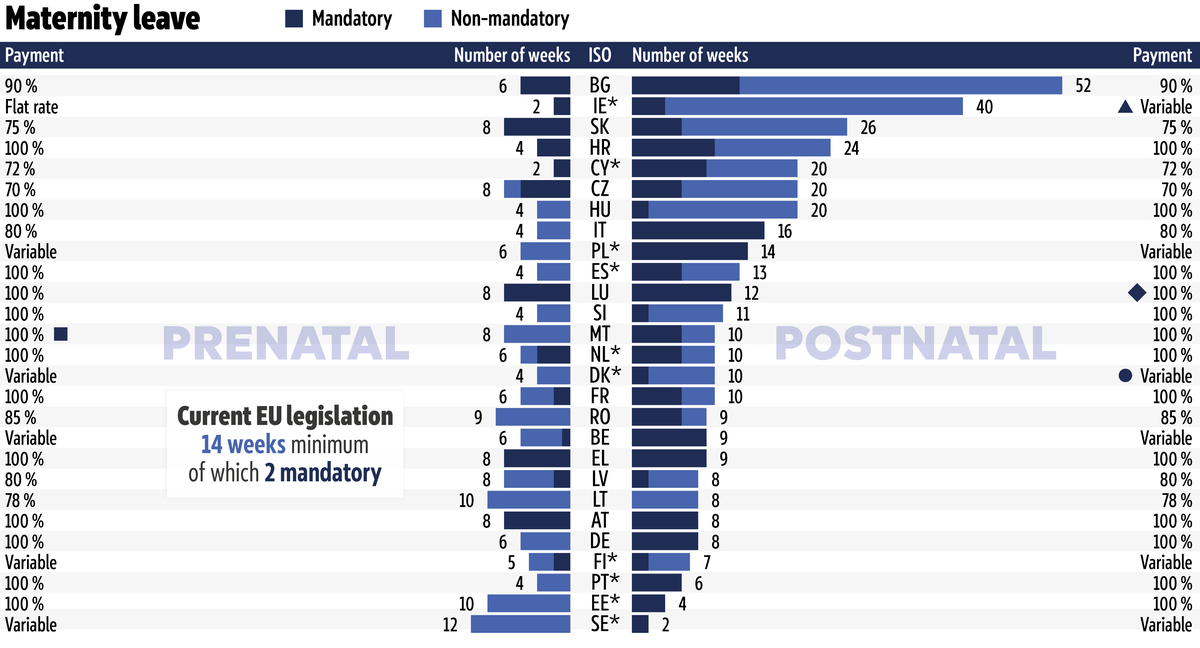
Graphic by Samy Chahri, EPRS.
Paternity leave
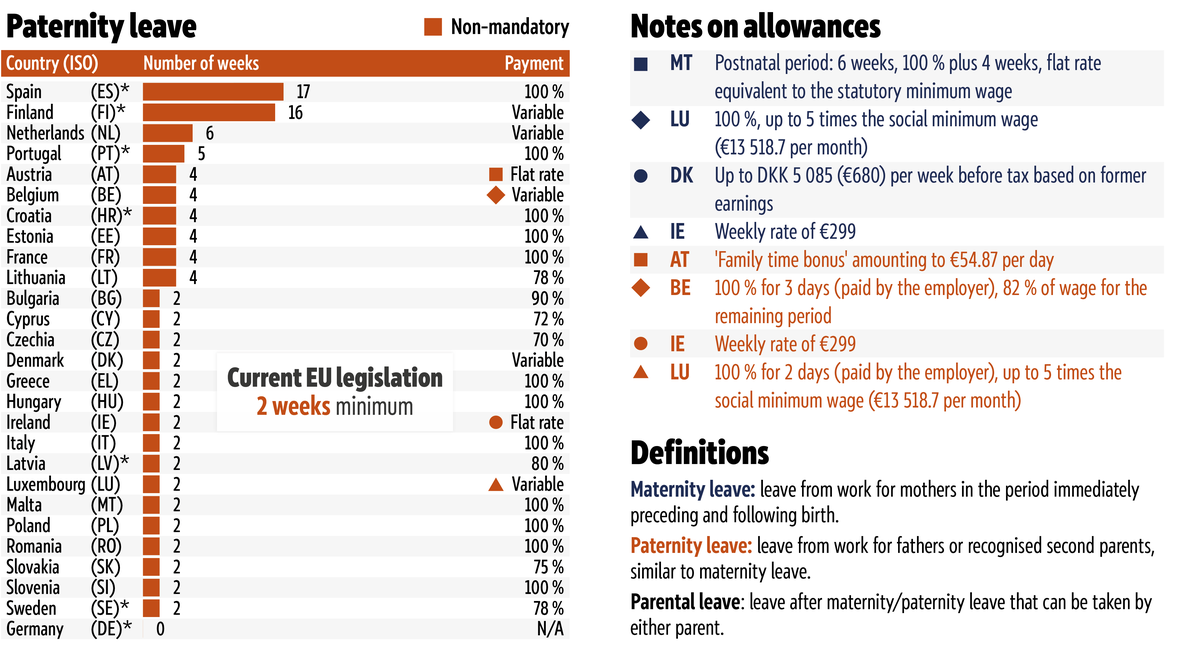
Graphic by Samy Chahri, EPRS.
Current situation
Maternity rights are set out in the 1992 Pregnant Workers Directive. This EU legislation sets the minimum period for maternity leave at 14 weeks, with two weeks' compulsory leave before and/or after confinement, and an adequate allowance subject to national legislation. A right to two weeks' paternity leave was introduced in the Work-Life Balance Directive for parents and carers, which entered into force on 1 August 2019. Member States had until 2 August 2022 to adopt the provisions necessary to transpose the directive. The right to paternity leave cannot be made subject to a period of work qualification or to a length of service qualification.
In 2017, the European Commission proposed the Work-Life Balance Directive following the withdrawal of an earlier proposal for a maternity leave directive, which would have extended the period of maternity leave. Although the new directive did not do so, it was expected to be particularly beneficial for gender equality in the labour market. As part of the European pillar of social rights (Article 9), it sought to address women's under-representation in the labour market, help them balance their work and family lives more easily, and encourage better distribution of caring responsibilities between women and men.
Explanation of the graphics
Given the complexity of national legislation, differences between the Member States, and the need to facilitate the presentation of the data in graphic form, simplifications have been made in respect of several countries. The terms of legislation as it applies in the public sector are illustrated in cases where there is a difference with the private sector.
Countries are ordered by the length of maternity or paternity leave granted. Given that national legislation may express leave periods in months, weeks, calendar days or working days, for the purposes of comparison, they are presented here in rounded weeks.
Some countries also have ceilings on the amount of money paid during maternity/paternity leave; these are not addressed in this publication. When national legislation does not state exactly when the maternity leave is supposed to start, the earliest possible time was taken as the starting point.
*Additional information on selected Member States
| Country | Provisions |
|---|---|
| Croatia | As of 1 March 2025, Croatia increased paternity leave to 20 working days for one child and 30 working days for twins or multiple births (up from 10 and 15 working days respectively since 1 August 2022), still requiring use as a single uninterrupted period. |
| Germany | The exemption clauses in Article 20(6) and (7) of the Work-Life Balance Directive exempt Member States from the obligation to offer 'paternity leave' under certain conditions. According to the European Commission, Germany fulfils these conditions owing to its comprehensive regulations on parental leave (in terms of time off) and parental allowance (in terms of pay). |
| Finland | A new act reforming parental benefits came into effect on 1 August 2022. Paternity leave ceased to exist in its original form. Instead, the reform gave both parents an equal quota of 160 parental allowance days. Parents can agree to give up as many as 63 days of their entitlement to the other parent or to another person who provides care for the child. This new generic parental leave encompasses the traditional rights to maternity, paternity and parental leave. |
| Latvia | The right to paternity leave is awarded to a person who takes care of a child when nobody has recognised the paternity of the child, or if the father has passed away or has been deprived of parental rights. |
| Poland | As from 19 March 2025, additional maternity leave was introduced, granting up to 15 weeks (or eight weeks depending on prematurity criteria) for parents of premature babies or those requiring extended hospitalisation after birth. |
| Portugal | There is no maternity or paternity leave, only parental leave. The option exists to take 120 or 150 days' leave: 120 days are paid at 100 % and 150 days at 80 %. An extra 30 days are available if parents share the leave period. The father can take any part except the initial parental leave reserved for the mother. |
| Spain | On 29 July 2025, Royal Decree-Law 9/2025 increased the 'childbirth and childcare leave' for both parents from 17 to 19 weeks per parent, and up to 32 weeks for single-parent families. The distribution is as follows: (i) six uninterrupted weeks immediately following birth; (ii) 11 additional weeks (or 22 in single-parent cases), to be taken in weekly blocks – either consecutively or intermittently – until the child reaches 12 months; (iii) two extra flexible weeks (four in single-parent cases), available until the child turns eight. |
| Sweden | Each parent is eligible for up to 240 days' paid parental leave (all but 90 days of which may be transferred to the other parent), plus unpaid leave until the child is 18 months old. The Swedish government's parental leave reform, implemented on 1 July 2024, allows for the transfer of paid parental leave days to relatives or friends. Maternity leave can be taken before or after birth within 60 days of delivery. |
Sources: National legislation (e.g. Mutual Information System on Social Protection – MISSOC); websites of national institutions, and relevant reports (e.g. by the International Network on Leave Policies and Research and the European network of legal experts in gender equality and non-discrimination). This is a revised version presenting the situation in the 27 Member States as known on 15 February 2026.
Classification
Policy areas: Social Policy
Regions: European Union
Committees: Employment and Social Affairs (EMPL)
Disclaimer
This document is prepared for, and addressed to, the Members and staff of the European Parliament as background material to assist them in their parliamentary work. The content of the document is the sole responsibility of its author(s) and any opinions expressed herein should not be taken to represent an official position of the Parliament.
Copyright
© European Union.
The reuse of this document is authorised under a Creative Commons Attribution 4.0 International (CC-BY 4.0) licence.

https://creativecommons.org/licenses/by/4.0/deed.en
To use or reproduce elements that are not owned by the European Union, permission may need to be sought directly from the respective rightsholders.