
Article page checkbox is not checked in page info.
EU joint defence procurement
EU joint defence procurement
Linda Tothova and Sebastian Clapp, Members' Research Service
Summary
Joint procurement of defence equipment by the EU has gained renewed strategic importance in response to the recent deteriorating security environment and persistent fragmentation within the European defence market. Although the European Defence Agency set a 35 % collaborative procurement benchmark back in 2007, cooperation among Member States remains limited. The 2022 coordinated annual review on defence reported that only 18 % of defence investment took place collaboratively, far below agreed targets. While total EU defence expenditure reached €381 billion in 2025, increased spending has not translated into commensurate growth in joint acquisition. EU institutions continue to highlight duplication issues, capability gaps and over-reliance on non‑EU suppliers.
To address these shortcomings, the Union has expanded financial and regulatory instruments. EDIRPA, EDIP and SAFE provide grants and loans to incentivise joint procurement, while the defence readiness roadmap 2030 raises the ambition to 40 % joint procurement by 2027. Targeted adjustments to the Defence Procurement Directive aim to reduce administrative barriers and facilitate multinational contracting.
Joint procurement offers potential economies of scale, stronger bargaining leverage, greater industrial predictability and enhanced interoperability. Studies indicate that meeting collaborative benchmarks could generate annual savings of several billion euros. Yet significant constraints persist, including differing threat perceptions by national governments, industrial competition that often runs counter to consolidation, governance complexity and risks of cost overruns in multinational programmes.
The European Parliament has consistently supported deeper pooling and interoperability, urging collaborative acquisition to be prioritised in EU instruments while cautioning against incentives that may reinforce national disparities. Sustained progress therefore depends on credible demand aggregation, coherent defence planning and effective coordination across EU and NATO frameworks.
Introduction
EU joint procurement of defence equipment has assumed renewed strategic importance in response to the recent deteriorating security environment and longstanding fragmentation within the European defence market. Cooperation among Member States seeks to reduce duplication, generate economies of scale, enhance interoperability and translate solidarity into greater operational efficiency, while improving the competitiveness of the European defence technological and industrial base. To this end, the Union has established a series of instruments to incentivise such collaboration, combining regulatory frameworks, loans and grants.
Key figures in 2025 for the EU‑27
-
€381 billion (estimate) combined defence budget
-
€100 billion combined procurement budget
-
35 % joint procurement benchmark since 2007
-
Less than 20 % joint procurement achieved
-
Ambition of at least 40 % joint procurement – by the end of 2027
-
Up to €10.9 billion p.a. potential savings with 35 % joint procurement; more with 40 %
-
Up to €57 billion p.a. potential savings with more defence cooperation
Current issues
In the EU defence context, joint procurement refers to the coordinated organisation or the collective purchase of defence-related goods, services and technologies by participating Member States. It can take various forms of cooperation, including pooling of research and development resources for shared capability projects, the use of centrally negotiated framework contracts which Member States can draw upon, or a fully centralised procurement arrangement in which an EU body – most likely the European Commission – may acquire relevant equipment or services directly on behalf of the participating EU countries (for example, vaccines during the COVID‑19 pandemic, gas supplies and 155 mm ammunition for Ukraine). Fundamentally, joint procurement means that capabilities or assets which Member States might otherwise obtain individually are instead developed, negotiated or purchased together to reduce costs, increase efficiency, strengthen interoperability and enhance overall strategic alignment.
In November 2007, the European Defence Agency's (EDA) steering board, which includes EU defence ministers, endorsed four non‑binding spending benchmarks designed to incentivise greater defence investment and collaboration. Among these were targets of allocating 35 % of defence procurement expenditure to joint procurement and 20 % to collaborative European defence research and technology (the benchmarks were given greater visibility by the 'permanent structured cooperation', PESCO, launched in 2017). However, nearly two decades on, EU defence equipment procurement remains fragmented and nationally focused, standing in marked contrast to the Union's repeated political commitments and efforts to enhance collaboration and interoperability. According to the EDA's 2022 coordinated annual review on defence (CARD), only 18 % of total investment in defence programmes involved cooperation between Member States. Although this represents a modest increase from the 11 % reported in CARD 2020 (based on data from 11 Member States), it remains far below the agreed target. Most recently, the defence readiness roadmap 2030 presented in October 2025 states that collaborative defence procurement remains under 20 %. A comparable pattern is observed in joint spending on defence research and technology, where collaborative investment also continues to fall short of collective ambitions.
In its assessment of the challenges facing the single market, the 2024 Draghi report on EU competitiveness stresses that less than a fifth of Member States' national defence expenditure is collaborative and highlights continued dependence on non‑EU suppliers. It therefore calls for the rapid implementation of the European defence industrial strategy (EDIS) and the related European defence industry programme (EDIP). The Niinistö preparedness report presents joint procurement as a corrective to Europe's fragmented defence landscape. In parallel, the Letta report on the single market stresses the relevance of joint procurement, not only in defence but also in areas such as innovation and critical materials, arguing that meeting established procurement benchmarks will require deeper integration of the EU defence market. Earlier estimates suggest that limited cooperation among Member States costs tens of billions of euros annually and that 'around 80 % of defence procurement is run on a purely national basis, leading to costly duplication of defence capabilities'. This assessment is echoed in the 2024 EPRS study, which emphasises the wide divergence in national procurement approaches, contributing to overlaps as well as capability gaps. More recent data reinforce this structural imbalance. Figures from the EDA's 2024-2025 cycle on defence equipment procurement across the EU published in September 2025 show that overall defence expenditure across the 27 Member States rose substantially, reaching €343 billion in 2024, and is forecast to increase to €381 billion in 2025. However, despite this increase in spending, the proportion allocated to collaborative procurement frameworks remains comparatively low. Limited participation in reporting – with only 12 Member States submitting the relevant data – further illustrates the unevenness of collective efforts and has prevented a fully comprehensive assessment.
Even so, the report emphasises that the original benchmark of 35 % 'has never been achieved since data collection began'. This disconnect between ambition and implementation is intensified by the challenge of pursuing three partly competing goals at once: delivering urgent military assistance to Ukraine, rebuilding national stockpiles and reinforcing Europe's defence technological and industrial base (EDTIB) with a long-term vision. As well as dealing with bureaucratic complexity, industrial interests and often unaligned planning and legislative cycles, defence budgets are controlled by 27 distinct governments, which, in turn, leads to fragmentation, duplication of efforts and lower efficiency levels in terms of joint operations, logistics and training (see below). This represents the structural weakness that collaborative benchmarks were designed to address. At the start of her second mandate, European Commission President Ursula von der Leyen pledged to work towards establishing a 'European defence union'. The 2024-2029 Commission political guidelines call for stronger joint investment in defence equipment, aiming to address production bottlenecks and close critical capability gaps.
The EU white paper for European defence — readiness 2030 underlines that 'collaborative procurement is the most efficient means to procure large numbers of "consumables" such as ammunition, missiles and drones', and gives the advantages of such collaboration (see below). The defence readiness roadmap 2030 acknowledges that Member States have thus far failed to meet or sustain the 35 % collaborative procurement benchmark, despite its importance for strengthening EU defence preparedness. The roadmap therefore sets a more ambitious objective: at least 40 % of defence procurement should be conducted jointly by the end of 2027. Based on input from the EU Military Staff (EUMS) and the EDA, a proposed annual defence readiness report is expected to monitor progress in addressing the EU's capability shortfalls and consequently feed into CARD. This aim was already visible during the Versailles summit in March 2022, where European leaders committed to developing 'further incentives to stimulate Member States' collaborative investment in joint projects and joint procurement of defence capabilities'. A joint communication by the Commission and the High Representative in response to the leaders' call emphasises the need to invest 'together', 'better' and in a 'European' way.
The European defence industry faces significant legal and administrative constraints that impede timely adaptation, production, cross‑border cooperation and innovation. For instance, fragmented procurement practices, extensive reliance on Article 346 TFEU (security concerns exception) and regulatory divergences in State aid and competition law continue to impede cross‑border cooperation, joint procurement and the smooth functioning of integrated defence supply chains. At the same time, administrative burdens and constrained access to finance limit the rapid scaling‑up of production capacity required to meet urgent security demands. The European Council acknowledged the gravity of this situation in its conclusions of 6 March 2025, calling explicitly for swift Commission action. The defence omnibus (see below) constitutes a targeted response to that mandate, designed to remove key obstacles and facilitate a strengthened and scaled European defence effort.
Since 2008, the EDA has developed successive EU capability development plans (CDP), incorporating contributions from EU Member States, the EUMS and the EU Military Committee (composed of Member States' defence chiefs, who are regularly represented by their permanent military representatives). These plans have been designed to strengthen coherence in EU defence planning by analysing potential threat scenarios and identifying the capabilities required to address them. The 2023 EU capability development priorities outline key areas in which the EU ought to have adequate military capabilities to achieve defined operational objectives. The document specifies that these priorities are intended to inform EU defence instruments and initiatives, including PESCO, the EDF, CARD and 'any future defence supporting tools'. In total, the 22 CDP priorities consist of 14 priorities across five military domains (land, air, maritime, space and cyber) and eight focused on strategic enablers and force multipliers. The analysis also builds on the Commission's earlier 'defence package communication' of February 2022, which emphasised that 'achieving our goals is only possible by developing, procuring and operating military equipment together'. It further underlined the Commission's intention to incentivise collaborative investment, preferably within established EU cooperative frameworks.
Some experts note that 'defence planning remains stuck at the national, rather than at the European or even Atlantic level', predominantly citing the lack of political will to unify efforts as an underlying structural factor. To this end, an EUISS expert analysis argues that the EU should adopt a more pragmatic approach to defence procurement cooperation. Rather than measuring progress against what Andersson describes as 'artificial benchmarks', he suggests focusing on tangible outcomes and practical forms of cooperation. In his view, prioritising concrete results and making better use of existing instruments would enable the EU and Member States to enhance defence and arms procurement cooperation in areas where joint action is most appropriate and effective.
EU joint defence procurement initiatives
The white paper for European defence – readiness 2030 underlines joint procurement as a central instrument for reducing fragmentation, enhancing interoperability and achieving economies of scale through the aggregation of Member State demand. Joint procurement is linked to industrial ramp‑up, greater predictability due to higher volumes for the European defence industry and the rapid placement of contracts, particularly in priority capability areas such as air and missile defence, ammunition, drones and strategic enablers. The European defence industrial strategy (EDIS) similarly promotes joint procurement by encouraging Member States to procure at least 40 % of defence materiel collaboratively by 2030 and increase intra-EU defence trade to at least 35 % of the value of the EU defence market. The defence readiness roadmap 2030 is even more ambitious and foresees the establishment of capability coalitions in all priority areas by the first quarter of 2026, alongside implementation plans up to 2030 and an initial assessment of EU defence industrial capacity by mid‑2026. Projects are expected to be launched in all priority areas in the first half of 2026. By the end of 2027, at least 40 % of defence procurement should be conducted jointly. By the end of 2028, the necessary projects, contracts and financing arrangements should be in place to address critical shortfalls, with all SAFE‑funded procurements delivered by the end of 2030.
The European Defence Agency and joint procurement
Within the EU framework, the EDA is defined by the Treaty on European Union as the Union's agency for defence capability development, research, acquisition and armaments. Following Directive 2009/81/EC on defence and security procurement, the EDA established a defence acquisition experts' network to exchange national experience. Since 2013, it has placed greater emphasis on joint procurement with Member States and the Commission. The agency supports harmonisation of requirements and can manage collaborative projects through ad hoc arrangements, including tendering and contracting on behalf of participating states. Activities have included the helicopter training portfolio, MARSUR, AIRMEDEVAC and EU SATCOM services, as well as joint procurement of anti-tank ammunition. In March 2023, Member States and Norway signed a seven-year framework arrangement enabling the EDA to coordinate joint procurement of ammunition to replenish national stockpiles and support Ukraine. In 2024, defence ministers endorsed a reinforced mandate for the agency to reflect the deteriorating security environment and EDA's evolving role within the EU defence framework. The 2024 long-term review expands support in the capability development cycle, e.g. limited off-the-shelf acquisitions where agreed. In October 2025 the European Council called on the Council to strengthen the EDA's role in defence capability development, research and acquisition.
In 2009, the Union had already sought to establish a more coherent regulatory framework at European level. Directive 2009/81/EC on defence and sensitive security procurement introduced harmonised rules for the awarding of contracts in this sector to foster openness and competition within the internal market. Its practical impact, however, has been limited. A 2016 evaluation by the European Commission acknowledged that most contracts, particularly those relating to high-value, strategically significant and technologically complex systems, continue to be awarded without recourse to EU-wide tendering procedures. The persistent reliance on Article 346 TFEU remains a key explanatory factor. It allows EU Member States to take the measures needed to protect their essential security interests related to the production and trade of arms, munitions and war material. This provision grants significant freedom to Member States, enabling them to bypass certain EU procurement rules. It is frequently relied upon in defence procurement, as noted in the Commission evaluation. Although the evaluation concluded that the directive is fit for purpose in legal terms, deficiencies in implementation have curtailed its effectiveness, a finding corroborated by a subsequent European Parliament study.
Source: EPRS, 2025. Graphics by Samy Chahri, EPRS
The June 2025 defence readiness omnibus introduces targeted adjustments to facilitate joint procurement among Member States. It creates incentives for collaborative acquisition involving at least three countries, streamlines procedures for contracting authorities and industry, and increases flexibility in framework agreements. The doubling of thresholds under the Defence Procurement Directive reduces administrative burdens for lower value contracts, enabling greater focus on strategic joint projects. In parallel, the simplification of intra‑EU transfer authorisations addresses cross‑border delays that have hindered multinational procurement and European Defence Fund implementation. Together, these measures seek to reduce fragmentation and accelerate coordinated capability development. Trilogues for a set of legislative files in the omnibus are currently ongoing. Although the defence readiness omnibus introduced targeted revisions to the directive on defence and sensitive security procurement, there is still additional scope to enhance the effectiveness, transparency and competitiveness of the EU defence procurement framework. A proposal for a full revision of the directive is foreseen for Q3 2026.
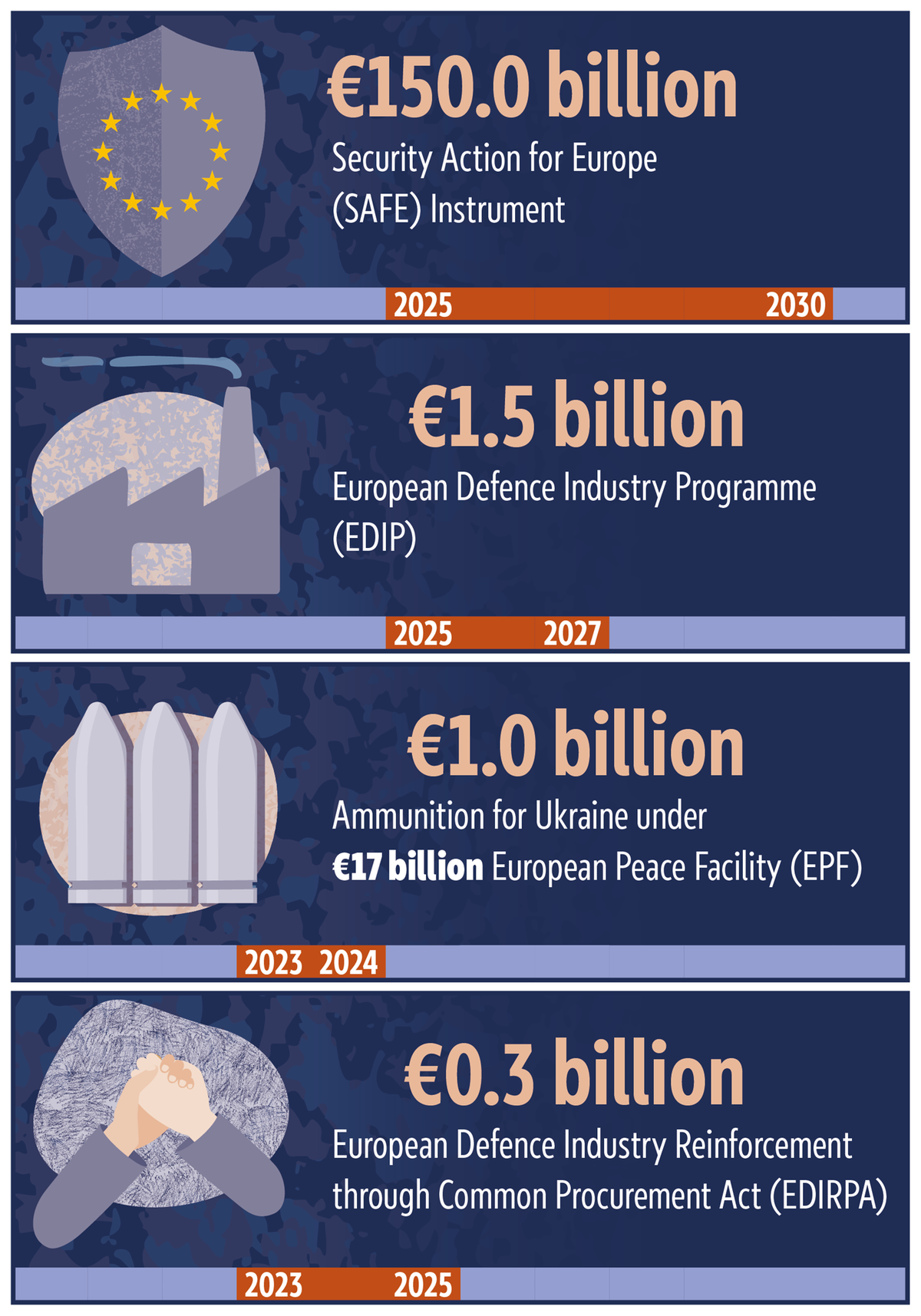
The European Peace Facility (EPF), established in March 2021, is an off-budget instrument designed to strengthen the EU's capacity to prevent conflicts, preserve peace and enhance international security. Covering 2021 to 2027, its financial ceiling has been progressively increased to more than €17 billion. A significant share has supported Ukraine: combined with the military assistance delivered by EU Member States, total EU support to the Ukrainian armed forces is estimated at €69.3 billion, of which €6.1 billion is under the EPF. In May 2023, the Council agreed to use one billion euros from the EPF to finance the joint procurement of 155 mm artillery ammunition and, if requested, missiles for the Ukrainian armed forces. This measure formed the second part of a three-track approach agreed in March 2023 to accelerate ammunition delivery and procurement for Ukraine, under which the EPF provided €1 billion for joint procurement and an additional €1 billion to reimburse Member States for ammunition supplied from stocks.
The European defence industry reinforcement through common procurement act (EDIRPA) was adopted in October 2023, with a mandate running until December 2025. EDIRPA was designed to encourage Member States to jointly procure urgent and critical defence items, particularly given the heightened needs following Russia's aggression against Ukraine. On 15 March 2024, the Commission adopted the EDIRPA work programme and launched the corresponding calls for proposals in three priority areas: ammunition, air and missile defence, platforms and the replacement of legacy systems. By the 25 July deadline, 12 proposals had been submitted by Member States and Norway in response to the EDIRPA call. Subsequently, the Commission approved €310 million under the instrument to support five cross‑border projects. Each project will receive €60 million and together they will leverage procurement exceeding €11 billion. The initiatives selected cover joint acquisition of air and missile defence systems, including Mistral and IRIS T SLM platforms, the common armoured vehicle system for protected troop transport, and two projects for 155 mm artillery ammunition. Involving 20 Member States, with an average of six participating per project, the scheme exceeds the minimum cooperation threshold and signals greater collaborative defence procurement.
The security action for Europe instrument (SAFE) – adopted by the Council in May 2025 – establishes a new EU financial instrument aimed at accelerating defence readiness through large‑scale investment in critical capabilities. It provides up to €150 billion in competitively priced, long maturity loans to Member States, financed through EU borrowing and underpinned by the Union's strong credit rating. SAFE prioritises common procurement to reduce fragmentation and enhance interoperability. Projects are expected to involve at least one SAFE beneficiary and another Member State, with participation open to Ukraine and EEA-EFTA countries. Given the prevailing security environment, temporary support for individual national procurements is also foreseen to ensure timely delivery of essential assets. Across both funding categories, contracts must limit non‑EU, non‑EEA EFTA and non‑Ukrainian components to a maximum of 35 % of total costs. Category 2 projects – more complex systems such as air and missile defence systems – are subject to stricter conditions, including the requirement that contractors possess the capacity to modify equipment without non‑EU restrictions. The instrument constitutes the first pillar of the Commission's rearm Europe plan/readiness 2030, which seeks to mobilise more than €800 billion in defence investment. While only Member States may access SAFE loans, EU candidate countries and partners with security and defence partnerships may join joint projects. 19 Member States have requested SAFE loans.
Buy European?
At the informal EU leaders' retreat in February 2026, European Council President António Costa highlighted a broad consensus among EU leaders on the strategic imperative to strengthen Europe's defence sector, including by mapping and reducing critical dependencies through diversification and applying a European preference to safeguard key capabilities. The defence readiness roadmap notes that at least 55 % of total investment should go to Europe by 2030. Across EDIRPA, SAFE and EDIP, the 'buy European' principle is expressed through a 35 % rule. To receive EU support, the cost of components originating from non‑associated third countries may not exceed 35 % of the estimated total component cost. There are, however, exceptions, e.g. the SAFE agreement with Canada extends the applicable eligibility criteria, thereby enabling broader participation by Canadian legal entities.
The first tranche of national defence plans under the SAFE initiative was approved by the European Commission on 15 January 2026 endorsing plans from Belgium, Bulgaria, Denmark, Spain, Croatia, Cyprus, Portugal and Romania, enabling those eight Member States to access approximately €38 billion in long-term, low interest loans. The second tranche subsequently approved in late January 2026 covers Estonia, Greece, Italy, Latvia, Lithuania, Poland, Slovakia and Finland, making them eligible for roughly €74 billion under the same framework. The Council cleared the path for the disbursement of the loans in February 2026. The first payments are expected to be processed in March 2026.
SAFE also marks a significant development in defence cooperation with third countries in the field. Ukraine, the EEA and EFTA states, as well as EU candidate and potential candidate countries, will be eligible to participate in joint procurement procedures. Procurement from Canadian industry will also be possible, due to a bilateral agreement with the Union pending final approval. Participation by other third countries may be envisaged, provided that a security and defence partnership has been concluded with the EU in advance. For instance, the UK, which has a security and defence partnership agreement with the EU, expressed interest initially but talks broke down in November 2025, due to claims that the EU was demanding too high a price on entry. UK Prime Minister Keir Starmer called for a resumption of talks in February 2026. The European Commission is also reportedly considering a potential second round of SAFE loans, due to strong demand in the first SAFE instrument.
The European defence industry programme (EDIP) is an EU financial instrument for 2025 to 2027 aimed at reinforcing the Union's defence industrial readiness. It represents the first implementation pillar of the European defence industrial strategy, and seeks to address structural shortcomings in Europe's defence industrial landscape that have become more visible since 2022. Backed by €1.5 billion from the EU budget, the EDIP is designed to incentivise Member States to cooperate more closely on procurement and production. It supports the scaling‑up of manufacturing capacities, strengthens cross‑border supply chains and enhances security of supply for critical defence products. A central feature is the structure for European armament (SEAP) programme, intended to facilitate joint acquisition and reduce administrative and legal obstacles to collaborative procurement. The programme also foresees closer cooperation with Ukraine's defence industry, including participation in joint procurement schemes. The EDIP further sets out a dedicated framework for European defence projects of common interest (EDPCI), intended to advance capability development, including in areas that ensure access to strategic domains, key enablers and critical systems.
According to the Commission proposal for the next multiannual financial framework (MFF), €131 billion is foreseen for defence and space, representing a fivefold increase over the previous MFF. It explicitly states that it shall 'encourage collaboration in defence R&D and procurement, including through defence projects of common European interest'.
Joint procurement: Benefits and drawbacks
Benefits of joint procurement
Firstly, aggregating demand across Member States generates economies of scale. Larger, consolidated orders reduce average unit costs by distributing fixed production expenditure, R&D outlays and associated overheads across greater output volumes. Put simply: 'When each country orders only 50 or 100 units of a system, rather than pooling demand for several hundred, the unit cost of tanks, ships or aircraft is far higher than it would be in a larger market.' Joint procurement also enhances bargaining power. Scale enhances not only efficiency but also bargaining leverage. By aggregating demand, the EU can strengthen its negotiating power vis‑a‑vis suppliers and vendors. This concentration of purchasing power enables it to shape market conditions and secure more advantageous procurement terms, including reduced prices and improved contractual arrangements. It also mitigates competitive bidding among Member States for scarce resources, which can otherwise drive up prices and distort markets. According to a 2024 EPRS study, meeting the long-standing 35 % collaborative procurement target could generate annual savings of up to €3.2 billion, with further gains possible through deeper cooperation. Increased joint procurement would strengthen the European defence industry, stimulate research and capability development, and promote convergence in military standards. Additional benefits include job creation, more efficient public spending and improved interoperability, potentially extending equipment lifespans. More coordinated defence equipment procurement from third countries could yield savings of up to €3.0 billion. Considering a high ambition scenario, up to €10.9 billion per year in savings may be possible. Earlier estimates by the Commission suggest that joint procurement could generate savings of up to 30 % in annual defence expenditure – resources that could then be reinvested in more efficient, modern and strategically advanced defence production.
Secondly, there are equally significant industrial benefits. Aggregate orders placed through a central coordinating body provide long-term predictability to manufacturers, enabling them to expand production lines, secure supply chains and recruit skilled labour. This is particularly relevant in the current context of constrained European stocks and limited surge capacity. The main defence industry lobby group, ASD Europe, strongly supports the renewed emphasis on collaborative procurement. According to ASD, aggregating demand and harmonising requirements would generate economies of scale, shorten lead times, reduce costs and improve efficiency, provided that new contracts are awarded to European suppliers to reduce dependencies and safeguard security of supply. From an industrial perspective, long-term and predictable orders are essential to providing planning certainty. With such scale and predictability, the European defence industry could scale up production, accelerate delivery and meet European capability needs with advanced systems.
Thirdly, common procurement fosters interoperability. The proliferation of different weapons systems and platforms across Member States complicates logistics, maintenance, training and joint operations. Joint acquisition reduces the variety of equipment types in service, thereby facilitating standardisation and compatibility among armed forces. EU Member States field larger aggregate numbers of main battle tanks, artillery systems and infantry fighting vehicles than the United States (US), yet these assets remain dispersed across numerous models, limiting standardisation and interoperability. By contrast, the US relies on a narrower range of platforms, which streamlines logistics, training and operational coordination. Similar fragmentation characterises the naval domain, where Member States operate diverse classes of frigates, destroyers and submarines. At the same time, limited fleets of air-to-air refuelling aircraft and medium and heavy transport aircraft reveal enduring gaps in strategic air mobility compared with the US. This fragmentation stems from legacy Soviet-era equipment, misaligned national planning cycles and industrial constraints. According to the EDA, more systematic collaborative planning and procurement, supported by clear EU‑level priorities and financial incentives, could mitigate these inefficiencies over time.
Fourthly, joint procurement embeds solidarity in practical and measurable terms. Rather than simply remaining a stated principle, solidarity becomes formalised through shared financial commitments, collective burden-sharing and mutual dependence on capability development. This also includes coordination of planning cycles and delivery timetables. In the current security environment, joint acquisition sends a clear strategic signal regarding the Union's capacity to act cohesively in the defence domain. It demonstrates an ability to aggregate demand, reduce fragmentation and generate economies of scale, thereby addressing long-standing inefficiencies identified in successive EU and national assessments. Beyond its immediate material effects, coordinated procurement also contributes to strategic autonomy by reducing critical dependencies and enhancing interoperability and structural interdependence among armed forces. It thus supports the gradual consolidation of a more integrated European defence posture grounded not only in shared values but also capabilities.
Finally, joint procurement can improve administrative efficiency over time. Although initial coordination is complex, shared procedures and joint tenders reduce the duplication of parallel national procurement processes. For instance, the experience accumulated within the EDA provides institutional expertise that smaller Member States can leverage, thereby enhancing the professionalism and efficiency of defence acquisition systems. Scholarly analysis of joint public procurement across the EU further shows that pooled demand and joint tendering can avoid multiple parallel acquisition exercises, thereby reducing administrative burdens on participating States. A practical example of this dynamic in action is the joint ordering of 155 mm ammunition by multiple Member States under the EDA framework, illustrating how coordinated procurement can streamline processes that would otherwise be conducted separately and possibly at greater length.
Joint procurement of drones
The defence readiness roadmap 2030 identifies drone and counter-drone capabilities as priority capability areas. It calls on Member States to organise at least 40 % of defence procurement collectively by the end of 2027. It also creates the framework for initiatives such as the European drone defence initiative, conceived as a European project of common interest, through which Member States are encouraged to form coalitions to develop a multilayered and technologically advanced system with interoperable detection, tracking and neutralisation functions. The February 2026 action plan on drone and counter-drone security calls for coordinated technological development, rapid industrial production and stronger ties between governments and industry. It explicitly identifies scaling up production of drone systems to enhance defence readiness and prepare European markets and supply chains for increased collective procurement. As part of the EU‑Ukraine drone alliance, Commission President Ursula von der Leyen announced that Europe will allocate €6 billion to bolster Ukraine's drone manufacturing capacity. The funding will be drawn from the interest generated by immobilised Russian assets.
An analyst notes that the strategic implications are pressing for Member States. The capacity to equip armed forces rapidly and at sustainable cost is increasingly constrained by structural limitations in Europe's defence industrial base. The challenge extends beyond slow output. It stems from a fragmented procurement architecture that prevents the Union from exploiting economies of scale. Nationally segmented orders, placed with limited cross-border coordination, inhibit the efficient scaling of production. This fragmentation inflates unit costs and prolongs delivery times. Breaking this pattern requires coordinated, large‑volume procurement across Member States. Only aggregated demand can provide industry with the predictability and scale necessary to reduce costs and accelerate production cycles. In the context of rising demand for advanced military capabilities, such coordination is no longer optional but operationally necessary. Delivering it, however, presupposes a fundamental recalibration of national approaches to defence policy and procurement.
Possible drawbacks of joint procurement
Firstly, common procurement may reduce flexibility at national level. Member States retain primary responsibility for defence under Article 42 Treaty on European Union and may be reluctant to subordinate urgent operational needs to collective timelines, especially due to their differences in strategic culture – a common understanding of threats and challenges as a basis for collective action. In practice, Member States differ in their threat perceptions and levels of ambition. Some retain a predominantly Atlanticist outlook centred on NATO, while others promote greater European strategic autonomy. These divergences translate into fragmented approaches to capability planning, procurement and threat assessment. Where threat perceptions diverge or capability priorities differ, joint acquisition can prove politically difficult. Larger Member States with established defence industries may also perceive reduced strategic autonomy if procurement decisions are shaped by collective rather than national industrial considerations. This is made worse by the fact that, in the field of defence planning, the Union has developed multiple, partially overlapping supporting instruments rather than a single integrated framework. European defence planning thus continues to be characterised by fragmentation and limited integration. As observers have argued, defence planning processes remain predominantly anchored at national level rather than being structured coherently at European or even transatlantic scale, reflecting persistent deficits in political commitment. Experts therefore contend that joint procurement will remain unsustainable without genuine common defence planning, adequate funding and clearer governance. They stress the need for institutional clarity, with a stronger coordinating role for the EDA to avoid fragmentation and power struggles.
Secondly, industrial cooperation can generate tensions. Decisions regarding workshare, production location and intellectual property rights often become politically sensitive. Without carefully designed governance mechanisms, joint procurement risks reinforcing existing industrial asymmetries or triggering disputes over fair return. Previous multinational armaments programmes in Europe have demonstrated that workshare negotiations can cause inefficiencies and cost overruns if not tightly managed. Disputes over leadership, workshare and intellectual property in multinational capability programmes reflect deeper structural divisions, as national industrial priorities frequently override pan‑European logic and constrain trust-based cooperation. The public clash between Airbus and Dassault over the future combat air system (FCAS) in 2025, alongside Germany considering alternative partnerships with Saab or BAE Systems, illustrates how governance deadlock and political uncertainty risk delaying flagship projects and fragmenting European defence integration. These issues have led to a situation where 'an announcement that [the project] is over is more likely than a relaunch'.
Thirdly, if joint procurement isn't managed efficiently, there is a risk of duplication. The coexistence of national procurement authorities, EU-level instruments and NATO frameworks may generate overlapping procedures. Unless coordination mechanisms are streamlined, transaction costs could offset part of the expected efficiency gains. There is already a long list of different forms of collaboration on armament procurement in the EU. A recent analysis by the European Union Institute for Security Studies identified around 200 defence partnerships linking EU Member States with one another and with strategic partners such as the US and Norway. A substantial proportion of these arrangements concern armament cooperation, notably in the areas of acquisition and procurement. In addition, a number of European bodies have been established with specific mandates to facilitate and support collaborative efforts in the field of armaments among Member States and partner countries (see below). Indeed, Camille Grand, the secretary general of ASD Europe, cautioned that Europe's expanding defence efforts risk duplication and inefficiency unless political leaders clarify institutional responsibilities. With national governments, NATO, the European Commission and the EDA all launching initiatives, governance remains fragmented. He called for clearer decision-making structures, particularly in areas such as air and missile defence, to ensure faster and more coherent capability delivery.
Fourthly, coordination among multiple sovereign actors may increase administrative complexity. In multinational capability programmes, governments must reconcile divergent threat perceptions, planning cycles and procurement rules. This process often generates protracted negotiations before a common target can be translated into harmonised technical specifications and a joint contract. One expert notes that differences in national regulatory and budgetary procedures can delay signature and implementation of defence contracts, particularly where unanimity or consensus is required. In practice, the requirement to synchronise parliamentary approval procedures, align multiannual financial frameworks and agree on workshare arrangements has frequently extended the preparatory phase of multinational armaments cooperation beyond initial planning assumptions.
Fifth, the reduction of costs in joint procurement is not guaranteed. One analyst questions the assumption that jointly building and procuring weapons will automatically reduce costs through economies of scale. While acknowledging that Europe's fragmented defence market generates inefficiencies, he argues that consolidation does not in itself guarantee savings or innovation. Cost reductions depend on credible, sustained and aggregated demand. Without this, fewer suppliers may weaken competitive pressure and undermine cost control. He also highlights governance risks, noting that political bargaining over workshare and industrial returns can dilute efficiency gains. He argues that joint procurement can deliver benefits, but only if accompanied by realistic demand signals, sound programme governance and preserved competition. Pooling is not a substitute for effective market and institutional design. Indeed, the joint procurement by Belgium, Germany, Spain, France, Luxembourg, Türkiye and the United Kingdom of the Airbus A400m military transport aircraft faced heavy delays and cost overruns. Therefore, according to experts: 'There are only a handful of truly European capability projects that have made it to life, albeit with the familiar problems of cost and delivery overruns (e.g. Eurofighter, A400M). So, Europeans are spending more on defence, but whether they can spend better or spend together in the future remains to be seen.'
Finally, the concentration of purchasing power at Union level may create monopsony effects (existence of only one buyer). While stronger bargaining power can reduce prices in the short term, sustained compression of profit margins risks weakening incentives for research and development. Producers facing reduced returns in the EU market may scale back activity or reallocate investment to jurisdictions with more favourable conditions. Indeed, defence procurement relies on cost‑plus, fixed price and target cost contracts, each allocating risk and incentives differently between governments and industry, yet all remain vulnerable to information asymmetries and strategic behaviour. Market fragmentation in Europe reflects the structural nature of defence as a public good, with the state acting simultaneously as regulator, owner and principal customer, creating monopsonistic demand and oligopolistic supply conditions. In this 'sole buyer and sole seller' dynamic, both sides are mutually dependent, as governments face limited suppliers while firms rely heavily on public contracts.
With whom: Options beyond EU level
Beyond EU-level defence procurement cooperation, there are additional avenues through which Member States can collaborate on capability development and acquisition. These options include structured co-production arrangements, models where one or several States procure equipment on behalf of a wider group and bilateral and multilateral cooperation frameworks. Such approaches provide flexible alternatives to complement EU mechanisms while accommodating varying levels of ambition, participation and strategic alignment.
EU Member States' collaboration
Beyond EU‑level initiatives, Member States frequently cooperate directly to develop or procure defence equipment. These bilateral or 'mini-lateral' frameworks, sometimes involving NATO allies or third countries, are shaped by national priorities and intergovernmental agreements rather than supranational governance. Driven by shared capability needs, geographic proximity, political alignment and industrial complementarities, they emerge pragmatically outside formal EU structures and constitute a bottom-up form of defence integration that balances sovereignty with efficiency, interoperability and cost-sharing objectives.
In some cases, cooperation goes beyond the acquisition phase and includes long-term maintenance, training, logistical support or even joint operation of the equipment. A prominent example is the strategic airlift capability (SAC), through which 12 NATO members (including 10 EU Member States, Norway and the US) jointly operate three Boeing C‑17 Globemaster III strategic transport aircraft (used, inter alia, to support earthquake relief operations in Haiti in 2010 and as logistics support to the 2014 MH17 crash investigation in Ukraine). Another example is the recent technical agreement on joint procurement of CV90 Mk IV infantry fighting vehicles (IFVs) planned for early 2026 by Estonia, Lithuania, the Netherlands, Norway, Finland and Sweden (CV90 IFVs were already delivered to Ukraine in 2023). According to their statement of intent, the cooperation aims at a standardised CV90 variant for all participants, including common training systems, ammunition and spare parts, thereby enhancing interoperability and lifecycle efficiency. Furthermore, in 2022, Germany, Sweden and the United Kingdom opted for collaborative procurement of all-terrain vehicles, some of which were delivered in 2025. Bilateral cooperation also remains particularly common. Notable examples include an agreement between Germany and Norway to jointly develop and procure six U212 common design submarines pertaining to joint development, procurement and training (the German Bundeswehr Procurement Office has since increased the order from two to six, with delivery planned annually from 2032 to 2037), and the coordinated selection of IFVs by the Czech Republic and Slovakia in 2022. A similar approach can be observed in the 2024 Danish-Swedish cooperation on IFV procurement, some of which were a replacement for vehicles previously donated to Ukraine. These cases demonstrate how Member States continue to pursue aligned procurement timelines, harmonised requirements and industrial coordination.
Role of NATO and OCCAR
At the Vilnius summit in 2023, allied leaders approved the defence production action plan, aimed at accelerating joint procurement and expanding industrial production capabilities across the alliance. The plan seeks to facilitate aggregation of demand, notably through multi-year multinational procurement contracts for prioritised capabilities. This commitment was further reinforced by NATO defence ministers in February 2025, who agreed on a revised version of the plan to sustain the momentum in defence industrial ramp-up. Political decisions build upon the framework of the NATO planning process (NDPP), which provides the strategic basis for aligning capability targets between allies. Operational implementation of these objectives is largely channelled through NATO's Support and Procurement Agency (NSPA). Established in 1958 (in its current structure since 2015), the agency supports allied and partner countries in logistics and procurement, with particular expertise in off-the-shelf acquisition of ammunition and equipment. Operating on a 'no profit-no loss' principle and fully funded by its customers, NSPA serves as a central platform for multinational acquisitions and lifecycle management. Since the onset of Russia's war of aggression against Ukraine in February 2022, interest in NSPA's services has increased, particularly from 2023 onwards, possibly reflecting countries' higher defence expenditure and urgent replenishment needs. NSPA currently manages 32 multinational support partnerships covering over 90 weapons systems and 170 projects, including the MFF/MRTT fleet on behalf of participating states. In January 2024, NSPA announced support to Germany, the Netherlands, Romania and Spain for the joint purchase of Patriot surface-to-air missiles, alongside the delivery of critical munitions, including around 220 000 155 mm artillery shells. In February 2026, NSPA awarded Rheinmetall a contract valued at approximately €200 million for the supply of 120 mm tank ammunition. Cooperation between the EU and NATO in delivering critical defence capabilities is particularly noteworthy in the field of air-to-air refuelling, long identified as a major European capability shortfall. In 2012, the EDA initiated a project at the request of participating Member States to harmonise requirements for air-to-air refuelling and address fragmentation in European procurement efforts. As the project progressed into the acquisition phase, responsibility was transferred in 2016 to the Organisation for Joint Armament Cooperation (OCCAR), which acted as the contract executing authority. OCCAR placed the procurement order on behalf of NSPA, resulting in the acquisition of Airbus A330 Multi Role Tanker Transport aircraft. The first aircraft was delivered in 2020. This process ultimately led to the establishment of the multinational MRTT fleet (MMF), comprising EU Member States and Norway. While initiated through the EDA framework, the fleet is owned by NATO, managed by NSPA and operated from bases located in both NATO and EU Member States. Furthermore, in April 2024, NSPA approved the first counter-small unmanned aircraft systems (C-sUAS) procurement framework agreement in the history of NATO, marking a significant step in the alliance's collective approach to addressing emerging aerial threats.
Furthermore, established in 1996, the Organisation for Joint Armament Cooperation (OCCAR) aims to streamline joint capability development and facilitate collaborative armament programmes. Its membership is currently limited to six European countries on the basis of a signed convention (Belgium, Germany, Spain, France, Italy and the UK) but allows for participation of other EU and NATO members as well as like-minded countries (e.g., Australia for the NATO-standard light weight torpedo and Brazil, as an observer, in the logistics support ship programme). In total, OCCAR currently manages over 20 programmes. Institutional ties between the EU and OCCAR have deepened significantly in recent years. In November 2024, the European Commission signed a financial framework partnership agreement (FFPA) with OCCAR, enabling indirect management of EU-funded defence projects. Under this arrangement, OCCAR became the first non‑EU entity entrusted by DG DEFIS to manage EU defence activities within such a framework, while the Commission secured observer status in OCCAR‑led programmes. Prior cooperation had already taken place under the European defence industrial development programme (EDIDP). This included projects such as the European secure software defined radio (ESSOR) on behalf of six EU Member States and the medium altitude long endurance remotely piloted aircraft system (MALE RPAS), and the European Defence Fund on European Patrol Corvette, the EU HYDEF interceptor programme, E‑NACSOS and the hyper sonic interceptor study (HYDIS2). The EDA signed a security arrangement with OCCAR in 2014, complementing the security agreement of 2012 between OCCAR and the EU.
OCCAR's cooperation with NATO structures is equally well established. A framework memorandum of understanding between OCCAR and NSPA has been in place since 2005, followed by a security agreement signed in 2009. A dedicated cooperation agreement between OCCAR and NSPA since 2014 has enabled arrangements like the multinational MRTT fleet acquisition, under which OCCAR managed the procurement of aircraft on behalf of NATO. More broadly, the NSPA‑OCCAR framework has supported collaboration in relevant programmes, including the counter-battery radar systems (COBRA) and the A400M strategic transport aircraft. Within these arrangements, OCCAR retains responsibility for programme management and the in-service support (ISS) phase of collaborative programmes, while NSPA performs material support functions, such as depot-level maintenance and spare parts management.
Overall, while these agreements reflect the growing tendency of EU/NATO states to pool demand and operate in complementary and mutually reinforcing ways in European joint capability development and procurement, they are not a panacea and could mean significant trade‑offs. The possible drawbacks identified in joint procurement may apply to such arrangements regardless of which institution, agency or group of Member States channels the initiative.
European Parliament position
The Parliament has consistently advocated for deeper defence cooperation, higher investment and greater pooling of resources to strengthen the EU defence sector. In its January 2026 resolution on the implementation of the common security and defence policy, the Parliament called for EU financing instruments, such as SAFE and EDIP, to be used to promote collaborative defence procurement. It welcomed the joint procurement benchmark set out in the defence readiness roadmap 2030, and stressed the importance of EU defence procurement with a European preference, while regretting that the EDA's 2007 joint procurement target remains unmet. In February 2026, the Parliament underlined that European security depends on a high degree of interoperability of Member States' equipment, and encouraged its joint development through the EU defence industry. In its December 2025 resolution, the EP warned that poor investment coordination could lead to inefficiencies and unnecessary costs. It expressed regret that national procurement qualifies for support under SAFE where a contract was signed before 30 May 2026, as this undermines the goal of joint procurement. It also highlighted the lack of comprehensive data on collaborative EU defence procurement.
Main references
- Andersson, J.J., Buying weapons together (or not): Joint defence acquisition and parallel arms procurement, EU Institute for Security Studies, April 2023.
- Centrone, M. and Fernandes, M., Improving the quality of European defence spending, cost of non-Europe report, EPRS, European Parliament, November 2024.
Statement on the use of AI
Any AI-generated content in this text has been reviewed by the author(s).
Disclaimer
This document is prepared for, and addressed to, the Members and staff of the European Parliament as background material to assist them in their parliamentary work. The content of the document is the sole responsibility of its author(s) and any opinions expressed herein should not be taken to represent an official position of the Parliament.
Copyright
© European Union.
The reuse of this document is authorised under a Creative Commons Attribution 4.0 International (CC-BY 4.0) licence.

https://creativecommons.org/licenses/by/4.0/deed.en
To use or reproduce elements that are not owned by the European Union, permission may need to be sought directly from the respective rightsholders.