
Article page checkbox is not checked in page info.
EU action against harmful gender stereotypes
EU action against harmful gender stereotypes
Ionel Zamfir, Members' Research Service
Summary
Fighting harmful gender stereotypes has become part of recent EU measures to promote gender equality. The European Parliament has repeatedly called on the European Commission and Member States to act. Survey data show that most EU citizens reject harmful gender stereotypes, despite significant disparities among Member States.
What are gender stereotypes?
Gender stereotypes ascribe certain gender characteristics (which may be statistically sound or patently false) to individuals, with a self-reinforcing limiting effect on their ambitions, or prescribe certain gender-related social norms, such as under the traditional 'men as breadwinners' model. They can be harmful to both women and men; for instance, to women by impacting their careers and financial independence, and to men by encouraging risk taking, or preventing them from getting more invested in raising their children.
EU action to combat gender stereotypes
To challenge gender stereotypes was one of the priorities of the EU's gender equality strategy 2020‑2025. The strategy stresses the harmful effect of stereotypes on gender equality, as they can limit women's and girls' aspirations and choices, and contribute to the gender pay gap. The Commission has provided funding under the CERV (Citizens, Equality, Rights and Values), Horizon, Creative Europe MEDIA and Erasmus+ programmes for projects aimed at debunking social, economic and cultural gender stereotypes. Recent Commission initiatives include: the #EndGenderStereotypes campaign, which targeted young adults directly and through influencers on social media; a mutual learning seminar with Member States in February 2023; and an educational toolkit for teachers and students to help them question gender stereotypes in transport. Moreover, the Commission has included the issue in EU education and research policies more broadly.
Recently enacted EU laws address digital systems' biases. According to the Artificial Intelligence (AI) Act, high-risk AI systems have to take measures to detect, prevent and mitigate possible biases that are likely to affect health and safety, have a negative impact on fundamental rights, or lead to discrimination under Union law. Under the Digital Services Act, providers of very large online platforms and of very large online search engines have to take measures, as necessary, to prevent or minimise biases that lead to discrimination of vulnerable people. The EU Directive on violence against women requires Member States to challenge harmful gender stereotypes as part of their policies to prevent gender-based violence.
Box 1
Any EU action to combat gender stereotypes is conditional on respect for freedom of thought and religion (according to Article 10 of the EU Charter of Fundamental Rights) and on the value of pluralism (enshrined in Article 2 of the Treaty on European Union). Philosophical and religious beliefs on gender roles are protected, although their manifestation and implementation can be restricted if they present a risk of discrimination and violence. The Court of Justice of the EU has played an important role in fighting stereotypes through its anti-discrimination case law while recognising the particular significance of maternity (a position that has attracted criticism for inconsistency). According to an academic article, the case law has evolved over time, from the view that EU 'law was not meant to challenge traditional gender-role stereotypes as regards parenthood' (judgment in the Hofmann case – 1984), to the objective of enabling men to be child carers on an equal footing with women (judgments in the Roca Álvarez (2010) and Maistrellis (2015) cases).
European Parliament position
Parliament has repeatedly urged the Commission and Member States to take action to combat gender stereotypes, such as in the digital sector, in science, technology, engineering and mathematics (STEM), in sport or in transportation. In its November 2025 resolution on recommendations for the EU gender equality strategy post-2025, Parliament notes the harmful role of gender stereotypes in accessing STEM and, in particular, information and communications technology (ICT) professions, as well as in the media. Parliament emphasises the need to act at the earliest stages of education, and calls on the Commission and Member States to use European Social Fund Plus funds to combat gender stereotypes in education and labour counselling. It urges the Commission to promote gender equality in education and training at all stages by dismantling stereotypes and investing in educators' gender-sensitive professional development.
What citizens think
Two Eurobarometer surveys conducted in 2024 on gender stereotypes show that, across the EU, most citizens reject potentially harmful gender stereotypes, despite significant disparities among Member States. In some, the view that women should be primary carers of their family still enjoys broad support.
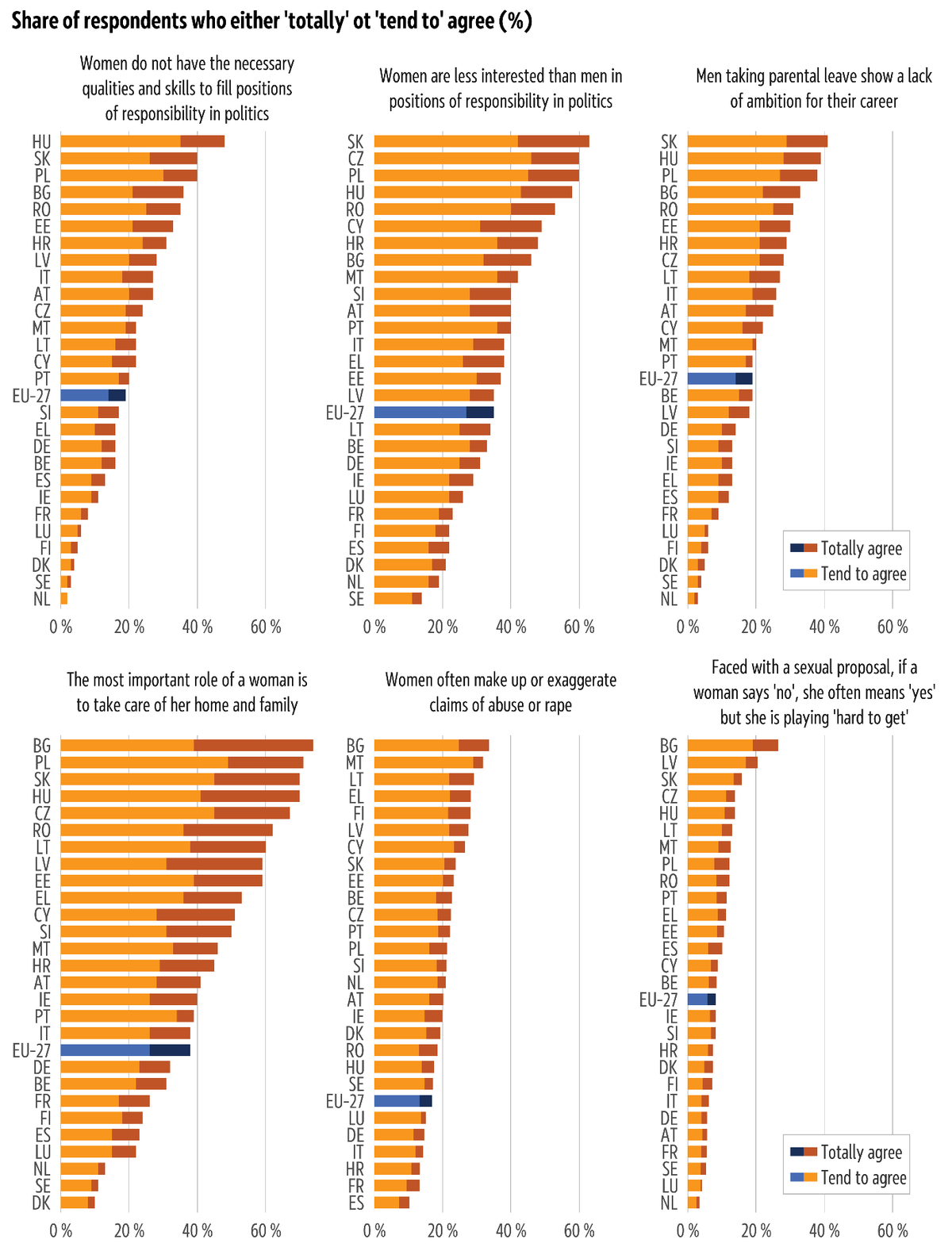
Data sources: Special Eurobarometer SP545 on gender stereotypes and Flash Eurobarometer FL544 on violence against women, 2024. Graphic: Marco Scipioni; EPRS.
Classification
Policy areas: Gender Issues, Equality and Diversity
Committees: Women's Rights and Gender Equality (FEMM)
Statement on the use of AI
Any AI-generated content in this text has been reviewed by the author(s).
Disclaimer
This document is prepared for, and addressed to, the Members and staff of the European Parliament as background material to assist them in their parliamentary work. The content of the document is the sole responsibility of its author(s) and any opinions expressed herein should not be taken to represent an official position of the Parliament.
Copyright
© European Union.
The reuse of this document is authorised under a Creative Commons Attribution 4.0 International (CC-BY 4.0) licence.

https://creativecommons.org/licenses/by/4.0/deed.en
To use or reproduce elements that are not owned by the European Union, permission may need to be sought directly from the respective rightsholders.