
Article page checkbox is not checked in page info.
European defence readiness roadmap
European defence readiness roadmap
Sebastian Clapp with Darius Engel, Members' Research Service
Summary
The defence readiness roadmap 2030 translates the ambition of the 2025 white paper for European defence into concrete objectives intended to ensure that EU Member States can deter and respond to high-intensity threats by the end of the decade. It identifies persistent fragmentation, limited joint procurement and dependence on non-EU suppliers as key structural weaknesses, despite rising defence spending. Capability coalitions are designed to coordinate national investment in priority areas, and European readiness flagships, such as the drone defence initiative and the European air shield, aim to provide urgent collective responses to emerging threats. Successful implementation will depend on meeting targets for collaborative procurement, industrial capacity expansion and regulatory streamlining.
The roadmap views defence readiness as dependent on a resilient industrial and technological base linked to innovation, workforce development and secure access to critical raw materials. It emphasises closer coordination with NATO and international partners, including Ukraine, whose integration into European defence planning is treated as strategically essential. Trade unions warn against deregulation and social cost shifting, while industrial actors emphasise predictable frameworks to incentivise investment. Expert analysts caution that political divergence among Member States, limited new funding and concerns over duplication with NATO may hinder progress.
The European Parliament supports greater defence ambition and calls for a unified posture based on sustained support to Ukraine and strengthened joint capability development.
Introduction
In March 2025, the Commission and the High Representative presented the white paper for European defence – readiness 2030, accompanied by the Commission's ReArm Europe plan. Together, these initiatives form an ambitious defence package designed to provide Member States with financial instruments intended to stimulate a substantial increase in defence capability investment. Building on this, the defence readiness roadmap 2030, presented in October 2025, sets out how Europe aims to enhance its defence readiness by 2030 to deter aggression and protect the continent's security for the coming decades. It operationalises the June 2025 European Council's guidance 'to present a roadmap and discuss the next steps in the implementation of its defence readiness objective' and the aims of the March 2025 white paper for European defence – readiness 2030 by defining concrete objectives, milestones and indicators. The roadmap also proposes flagship initiatives in urgent areas aligned with NATO commitments. It outlines that defence readiness requires EU Member States to possess armed forces able to anticipate, prepare for and respond to defence related crises, including high-intensity warfare. This depends on coherent and interoperable forces with proper equipment, resources, training and doctrine.
Strong public support for EU defence cooperation
There is strong public support for defence cooperation at EU level. Recent data indicate that 77 % of Europeans support the common security and defence policy in EU Member States. In parallel, 71 % believe that the Union should strengthen its capacity to produce military equipment. Furthermore, 69 % of respondents favour a common foreign policy, suggesting sustained backing for deeper EU external action. A further 67 % view the EU as a source of stability in an increasingly volatile international environment, and 69 % consider that the Union possesses sufficient instruments and influence to safeguard Europe's economic interests globally. This is reinforced by the winter 2025 Eurobarometer poll, which shows support for the CSDP is stronger than ever, and considered the number one priority.
Readiness also entails meeting collective capability targets arising from national and NATO commitments. It relies on a strong and innovative European defence industrial and technological base (EDTIB) supported by an enabling regulatory framework, a competitive internal market, military mobility and strategic partnerships. The roadmap consolidates national, multinational and EU-level initiatives and instruments to achieve this. Russia's war of aggression against Ukraine, increasing hybrid attacks against Member States and Moscow's heavily militarised economy represent a long-term threat to European security. Against this backdrop, Europe aims to develop interoperable capabilities, and acquire the capacity to act without excessive reliance on others while still strengthening cooperation with NATO. Although defence spending has increased significantly – from approximately €218 billion in 2022 to a projected €381 billion in 2025 (2.1 % of GDP) – fragmentation persists and less than half of equipment is sourced in the EU. According to the roadmap, Europe must invest more, act collectively and strengthen its strategic autonomy through joint defence initiatives.
Capability gaps and European readiness flagships
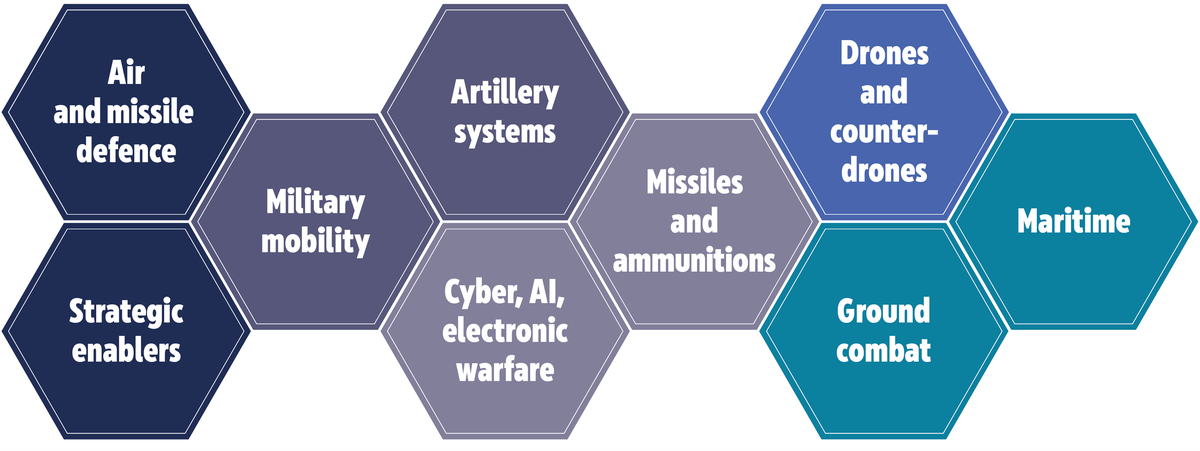
The roadmap notes that the objective of closing Europe's critical military capability gaps by 2030 lies at the heart of the EU's defence readiness agenda. To deter and defend against threats across all domains (land, air, sea, cyber and outer space), the EU and its Member States require a full spectrum of operational capabilities. Priority capability areas have already been identified, including at the highest level at the special European meeting in March 2025 (see Figure 1). According to the roadmap, delivering defence readiness by 2030 requires a systemic approach that ensures interoperability, complementarity and coherence across national procurement and capability development programmes. Furthermore, the EU Military Staff is conducting a classified assessment of Member States' armed forces capabilities, including gaps relative to NATO targets and lessons learned from Ukraine's defence effort. This analysis will be updated annually and integrated into the coordinated annual review on defence to link capability shortfalls to EU level procurement priorities. Chiefs of defence will review capability assessments and guide national armament directors in designing joint solutions, while Member States are expected to continue sharing aggregate defence planning data to allow progress to be tracked. The Commission and the High Representative will present an annual defence readiness report to the European Council each October. This report will assess the progress made in closing capability gaps and provide indicators for monitoring procurement, production and readiness developments. The report will inform strategic guidance from Heads of State or Government and steer discussions between defence ministers.
Graphic by: Samy Chahri, EPRS.
A central mechanism to close capability gaps would be the establishment of Member State-led capability coalitions. These coalitions would organise cooperation in each priority capability area by identifying lead nations, setting objectives and defining collaborative projects. Building on European Defence Agency-led priority implementation roadmaps, capability coalitions would remain open to participation by any Member State and operate on a voluntary basis. The coalitions would be supported by European defence industrial programme tools – such as European defence projects of common interest or the structures for European armament programme – and could launch new permanent structured cooperation projects. The European Defence Agency would provide expertise and coordination, the European Union Military Staff would supply capability assessments and the Commission would ensure access to funding and industrial policy instruments. Member States are expected to finalise coalition membership and governance arrangements by early 2026.
The effectiveness of this framework depends on the degree of joint procurement. Despite a long-standing target to allocate 35 % of defence investment to collaborative procurement, Member States remain below 20 %. The Commission notes that meeting the 2030 readiness objective demands significant increases in joint procurement. Larger and more coordinated orders would reduce costs, strengthen the EDTIB and enhance supply chain resilience. The roadmap sets milestones: coalition formation by 2026, industrial capacity mapping by mid-2026, project launches in 2026, 40 % joint procurement by 2027, contracts in place to close critical capability gaps by 2028 and full delivery through the Security Action for Europe (SAFE) instrument by 2030. SAFE, adopted in May 2025, is an EU financing tool that offers up to €150 billion in long-maturity loans to accelerate defence readiness by supporting large and urgent capability investments and strengthening the EDTIB. It prioritises common procurement, temporarily allows national purchases, applies content rules to limit external dependencies and forms the first pillar of the ReArm Europe plan that seeks to mobilise €800 billion in defence spending. 19 Member States have so far requested SAFE loans.
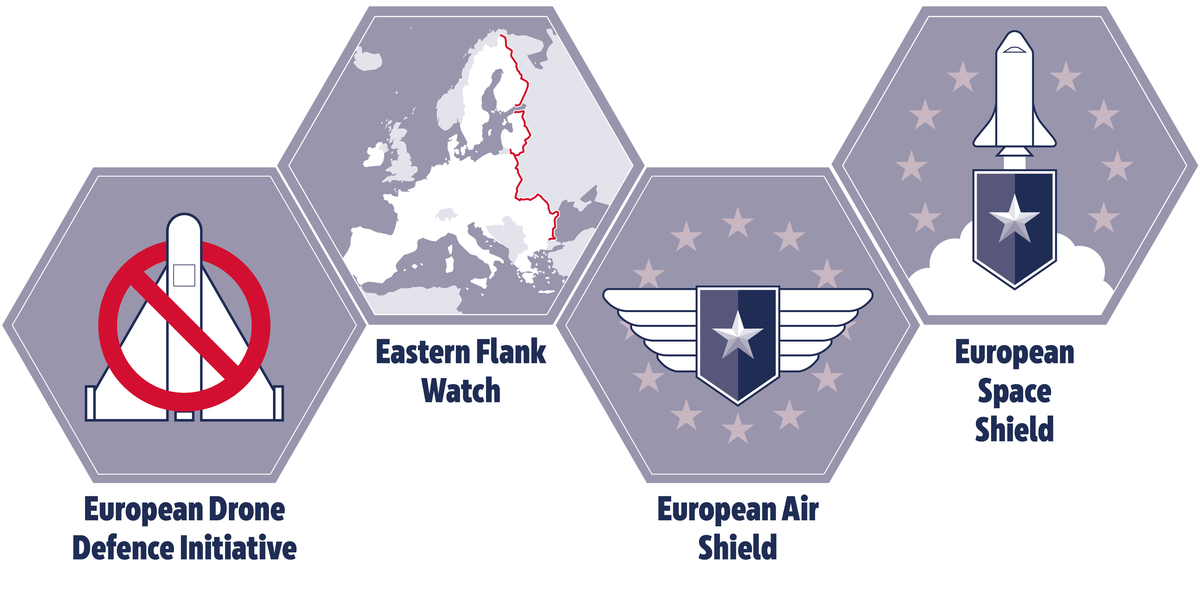
Along with capability coalitions, the Commission and the High Representative propose a set of European readiness flagships. These are pan-European defence projects designed to respond rapidly to pressing security threats. Four initial flagships have been put forward: the European drone defence initiative, the eastern flank watch, the European air shield and the European space shield. These initiatives would reinforce multiple priority capability areas simultaneously and be open to all Member States. The Commission would provide facilitation and regulatory coherence, while the High Representative would ensure alignment with NATO defence planning.
The European drone defence initiative responds to the rapid proliferation of drones and repeated violations of European airspace. Drawing on lessons from Ukraine, it would build an integrated network of detection, tracking and neutralisation systems, accompanied by precision strike capabilities. It includes dual-use applications in border security and protection of critical infrastructure. The eastern flank watch would integrate air defence, counter drone capabilities, ground systems and maritime surveillance to strengthen deterrence along the EU's eastern borders from the Baltic to the Black Sea. It would align closely with NATO activities, including forward presence forces. The European air shield aims to deliver a continent-wide integrated air and missile defence system that is interoperable with NATO command architecture. It would protect European population centres, military infrastructure and energy networks against a full range of airborne threats. The European space shield addresses vulnerabilities in space by enhancing space domain awareness and protecting satellite-based navigation, communication and surveillance services, on which modern defence depends. It would build on EU programmes such as Galileo and IRIS2 and help reduce dependence on non-European space infrastructure. These flagships are scheduled to begin implementation between 2025 and 2026 and will be closely monitored through the annual defence readiness report. Taken together, capability coalitions and readiness flagships form the strategic framework to ensure Europe closes its most urgent capability gaps and achieves defence readiness by 2030 through collective action, industrial strengthening and enhanced interoperability with NATO.
Graphic by: Samy Chahri, EPRS.
At the October 2025 European Council, leaders reaffirmed the EU's determination to enhance its defence readiness by 2030 and deliver on this objective with the necessary pace and scale to deter both immediate and future threats. A stronger and more capable EU is seen as complementary to NATO and a positive contributor to global and transatlantic security. Looking ahead, EU leaders also emphasised the importance of close cooperation with like-minded partners that share the Union's foreign and security policy objectives. During the special meeting of the European Council on 6 March 2025, leaders agreed on a set of priority areas to reinforce the Union's defence capabilities. These include work on air and missile defence, artillery systems, drones, military mobility, artificial intelligence and electronic warfare. Based on these priorities, the European Council asked Member States to pursue their implementation at national level, establish capability coalitions by the end of 2025 and propose specific projects by the first half of 2026. In addition, leaders requested the European Commission present a roadmap for defence industry transformation, and invited the Commission, together with the High Representative, to submit proposals aimed at further strengthening military mobility within the Union.
News outlets reported mounting uncertainty over the proposed EU defence flagships, ahead of the December 2025 European Council meeting. Several large Member States, notably Germany, France and Italy, oppose endorsing these projects at EU level, arguing that large-scale defence capability development should remain a national responsibility or be handled through NATO. As unanimity among all 27 leaders is required, draft summit conclusions omitted any reference to the flagships, leaving them in political limbo. While some northern and eastern states sought to keep the initiatives alive, many governments favour ad hoc coalitions of willing states rather than Commission-led projects. The debate reflects persistent tensions over the Commission's role in defence integration and Member States' determination to retain control over defence matters. This is also reflected in national doubts over the plans in the defence readiness roadmap. For instance, an internal German parliamentary briefing shows Berlin broadly supports stronger EU defence cooperation but remains sceptical towards several European Commission flagship initiatives. It cites limited political backing for geographically focused projects such as the eastern flank watch and unresolved questions on governance and coordination within existing EU frameworks and NATO. Therefore, rather than clearly endorsing the Commission's flagship proposals, leaders at the European Council meeting in December 2025 took stock of ongoing work on Member State-led capability coalitions, priority capability areas and the roll-out of projects planned for the first half of 2026.
The Aerospace, Security and Defence Industries Association of Europe (ASD) supports the aim of achieving defence readiness by 2030 and considers the roadmap a necessary means of turning political goals into concrete milestones. It endorses efforts to close capability gaps through structured cooperation, joint procurement and flagship projects, and welcomes the recognition that a resilient industrial base underpins European security. ASD stresses that industry is ready to scale production and deliver advanced capabilities for the EU and NATO, and calls on the European Council to provide strategic direction so implementation can begin. IndustriAll Europe takes a critical view, arguing that the initiative relies too heavily on deregulation and unconditional funding, which it fears will weaken labour, safety and environmental standards. It warns that diverting cohesion funds to defence could harm social stability, and insists that EU defence industrial reform must not come at the expense of workers' rights or public investment in social priorities. The European Confederation of Independent Trade Unions (CESI) argues that credible readiness must reflect the needs of military and civilian personnel. It maintains that safeguards for training, working conditions, social budgets and structured consultation would create a more effective roadmap than top-down policy design. CESI Secretary General Klaus Heeger supports stronger EU defence capabilities but warns against undermining social rights, noting that Europe's innovative edge depends on its workforce.
Luigi Scazzieri of the EU Institute for Security Studies judges the roadmap's ambition sound but sees major institutional and political obstacles. He highlights the risk of duplication with NATO, difficulties integrating the UK and Norway, and the need for Member States to share sensitive capability data and invest more in the EU Military Staff and the European Defence Agency. He also questions whether capability coalitions will attract broad participation without additional funding, and notes unresolved financing questions before the next multiannual financial framework (MFF). Progress towards an integrated defence market will depend on governments accepting greater EU-level competition. Nick Witney of the European Council on Foreign Relations argues that the roadmap marks a shift of power towards the European Commission, which seeks to drive integration through milestones and annual reporting backed by financial leverage. Several Member States view this as encroachment and have sought to reinforce the European Defence Agency's role. Witney concludes that the roadmap's success will determine whether the EU becomes a credible defence actor or not.
The defence industrial dimension and horizontal enablers
The roadmap states that a resilient, competitive and technologically advanced European defence industrial base is essential for achieving strategic readiness by 2030. It emphasises that Europe's deterrence credibility relies not only on addressing military capability gaps but also on ensuring that the EDTIB can deliver sufficient equipment and innovation. Furthermore, it underscores the value of the defence industry for economic security and growth given its employment potential and spill-over effects across industries. The closure of capability gaps should therefore also boost competitiveness, empower firms and put the EU defence industry at the technological frontier.
According to the roadmap, Russia's war against Ukraine has highlighted the need for robust ammunition stockpiles, well-coordinated supply chains and scalable production lines. Public as well as private investment in industrial scale-up is thus identified as essential. The Commission pledges to provide guidance to the industry in terms of cooperation and to reconsider current State aid rules with Member States. It will also begin mapping European industrial production capacity with an annually shifting focus, starting with air and missile defence, drones, and space systems first. Member States are expected to engage in multiannual, coordinated procurement to send predictable demand signals to the industry, thereby encouraging investments. Noting that the market share of non-EU suppliers has increased and, according to the Commission, less than 50 % of defence equipment is procured within the EU, the union federation IndustriAll Europe positively acknowledges the roadmap's emphasis on overcoming fragmentation, increasing interoperability and complementarity, and boosting procurement from within the EU. The roadmap further highlights the transformative role of disruptive technologies in modern warfare and posits innovation as central to defence readiness. The EU is set to expand research, development and production of advanced systems through funding mechanisms like the European Defence Fund, cohesion funding, the proposed EU competitiveness fund and Horizon Europe, which will also promote dual-use innovation. To further promote this, the roadmap suggests simplified procurement processes for start-ups and SMEs. The European Defence Industry Transformation Roadmap, presented in November 2025, presents a structured approach to link industrial innovation with capability development. ASD adds that it sees Europe's defence industry as fully committed and capable of developing critical capabilities and ramping up production to meet the needs of the EU and its NATO allies.
Given AI's projected importance in defence capability, the Commission intends to simplify access to datasets relevant for AI training and remove administrative barriers. The roadmap further stresses the need to enhance innovation and investment across Europe's defence-tech-industrial base to support the production of critical tech for modern warfare. Moreover, it states that a new partnership among the EU, national governments and industry stakeholders should strengthen collective readiness, and proposes an annual summit of defence industry for this purpose. Human capital is also identified as a cornerstone of the defence industry. Through the pact for skills, the EU aims to retrain 600 000 workers for roles in the defence industry by 2030. The European Confederation of Independent Trade Unions (CESI) stresses that defence policy initiatives should be planned and executed together with the military and civilian personnel who will implement them. It argues that formal social-partner participation in these structures would make the roadmap's roll‑out more effective, practical and politically sustainable. IndustriAll Europe furthermore argues that shifting workers into defence would not compensate for job losses in the automotive sector, and that reskilling plans should address the ethical concerns raised by replacing civilian jobs with defence production. Additionally, the roadmap stresses the need to secure access to critical raw materials. The Observatory of Critical Technologies has thus been tasked with providing risk assessments and recommending mitigation measures, such as stockpiling and supply diversification.
The roadmap also notes that international partnerships with like-minded countries are essential for reinforcing supply chain resilience and interoperability. It references negotiations with the UK and Canada to enable joint procurement via SAFE (the Council authorised negotiations on the matter with the UK and Canada on 18 September 2025), and highlights planned greater cooperation with NATO in terms of classified information exchange as well as defence industrial dialogues with Japan and potentially India. It further recommends that the EU and Moldova strengthen their defence partnership.
Objectives, milestones and indicators
To ensure that the EDTIB can deliver the capabilities required by Member States at the necessary scale and speed by 2030, the roadmap sets clear objectives. These include substantially expanding production lines, cutting delivery times, harnessing innovation (including Ukrainian solutions) and securing supply chains by reducing critical dependencies. To track progress, several milestones have been defined. These include the adoption of the European Defence Industry Programme by co-legislators and the presentation of the European defence industry transformation roadmap by the Commission in November 2025. The European Defence Industry Programme was signed into law on 16 December 2025 and entered into force on 30 December 2025. On 19 November 2025, the Commission put forward the EU defence industry transformation roadmap with the intention of modernising the defence industrial base in Europe and aligning it more closely with readiness requirements for 2030. It highlights the growing significance of disruptive technologies and the need to incorporate advanced technological solutions into operational capabilities. It further places strong attention on strengthening defence production through advanced manufacturing processes and greater scaling of output. The roadmap reflects lessons drawn from the war in Ukraine and seeks to bring defence and deep technology communities into closer contact, speed up the adoption of cutting-edge technologies and facilitate access to procurement opportunities in the defence sector.
By the end of 2025, tech alliances for defence are to be established by the Commission to connect defence users in Member States with tech innovators. On 28 November 2025, the Commission held a launch event in Brussels. Commissioner Kubilius engaged with defence industry representatives to assess European drone and counter-drone capabilities against the backdrop of recent EU airspace incidents and battlefield lessons from Ukraine, where unmanned systems have become decisive. The discussions underlined the urgency of strengthening the EU's technological preparedness and resilience in this domain. Earlier the same day, the European Commission launched the EUDIS tech alliances, as set out in the EU defence industry transformation roadmap, to deepen cooperation between Member States and defence innovators. The event showcased emerging companies presenting novel solutions to national representatives, including those involved in drone and counter-drone capability initiatives. The Commission also plans to expand strategic dialogue with industry and host the first annual defence industrial summit by mid‑2026. From mid‑2026 onwards, the Commission is due to present an overview of the capacity increases required to guarantee reliable supply across the agreed capability areas. The second half of 2026 should see a comprehensive risk analysis and accompanying action plan for mitigating the dependence of the European defence industry's international supply chains on critical raw materials. By 2026, 200 000 workers are expected to be reskilled for the defence sector, while by the end of 2027 the Commission expects the competitiveness fund, defence window and Horizon Europe framework programme to be adopted and operational. ASD considers the roadmap's timelines and indicators to reflect the urgency of the task and calls for swift strategic guidance from the European Council to move from ambition to implementation.
In terms of monitoring, the roadmap proposes indicators for the annual defence readiness report, including the EU27 defence industry's contribution to EU GDP (percentage), employment in the industry, including annual job creation, the share of new or expanded defence production facilities, the uptake of EU programmes that support defence innovation, the number of defence-related patents registered in the EU, the number of defence startups created and the number of unicorns in the sector.
Horizontal enablers
The roadmap further argues that horizontal enablers are essential for delivering a genuine EU‑wide market for defence equipment by 2030, needed to unlock innovation, large-scale production and economies of scale. It calls for harmonised procurement rules and transfer procedures, a resilient security of supply regime and broad adoption of recognised standards with reciprocal recognition of certification. It further notes that the review of the Defence and Security Procurement Directive ought to provide Member States with more agile procedures in terms of joint procurement, while greater transparency and predictability should help industry to scale up and innovate. The roadmap also calls for the legislative adoption of the defence readiness omnibus and the defence mini-omnibus, with agreement on the latter reached in November, since they contain measures to strengthen cross-border trust and should incentivise investment in the defence industry ahead of the next MFF (2028-2034). Completing additional single market legislative work by the end of 2026, including the evaluation of the Public Procurement and Intra-EU Transfers Directives, represents another milestone.
One expert from the Centre of European Reform (CER) expresses uncertainty over whether Member States would quickly open national contracts to EU-wide competition or loosen intra-EU transfer controls, expecting instead movement in specific niches, such as small drones, rather than a rapid shift to a full single market. The German Aerospace Industries Association (BDLI) warns that the planned easing of State-aid and competition rules and the measures to secure access to critical raw materials must be defined 'quickly and bindingly', arguing that only clear and predictable framework conditions will enable the European aerospace and defence industry to invest in the extra production capacity and innovation that the roadmap demands. IndustriAll Europe furthermore cautions that 'throwing money at the problem' without prerequisites for companies, combined with accelerated deregulation via the defence omnibus, risks excessive weakening of labour, health and safety, procurement and environmental standards in the defence sector, and could thus fuel worker and public discontent, rather than strengthen readiness.
Military mobility is another critical horizontal enabler for European security and support to Ukraine, according to the roadmap, which states that barriers to moving troops and equipment across the Union still persist. Only half of Member States met the target of five working days for cross‑border movement permissions in 2024. More than 500 hotspot projects, with an estimated €100 billion investment need, must be addressed to remove bottlenecks along priority corridors, especially on the eastern flank's inadequate trans-European transport networks. To address this, the roadmap seeks to establish an EU-wide military mobility zone encompassing aligned regulation and streamlined procedures, supported by an integrated network of land routes, airports, seaports and support elements by the end of 2027. It thereby aims to guarantee the seamless movement of troops and military equipment throughout the Union, in close coordination with NATO, and to enhance the availability of civil-military transport capabilities. To achieve this, the roadmap foresees several major milestones.
First, the military mobility package, which was released on 19 November 2025, sets out to create an EU‑wide military mobility area by 2027, bringing the Union closer to a 'military Schengen' by making the movement of forces and equipment faster, safer and more coordinated. It introduces the first harmonised EU rules for cross-border military movements, including a maximum three-day processing limit and simplified customs procedures. It also establishes the European military mobility enhanced response system to provide fast-track measures and priority access to infrastructure for EU or NATO operations. It seeks to strengthen the resilience of key corridors through dual-use upgrades and a new resilience toolbox. It also supports pooling and sharing through a solidarity pool and prospective military mobility digital information system. Governance would be reinforced through a military mobility transport group, a strengthened Trans‑European Transport Network Committee and national coordinators responsible for cross-border military transport.
Second, specific mobility hotspot projects – tangible fixes to known infrastructure bottlenecks along designated corridors – would be identified and prioritised by Q1 2026. Following this, the adoption of the military mobility package by the end of 2026 represents the third milestone. Finally, by the end of 2027, a new military mobility window within the Connecting Europe Facility should be fully approved and operational. To track progress, the annual defence readiness report will monitor Member States' commitment to ensure that movement authorisations for troops and equipment are issued within three to five working days, assess the number of hotspot projects supported by EU funding, measure the share of the CEF military mobility budget disbursed, and record the number of projects supported by the European Investment Bank (EIB) Group.
Ensuring adequate financial resources and investment is another central pillar of the roadmap, which underlines that EU instruments under the current MFF have already demonstrated strong added value for Europe's defence industry. It notes that the European Defence Fund (EDF) has become the third research and development (R&D) investor in the EU, while the ASAP and EDIRPA programmes have helped to address critical shortfalls and leveraged over €12 billion in additional investment by Member States and industry. The European Defence Industry Programme (EDIP) is expected to provide new tools for delivering capabilities through initiatives such as the European defence projects of common interest and the structures for European armament projects. BDLI notes that, despite this ambitious toolbox, the roadmap's financial architecture largely refers to existing instruments such as EDIP and SAFE, rather than creating new budget lines. They caution that the industrial impact will therefore depend heavily on how far Member States actually make use of these instruments. One observer argues that eastern flank states should not shoulder the cost of a 'drone wall' project – which the roadmap describes as open to all Member States willing to participate – alone, and calls for joint EU borrowing of around €1.3 billion (equivalent to what Ukraine spends on drones, representing approximately 2 % of Ukrainian military budget) for unmanned aerial vehicles to ensure solidarity with frontline countries.
According to the roadmap, the activation of the national escape clause has so far enabled 16 Member States to expand their defence budgets, while the SAFE instrument has been fully subscribed to by 19 Member States, exhausting its €150 billion envelope. Following the mid-term review amendments of cohesion policy instruments, Member States and regions can also redirect cohesion funds to investments related to defence, such as military mobility. The roadmap states that additional targeted support would be provided to EU regions bordering Ukraine, Russia and Belarus. The president of the European Committee of the Regions (CoR) previously warned that diverting cohesion funding towards defence would be a 'catastrophic mistake', calling for additional resources instead. IndustriAll Europe argues that economic security would depend on social stability, and that cutting social budgets to finance defence risks weakening internal security and might empower extremist political forces.
For the next MFF, the Commission writes in the roadmap that it will propose a substantial budget increase for defence and space. €131 billion of the European competitiveness fund would then be dedicated to supporting long-term defence readiness efforts. Additionally, dual-use projects would be eligible for funding from a €175 billion budget under Horizon Europe, while the European Innovation Council would be given the ability to back innovation in critical defence technologies. The military mobility budget is also set to grow from €1.76 billion to €17.65 billion. One expert from the European Council on Foreign Relations (ECFR) comments that financial leverage coming from EU money would strengthen the Commission's ability to strategically address defence issues because Member States' access to EU funding instruments, together with €150 billion in borrowing under SAFE, would presumably come with Commission oversight.
The roadmap furthermore highlights the importance of mobilising private capital and expects progress on the savings and investments union to direct long-term funds towards investment in defence, innovation and infrastructure, and mentions that the EIB Group's increased financing for such projects would convey a strong message to markets. It sets the objective of stimulating a significant increase in both public and private investment in the European defence sector and maximising the EU-funded support's impact and efficiency. To advance this, several milestones are outlined. By the first quarter of 2026, the Commission, together with the EIB and EIF, aims to establish a fund of funds of up to €1 billion in equity to accelerate the growth of defence-related scale-ups and projects. By the end of 2027, new MFF instruments are expected to be approved and operational, and at least half of the SAFE envelope to be disbursed by the third quarter of 2028. To measure progress, the Commission suggests the annual defence readiness report could include indicators to track the ratio of public to private investment in defence and monitor the annual evolution of the EIB Group's support to security and defence.
Supporting Ukraine
The roadmap identifies Ukraine's defence resilience as integral to its own and Europe's security. Europe's own readiness, the roadmap argues, would thus be strengthened by integrating Ukraine's combat-tested experience, innovative approaches, civil–military coordination and rapidly growing defence production base. Member States and the EU intend to develop lasting security guarantees for Ukraine founded on several pillars, such as stable multi-year financing and arms supply, legal arrangements and consultative mechanisms, industrial integration with the EDTIB, and alignment with Ukraine's postwar reconstruction and path toward EU membership. A central element of this approach, according to the roadmap, is the preservation of Ukraine's qualitative military edge (QME). The Commission is preparing a reparations-based loan mechanism drawing on immobilised Russian assets to secure this edge. According to the Commission, this would ensure predictable, multi-year funding and give Ukraine steady access to military equipment from European and Ukrainian industries, while also stimulating joint innovation and production. The roadmap further states that complementary efforts, including enhanced training through the European Union military assistance mission Ukraine (EUMAM) and improved intelligence sharing, would reinforce Ukraine's QME. The launch of a drone alliance with Ukraine exemplifies how such cooperation can function in practice. Supported by diverse EU funding channels, including €2 billion from ERA loans, the alliance aims to foster joint ventures between Ukrainian and European firms, merging European technological capacity with Ukraine's operational insights. The roadmap furthermore asserts that Ukraine would be fully involved in the implementation of EU defence financing tools, such as SAFE and the EDIP/Ukraine Support Instrument (USI), to maximise procurement for, with and from its domestic industry. If cooperation continues to progress, the Commission may consider an additional Ukraine-focused initiative in early 2026 to deepen collaboration. One CER expert comments that, since EDIP's budget for Ukraine is small, near-term resources would hinge on decisions to use Russia's frozen assets. An analyst adds that the EU should make more systematic use of Ukraine's unmanned aerial vehicle (UAV) expertise, as the country produces around 4 million drones annually, with the scope to double that if adequately funded, as stated by the Ukrainian president.
The roadmap outlines the objective of enabling Ukraine to deter any Russian aggression, while fully integrating its defence industry into Europe's to enhance Ukraine's production capacity and benefit from its innovative ingenuity. To achieve this, the document sets out several milestones. By the end of 2025, the Ukraine support instrument under EDIP and a 'reparation loan' are expected to be adopted and the High Representative's initiative for 2 million rounds of artillery ammunition fulfilled. By September 2025, 80 % of the pledge had already been fulfilled. By early 2026, Ukraine is to be included in relevant capability coalitions, and the EU–Ukraine drone alliance launched. In parallel, the Commission will assess whether additional incentives are needed to encourage Member States to expand their support for Ukraine and will table proposals for further measures to accelerate the delivery of military aid. By the end of 2026, the EU plans to implement 'brave tech EU', a framework to fund and test new technological solutions responding to battlefield needs identified jointly with Ukraine. Finally, the EUMAM training mission and support for the coalition of the willing are to be continued. Progress will be measured through the annual defence readiness reports tracking the scale of EU military assistance to Ukraine, the number of Ukrainian soldiers trained under EUMAM and the amount of large-calibre ammunition delivered. Additional indicators include the proportion of SAFE loans allocated to Ukraine, total EU investment in the Ukrainian defence industrial and technological base (UADTIB), and the number of EU–Ukraine joint ventures established in the defence sector.
European Parliament position
The European Parliament places a strong emphasis on accelerating European defence readiness in response to Russian hybrid aggression. It argues that the EU must move from fragmented capability development to a unified defence posture anchored in deterrence credibility, operational readiness and sustained support to Ukraine. The resolution calls for a shift from crisis management towards collective defence planning, including a revision of EU capability targets and the creation of a European Defence Union complementary to NATO. It advocates a European command and control structure comparable to NATO SHAPE to coordinate planning, intelligence and joint operations, along with enhanced EU NATO interoperability. A major focus is investment in integrated air and missile defence, long-range strike capabilities and a full spectrum of unmanned aerial vehicle and counter-UAV architecture deployed along the eastern flank and in the Baltic and Black Sea regions. Members call for greater budget and staff for the European Defence Agency, defence industrial scaling through SAFE and EDIP, and increased funding in the next MFF. They also call for significant industrial cooperation with Ukraine to harness its innovation in drone warfare, strengthening Europe's defence production resilience and technological edge.
Main references
- European Commission and High Representative of the Union for Foreign Affairs and Security Policy, joint communication to the European Parliament, the European Council and the Council: Preserving peace – defence readiness roadmap 2030, October 2025.
Disclaimer
This document is prepared for, and addressed to, the Members and staff of the European Parliament as background material to assist them in their parliamentary work. The content of the document is the sole responsibility of its author(s) and any opinions expressed herein should not be taken to represent an official position of the Parliament.
Copyright
© European Union.
The reuse of this document is authorised under a Creative Commons Attribution 4.0 International (CC-BY 4.0) licence.

https://creativecommons.org/licenses/by/4.0/deed.en
To use or reproduce elements that are not owned by the European Union, permission may need to be sought directly from the respective rightsholders.