
Article page checkbox is not checked in page info.
2028-2034 MFF: Quality analysis of the Commission’s impact assessments
2028-2034 MFF: Quality analysis of the Commission's impact assessments
Irmgard Anglmayer and Esther Kramer, Ex-Ante Impact Assessment Unit

Key findings
The European Commission drew up seven impact assessments (IAs) in support of 18 programme proposals for the 2028-2034 multiannual financial framework (MFF) and the proposed regulation on a horizontal performance framework. The broad scope of these IAs does not allow individual programme proposals to be assessed in any detail – as is particularly salient in the case of the IA on the national and regional partnership plans, covering nine legislative proposals.
All IAs acknowledge a deviation from the scope and depth of a standard IA as defined by the Better Regulation Guidelines (BRG). This is justified with Tool #9 of the BR Toolbox, which indicates the specificity of the MFF, but does not define how related IAs should be carried out. As a result, the application of the better regulation principles varies widely across the MFF IAs. They are similar insofar as the Commission chose for all of them a mostly horizontal rather than policy-specific approach and did not include any budgetary considerations and scenarios. These choices affect the quality of key sections of the IAs considerably, albeit to varying extents.
The problem definition often lacks specificity and substantiation. Similarly, the IAs' objectives remain largely unspecific, which, in turn, affects the IAs' monitoring and evaluation provisions and risks hampering the future measuring of the objectives' achievement. The description of policy options is in most cases short and vague, which weakens the impact analysis. The depth to which economic, social and environmental impacts are assessed varies across the sampled IAs. The analysis remains predominantly qualitative, with quantification largely lacking. All seven MFF initiatives are deemed relevant for small and medium-sized enterprises (SME) and are thus listed in the 'SME filter'. The IAs state that they place great emphasis on simplification and burden reduction. None of them is accompanied by a subsidiarity grid, and they discuss subsidiarity, European added value and proportionality rather briefly. While the IAs differ considerably in terms of quality and transparency when it comes to their evidence base and methodology, all of them acknowledge certain limitations and a lack of data (notably quantitative data). Consultation activities were largely limited to open public consultations.
The Regulatory Scrutiny Board (RSB) found significant shortcomings in all seven draft IAs, prompting it, exceptionally, to issue opinions without qualification. The persisting flaws in the final IAs suggest that the RSB recommendations have at best been partially addressed. Altogether, the limited quality of the MFF IAs appears to reflect a missed opportunity to provide policymakers with high-quality and transparent evidence for one of the most important policy packages to be negotiated in the coming months and years.
This briefing complements the set of initial appraisals that EPRS prepared on the European Commission's seven impact assessments (IAs) accompanying 19 legislative proposals linked to the 2028-2034 multiannual financial framework (MFF). It presents a synthesised analysis of common features, as well as methodological strengths and weaknesses identified in these IAs, checked against the Commission's own rules for policymaking, the Better Regulation Guidelines and Toolbox.
Background
The multiannual financial framework (MFF) for the period 2028-2034, worth almost €1.8 trillion in commitments (2025 prices),1 envisages a complete overhaul of the current MFF architecture. It aims to make 'the EU budget and its programmes simpler, more flexible and strategically attuned to the priorities of today'. The proposed new MFF structure is meant to reduce fragmentation, complexity, overlaps and the lack of flexibility in the EU's current funding instruments.
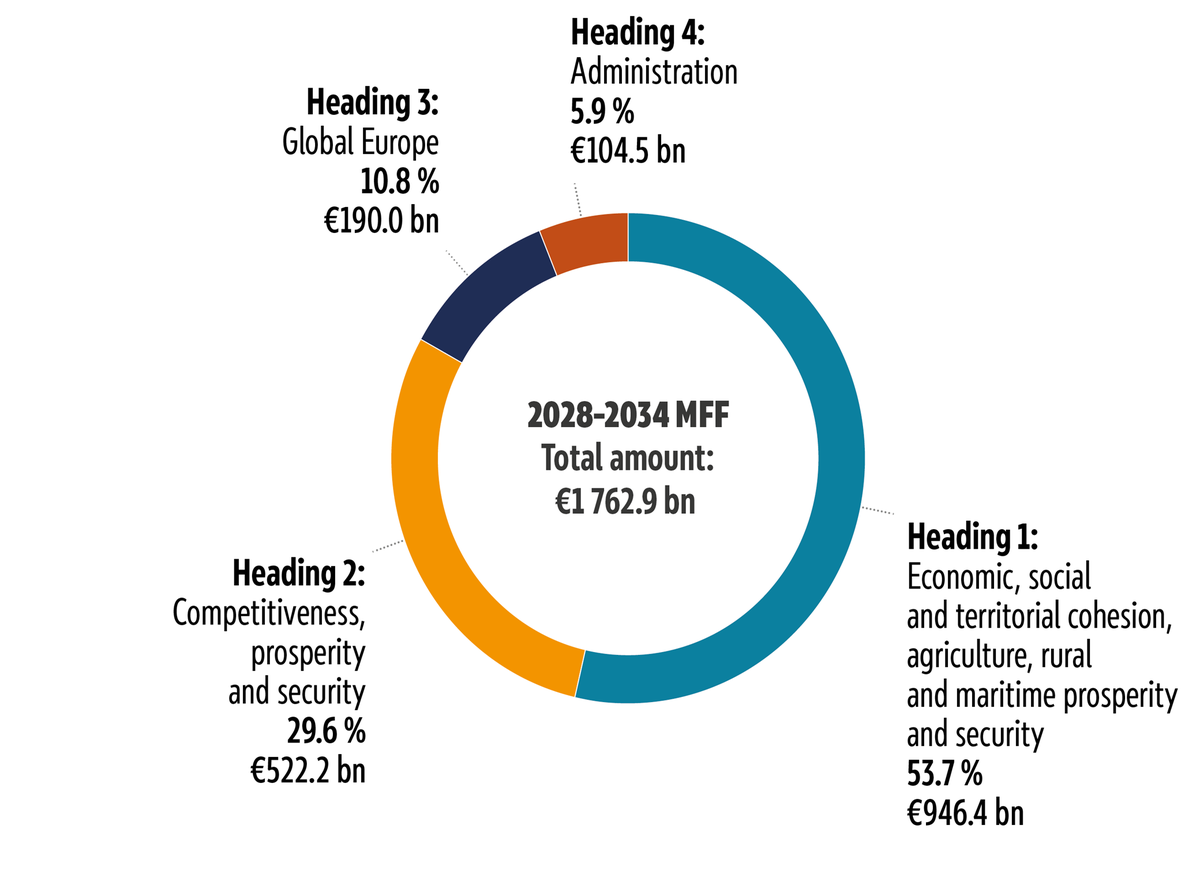
Source: M. Pari and S. Pradier, EU budget 2028-2034: Overview of the Commission's proposal, EPRS, European Parliament, 2025; Graphic by Lucille Killmayer.
Announced in the 2025 Commission work programme (CWP), the Commission released its proposals for the post-2027 MFF in two batches, on 16 July and 3 September 2025. The accompanying communication, 'The road to the next multiannual financial framework', announced that the MFF would be both simpler and 'more impactful'. In the new MFF architecture, the Commission proposes grouping programmes under four headings (see Figure 1).
The European Parliament, in its resolution of 7 May 2025 on a revamped long-term budget, backed the idea of simplification as such. However, it called for more transparency, accountability and scrutiny, control of spending, and for reducing the risks of double funding, misuse and fraud. Regarding better law-making, Parliament regretted that the Commission had in the past 'not systematically conducted thorough impact assessments … for all legislation involving spending through the budget', insisting on a change of this practice.
Coverage of the MFF-related impact assessments
The Commission's preparatory work for the 2028-2034 MFF includes seven impact assessments. These support, either directly or indirectly, 18 MFF programme proposals and the proposed horizontal framework for budget expenditure tracking and performance (see Table 1).2 Three cases can be distinguished:
-
an IA accompanying precisely one legislative proposal, as is the case for the IAs on the Single Market and Customs Programme; Global Europe; the Union Civil Protection Mechanism (UCPM); and the budget performance framework;
-
an IA explicitly accompanying a package of legislative proposals, as is evident from the presentation of the IA's title and content. This applies to the IAs on the European Competitiveness Fund, and the AgoraEU and Erasmus+ programmes;
-
an IA accompanying one or more legislative proposal(s) and indirectly covering further proposals, although this may not be instantly evident from the IA's title or presentation. Proposals concerned are either specifically mentioned in the IA, or they contain a cross-reference to that IA in their explanatory memorandum.3 This concerns the Justice programme and, notably, the spending programmes subsumed under the national and regional partnership plans (NRPPs). The NRPP IA covers as many as nine legislative proposals, reflecting the Commission's endeavour to bring together current MFF programmes or individual strands within them, and regroup them into a single national and regional partnership plan for each Member State. These plans cover economic, social and territorial cohesion, agriculture, rural and maritime prosperity and security. By its nature, that IA's broad scope does not allow an assessment of the individual programme proposals covered in any detail. It is therefore questionable whether the respective proposals can be considered as being supported by an IA.
| Impact assessment subject
and reference | MFF proposals covered
(direct coverage highlighted in bold) | MFF heading | |
|---|---|---|---|
| 1 | National and regional partnership plans – SWD(2025) 565 |
National and regional partnership plans – COM(2025) 565 European Fund for Regional Development, Interreg and Cohesion Fund – COM(2025) 552 European Social Fund – COM(2025) 558 Common Fisheries Policy – COM(2025) 559 Common Agriculture Policy – COM92025) 560 Connecting Europe Facility – COM(2025) 547 Union support for asylum, migration and integration – COM(2025) 540 Border management and common visa policy – COM(2025) 541 Union support for internal security – COM(2025) 542 |
H1: Economic, social and territorial cohesion, agriculture, rural and maritime prosperity and security |
| 2 | European Competitiveness Fund (ECF) – SWD(2025) 555 |
European Competitiveness Fund – COM(2025) 555 Horizon Europe – COM(2025) 543 Implementation of Horizon Europe and research/innovation parts of the ECF – COM(2025) 544 |
2: Competitiveness, prosperity and security |
| 3 | Single Market and Customs Programme – SWD(2025) 592 | Single Market and Customs Programme – COM(2025) 590 | |
| 4 | AgoraEU and Erasmus+ programmes – SWD(2025) 550 |
AgoraEU – COM(2025) 550 Erasmus+ - COM(2025) 549 Justice programme – COM(2025) 463 |
|
| 5 | European Civil Protection Mechanism – SWD(2025) 545 | Union Civil Protection Mechanism and Union support for health emergency preparedness and response – COM(2025) 548 | |
| 6 | Global Europe – SWD(2025) 552 | Global Europe – COM(2025) 551 |
H3: Global Europe |
| 7 | Budget expenditure-tracking and performance framework – SWD(2025) 590 | Budget expenditure-tracking and performance framework – COM(2025) 545 |
All MFF headings |
Source: Authors' compilation.
Further programme proposals under the 2028-2034 MFF were presented entirely without an IA. Instead, they were accompanied by a staff working document taking the form of an ex-ante evaluation. This concerns the proposal, under the ordinary legislative procedure, on the Pericles V programme (i.e. the EU's programme for the protection of the euro against counterfeiting);4 the three MFF proposals pertaining to the Euratom Treaty;5 and the proposed Council decision on the association of the overseas countries and territories with the EU. The choice of conducting an ex‑ante evaluation (rather than an IA) is in line with the requirements set out by Article 34 of the EU's Financial Regulation and Tool #9 of the BR Toolbox, according to which spending programmes with a 'relatively small budget' that provide continuity in terms of scope and structure do not require an impact assessment but rather an ex-ante evaluation. Meant to support the preparation of the programmes in question, and drawing on ex-post evaluations of previous programmes, ex-ante evaluations analyse the issues to be addressed, the EU added value, objectives, and the expected effects of different options and monitoring and evaluation arrangements.
Methodological approach – EU better regulation framework
Based on the Interinstitutional Agreement on better law-making (IIA-BLM), the Commission's Better Regulation Guidelines (BRG) and Toolbox lay down the rules for carrying out IAs, which are considered an essential tool for high-quality EU law-making. IAs are designed to facilitate transparent political decision-making by explaining the reasoning behind a legislative proposal and providing a solid evidence base for the proposed measures.
The above-mentioned seven IAs relating to the proposals for the 2028-2034 MFF programmes do not follow the standard EU IA approach. They all acknowledge from the start a deviation from the scope and standard IA methods as defined by the Commission's BRG; this affects their quality in terms of better regulation and transparency to varying extents.
Tool #9 Better Regulation Toolbox
'The special case of preparing a new multiannual financial framework is a unique process requiring a specific approach as regards scope and depth of analysis. For this process, practical guidance for the preparatory work is normally issued by [the Commission's] Secretariat-General and DG BUDG.'
Source: Better Regulation Toolbox (2023).
The IAs justify the deviation from the better regulation framework by invoking Tool #9 of the BRG relating to the preparation of spending programmes, which recognises that 'the special case of preparing a new multiannual financial framework is a unique process'. This admission constitutes progress in terms of transparency compared with the IAs accompanying the 2018 proposals for the MFF 2021-2027,6 which also differed significantly in form and substance from the standard BRG requirements, but did not provide any explanation in this respect. The 2025 MFF IAs also show progress in terms of substance, as the 2018 assessments focused on presenting the expected positive effects of the MFF proposals rather than assessing and comparing relevant impacts of alternative policy options.
However, Tool #9 does not detail what the 'specific approach as regards scope and depth of analysis' means in practice for MFF IAs. At the same time, it does not say either that the better regulation principles would not apply. This lack of specific guidance suggests that the Commission has discretion over the implementation of the better regulation principles when preparing an IA for an MFF proposal, which makes it difficult to formally assess those IAs' quality. The application of better regulation standards in the 2028-2034 MFF IAs varies considerably – however, they have some important common features.
First, a particularity of the 2028-2034 MFF IAs is their common focus on 'how to streamline the architecture of the EU budget'. Instead of developing objectives based on a specific problem definition, as would be the case in a standard IA, their approach is driven by the horizontal objectives of Commission President von der Leyen's political guidelines and the communication on the next MFF (reduce complexity and administrative burden and increase the MFF's flexibility). Moreover, as most of the IAs point out, 'policy aspects are considered in the analysis of the context, the problem definition and the objectives', but are not, or only sporadically, discussed in the sections on the options and their impacts, which usually are key parts of any IA and address the specific subject matter of the relevant legislative proposal in detail.
Second, the IAs state that the proposed fundamental changes to the MFF architecture and the uncertainty about the future budget allocations would not allow for the development of scenarios. This is surprising, as IAs relating to spending programmes usually make assumptions in order to build alternative scenarios (typically assuming no change, higher and lower budget allocations) and to enable a comparative assessment of the scenarios' potential impacts.7 In addition, the 2028‑2034 MFF IAs argue that the impossibility of developing scenarios also prevents quantified analysis, resulting in the IAs being mainly qualitative. However, Tool #9 does not exclude quantifications, and some of the MFF IAs do indeed complement their qualitative assessment with (limited) quantifications, whereas others provide no quantification at all (see section on data quality and methods below).
Altogether, the absence of clear rules for MFF IAs, the varied application of the better regulation standards (and tools) in the seven IAs for the 2028-2034 MFF, and the horizontal approach to essential parts of these IAs make it challenging to compare their quality. In the following, this briefing pinpoints common (or similar) features identified across the seven IAs, providing an overview of their strengths and weaknesses.
Problem definition
An evidence-based and coherent problem definition is of particular importance for an IA's quality, as it lays the groundwork for a pertinent intervention logic and the ensuing impact analysis: if the problem is poorly defined, the resulting definition of objectives and options – and their assessment – risk being flawed, as well.
In many of the sampled IAs, the problem definition seems to lack coherence, clarity and, for some of them, also sufficient and transparent substantiation. The IAs provide general lines of problematic elements in the current situation (baseline), covering a vast range of policy areas. However, they neither address policy details nor the precise nature of the problems in relation to the main affected stakeholder groups, as requested by the BRG. Moreover, the links between the problems, the underlying drivers and the consequences of the problems are not systematically spelled out, with problems and drivers occasionally overlapping, and little information provided on their respective consequences. In addition, most of the IAs do not indicate whether all problems and drivers are equally relevant or weigh differently (and if so, how).
Notwithstanding these weaknesses, the description of the nature of the problems seems to be overall satisfactory in most MFF IAs. However, the frequently observed lack of sufficient evidence, combined with the limited quantification, affects the analysis of the problems' magnitude, which is addressed either vaguely or not at all. This exacerbates the above-mentioned weaknesses, because the overall relevance of the problems remains vague and with it, the intervention logic of the IAs (e.g. the IAs on Global Europe and on the Single Market and Customs Programme). It seems that, in most cases, the problem analysis was performed with a specific policy option in mind - a process known as 'backward engineering'. This process is explicitly rejected by the BRG (Tool #13), with the Commission cautioning that 'this not only undermines the quality of the analysis, but it also hurts the credibility of the whole impact assessment process'. Finally, the question of whether and how the problems are expected to persist (or aggravate) without the proposed interventions could have been explored more thoroughly in most of the sampled IAs.
The problem definition in most MFF IAs is mainly based on stakeholder feedback and ex-post or interim evaluations of the programmes they cover, in line with the BRG's 'evaluate first' principle. Some IAs draw on a wide range of sources, pertinent reports and studies, while others would have benefited from a larger amount of external input and a more consistent use of data already featured in the evaluations, in particular quantified information.
Subsidiarity / proportionality
Most of the MFF IAs maintain the legal bases of the numerous existing programmes they propose to merge. The wide range of programmes and policy areas covered by each IA is reflected in a high number and variation of legal bases in most IAs. As noted, contrary to the BRG, most of the MFF IAs do not assess and/or substantiate sufficiently whether and how the identified problems would persist in the absence of (new) EU action, although a thorough analysis of a dynamic baseline scenario would have been important to explain the need for and added value of EU action. Several IAs refer to evaluations of previous programmes, some of which are not (yet) publicly available, meaning that the assertions cannot be checked.
Most IAs explain the need for EU action in the policy areas they encompass by citing the priorities of the political guidelines, i.e. to be more flexible, effective and efficient amid rapid changes and newly emerging internal and external challenges, in particular regarding cross-border activities (e.g. in the customs union, in cohesion policy and in civil protection). They state that better cooperation and coordination would entail the added value of limiting inefficiencies and administrative burdens, for instance by reducing suboptimal investments (IA on the Competitiveness Fund) or by limiting regional disparities within and between Member States (IA on the NRPPs).
Overall, it appears that subsidiarity analysis could have been more thoroughly substantiated in most of the IAs. None of them includes a subsidiarity grid, which could have supported and guided a more exhaustive analysis, as recommended by the BRG for 'politically sensitive and important proposals' (only the IA on a budget expenditure-tracking and performance framework falls under exclusive EU competence, and therefore no subsidiarity assessment was required in that case). In addition, most of the IAs do not assess proportionality, neither in the context of subsidiarity nor in the assessment of the options. The IAs that do discuss it provide limited qualitative reflections in the comparison of the options. Only the IA on AgoraEU and Erasmus+ features a rather comprehensive proportionality analysis.
In the context of their subsidiarity check, national parliaments issued three reasoned opinions on three of the total 19 legislative proposals, in accordance with Article 6 of Protocol No 2 on the application of the principles of subsidiarity and proportionality (see Table 2).
| Proposal | Issuing chamber | Main points raised |
|---|---|---|
| National and regional partnership plans – COM(2025) 565 | German Bundesrat | The proposal is not in line with the subsidiarity and proportionality principles. |
| Common Agriculture Policy - COM(2025) 560 | Romanian Senate | The proposal it not in line with the subsidiarity principle, but complies with the proportionality principle. |
| Union Civil Protection Mechanism – COM(2025) 548 | French Senate | The proposal appears to be contrary to the principles of subsidiarity and proportionality. |
Source: Authors' compilation, based on IPEX data.
In addition, national parliaments raised concerns in the context of the political dialogue. Contributions were received on each of the 19 proposals – 73 in total. They came from the Spanish Cortes Generales (19), the German Bundesrat (12), the Czech Senate (10), the Portuguese Parliament (9), the Romanian Senate (7), the Italian Chamber of Representatives (5), the Irish Houses of Oireachtas (5), the Italian Senate (3), the Polish Senate (2), and the Dutch Senate (1). The highest number of contributions – seven each – was submitted on the proposals regarding the national and regional partnership plans and the Common Fisheries Policy .
Objectives of the initiative
Unlike standard IAs applying the better regulation criteria (where the objectives of an initiative are to be developed in the context of an intervention logic, from an evidence-based problem definition, to corresponding objectives, to specific policy options), the MFF IAs' overarching objectives are based on the common political goals of all MFF proposals: to reduce complexity and administrative burden of EU funding programmes, and to increase the MFF's flexibility. This affects the definition of the objectives in the seven MFF IAs.
The definition of the general objectives' quality varies between these IAs. In some cases, they are Treaty-based and directly linked to the problem and/or problem drivers, as requested by the BRG, while in others, they are more loosely related and diverse. In all cases, there is an overlap between general and specific objectives, often owing to a lack of specificity of the latter. This is contrary to the BRG, according to which an IA's general, specific and operational objectives should be clearly distinct and increasingly specific. In the same vein, none of the IAs presents tangible operational objectives as to what should be achieved by whom, how and when. Some of the IAs provide other measurable deliverables (e.g. the IA on the UCPM) or examples on how the achievement of objectives could be measured (the IA on the AgoraEU and Erasmus+ programmes). All in all, most of the IAs' objectives appear to only partially fulfil the better regulation 'SMART' criteria (according to which objectives should be specific, measurable, achievable, relevant and time-bound).8 This lack of clarity and specificity in the objectives' definition risks hampering the future monitoring and measuring of their achievements (see also the section on monitoring below).
As regards the United Nations (UN) Sustainable Development Goals (SDGs), most MFF IAs state briefly, either in the text or in Annex 3, that their preferred option would help achieve several SDGs in the policy areas concerned. Some briefly describe how they would support these SDGs (e.g. the IA on Agora EU and Erasmus+), while others do not corroborate this assertion.
Range of options considered
According to the BR Toolbox (Tool #16: How to identify policy options), an IA first needs to construct a baseline, i.e. a no-intervention scenario against which different policy options (and their impacts) are to be compared. It should then develop 'a wide variety of policy options', and at least two realistic alternative policy options in addition to the baseline to address the problems, their drivers and the identified objectives. The options are to be described 'in reasonable detail', to allow for an in-depth analysis of the expected impacts. This description should include the different policy measures they comprise and an indication on how, and by whom, the options would be implemented, monitored and enforced. In addition, Tool #16 explicitly states that policy options that 'are built around each other' should be avoided.
All seven IAs in question present a baseline scenario, albeit to a varying degree of analytical depth. In most of the seven MFF IAs, the range of options is limited to two or three policy options, which corresponds to the BRG by a narrow margin. Solely the IA on the NRPPs displays more complexity and thus considers more options. Some IAs present options that differ only in the extent to which they integrate current funding programmes and instruments (e.g. Single Market and Customs Programme) and are thus, strictly speaking, not self-standing alternative options.
Shortcomings in the examined IAs' policy option sections vary from one IA to another, with many featuring the following limitations:
-
a short and vague description of the policy option, without precise measures or actions;
-
a lack of specification on how or by whom the policy options would be implemented;
-
a flawed intervention logic, in that the policy options appear to be only partially linked to the problems, drivers and objectives.
Moreover, in some cases, it appears questionable whether the described policy options present fully realistic and/or self-standing alternatives to the baseline, and/or whether the IA identifies the full range of options to address the problem drivers.
On discarded policy options, the BRG require that policy options initially considered but discarded at an early stage of the IA process need to be explained. While most MFF IAs are overall transparent about discarded options, the description of the discarded options and the justification for discarding them could be more detailed in some cases.
Assessment of impacts
Once the retained policy options are identified, an IA should, according to the BRG, 'carry out a robust assessment of their economic, social and environmental impacts and of who will be affected and to what degree'. Furthermore, the IA should inform policymakers to what extent the identified policy options meet the set objectives, 'with what benefits, at what cost, with what implications for different stakeholders, and at what risk of unintended consequences'. The selection of a preferred option should be based on a thorough assessment of the retained options against the criteria effectiveness, efficiency and coherence.
Although the assessment of impacts is generally a core section of every IA, the depth and comprehensiveness of that section appears uneven in the seven IAs supporting the MFF proposals. While it seems well-substantiated in some IAs (e.g. Competitiveness Fund), it is superficial in others. For example, in the case of the UCPM and the Single Market and Customs Programme, the IA discusses economic, social and environmental impacts cursorily at best. These limitations appear to be linked to the above-noted approach of the assessments rather being horizontal than policy-specific, and to the lack of specificity in the definition of the policy options.
In all sampled IAs, regardless of their analytical depth, the assessment of impacts remains predominantly qualitative, with quantifications largely lacking. Even cost-benefit analyses are mostly qualitative, and - in addition - the effects of cost and benefits are not systematically assessed relative to the different stakeholder groups (as requested by the BRG). Remarkably, although the IAs in question relate to EU spending programmes, they lack an analysis of budgetary impacts, since, as noted above, the Commission chose not to include funding scenarios. This political choice appears at odds with the associated legislative proposals, which naturally operate with budgetary ceilings, allocating an indicative financial envelope to each of the proposed programmes for the 2028-2034 funding period.
Consideration of further impacts (beyond economic, social and environmental) remains scarce in the sampled IAs, although some IAs touch on fundamental/human rights impacts 9 (NRPPs, Global Europe, AgoraEU and Erasmus+); impacts on gender equality (horizontal performance framework, AgoraEU and Erasmus+); digitalisation (e.g. Competitiveness Fund, AgoraEU and Erasmus+); and democracy and equality (AgoraEU and Erasmus+).
Some of the EPRS briefings analysing the MFF IAs (see list in endnote 1) noted a lack of assessment of impacts that would have been relevant for a specific initiative. For instance, assessing the territorial impacts would have been appropriate in the IA on the NRPPs, given their obvious regional dimension. Similarly, the IA on the Single Market and Customs Programme could have addressed impacts on third countries, fundamental rights and consumer protection.
All sampled IAs contain an analysis of how the policy options compare in terms of effectiveness, efficiency and coherence, albeit with some variations. While the efficiency criterion remains unaddressed in the IA on the NRPPs, further criteria are added in other IAs. In particular, the IA on Global Europe also compares the options against 'economic, social and environmental sustainability'; the IA on the UCPM adds 'simplification, synergies, and the "ability to act"'; and the IA on AgoraEU and Erasmus+ also performs a brief proportionality assessment.
Impacts on SMEs / Competitiveness
The network of national SME envoys, a small and medium-sized enterprises (SME) policy advisory group, identified all seven MFF initiatives as relevant for SMEs. Their listing in the 'SME filter' requires a proportionate SME test to be undertaken. Effectively, all IAs feature separate annexes on an SME check,10 examining the initiatives' direct and indirect impacts on SMEs, and a competitiveness check. Solely the IA on Global Europe includes only an annex on competitiveness, which nevertheless presents some reflections regarding SMEs. Overall, the qualitative SME analysis appears well-substantiated in some IAs (e.g. Competitiveness Fund, performance framework, AgoraEU and Erasmus+), while it is more limited in the others.
The competitiveness check assesses different dimensions, such as cost and price competitiveness, international competitiveness, capacity to innovate and SME competitiveness. Some IAs explicitly assess if all options are in line with the Commission's agenda to support the EU's competitiveness, most notably the competitiveness compass adopted in January 2025 (e.g. IAs on the Competitiveness Fund and the NRPPs).
Youth
With the introduction of the 'youth check' in the wake of the 2022 European Year of Youth,11 the Commission committed to examining the relevance and potential impact of key policy proposals on young people, and to specifically consulting with young people and youth organisations. The Commission claims to have run a youth check on several initiatives listed in its annual work programme, including the post-2027 MFF proposals. In practice, however, it appears that only a few of the seven MFF-related IAs examine the initiative's impact on young people. Indeed, only one IA genuinely follows the youth check approach, namely the one relating to AgoraEU and Erasmus+. While the IA on the NRPPs includes a few scattered references to youth and young people, some of the nine legislative proposals covered by this IA explicitly consider young people more comprehensively, namely the proposals on the NRPP, the European Social Fund and the Common Agricultural Policy (young farmers). Finally, the proposal on the performance framework features relevant youth-related intervention fields and indicators, while the associated IA does not elaborate on youth impacts.
Simplification, burden reduction and other regulatory implications
Generally, in pursuit of greater effectiveness and efficiency of EU funding programmes, the new MFF architecture is intended to be simpler and to reduce administrative burdens for applicants, beneficiaries, managing authorities, Member States and the European Commission. Each of the seven MFF-related IAs effectively places great emphasis on simplification and burden reduction. These are meant to be achieved through a range of measures, including:
-
streamlining of the existing legal frameworks, in particular the integration or merger of current MFF programmes;
-
greater flexibility in programme implementation;
-
simplified access to funding, e.g. through single-entry application portals;
-
simplified programme management;
-
simplified reporting requirements for funding recipients;
-
harmonisation and digitalisation of administrative procedures.
In the context of simplification, the proposed regulation establishing a budget expenditure-tracking and performance framework deserves a special mention, as it would replace the various performance provisions included in the legal acts governing more than 50 programmes in the 2021‑2027 MFF. The IA states that the adoption of this single regulation is 'expected to achieve significant simplification', without, however, exploring this aspect in great detail.
The 'one in, one out approach' (OIOO) is not uniformly applied across the seven IAs in question. Only the IAs on the Competitiveness Fund, the Single Market and Customs Programme and the NRPPs are explicitly deemed to be relevant for the OIOO approach. The two former provide some details on the expected cost savings for businesses and citizens (the OIOO table in Annex 3 for the preferred option is filled in, but without quantification), while the latter remains vague on the OIOO application, merely stating that 'the extent of the "one in, one out" will depend on the [national] plans' scope'. The other IAs either do not mention OIOO at all, or leave the OIOO table in Annex 3 blank, suggesting the initiatives in question would fall outside the scope of the OIOO approach.
Monitoring and evaluation
The above-noted weaknesses in defining distinct, clear and specific objectives also affect the IAs' provisions for monitoring and evaluation. In line with the BRG, IAs should analyse monitoring arrangements, including systematic data collection, and identify pertinent indicators to measure the success of an initiative under the IA's preferred option (usually in relation to its specific or operational objectives). Given that the MFF IAs do not present operational objectives, and that their specific objectives often overlap with general objectives, a precise definition of targeted and measurable indicators appears challenging to achieve and is, indeed, missing in nearly all IAs.
Most of the MFF IAs do not present any monitoring indicators. Instead, they all point to the IA on the performance framework, which provides for an implementation report of each programme but does not discuss specific indicators for the other MFF files. Therefore, it remains unclear how the achievement of the MFF initiatives' objectives would be measured, which data would be collected, and who would be involved in the process. Not even the IA on the performance framework presents specific monitoring indicators in relation to its own objectives; instead, it proposes tracking two cross-cutting aspects over time (in the framework of a study looking at the relevance/fitness of the intervention field and list of indicators, and at the administrative costs of implementing performance provisions), without exploring further details. The IA on the AgoraEU and Erasmus+ programmes does not provide monitoring indicators either, but presents examples on how success of the initiative could be measured (in Annex 10). The IA on the UCPM appears to be the only MFF IA with a more detailed analysis of monitoring arrangements. It includes a list of suggested headline indicators that specify clear targets in line with the performance framework for the post-2027 budget (policy area (level 1): crisis management), and also describes data collection methods.
Finally, most of the MFF IAs announce that an ex-post evaluation will be carried out in accordance with the BRG,12 without however indicating a timeline or other specifics in this respect.
Stakeholder consultation
As required by the BRG, all MFF IAs present a synopsis report of the consultation activities undertaken for the respective initiatives in a dedicated annex. The synopsis report informs about the methodology (i.e. consultation strategy), the stakeholder groups and the consultation results.
For each of the seven initiatives, the Commission carried out a questionnaire-based open public consultation running from 12 February 2025 until 7 May 2025, thus respecting the mandatory 12‑week period. The number of valid responses received ranged from 555 replies for the questionnaire on the performance framework, to 5 845 replies for the education, training, culture and civil society programmes. Beyond the replies to the questionnaires, the public consultations also yielded a significant number of position papers, going into the hundreds.
For each file, the synopsis report presents a breakdown of stakeholders by category. The extent and clarity to which stakeholders' views are described and systematically referenced throughout the IAs vary. The same holds for the substantiation of stakeholder support for the preferred option. Overall, consultation activities appear to have been heavily centred on the open public consultations. A call for evidence was launched for none of the initiatives.
While significant targeted consultation activities have reportedly taken place for some initiatives (e.g. Competitiveness Fund), none are mentioned for the others. Over half of the synopsis reports include a reference to the European Citizens' Panel on the new EU long-term budget, held in Brussels in May 2025. This format gave 150 randomly selected citizens from across all 27 EU Member States the opportunity to share their views.
Finally, some of the IAs report on the use of artificial intelligence (AI) for analysing the responses and position papers to the open public consultations. Relying on a hybrid approach, the Commission combined Large Language Model (LLM)-driven topic modelling and expert human validation.
Supporting data and analytical methods used
Most of the 2028-2034 MFF IAs are based on stakeholder consultations and ex-post or interim evaluations of the programmes they cover, in line with the BRG 'evaluate first' principle. Apart from this commonality, the IAs differ considerably in terms of quality and transparency of the evidence base. While some are largely based on a wealth of transparently referenced and linked data sources, reports and studies (the IAs on AgoraEU/Erasmus+, civil protection and the Competitiveness Fund), others show more limited substantiation and/or poor referencing of sources (the IAs on the NRPPs, Global Europe, the performance framework and the Single Market and Customs Programme – the latter with consistent lack of precise referencing and systematic absence of links). Transparency is also affected where the frequently cited evaluations had not yet been finalised at the time of drafting the IAs; and were therefore not publicly available for scrutiny. Moreover, even in IAs with more solid substantiation overall, a lack thereof was noted in important parts (e.g. in the comparison of the options and the selection of the preferred option in the IA on the UCPM).
All IAs acknowledge certain limitations and point to a lack of data (which is not always specified). Furthermore, the large absence of quantification entails limitations in key sections of the IAs, notably the problem definition and the assessment of potential impacts. Nonetheless, while some IAs do not feature any quantification (including in the 'one in, one out' approach to administrative burden,13 as is the case e.g. in the IA on the Single Market and Customs Programme), others do provide relevant – albeit limited – quantified estimates; for instance, estimates of economic impacts in the IA on the Competitiveness Fund and estimated administrative costs in the IAs on the NRPPs and the performance framework – whereby in the latter, 2021-2027 data was extrapolated to the entire EU budget, given that 2028-2034 allocations were unknown at the time of drafting the IAs. Another example suggesting that most IAs could have done more in terms of quantified information is the IA on the AgoraEU and Erasmus+ programmes: without carrying out own quantifications, it uses at least some quantified estimates from relevant evaluations (e.g. for impacts on SMEs in the audiovisual sector) to substantiate the analysis.
More could also have been done in terms of transparency regarding information on methods and assumptions underpinning the analysis. Some MFF IAs offer comprehensive and specific information, including on sensitivity analyses carried out to improve the IA's robustness (e.g. the IAs on the performance framework and on the AgoraEU and Erasmus+ programmes), whereas others do not provide any, or little, information in this respect.
Finally, three IAs mention the use of modelling – the IAs on the Competitiveness Fund and on the NRPPs refer to the RHOMOLO model, which is featured in the Commission's Modelling Inventory and Knowledge Management system (Midas), as is the SOCRATES model, referenced in the IA on the Agora EU and Erasmus+ programmes.
Follow-up to Commission Regulatory Scrutiny Board opinion
The Regulatory Scrutiny Board (RSB) issued profoundly critical opinions on the draft versions of each MFF‑related IA. 'Exceptionally', the Board refrained from giving a qualification to these opinions, instead of the usual 'positive', 'positive with reservations' or 'negative', as set out in BRG Tool #3. This is a novelty.
While acknowledging the applicability of Tool #9 for the preparation of new MFF proposals, the Board found that the draft IAs lacked 'several key elements', and noted 'significant shortcomings' across most sections of the IAs. In conformity with Tools #3 and #8, all IAs in question provide – albeit to a varying degree of depth – an explanation of how the RSB's recommendations were addressed. It appears that, despite some efforts on the Commission's side, the Board's comments were merely partially taken into account, with considerable shortcomings remaining unresolved in the revised (i.e. final) IAs.
Finally, Tool #3 requires the Board's opinion to be published once the related proposal(s) have been adopted by the College of Commissioners. This is indeed the case for six of the IAs in question. Only the RSB opinion on the IA on the NRPPs is not retrievable in the register of Commission documents; it is solely linked in the file-specific record on the 'Have your say' portal.
Coherence between the Commission's proposals and IAs
The legislative proposals appear to be largely coherent with the preferred option identified in each of the IAs in question – with one difference: as stated above, none of the IAs analyse budgetary impacts, arguing that it was impossible to develop funding scenarios. By contrast, the associated MFF proposals allocate expenditure ceilings to the different programmes.
This briefing analyses whether the principal criteria laid down in the Commission's own Better Regulation Guidelines appear to be met by the IAs accompanying the MFF proposals for the 2028-2034 period. It does not attempt to deal with the substance of the respective proposals.
Endnotes
Classification
Policy areas: Budget | Ex-ante Impact Assessment
Committees: Public Health (SANT), Civil Liberties, Justice and Home Affairs (LIBE)
Disclaimer
This document is prepared for, and addressed to, the Members and staff of the European Parliament as background material to assist them in their parliamentary work. The content of the document is the sole responsibility of its author(s) and any opinions expressed herein should not be taken to represent an official position of the Parliament.
Copyright
© European Union.
The reuse of this document is authorised under a Creative Commons Attribution 4.0 International (CC-BY 4.0) licence.

https://creativecommons.org/licenses/by/4.0/deed.en
To use or reproduce elements that are not owned by the European Union, permission may need to be sought directly from the respective rightsholders.