
Article page checkbox is not checked in page info.
Financing Ukraine in 2026 and 2027: Reparations loan, revision of long-term EU budget or alternative solution?
Financing Ukraine in 2026 and 2027 Reparations loan, revision of long-term EU budget or alternative solution?
Anna Caprile, Tim Peters and Jakub Przetacznik, Members' Research Service

Summary
On 3 December 2025, the European Commission unveiled a package of five legislative proposals underpinning two possible options for funding Ukraine in 2026 and 2027: a reparations loan, borrowing cash balances from banks and other financial companies holding immobilised Russian Central Bank assets; or joint EU borrowing, guaranteed by the 'headroom' in the EU budget. These proposals form the basis for discussions at the 18-19 December European Council meeting.
Without new additional financial support from the EU and other international donors, Ukraine is expected to run out of funds early in 2026.
The value of Russian assets immobilised worldwide is estimated at around €300 billion. The European Parliament has repeatedly demanded those assets be used to support Ukraine's defence against Russia's occupation forces. At the same time, Russian assets have become a major point in discussions towards a peace plan, escalating the pressure on the EU to take a decision.
Belgium continues to resist use of the immobilised assets and recently received support from other Member States, such as Italy and Bulgaria, on that issue. Hungary has voiced opposition to any further support for Ukraine, blocking the option to use the 'headroom' of the EU budget, which would necessitate a unanimous amendment. If both options proposed by the Commission are blocked, a 'coalition of the willing' could be the option of last resort.
Immobilised Russian sovereign assets
At the 23 October European Council meeting, Member States could not reach agreement on whether and how to use Russia's immobilised sovereign assets to finance Ukraine's defence and reconstruction, mainly due to the reticence expressed by Belgium, where most Russian assets frozen in the EU are located. Belgium would potentially therefore be left exposed to Russian legal claims or a sudden lifting of sanctions. Instead, European leaders tasked the Commission with presenting options backed by legislative proposals for the next European Council meeting, due to take place on 18 and 19 December 2025. Meanwhile, a leaked draft United States-Russia 28‑point peace plan included a clause detailing the future use of Russia's sovereign assets immobilised worldwide, of which 72 % are held in the EU (see Figure 1) for US-led efforts to rebuild and invest in Ukraine and US-Russian joint investment ventures in different areas. Although negotiations have resumed since then, and different draft plans have been developed, immobilised Russian assets have become a major point in the discussions towards a peace plan, and the pressure on the EU to take a decision has escalated.
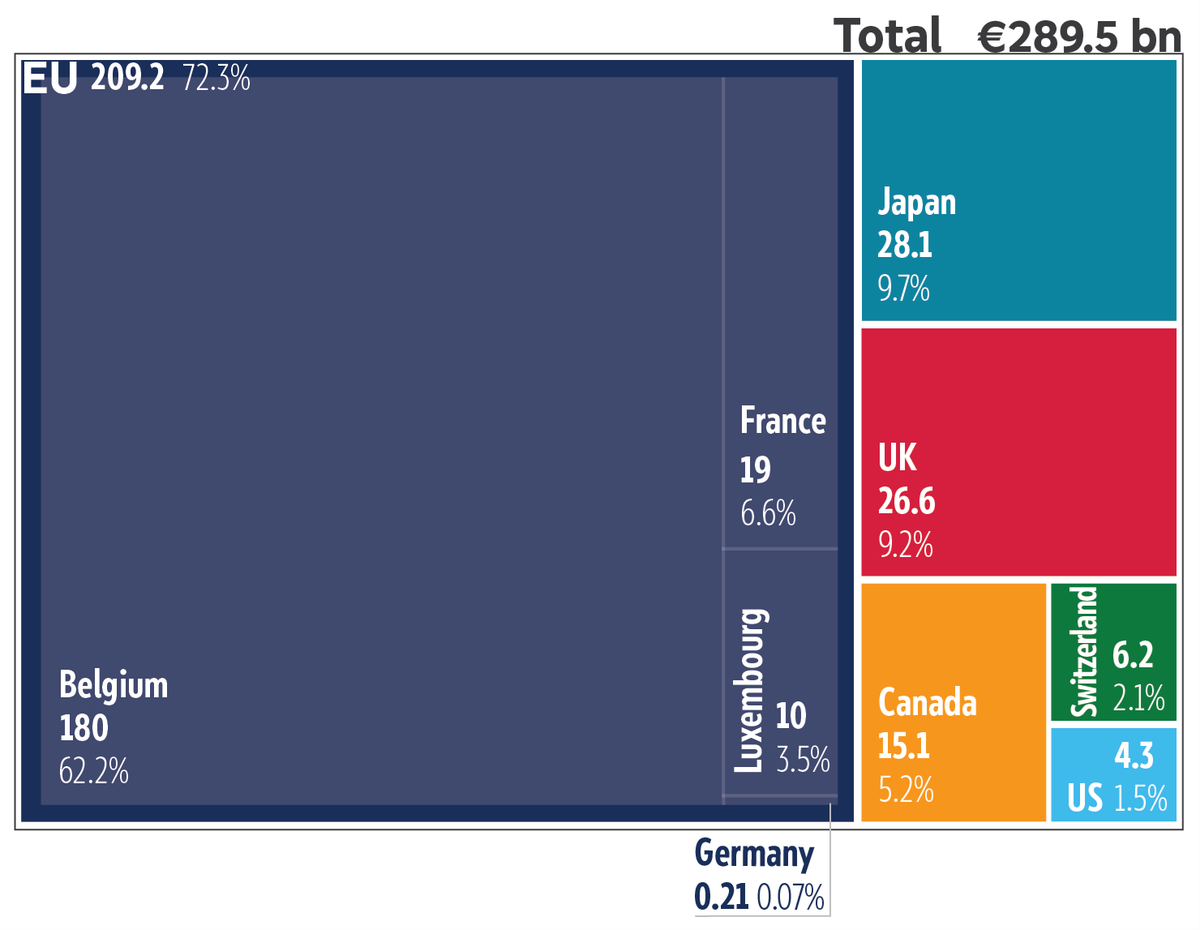
Source: EPRS, data from PISM, Swiss Federal Government. For Luxembourg, where estimations vary from 'several billion euros to around €20 billion', the authors opted for a conservative figure (€10 billion). Calculations are based on the figures provided in the report 'Prospects for the use of frozen assets of the central bank of Russia' (PISM), June 2025, and on publicly available information. Most credible estimations are generally at the lower end of the range of estimations. The figures are compatible with the estimations provided by the earlier report, Resolving Accountability over Russian State Assets: New Understandings of Jurisdiction and Policy Opportunities, NewLines Institute, January 2025. Estimations for Australia, however, were highly incongruent across several sources, and are therefore not included in this graph; Graphics: Nadejda Kresnichka-Nikolchova and Lucille Killmayer, EPRS.
European Commission legislative package
On 3 December 2025, the Commission unveiled a package of legislative proposals underpinning two possible options for the funding of Ukraine in 2026 and 2027 (and beyond):
-
Option 1: A reparations loan, using borrowed cash balances from EU financial institutions holding immobilised Russian Central Bank assets
-
Option 2: Joint EU borrowing, guaranteed by the 'headroom' of the EU budget.
With either option, the Commission would deliver on the EU's continued commitment to supporting Ukraine by providing €90 billion for 2026 and 2027. The legislative package underpinning the above options consists of five legislative proposals, three of which have been already made public, whilst the other two are sanctions-related and would therefore only be published once adopted by the Council. Procedures to adopt each legislative proposal differ.
-
A proposal for a Council regulation to prohibit any transfer of immobilised Russian Central Bank assets (COM(2025) 3501 final), already adopted by the Council on 12 December 2025 by written procedure: Regulation (EU) 2025/2600.
Legal basis: Article 122(1) TFEU. Adoption procedure: Council decision by qualified majority voting. Role of Parliament: transmitted to Parliament for information.
-
A proposal for a regulation to establish a reparations loan to Ukraine (COM(2025) 3502 final).
Legal basis: Article 212 TFEU. Adoption procedure: ordinary legislative procedure, qualified majority voting in Council, simple majority in Parliament. Role of Parliament: co-legislator. Proposal submitted by the Commission to the co-legislators on 3 December.
-
Two proposals that put in place important safeguards for the reparations loan, designed to protect EU Member States and financial institutions from possible retaliation measures. The two joint proposals to amend Council Regulation 833/2014, which will be complemented by a parallel proposal for a Council decision submitted by the High Representative for Foreign Affairs and Security Policy and Vice-President of the European Commission, will be made public once the Council takes a position on them, according to the applicable procedures.1
Legal basis: Article 29 TEU and Article 215 TFEU. Parliament is informed.
-
A proposal for an amendment of the current multiannual financial framework (MFF) to allow for the use of the EU budget's 'headroom' to guarantee a loan to Ukraine (COM(2025) 3500 final), which could serve both of the options put forward.
Legal basis: Article 312 TFEU. Adoption procedure: unanimity in the Council, consent by Parliament.
Procedure and financing ceilings of each option
The two options proposed by the European Commission aim to respond to Ukraine's evolving financing needs in a way which is both flexible and effective, and whether the country is at war or at peace. According to President Ursula von der Leyen, both options will cover two-thirds of Ukraine's financing needs for 2026 and 2027 i.e. €90 billion. Other international partners would cover the remaining €45 billion.
Ukraine recently approved its budget for 2026. Expenditure for defence and security is set at €57 billion. According to the European Commission, that expenditure will be supported by €51.6 billion of in-kind military assistance. The Commission assesses that Ukraine's 2026 budget will require €43 billion of international aid, of which only €22 billion was firmly confirmed by November 2025.
-
Option 1. A reparations loan, using immobilised Russian assets
As per the Commission's proposal, the proposed reparations loan could provide up to €210 billion. The loan would be available until the end of 2030, except for loans necessary to maintain the G7 Extraordinary Revenue Acceleration (ERA) loans initiative, for which resources would be available until the end of 2055. The indicative distribution of the reparations loan is €95 billion for macro-financial assistance, including €45 billion for the repayment of the ERA loans, and €115 billion to support Ukraine's defence industrial capacities. To receive these resources, Ukraine should submit a Ukrainian Financing Strategy (UFS) to the Commission, containing details on 'Ukraine's financing needs and financing sources in principle for the forthcoming 12 months' as well as a duly justified request for funds in principle six times a year. A positive UFS assessment would allow the Council to accept an implementing decision, which will outline the amount of assistance to be made available to Ukraine.
The proposed regulation envisages a reparations loan dialogue under which 'the competent committee of the European Parliament may invite the Commission to discuss the implementation of this regulation'. The Commission will submit to the European Parliament and to the Council an annual implementation report by the end of June each year. Moreover, an evaluation report, assessing the results and efficiency of the reparations loan by the end of 2031, must be provided.
-
Option 2. Joint EU borrowing, backed by the EU budget
Ursula von der Leyen stated that this solution would enable the Commission to borrow €90 billion on the capital markets, using the EU budget as a guarantee for this purpose. The explanatory memorandum specifies that as this is 'a guarantee, no expenditure is expected during the period of the 2021-2027 MFF'. The memorandum clarifies that 'the possibility to mobilise the guarantee over and above the MFF ceilings would offer full coverage of the financial assistance available to Ukraine'. However, the document does not specify any amount. The proposal submitted by the Commission for an amendment to the 2021-2027 MFF adds a second subparagraph to Article 2(3) of the MFF Regulation (EU, Euratom) 2020/2093, defining the ceilings of the MFF.
Reparations loan: Rationale and arrangements
The explanatory memorandum to the Commission's proposal provides the rationale for the reparations loan, and the argumentation why it does not constitute seizure or confiscation of sovereign assets. It refers to the 'legal obligation on Russia to make reparations for the damage that it has caused through its illegal war of aggression',2 concluding that 'it is appropriate for the Union to provide the Reparations Loan to Ukraine as a limited recourse loan that will become due and payable when Ukraine receives from Russia cash or non-monetary assets as war reparations, indemnities or any financial settlement from Russia, other than territory'. Furthermore, it argues that to address Ukraine's massive needs 'it is appropriate to develop an innovative solution that is not expected to place a financial burden on either Ukraine or Member States'.
The proposal recalls that 'the European Council has repeatedly stated that, subject to EU law, Russia's assets should remain immobilised until Russia ceases its war of aggression against Ukraine and compensates it for the damage caused by its war'. The already approved Council Regulation included in this legislative package, aimed at prohibiting any transfer of immobilised Russian Central Bank assets back to Russia, sets this prohibition into EU law until its revocation, and therefore does not depend, as is the case today, on periodic renewal of EU sanctions every six months. The value of Russian Central Bank assets held by financial institutions in the Member States is approximately €210 billion, representing around 70 % of such immobilised assets worldwide.
The Commission's proposal confirms that, under the proposed scheme, Russian Central Bank property rights will not be touched, as Russia will maintain ownership of its asset, i.e. its claim on the financial institutions in the Union where the assets are held. This claim, and the subsequent liability of those financial institutions to repay the Russian Central Bank once sanctions are lifted, will not be touched, and therefore there is no interference in the Russian Central Bank's property rights.
The immobilisation of Central Bank of Russia and other sanctioned Russian state entities' assets and reserves generates an extraordinary and unexpected accumulation of cash balances on the balance sheets of financial institutions, because all payment of principal and interest, coupons, dividends or other income on securities to the Central Bank of Russia is prohibited. These cash balances, the proposal argues, 'are not the property of the Central Bank of Russia and are not protected by sovereign immunity'. In other words: while the Central Bank's right to claim future repayment from the financial institutions, once sanctions are lifted, remains untouched, the transfer and use of these cash balances, as long as the assets remain immobilised, does not interfere with the property rights of the Russian Central Bank, according to the Commission's proposal.
Following this logic, the EU would borrow the extraordinary cash balances accumulated due to the immobilisation of assets from those financial institutions, to fund the reparations loan to Ukraine. This is an exchange of the asset on the respective financial institution's balance sheet from cash to a Union debt instrument, but without impacting the liability of the financial institutions to repay the Russian Central Bank, once sanctions are lifted, and therefore not interfering with the property rights of the Central Bank of Russia. This limited recourse reparations loan to Ukraine would be repaid by Ukraine 'once it receives the reparations due from Russia, which it is legally entitled to'. Therefore, the reparations loan constitutes 'a reversible mechanism, whereby once the conditions for lifting the sanctions as expressed by the European Council and the G7 are met – namely Russia ceases its war of aggression against Ukraine and compensates it for the damage caused by this war – Ukraine will repay the Union, the Union will repay its borrowing from financial institutions, and those financial institutions will repay the Russian Central Bank'.
Reparations loan: Member State guarantees and other security mechanisms
A Member State could suffer damage due to enforcement in a third country of arbitration awards in connection with the immobilisation and use of immobilised Central Bank of Russia assets. The EU should ensure fair sharing and solidarity with that Member State through the conclusion of guarantee agreements with Member States covering the risk of such damages. To that end, the proposal envisages that Member States may provide irrevocable, unconditional and on-demand guarantees to the EU. Those guarantees may be provided by Member States in line with their respective relative share in the total gross national income (GNI) of the EU (see Figure 2). As a second line of defence, the Union should be endowed with a liquidity mechanism, enabling Union borrowing to support repayments if necessary. Finally, as a third layer of defence, the Union should be able to meet its obligations with Union debt securities. This three-tier defence ensures, according to the proposal, that there is no scenario under which the relevant financial institutions will not be repaid, in order to ensure that they are able to honour all contractual commitments related to the assets and reserves of the Central Bank of Russia
Article 25 of the proposed regulation on the reparations loan provides the basis for calculations of voluntary guarantees by Member States. The contribution of each participating Member State to the €210 billion reparation loan shall be based on its relative share of GNI in the total GNI of the Union, as defined in the heading 'General Revenue' of the general EU budget for 2026, Part A, Table 4, column 1.
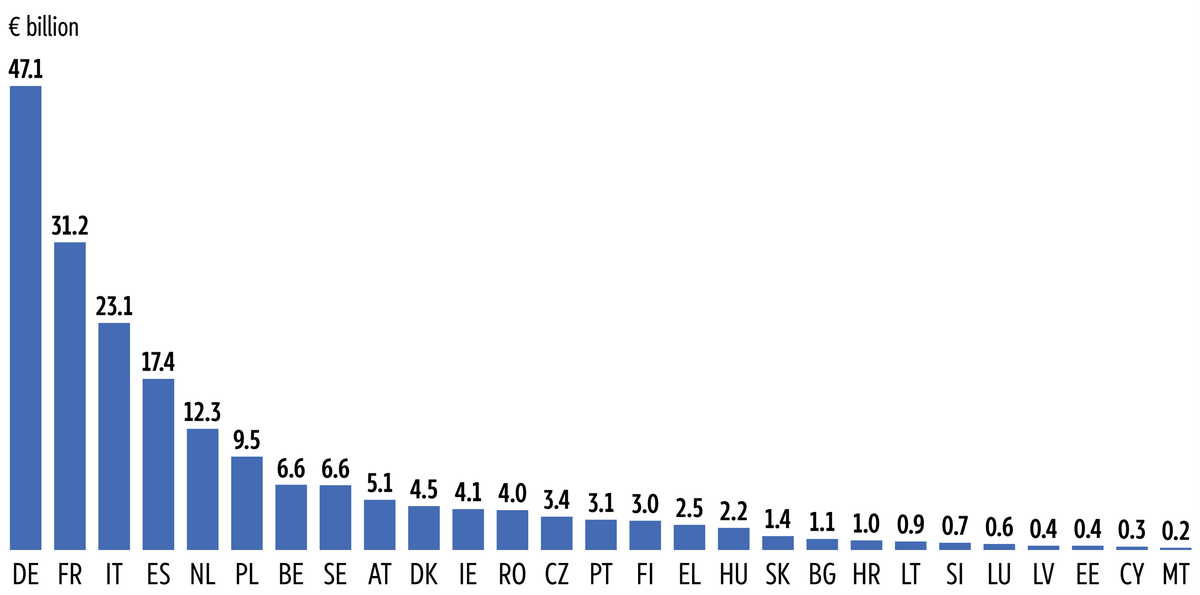
Source: EPRS calculations based on Article 25 of the draft proposal for a regulation establishing a reparations loan to Ukraine, Graphics: Nadejda Kresnichka-Nikolchova and Lucille Killmayer, EPRS.
Any mandatory guarantee would have to be decided under the EU's strict own resources rules. Article 311 TFEU envisages unanimity for its adoption and subsequent ratification in national parliaments. Any adoption of mandatory guarantees outside the EU's own resources would be a circumvention of those own resources rules.
18-19 December 2025 European Council meeting
EU Heads of State or Government will discuss the above proposals at the 18 and 19 December 2025 European Council, amidst great expectation and increasing threats of retaliation coming from the Kremlin. The leaders of Estonia, Finland, Ireland, Latvia, Lithuania, Poland and Sweden signed a letter, addressed to European Council President António Costa and European Commission President von der Leyen, supporting 'the Commission's proposal of a reparations loan funded by the cash balances from the immobilised Russian assets in the EU ... as the most financially feasible and politically realistic solution'. On the other side, Belgium, where most of the assets immobilised in the EU are held, mainly by the Euroclear clearing house, has been intransigent in requiring iron-clad guarantees to protect itself and Euroclear, both from any adverse economic or reputational impact. Belgium sent amendments to the Commission proposal on 9 December, the content of which are not public.
Another issue which may create tension at the European Council meeting is the position of other EU countries, besides Belgium, regarding the management of Russian immobilised assets held under their own jurisdictions. Recently, France, where between approximately €18 and €19 billion are held, has been accused of a lack of transparency in disclosing the financial institutions where these assets are kept.
On 12 December 2025, the Council adopted the Council Regulation prohibiting transfers, based on Article 122 TFEU, allowing for an indefinite immobilisation of Russian sovereign assets. This step paved the way for the approval of the reparations loan as proposed by the Commission in a next step. However, Belgium still opposes the use of immobilised Russian assets and has received support from Italy, Bulgaria, Malta and Czechia. Hungary and Slovakia oppose any further EU support for Ukraine regardless of which instrument is used.
If neither Commission proposal finds enough support in the Council to be adopted, a 'coalition of the willing' could be an alternative solution. This would channel EU support to Ukraine through macro-financial assistance backed up by individual contribution agreements with all participating Member States and possibly other international donors, such as the United Kingdom. Such a coalition could also be organised completely outside the EU in a purely intergovernmental way. This would keep opposing countries out of the discussions but would also prevent the use of existing EU mechanisms for the payment to Ukraine and subsequent control of the funds spent.
European Parliament position
In its resolution of 27 November 2025 on the EU position on the proposed plan and EU engagement towards a just and lasting peace for Ukraine, Parliament calls on the Member States 'to adopt and implement, without further delay, a legally and financially sound "reparation loan" to Ukraine, backed by the frozen Russian assets' and stresses that 'the fate and conditions of investment of these assets are not a matter for negotiation without the EU'. Furthermore, Parliament underlined that 'any peace agreement must oblige Russia to fully compensate Ukraine for all material and immaterial harm and damage it has caused'. Parliament insisted that 'no sanctions will be lifted before a peace agreement is negotiated and implemented'. In earlier resolutions on Ukraine, Parliament had consistently advocated the 'Russia must pay' principle and the use of Russian sovereign assets under 'a sound legal regime'.
The annual report on the EU's common foreign and security policy adopted by Parliament's Committee on Foreign Affairs (AFET) on 2 December, with a plenary vote expected in January 2026, expressed support for ongoing aid to Ukraine. The annual report on the EU's common security and defence policy adopted by the Committee on Security and Defence (SEDE) on 3 December (plenary vote also expected in January 2026), supported the idea of an EU reparations loan. In 2024, the Parliament approved the Ukraine Facility (2023/0200(COD), AFET- Committee on Budgets (BUDG) joint lead), with €50 billion – €17 billion in grants and €33 billion in loans. In 2024, the Ukraine Loan Cooperation Mechanism was adopted (2024/0234(COD), the Committee on International Trade (INTA) took the lead, with AFET and BUDG giving opinions), enabling Ukraine to service and repay loans of up to €45 billion, using windfall profits generated from frozen Russian assets, based on an earlier G7 agreement.
A paper prepared by an external expert on 'EU sanctions and Russia's frozen assets' for AFET was published and presented on 2 December. The author presented the reparations loan as the most viable and legally sound way forward.
Main references
- Confiscation of immobilised Russian sovereign assets: State of play, arguments and scenarios, EPRS Briefing, September 2025.
- Veber, Maruša T., EU sanctions and Russia's frozen assets, External Policies Analysis and Support Unit, Directorate-General for External Policies of the Union, European Parliament, November 2025.
Endnotes
Classification
Policy areas: Foreign Affairs
Regions: European Union, RUSSIA, Non-EU Europe and the North
Disclaimer
This document is prepared for, and addressed to, the Members and staff of the European Parliament as background material to assist them in their parliamentary work. The content of the document is the sole responsibility of its author(s) and any opinions expressed herein should not be taken to represent an official position of the Parliament.
Copyright
© European Union.
The reuse of this document is authorised under a Creative Commons Attribution 4.0 International (CC-BY 4.0) licence.

https://creativecommons.org/licenses/by/4.0/deed.en
To use or reproduce elements that are not owned by the European Union, permission may need to be sought directly from the respective rightsholders.