
Article page checkbox is not checked in page info.
2026 Commission work programme: Forward planning and better regulation in focus
2026 Commission work programme Forward planning and better regulation in focus
Isabelle Ioannides, Hubert Dalli and Irmgard Anglmayer, Ex-Ante Impact Assessment Unit and Ex-Post Evaluation Unit
Summary
On 21 October 2025, the European Commission under Ursula von der Leyen's second mandate adopted its work programme for 2026 (2026 CWP). In line with the Commission President's political guidelines and letter of intent and highlighting the need for full implementation of Mario Draghi's competitiveness report, the 2026 CWP places a strong emphasis on competitiveness, innovation and collective security. In parallel, the Commission commits to advancing simplification, implementation, and this year, also to strengthening enforcement. These three areas will remain key horizontal priorities for the entire Commission mandate. Just like last year's CWP, the 2026 CWP adheres to the seven headline ambitions put forward in the political guidelines. It is accompanied by a report on implementation, simplification and enforcement, the first of its kind. This new annual report is set to replace the annual burden survey.
Annex I of the 2026 CWP puts forward 70 major new legislative and non-legislative initiatives, 44 % of which fall under the competitiveness headline ambition. (Up to) 48 of the new initiatives are legislative, including three sector-specific omnibus packages (on energy product legislation, taxation and citizens). Of the forthcoming legislative initiatives, 67 % are likely revisions of existing legislation, while more than half have a strong simplification dimension.
Unlike previous CWPs, the 2026 CWP does not indicate whether a legislative initiative will be accompanied by an impact assessment; this lack of transparency runs counter to the spirit of the Interinstitutional Agreement on Better Law-Making. Information on the Commission's 'Have your say' portal shows that, at the time of writing, two thirds of the up to 48 legislative initiatives were expected to be accompanied by an impact assessment (though the final number may be higher). The annual evaluation plan presented in Annex II of the CWP, comprising 20 evaluations, does not appear exhaustive. Finally, the communication on Better Regulation, expected in Q2 2026, may entail a revision of the Better Regulation Guidelines, the first since 2021.
Introduction
The European Commission's 2026 work programme (2026 CWP), adopted on 21 October 2025 and entitled Europe's Independence Moment, sets an ambitious tone for the Commission's work in the year ahead. In a political context where Europe is defined as 'in its most precarious state for decades' and the international order as 'rapidly fraying', the 2026 CWP urges Europe to 'step up to secure and shape its own future'. It underlines the urgent need for Europe to take bold and immediate action to address the compounding challenges within the EU and abroad. In this regard, the Commission calls for Europe to 'stand united' and deepen cooperation at all levels, from the EU level down to local communities, in order to enhance the EU's ability to act autonomously and be ready for the future. In the spirit of better interinstitutional cooperation, the Commission reiterates that it 'remains strongly committed to supporting a right of initiative for the Parliament'. Additionally, the Commission notes that its work programme is 'inspired by consultations with the European Parliament and with Member States'.
The 2026 CWP retains its predecessor's focus on the twofold objectives of simplification and implementation in order to strengthen competitiveness, consolidate the full potential of the single market, boost resilience and innovation, and enhance security. The 2026 CWP also adds a key third horizontal objective: enforcement. In that context, it urges to 'speed up the full implementation' of Mario Draghi's report on the future of European competitiveness (September 2024). Beyond boosting economic strength, the 2026 CWP seeks to prioritise affordability and the safeguarding of jobs in the EU, particularly in manufacturing and clean energy. Moreover, the 2026 CWP reaffirms the EU's commitment to upholding fundamental values, strengthening democratic principles and ensuring security and defence. In that sense, it aligns with the 2025 CWP.
The 2026 CWP outlines the Commission's main initiatives, both legislative and non-legislative, that it intends to undertake in the second year of its mandate. More than half of the legislative proposals in 2026 will have a strong simplification component, among them three omnibus proposals on energy product legislation, taxation, and citizens. The Commission also commits to stress-testing EU laws and implementing rules and using new consultation tools, namely the implementation dialogues and reality checks (both announced in February 2025), to find further possibilities for simplification. These will then feed into additional simplification proposals.
The 2026 CWP is accompanied by:
-
five annexes providing greater detail on the Commission's key legislative and non-legislative initiatives for 2026, comprising several simplification initiatives (Annex I), an overview of planned evaluations and fitness checks (Annex II), pending proposals (Annex III), envisaged withdrawals (Annex IV) and planned repeals (Annex V);
-
a 2025 Annual overview report on simplification, implementation and enforcement, covering the period from 1 January to 31 July 2025.
Purpose of the briefing
This briefing analyses the 2026 CWP and its accompanying documents to help parliamentary committees in the planning of forthcoming legislative and non-legislative work. It discusses the Commission's ambitions by examining the 2026 CWP's scope, objectives and their operationalisation against the EU's Better Regulation agenda and, where relevant, past Commission work programmes, especially the 2025 CWP.
Source: Authors' compilation; Graphic by: Giulio Sabbati, EPRS.
The briefing also highlights the Commission's most important policy and legislative initiatives for the year ahead, as laid out in the 2026 CWP. An annex to this briefing examines the up to 48 legislative initiatives contained in the 2026 CWP, specifying whether the proposal is a new initiative or an initiative to revise existing legislation, and whether the initiative targets simplification of EU legislation. The annex also indicates whether an impact assessment is planned and tentatively signals which committee(s) could be in charge (pending the final referrals) for each legislative initiative. It reports on the indicative timing of the initiatives in quarters (Q1, Q2, Q3, Q4), as indicated in the 2026 CWP. Where available, a link to the 'call for evidence' on the Commission's 'Have your say' portal is included, providing further details on the scope and nature of the initiative.
CWP in the policy cycle
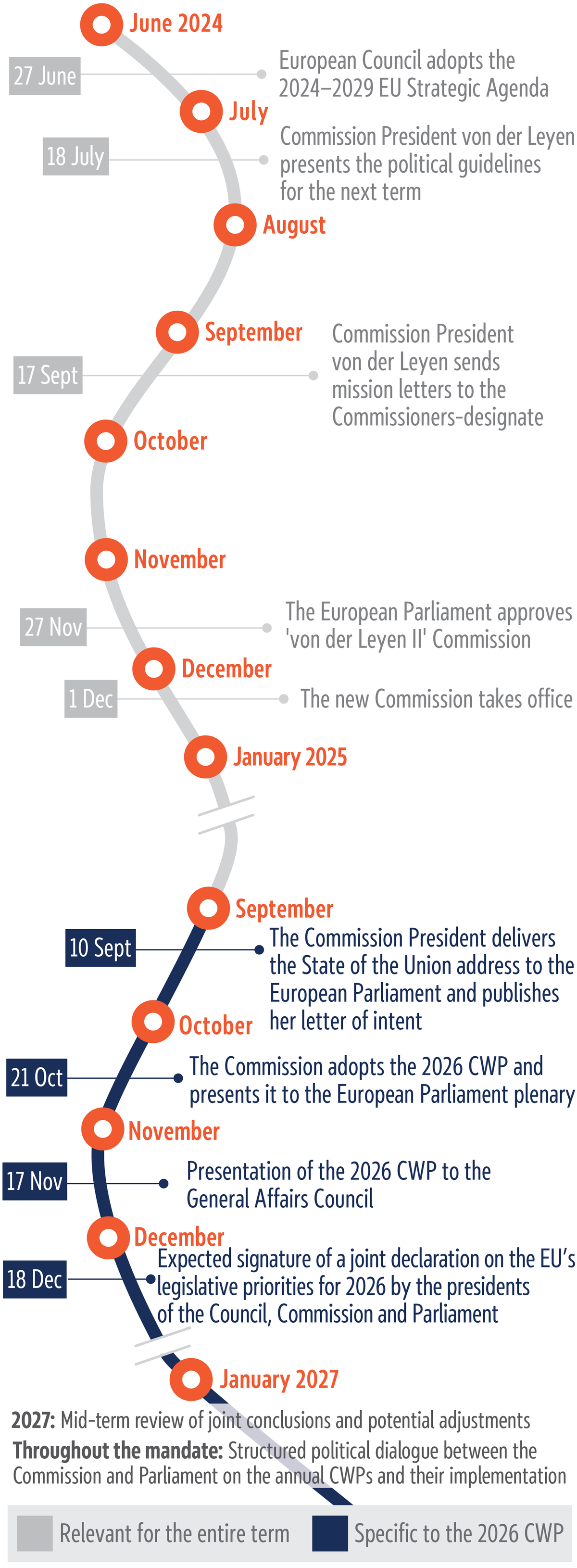
In addition to translating the priorities set out by the European Council in the EU's Strategic Agenda on 27 June 2024, the 2026 CWP is a key vehicle to deliver on commitments outlined in the political guidelines and mission letters President von der Leyen sent to each Commissioner-designate in September 2024. The ideas spelled out in her 2025 State of the Union address and her letter of intent of 10 September 2025 are also reflected in the 2026 CWP. In this letter, the Commission President outlines the initiatives of major political importance for 2026, in advance of the adoption of the Commission's 2026 CWP.
The 2026 CWP was presented to the European Parliament plenary by the Commission President herself on 21 October 2025. Then on 17 November 2025, the Commission presented the CWP to the General Affairs Council. Drawing on the CWP, the Commission and the co-legislators, as laid down in the 2016 Interinstitutional Agreement on Better Law-Making (IIA-BLM), exchanged views on the initiatives for the year ahead with a view to agreeing on a joint declaration on the legislative priorities of all three institutions and expressing their views on the intended withdrawals.1 The planned calendar envisages that the three presidents – of the Commission, Parliament and the Council – will sign the joint declaration in the margins of the European Council meeting on 18 December 2025.
The CWP is not an exhaustive or definitive work plan. In fact, the Commission has previously adopted other key initiatives beyond the CWP. Additionally, some of the CWP initiatives may be modified in scope, postponed, or cancelled.2 Parliament will closely monitor the implementation of the CWP through structured political dialogue, as provided for in the 2010 Framework Agreement on Relations between the European Commission and the European Parliament.3
Horizontal priorities: Simplification, implementation, enforcement
To boost competitiveness and strengthen the single market, simplification and burden reduction remain a 'cross-cutting priority' for 2026. As mentioned earlier, the Commission's simplification agenda builds on the Draghi report, which points to the considerable implementation challenges and impacts that the complexity of the EU acquis poses to the EU's competitiveness. It also draws on Enrico Letta's single market report, which presents a vision for an enhanced single market. President von der Leyen's 2024-2029 political guidelines translated these findings into a commitment to 'less red tape and reporting, more trust, better enforcement, faster permitting'. In their mission letters, Commissioners were tasked with identifying opportunities for burden reduction and simplification in their respective areas (also referred to as 'stress-testing'). Delivering on these commitments, the Commission placed regulatory simplification, better implementation and better enforcement of regulation at the core of the 2026 CWP as horizontal objectives. These objectives are closely linked to the economy, as is also evident from Valdis Dombrovskis' job title as Commissioner for 'economy and productivity, and implementation and simplification'.4
Though ambitious, the Commission's simplification agenda is not entirely new. In its March 2023 communication on Long-term competitiveness in the EU, the Commission first introduced the target of reducing companies' reporting requirements by 25 % 'without undermining the related policy objectives', and of introducing a systematic competitiveness check 5 for impact assessments underpinning legislative proposals. In line with the September 2023 communication on the SME relief package, which stressed the particular relevance of burden reduction for small and medium-sized enterprises (SMEs), President von der Leyen's mission letters set a more ambitious burden reduction target of 35 % for SMEs. In this respect, the 2026 CWP reaffirms the emphasis of the 2024 and 2025 CWPs on cutting red tape. 6
According to the Commission's simplification report, stress-testing does not only apply to the stock of EU legislation but also to delegated and implementing acts. For instance, the Commission has identified dozens of secondary acts as 'non-essential to the effective functioning of basic legislation' in the areas of financial services and environmental law. To better understand the implementation challenges, the Commission has introduced new tools, 'implementation dialogues' and 'reality checks', with the aim to collect feedback from directly concerned stakeholders, which would then inform stress-testing exercises.
While in October 2023 the Commission committed to reporting on the progress achieved towards the burden‑reduction targets in its annual burden surveys, it has not presented a burden survey since 2023.7 It appears that, as of 2025, the annual overview report on simplification, implementation and enforcement accompanying the 2026 CWP is to replace the annual burden survey. Covering the period 1 January to 31 July 2025, this new report presents a synthesis of the individual Commissioners' reporting on the progress made in their respective areas of responsibility. In its resolution of 11 September 2025, Parliament welcomed the Commission's simplification efforts but insisted that 'new simplification proposals should improve regulatory coherence, preserve legal predictability for companies and should not undermine agreed policy objectives'.
A key component of the Commission's simplification agenda are the sector-specific omnibus packages, which aim to significantly reduce red tape and simplify legislation. The omnibus approach – revising a bundle of acts in one go – was developed in response to the European Council's call in November 2024 for a 'simplification revolution'. As a result, between February and November 2025, seven proposed omnibus packages were presented for the co-legislators' consideration and adoption (see Table 1). Five of them are expected to generate well over €8 billion in annual savings in recurring administrative costs, with the defence omnibus expected to generate even greater savings (see Table 1).
While the 15-page simplification report provides total figures for the expected savings resulting from each of the proposed omnibus packages (except for defence and digital), it remains silent on the calculation methods and underlying evidence. Greater depth and transparency would therefore be desirable in future simplification reporting. It is also noteworthy that none of the omnibus packages put forward to date was underpinned by an impact assessment. However, the Commission produced analytical staff working documents (SWDs; see Table 1) for each of them, explaining the envisaged simplification measures, outlining stakeholder feedback and quantifying expected savings. It remains to be seen whether future simplification reports will present the concrete results of the omnibus initiatives once adopted. In addition to this annual reporting exercise, the Commission has committed to continuously reporting on the administrative burden reduction target and key results on a dedicated simplification website.
| No | Topic | Date of proposal | Proposal reference | SWD | Estimated savings | |
|---|---|---|---|---|---|---|
| 1 | Sustainability and
the Carbon Border Adjustment Mechanism* | 26/02/2025 |
COM(2025) 80
COM(2025) 81 COM(2025) 87 |
SWD(2025) 80
SWD(2025) 58 | €4.5 billion
€1.2 billion (Total: €5.7 billion) |
|
| 2 | Investment simplification* | 26/02/2025 | COM(2025) 84 | SWD(2025) 84 | €350 million | |
| 3 | Common agricultural policy* | 14/05/2025 | COM(2025) 236 | SWD(2025) 236 | €1.79 billion | |
| 4 | Small mid-cap companies* | 21/05/2025 |
COM(2025) 258
COM(2025) 501
COM(2025) 502
COM(2025) 503 COM(2025) 504 |
SWD(2025) 501
SWD(2025) 130 | €380 million | |
| 5 | Defence readiness | 17/06/2025 |
COM(2025) 820
COM(2025) 821 COM(2025) 822 COM(2025) 823 | SWD(2025) 820 | Between €42.5 billion and €51.3 billion (depending on the scenario) | |
| 6 | Chemicals | 08/07/2025 | COM(2025) 526 COM(2025) 531 | SWD(2025) 531 | €363 million | |
| 7 | Digital | 19/11/2025 |
COM(2025) 836
COM(2025) 837 | SWD(2025) 836 | €6 billion | |
Source: Authors' compilation based on COM(2025) 871.
While parts of the first omnibus have been adopted,8 the remaining ones are still being negotiated. Three further omnibus packages are forthcoming by the end of 2025, all outside the CWP, and again without an impact assessment (see Table 2). An additional three omnibus initiatives are listed in the 2026 CWP: on energy product legislation (Q2 2026); taxation (Q2 2026); and a citizens omnibus (Q4 2026) addressing the administrative burdens on citizens. According to the Commission, the 'omnibus packages and simplification proposals as well as other initiatives ... will simplify legislation to streamline permit granting, authorisations and reporting requirements'.
| Topic | Expected date of proposal | Scope |
|---|---|---|
| Environmental omnibus | 04/12/2025 | Call for evidence |
| Automotive omnibus | 10/12/2025 | n/a |
| Food and feed safety | Q4 2025 | Call for evidence |
Source: Authors' compilation based on various Commission sources.
The omnibus approach was met with criticism by some academic experts and stakeholders. After civil society organisations filed a complaint, the European Ombudswoman opened an inquiry in May 2025. In November 2025, the Ombudswoman found that there had been several procedural shortcomings in the way the Commission prepared the legislative proposals it considered urgent, namely on corporate sustainability due diligence (Omnibus I), the common agricultural policy (CAP), and countering migrant smuggling. According to the Ombudswoman, this practice amounts to maladministration. Moreover, an expert argued that 'omnibus legislation functions as a procedural bypass', allowing 'the Commission to move fast, but at the cost of transparency, evidence, and participation', and concluding that the approach would 'introduce legal vulnerability and policy uncertainty'. Another expert recommended the Commission recalibrate its omnibus approach to make it more effective.
An analysis of the seven headline ambitions
Similar to the 2025 CWP, the 2026 CWP is structured around the Commission's seven political priorities for 2024-2029 (see Table 3), to explain how these will be implemented in the coming year.
| No. | The Commission's seven political priorities for 2024-2029 |
|---|---|
| 1 | A new plan for Europe's sustainable prosperity and competitiveness |
| 2 | A new era for European defence and security |
| 3 | Supporting people, strengthening our societies and our social model |
| 4 | Sustaining our quality of life: food security, water and nature |
| 5 | Protecting our democracy, upholding our values |
| 6 | A global Europe: leveraging our power and partnerships |
| 7 | Delivering together and preparing our Union for the future |
Priority 1: 'A new plan for Europe's sustainable prosperity and competitiveness'
The Commission highlights Europe's historic ability to reinvent itself in the face of 'industrial and tech revolutions, global competition and changing societies'. It acknowledges, however, that the many 'structural brakes' on the EU's competitiveness require urgent attention, and the need to fully implement the Draghi report.
This heading has by far the most initiatives under it – a clear indication of the importance the Commission attaches to this priority. Under this heading, the 2026 CWP proposes 31 initiatives, 28 of which are legislative ones. Among those, 17 are simplification initiatives or initiatives with a strong simplification dimension (including the omnibus packages on energy products and taxation). This constitutes not only a build-up, but also an intensification of the efforts under the 2025 CWP, which, being the first CWP under a new Commission, was understandably heavier on strategy and planning rather than concrete legislative action. Under this heading, the 2025 CWP had 22 policy initiatives, 11 of which were legislative. Many of the initiatives under this heading were already announced in the Commission's Competitiveness Compass,9 one of the flagship initiatives in the 2025 CWP, intended to lay down 'a new roadmap to restore Europe's dynamism and boost our economic growth'. The 2026 CWP makes no reference to the Competitiveness Compass, despite these clear linkages.
The Commission notes that Europe can no longer rely on the international order in which it had long operated to assure its security and prosperity. Against this backdrop, Europe's prosperity and competitiveness depend on its ability to strengthen its sovereignty and autonomy. Among the initiatives envisaged in this regard are the advanced materials act, the cloud and AI development act, the creation of a Critical Raw Materials Centre, and several initiatives to simplify and upgrade the EU's energy policy and strengthen energy security.
Complementary to the above are the Commission's efforts to unleash the full potential of the single market and place a significant focus on research and innovation, with initiatives such as the European innovation act, the European research area act and the quantum act. Further objectives under this heading include supporting the EU industrial sectors while keeping the EU on track to meet its climate goals, accelerating work on enabling EU lead markets, establishing a sustainable tourism strategy and updating competition rules.
The Commission's plan to revise – and notably simplify – its Better Regulation tools also falls under this heading. In particular, the Commission intends to 'apply a more rigorous and structured application of the proportionality principle in better regulation'. In this regard, the CWP envisages a communication on better regulation for Q2 2026. Drawing on previous experience, it can be assumed that this communication will entail a revision of the Better Regulation Guidelines and Toolbox, the first reform since 2021. In this context, it is worth recalling that in her 2024-2029 political guidelines Commission President von der Leyen proposed 'to renew' the 2016 Interinstitutional Agreement on Better Law-Making (IIA-BLM).
Priority 2: 'A new era for European defence and security'
Under this heading, the Commission proposes nine initiatives, six of which are legislative, two are non-legislative, and one has not been categorised. Moving beyond the 2025 CWP's ambition to urgently strengthen the EU's crisis preparedness and defence readiness, the 2026 CWP highlights the Commission's intention to streamline security across all policy areas. Under this heading, the overarching goal is for 'Europe's defence [to] be developed in Europe'. Discussions about European defence sovereignty gained traction with the new US administration,10 notably following the announcement of winding down US support for Ukraine.
Against this backdrop, the initiatives proposed under this heading in the 2026 CWP build on the EU defence readiness roadmap 2030 and focus on strengthening the EU's defence industry capacity. The newly launched Security Action for Europe (SAFE) instrument aims to raise €150 billion on the capital markets to boost investments in key defence areas. This initiative will be complemented by simplifying defence and sensitive security procurement rules to facilitate cooperation and innovation within the EU's defence industrial base. In the context of the EU's strong commitment to Ukraine and drawing on former Finnish President Sauli Niinistö's report on strengthening Europe's civilian and military preparedness, several key flagship initiatives will be launched: the European drone defence initiative, which is crucial to the Eastern Flank Watch, and the qualitative military edge programme, which aims to ensure the steady flow of military equipment to Ukraine.
As in the 2025 CWP, migration-related initiatives are grouped under the CWP political priority 'A new era for European defence and security' and are central to internal security. The Commission will focus on implementing the Pact on Migration and Asylum, which aims to balance responsibility and fairness in migration burden-sharing among Member States. It also plans to reinforce Frontex, the European Border and Coast Guard Agency, and expand its presence. This will be coupled with proposals for sanctions targeting smugglers and traffickers and the digitalisation of returns to modernise the EU return system. On police cooperation across borders, the Commission will propose strengthening Europol and creating a new European critical communication system. To combat organised crime, measures to better protect children and fight human trafficking are envisaged. Building on the EU's visa strategy, the Commission plans an initiative for attracting and retaining international talent.
Priority 3: 'Supporting people, strengthening our societies and our social model'
Under this heading, the 2026 CWP proposes 15 policy initiatives, at least seven of which are legislative ones. The Commission recalls that one of the cornerstones of the European project is a social market model 'characterised by high standards for working conditions and strong social protection and quality of life', and that competitiveness and security are 'first and foremost about people, their jobs, families and livelihoods'. Against this backdrop, the 2026 CWP chooses to put human resources at the forefront, by proposing a quality jobs act, a fair labour mobility package and an education package, with the objective of empowering and equipping the EU workforce to drive a competitive economy and seize the opportunities that present themselves.
The 2026 CWP also proposes 'a series of measures to address the affordability and cost of living crisis facing Europeans'. These measures range from initiatives to boost affordable and sustainable housing to anti-poverty initiatives.
Priority 4: 'Sustaining our quality of life: food security, water and nature'
Under this heading, the 2026 CWP proposes four policy initiatives, at least two of which are legislative ones. The Commission intends to deliver measures to strengthen the competitiveness of EU farming, fishing, aquaculture and the agri-food chain, and support for rural communities. These measures include a livestock strategy, an update of rules on unfair trading practices in the food chain, and Vision 2040 for fisheries and aquaculture. A proposal for an ocean act aims to strengthen and modernise maritime spatial planning, and to bring relevant ocean-related targets together in one place.11
Priority 5: 'Protecting our democracy, upholding our values'
Under this heading, the Commission envisages proposing eight initiatives, three of which are legislative. It adopts a sombre tone in presenting the challenges to freedom, democracy and fundamental values in the EU. To address them, the Commission plans to ensure that respect for the rule of law is a condition for all funds, for instance, by introducing safeguards into the EU's long-term budget, the multiannual financial framework (MFF). Furthermore, media freedom is a central focus: besides boosting funding for media, the Commission plans to improve support and protection for the media and the independent press and launch a new media resilience programme to support independent journalism and media literacy.
Building on EU efforts for a comprehensive approach to mental health, three forthcoming initiatives pertain to rendering technology and social media safe. The first one focuses on young people, more specifically the relationship between children and social media. The second is a proposal for a digital fairness act to address outstanding unfair and deceptive consumer practices. The third is a proposal for an action plan against cyberbullying targeted specifically at young people.
Equally high on the Commission's agenda are efforts to fight corruption, disinformation and manipulation – topics that are deeply interconnected. Accordingly, the Commission plans to present a new anti-corruption strategy and, in parallel, a comprehensive review of the EU's anti-fraud architecture. Two further CWP initiatives relate to equality: a new gender equality strategy and the updated strategy for the rights of persons with disabilities.
Priority 6: 'A global Europe: leveraging our power and partnerships'
As in 2025, the 2026 CWP centres on the EU's need to 'project stability, fairness and strength, and our commitment to the rules-based order'. In this context, under the heading of 'a global Europe', the CWP proposes only three non-legislative initiatives. It highlights the Commission's intention to translate the new EU–US trade framework into concrete opportunities for businesses through improved access to the US market and existing value chains, while at the same time ensuring that EU jobs and regulatory standards are safeguarded. In parallel, the CWP explicitly points out the need to develop strategic partnerships with other partners through trade deals and a cross-regional connectivity agenda.
In the 2026 CWP, like the 2025 CWP, this heading focuses on Ukraine and the Middle East. It includes an explicit commitment 'to stand firmly with Ukraine, providing steadfast support for its urgent financial and military needs and reconstruction efforts', continuing to sanction Russia and advancing Ukraine's accession process. The plan also highlights the rollout of the Pact for the Mediterranean, announced last year, to build comprehensive partnerships in 'areas of mutual interest', such as economic stability, jobs, clean energy, transport, security and migration. Additionally, the Commission will publish a Middle East strategy, with a focus on Syria, Lebanon, the humanitarian crisis in Gaza and governance reforms for the Palestinian Authority. At a global level, the 2026 CWP sets out two external policy initiatives: the reform of the global humanitarian aid system and the adoption of the global health resilience initiative.
Priority 7: 'Delivering together and preparing our Union for the future'
Under this heading, the Commission does not present any initiatives, but it provides an update on the two initiatives from its 2025 CWP. Firstly, it focuses on the proposal for the 2028-2034 MFF, which was published on 16 July 2025. The MFF is set at €1.8 trillion (commitment appropriations, 2025 prices), which corresponds to 1.26 % of EU GNI. On 3 September 2025, the Commission adopted a second package of sectoral proposals for the post-2027 EU budget, with the largest budget increase observed in Heading 2: Competitiveness, prosperity and security (+140 %).12 The 2026 CWP states: 'Ambitious policies require equally ambitious resources and political will.' In that vein, the Commission urges Parliament and the Council to rapidly agree on the new MFF and to push forward with the legislative priorities that matter most.
Secondly, the Commission is moving forward, as announced in the previous CWP, with its pre-enlargement policy reviews package, which was published on 4 November 2025. However, the communication on how to render EU governance fit for a next enlargement round, which was due to be published on the same day, has been postponed to the end of the year or early 2026.
A Better Regulation perspective on the 2026 CWP's annexes
Overview
The 2026 CWP includes five annexes, as already mentioned. Table 4 provides an overview of the planned number of dossiers and legislative and non-legislative initiatives. Unlike Annex I (new initiatives), Table 4 considers each box indicated as an initiative in Annex I as a dossier, and each individual act as a single initiative. For example, the European product act, for which the Commission plans three legislative revisions, is counted as one dossier encompassing three initiatives.
| Annex | Dossiers | Initiatives/proposals |
|---|---|---|
| Annex I – New initiatives | 61 dossiers |
70 new policy initiatives:
|
|
Annex II – Annual plan on
evaluations and fitness checks | 20 evaluations and fitness checks | 20 evaluations |
| Annex III – Pending proposals | 111 dossiers | 151 initiatives |
| Annex IV – Withdrawals | 25 dossiers | 25 intended withdrawals |
| Annex V – Envisaged repeals | 1 dossier | 1 envisaged repeal of existing legislationv |
i) Initiative on short-term rentals.
ii) European integrated framework for climate resilience; review of the anti-fraud architecture.
iii) qualitative military edge programme.
iv) Unlike previous years, the 2026 CWP does not specify whether an impact assessment will be drawn up for a given proposal. For further details on the specific initiatives, see the annex to this briefing.
v) Outward processing arrangements on textiles and clothing products reimported into the Community after working or processing in certain third countries.
Annex I on 'new initiatives'
The number of initiatives in Annex I suggests an ambitious agenda for 2026: it includes 61 dossiers, comprising a total of 70 flagship policy initiatives (as some dossiers include more than one initiative), grouped according to the Commission's seven headline priorities. In comparison, the 2025 CWP included 45 dossiers and 2024 – an election year – included 15 dossiers.
Out of the 70 initiatives in the 2026 CWP, the majority (48 at most) are legislative, while 22 are non-legislative (primarily strategies, roadmaps, action plans and communications). The up to 48 legislative initiatives break down as follows: a total of 44 are set to be legislative initiatives; one is not specified as a legislative or non-legislative initiative; two are categorised as both non-legislative and legislative; and one is not categorised at all. The number of legislative initiatives has therefore substantially increased from the 2025 CWP, which included only 18 legislative initiatives.
Unlike previous years, the 2026 CWP does not give any information on whether the initiatives presented in its Annex I will be accompanied by an impact assessment. The information available on the Commission's 'Have your say' portal at the time of writing indicated that at least 32 of the up to 48 legislative initiatives will be supported by an impact assessment. It should be noted that the Commission is still in the process of launching 'calls for evidence'13 for CWP initiatives, which is the most reliable source of information regarding the intention to prepare impact assessments. For legislative initiatives for which no call for evidence has been launched yet, it is not possible to determine whether an impact assessment can be expected. The Commission's lack of transparency in this regard goes against the 2016 IIA-BLM (point 8) and hinders Parliament's advance planning, especially for Q3 2026, in which the bulk of the new initiatives fall. In that sense, it impedes Parliament's oversight capacity.
In principle, all legislative CWP initiatives should be underpinned by an impact assessment, in line with point 13 of the IIA-BLM, which states that 'initiatives included in the Commission work programme or in the joint declaration will, as a general rule, be accompanied by an impact assessment'. In recent years, however, some major legislative initiatives have been presented without an impact assessment or have instead been supported by an analytical SWD. This is the case for the omnibus packages put forward to date, as stated earlier. This practice of publishing an SWD in place of an impact assessment is first mentioned in the 2021 Better Regulation reform, which notes that it may be applied in 'cases where the Commission was unable to produce an impact assessment where one should have been prepared'. The objective of these SWDs is to present 'the evidence behind the proposal and cost estimates'. The Commission has increasingly reverted to this practice, typically arguing that urgency to act does not allow for a fully-fledged impact assessment.14
Most of the legislative initiatives (32 out of at most 48) appear to be revisions to existing legislation. Moreover, 25 of these legislative initiatives are set to be geared towards simplification. This confirms the von der Leyen Commission II mandate's continued focus on streamlining policies and achieving net cost savings. However, there are several issues with the way these initiatives are presented in Annex I. The title of Annex I – 'new initiatives' – is in itself confusing. This confusion is compounded by the fact that not all revisions are specifically labelled as such. Some are easily recognisable (e.g. strengthening energy security), but others such as the chips act and the construction services act appear as new initiatives and could be confused as new legislation while actually being revisions to existing legislation. The Commission has marked the 'simplification initiatives or initiatives with a strong simplification dimension' with a light blue colour code in CWP Annex I. In some cases, it is difficult to ascertain whether a simplification initiative is a new initiative or a revision of existing legislation.
In terms of implementing the Commission's political priorities, 25 dossiers alone (translating into 31 initiatives) fall under the 2026 CWP's first heading entitled 'A new plan for Europe's sustainable prosperity and competitiveness'. This represents an increase of 25 % in dossiers and more than 40 % in initiatives compared with the 2025 CWP. Furthermore, it underscores the von der Leyen II Commission's continued strong focus on competitiveness. Additionally, more emphasis will be put on priority headings 3 and 5:
-
'Supporting people, strengthening our societies and our social model' (12 dossiers/15 initiatives) as compared to the 2025 CWP (4 dossiers/4 initiatives);
-
'Protecting our democracy, upholding our values' (8 dossiers/8 initiatives), as compared to last year's work programme (3 dossiers/5 initiatives).
The dossiers linked to the priority headings 2, 4 and 6 have remained rather stable in number of dossiers and initiatives:
-
'A new era for European defence and security' (9 dossiers/9 initiatives) as compared to last year's work programme (8 dossiers, 11 initiatives);
-
'Sustaining our quality of life: food security, water and nature' (4 dossiers/4 initiatives), as in the 2025 CWP;
-
'A global Europe: leveraging our power and partnerships '(3 dossiers/3 initiatives), as in the 2025 CWP;
On 'Delivering together and preparing our Union for the future' (priority heading 7), Annex I of the 2026 CWP does not include any files, while the 2025 CWP outlined 2 dossiers/2 initiatives.
In terms of the timing of the Commission's 'new initiatives', Annex I indicates the quarter (Q) in which the Commission expects to adopt them. The majority of the (up to) 48 legislative initiatives, namely 23, should be put forward in Q3 2026. Six legislative initiatives are expected in Q1, 8 in Q2 and 11 in Q4. Nevertheless, the information on timing is purely indicative and may change - in increasingly volatile times, this aspect is plausible. Thus, the timing signalled in the 2026 CWP should be cross-checked against other Commission documents, such as the provisional agendas of forthcoming Commission meetings and the 'calls for evidence' and other file-specific information on the 'Have your say' portal.
Annex II on evaluations and fitness checks
Annex II of the 2026 CWP carries the same title as in the 2025 CWP – 'Annual plan on evaluations and fitness checks' – but does not include any fitness checks this year. It lists 20 evaluations: 19 policy evaluations and the mid-term evaluation of the Ukraine Facility. The 2026 CWP retains the same minimalist structure as the 2025 CWP and confirms the trend of a departure from the more detailed and descriptive format of previous editions.
The 2026 CWP continues with the Commission's drive to stress test the EU acquis in order to identify potential for simplification and cost-reduction, as envisaged in the Commission President's 2024-2029 political guidelines and her mission letter to Commissioner Dombrovskis. The preparation of an annual evaluation plan, to be presented alongside the CWP, is a crucial component of this stress-testing exercise.
Annex II also fulfils the Commission's obligation under Article 8 of the IIA-BLM to include information regarding evaluation work in its work programme. The fact that the Commission's 'Have your say' portal includes several evaluations that are due to be adopted in 2026 but are not listed in Annex II of the 2026 CWP indicates that the 'annual plan on evaluations and fitness checks' presented in Annex II is not exhaustive. It appears, from a cross-check of the evaluations listed in Annex II with the respective calls for evidence on the Commission's 'Have your Say' portal, that at least seven of these evaluations will be conducted alongside impact assessments in a single process ('back-to-back' in Commission jargon). In its resolution of 7 July 2022 on better regulation, Parliament expressed serious concern 'about the increasing trend of evaluations and impact assessments being carried out in parallel, although evaluation results should feed into any revision of legislation'.15
Other annexes
Annex III on pending proposals includes 111 dossiers, comprising a total of 151 proposals put forward in previous years. By comparison, the 2025 CWP had 131 pending proposals under 123 dossiers. As in the 2025 CWP, the bulk of initiatives and dossiers (67 initiatives under 58 dossiers) fall under the political priority 'A new plan for Europe's sustainable prosperity and competitiveness'.
Annex IV presents a list of 25 pending legislative proposals that the Commission intends to withdraw within six months of the CWP's adoption. There are intended withdrawals under six of the seven priority headings (no withdrawals are envisaged under the heading 'A new era for European defence and security'). The Commission justifies the intended withdrawals on the grounds that the adoption of these proposals 'would no longer be in the general interest in view of their adoption date, lack of progress in the legislative process, potential burden and non-alignment with the Union's priorities'. This is a generic justification covering all intended withdrawals, unlike in previous CWPs, which gave an individual reason for each. The list of intended withdrawals includes, for instance, the proposed directive on European cross-border associations and several proposals regarding the system of own resources of the EU.
Pursuant to point 9 of the 2016 IIA-BLM, intended withdrawals are subject to interinstitutional consultations. Just like the 2025 CWP, the 2026 edition also features a relatively high number of intended withdrawals: 37 in 2025 and 25 in 2026. By comparison, the 2024 CWP had six intended withdrawals and the 2023 CWP had only one.
Annex V mentions just one legal act that the Commission envisages to repeal, together with its reasons for the repeal. To recall, in Parliament's view, 'a thorough impact assessment must equally be conducted for any potential repeal'. The Commission does not seem to share this view, arguing that repeals announced in the CWP do not require an impact assessment 'as the Commission has already taken a decision informed by the available evidence (for instance, the results of an evaluation)'.16
EPRS analytical support for committees
When considering upcoming legislative proposals, Parliamentary committees (along with their respective secretariats) can refer to relevant EPRS publications on the European Parliament's Think Tank website. In addition to the 'EU legislation in progress' briefings and the newly created 'pre-initiative' briefings,17 EPRS produces two types of publications that are specifically linked to Parliament's legislative and policy scrutiny of CWP initiatives: 1) initial appraisals of Commission impact assessments (see examples); and 2) implementation appraisals of existing legislation that will be revised (see examples).
Impact assessment work in the European Parliament: An ex-ante perspective
The Ex-Ante Impact Assessment Unit (IMPA) in EPRS routinely prepares initial appraisals of Commission impact assessments. These briefings provide a concise critical analysis of the quality of the Commission's impact assessments accompanying its legislative proposals, as set out in the Better Regulation Guidelines and Toolbox. Initial appraisals are transmitted to the committee(s) responsible and committee(s) for opinion to support them with focused and timely input and therefore ensure that the consideration of the proposals is informed and effective. In that sense, initial appraisals support Parliament's commitment to fully considering Commission impact assessments when examining legislative proposals, in line with the 2016 IIA-BLM. By extension, they also promote evidence-based policymaking.
In line with Parliament's impact assessment handbook, IMPA provides three additional tools to support committees to 'reach well informed decisions and achieve the goal of high-quality, clear, simple and effective legislation'. These tools can be triggered at the responsible committee's request and encompass: 1) detailed appraisals of the quality and independence of Commission impact assessments; 2) complementary or substitute impact assessments of aspects not dealt with or, in the responsible committee's review, inadequately dealt with in the Commission's impact assessment; and 3) impact assessments of substantial parliamentary amendments.
IMPA has also reviewed the overall quality of the Commission's impact assessments over the past legislative term and has published initial appraisals of them. A first synthesis study, published in 2019, covered 132 Commission impact assessments, adopted between July 2015 and December 2018. In February 2025, EPRS published a second synthesis review of the quality of 143 Commission impact assessments, adopted between December 2019 and November 2024.
Evaluation work in the European Parliament: An ex-post perspective
The Ex-Post Evaluation Unit (EVAL) in EPRS contributes to Parliament's evidence-based policymaking and oversight through its landmark publication, the 'European implementation assessments'. These impartial and factual evaluations of the application of EU legislation or policy are prepared to accompany and inform Parliament's implementation reports, in line with the evaluation criteria outlined in the Better Regulation Guidelines and Toolbox. Committees can also ask EVAL to provide other ex-post evaluation studies outside the context of implementation reports, for instance, in the context of trade negotiations, mainstreaming of EU policies, or to support the work of special committees and committees of inquiry.18
In addition, EVAL routinely prepares proactive briefings on the operation of existing EU legislation when that legislation is due to be revised (referred to as 'implementation appraisals'). To support parliamentary committees in their consideration of such legislative revisions, implementation appraisals provide an overview of the application of the relevant legislation that is to be revised, drawing from publicly available sources. More specifically, implementation appraisals analyse succinctly the evaluations and positions of EU institutions and bodies, as well as key external organisations and stakeholders (e.g., national parliaments, civil society, experts/academia) involved in the application of the given legislation.
Implementation appraisals focus only on those initiatives within the CWP that substantially revise existing legislation. EVAL aims to publish these appraisals, whenever possible, before the amending legislative proposal reaches Parliament, or, at the latest, before the responsible parliamentary committee starts to consider a legislative proposal.
Conclusions
With its key 70 policy initiatives, including (up to) 48 legislative and 22 non-legislative measures, the 2026 CWP has put forward an ambitious agenda. The von der Leyen II Commission's continued strong focus on competitiveness is evident in the fact that nearly half of the policy initiatives (31) fall under the category of sustainable prosperity and competitiveness.
Similar to the two previous CWPs, the 2026 CWP also reaffirms and scales up the Commission's simplification agenda. Out of the (up to) 48 legislative initiatives, over half (25) are simplification initiatives aimed at reducing administrative burdens that result from existing EU legislation and simplifying the legislative framework. The general burden-reduction target of 25 % (which includes all administrative costs, not just reporting costs) and the more ambitious target of 35 % for SMEs as put forward in the Commission's simplification communication of February 2025, are maintained. The 2026 CWP continues to utilise sector-specific omnibus packages of proposals – a core vehicle of the Commission's simplification agenda – to revise a bundle of legislative acts in a single procedure, aimed at achieving substantial cuts in red tape and legislative simplification.
Transparency, however, falls short in the 2026 CWC. Firstly, it is not clear how many of the (up to) 48 legislative initiatives will be accompanied by an impact assessment, as this information is not included in the 2026 CWP. As the calls for evidence on the Commission's 'Have your Say' portal come out on a rolling basis, it appears that at the time of writing, at least 32 proposals will undergo an impact assessment. Since no omnibus package released to date has been accompanied by an impact assessment, presumably one should not be expected for the three omnibus packages included in the 2026 CWP. Secondly, it is not always clear which 'new initiatives' (the title of the 2026 CWP's Annex I), are actually new acts and which are revisions of existing legislation. This situation also concerns 'new initiatives' that the Commission lists as part of its simplification agenda.
A communication on Better Regulation is envisaged for Q2 2026 under the competitiveness heading of the 2026 CWP. While the CWP only indicates that it will target the application of the proportionality principle, it can be assumed that this communication will entail a revision of the Better Regulation Guidelines and Toolbox. This revision could go hand in hand with the planned revision of the 2016 Interinstitutional Agreement on Better Law-Making (IIA-BLM), announced in the Commission's political guidelines.
Finally, the inclusion of an annual plan of evaluations and fitness checks in Annex II of the CWP follows the model of the 2025 CWP. While it outlines 20 evaluations, the 2026 annual evaluation plan is non-exhaustive.
Endnotes
Annex – Tentative distribution of legislative files in the 2026 CWP between parliamentary committees
Indication of the responsible committee(s)
The annex to this briefing presents an overview of the (up to) 48 legislative initiatives included in Annex I of the 2026 CWP, with a provisional assignment to parliamentary committees. The selection was made by consulting information published on the European Parliament's Legislative Observatory portal. Since the referral to the responsible committees was uncertain at the time of writing, the committees identified in the table overleaf serve only as an indicative guide. It should be noted that, once the European Commission adopts a proposal and it is referred to Parliament, the decision on which committee is competent will be taken according to the official referral procedure, in line with Parliament's Rules of Procedure (RoP). Thus, the final decision may differ from our tentative assumption. Moreover, information on the scope of the presented initiatives was insufficient at the time of writing to allow for a more certain allocation of files per committee. It is also worth noting that some proposals could fall under the remit of several committees.
The table below sometimes lists multiple committees for a single initiative. This could mean one of three possible scenarios: 1) a possible joint procedure between the committees mentioned, as outlined in Rule 58 of Parliament's RoP; 2) an indication that, based on the information in the 2026 CWP and its annexes, it was unclear which of the committees indicated in the column would take the lead on the file; or 3) that the legislative initiative is expected to contain more than one proposal for a given legislative act.
Indication of the type of initiative (new, revision or simplification)
The annex to this briefing includes new legislative initiatives, revisions of existing legislation and simplification initiatives. The fourth column of the annex seeks to differentiate between new initiatives and revisions, based on the authors' analysis using the call of evidence on the Commission's 'Have your say' portal (when available). Simplification initiatives are indicated with an asterisk.
Indication of the preparation of an ex-ante impact assessment
As explained in the briefing, unlike the work programmes from previous years, the 2026 CWP does not indicate whether an impact assessment will accompany the new initiative listed its Annex I. The information further down regarding forthcoming or launched impact assessments was collected from the Commission's 'Have your say' portal. When no information was available on the 'Have your say' portal at the time of writing, the indication 'tbc' was used.
| No | Committee (pending referral) | Expected legislative initiative, listed in the same order as in Annex I (New initiatives) of the 2026 CWP | Expected presentation (quarter), as indicated in the 2026 CWP, and call for evidence | Assumed type of initiative (new initiative or revision of existing legislation) | Ex-ante impact assessment expected |
|---|---|---|---|---|---|
| A new plan for Europe's sustainable prosperity and competitiveness | |||||
| 1. | JURI | 28th regime for innovative companies* | Q1
Call for evidence | New initiative | Yes |
| 2. | ITRE | European innovation act* | Q1
Call for evidence | New initiative | Yes |
| 3. | IMCO | Public procurement act* | Q2
Call for evidence | Revision | Yes |
| 4. | ITRE | Advanced materials act* | Q4
Call for evidence | New initiative | Yes |
| 5. | ITRE/IMCO | Cloud and AI development act | Q1
Call for evidence | New initiative | Yes |
| 6. | ITRE | Chips act | Q1
Call for evidence | Revision | Yes
(in parallel with the evaluation) |
| 7. | ITRE | Critical raw materials centre | Q2
Call for evidence | New initiative | tbc |
| 8. | ITRE | European research area act | Q3
Call for evidence | New initiative | Yes |
| 9. | ITRE/SANT | European biotech act II* | Q3
Call for evidence | New initiative | Yes |
| 10. | ITRE | Quantum act | Q2
Call for evidence | New initiative | Yes |
| 11. | ENVI | Circular economy act* | Q3
Call for evidence | Revision | Yes |
| 12. | IMCO | Update of the new legislative framework of product rules (European product act)* | Q3
Call for evidence | Revision | Yes |
| 13. | IMCO | Update of rules on the market surveillance and compliance of products (European product act)* | Q3
Call for evidence | Revision | Yes
(in parallel with the evaluation) |
| 14. | IMCO | Update of the rules on standardisation (European product act)* | Q3
Call for evidence | Revision | Yes |
| 15. | TRAN | EU delivery act – update of the rules on postal services* | Q3
Call for evidence | Revision | Yes |
| 16. | ITRE | Strengthening energy security | Q1
Call for evidence | Revision | Yes |
| 17. | ITRE/ENVI | Update of the governance of the energy union and climate action including the phase-out of fossil fuels subsidies* | Q4 | Revision | tbc |
| 18. | ITRE/ECON | Development of the CO2 transportation infrastructure and markets (energy union package for the decade ahead) | Q3
Call for evidence | New initiative | Yes |
| 19. | ITRE | Setting up of the energy efficiency framework (energy union package for the decade ahead)* | Q3 | Revision | tbc |
| 20. | ITRE | Setting up of the renewable energy framework (energy union package for the decade ahead)* | Q3 | Revision | tbc |
| 21. | ENVI/IMCO/ITRE | Omnibus to simplify energy product legislation* | Q2 | Revision | tbc |
| 22. | ENVI | Revision of national targets and flexibilities in the EU climate policy framework (climate package for the decade ahead) | Q4 | Revision | tbc |
| 23. | ENVI/ECON/TRAN | Update of the EU emissions trading system for maritime, aviation and stationary installations, and the relevant market stability reserve (climate package for the decade ahead) | Q3
Call for evidence | Revision | Yes
(in parallel with the evaluation) |
| 24. | ENVI | European integrated framework for climate resilience | Q4
Call for evidence | New initiative | Yes |
| 25. | ECON/FISC | Omnibus on taxation* | Q2 | Revision | tbc |
| 26. | JURI/ECON | Update of the rules on shareholder rights* | Q4
Call for evidence | Revision | Yes
(in parallel with the evaluation) |
| 27. | ECON | Update of the Regulation on European venture capital funds | Q3 | Revision | tbc |
| 28. | ECON | Update of the rules on antitrust procedures* | Q3
Call for evidence | Revision | Yes |
| A new era for European defence and security | |||||
| 29. | SEDE/IMCO | Simplifying defence and sensitive security procurement* | Q3
Call for evidence | Revision | Yes |
| 30. | SEDE/ITRE | Qualitative military edge programme | Q1 | New initiative | tbc |
| 31. | LIBE | Strengthening Frontex | Q3
Call for evidence | Revision | Yes |
| 32. | LIBE | Digitalisation of the return process* | Q3
Call for evidence | New initiative | Yes |
| 33. | LIBE | Modernised rules to combat organised crime | Q3
Call for evidence | Revision | Yes
(in parallel with the evaluation) |
| 34. | LIBE | Strengthening Europol | Q2
Call for evidence | Revision | Yes
(in parallel with the evaluation) |
| 35. | ITRE/LIBE | Creation of a European critical communication system | Q3
Call for evidence | New initiative | Yes |
| Supporting people, strengthening our societies and our social model | |||||
| 36. | IMCO | Initiative on short term rentals | Q2 | New initiative | tbc |
| 37. | IMCO | Construction services act* | Q4
Call for evidence | Revision | Yes |
| 38. | EMPL | Quality jobs act | Q4 | New initiative | tbc |
| 39. | EMPL | Proposal for a European social security pass (fair labour mobility package)* | Q3
Call for evidence | Revision | tbc |
| 40. | EMPL | Strengthen the European Labour Authority (fair labour mobility package)* | Q3
Call for evidence | Revision | tbc |
| 41. | EMPL | Skills portability initiative (fair labour mobility package)* | Q3
Call for evidence | Revision | tbc |
| 42. | CULT/LIBE | Citizens omnibus* | Q4 | Revision | tbc |
| Sustaining our quality of life: food security, water and nature | |||||
| 43. | AGRI | Update of the rules on unfair trading practices in the food chain | Q3
Call for evidence | Revision | Yes |
| 44. | PECH/
TRAN | Ocean act | Q4 | Revision | tbc |
| Protecting our democracy, upholding our values | |||||
| 45. | IMCO | Digital fairness act | Q4
Call for evidence | New initiative | Yes |
| 46. | LIBE | Strengthening Eurojust | Q2
Call for evidence | Revision | Yes |
| 47. | CULT | Update of the rules on audiovisual media services* | Q3
Call for evidence | Revision | Yes (in parallel with the evaluation) |
| 48. | CONT | Review of the anti-fraud architecture | Q4
Call for evidence | Revision | Yes |
Classification
Policy areas: Public International Law | Competition Law and Regulation | Taxation | European Semester | Evaluation of Law and Policy in Practice | Transposition and Implementation of Law | Ex-ante Impact Assessment | European Added Value | Forward Planning | Security and Defence | International Trade | Human Rights | Global Governance | Foreign Affairs | Development and Humanitarian Aid | Democracy | Private International Law and Judicial Cooperation in Civil Matters | Petitions to the European Parliament | Intellectual Property Law | EU Law: Legal System and Acts | EU Democracy, Institutional and Parliamentary Law | Gender Issues, Equality and Diversity | Contract Law, Commercial Law and Company Law | Area of Freedom, Security and Justice
Committees: Housing Crisis in the EU (HOUS), European Democracy Shield (EUDS), Tax Matters (FISC), Public Health (SANT), Security and Defence (SEDE), Human Rights (DROI), Petitions (PETI), Women's Rights and Gender Equality (FEMM), Constitutional Affairs (AFCO), Civil Liberties, Justice and Home Affairs (LIBE), Legal Affairs (JURI), Culture and Education (CULT), Fisheries (PECH), Agriculture and Rural Development (AGRI), Regional Development (REGI), Transport and Tourism (TRAN), Internal Market and Consumer Protection (IMCO), Industry, Research and Energy (ITRE), Environment, Climate and Food Safety (ENVI), Employment and Social Affairs (EMPL), Economic and Monetary Affairs (ECON), Budgetary Control (CONT), Budgets (BUDG), International Trade (INTA), Development (DEVE)
Disclaimer
This document is prepared for, and addressed to, the Members and staff of the European Parliament as background material to assist them in their parliamentary work. The content of the document is the sole responsibility of its author(s) and any opinions expressed herein should not be taken to represent an official position of the Parliament.
Copyright
© European Union.
The reuse of this document is authorised under a Creative Commons Attribution 4.0 International (CC-BY 4.0) licence.

https://creativecommons.org/licenses/by/4.0/deed.en
To use or reproduce elements that are not owned by the European Union, permission may need to be sought directly from the respective rightsholders.