
Article page checkbox is not checked in page info.
Military drone systems in the EU and global context: Types, capabilities and regulatory frameworks
Military drone systems in the EU and global context: Types, capabilities and regulatory frameworks
Sebastian Clapp, Members' Research Service
Summary
Military drones have become a defining feature of modern warfare, as seen in Ukraine where they have caused more casualties than any other weapon. Their widespread use spans reconnaissance, strikes, logistics and naval operations, with both state and non-state players increasingly relying on unmanned systems.
The European Union (EU) has prioritised drone development and countermeasures, funding and coordinating research and capability development through the European Defence Fund and Permanent Structured Cooperation. EU leaders have committed to strengthening the defence industry and made major investments in drone production, innovation, and interoperability. The EU is also fostering synergies between the civilian and the defence sectors, addressing strategic dependencies and collaborating with NATO. Furthermore, the European Defence Agency is advancing unmanned aerial system technology through joint projects and its innovation hub.
Meanwhile, drone regulation remains fragmented: civilian drones are subject to comprehensive EU rules, while military drone use falls under international law. Legal concerns persist, especially regarding proportionality, accountability and lethal autonomous weapons (LAWS). The European Parliament has called for transparency, adherence to international law and a ban on LAWS, while supporting defence innovation and proposing an EU drone package to stimulate joint procurement and industry participation, particularly from Ukraine. EU lawmakers continue to stress the need for ethical guardrails, robust export controls and a coherent regulatory framework that balances innovation with international legal obligations. The Parliament also emphasises the importance of meaningful human control over all lethal decisions and insists that military artificial intelligence include strong accountability mechanisms.
Introduction
Drones have become a dominant force in Russia's war against Ukraine, with their numbers reaching unprecedented levels. In May 2024, Ukraine's military leadership indicated that drones were the leading cause of casualties on both sides, stating that 'drones kill more soldiers than any other weapon'. At the start of 2024, Ukraine aimed to produce 1 million drones, later raising the target to 4 million annually; Russia is reportedly keeping pace. Over 100 drone variants are in use, ranging from small hobbyist models to large, nearly 20-metre-wide unmanned aircraft. These drones serve multiple purposes, including reconnaissance, targeted strikes and guidance for other weapons systems. They are also used as decoys, communication relays and transport tools. Both nations manufacture their own drones, adapt civilian models, or source them from allies.
The war's conditions have made drones essential, particularly as manned aircraft face strong air defences. Amidst Ukraine's ammunition shortages, drones have played a crucial role in sustaining its defence. Beyond aerial systems, Ukraine has deployed naval drones to target Russia's Black Sea fleet, successfully sinking several vessels. The country is working towards developing a dedicated fleet of these unmanned warships. Ground-based drones, while less advanced, are also being used for transport, reconnaissance and limited attacks.
However, drones are not only prevalent in the war in Ukraine; they are now a common feature in conflicts worldwide, playing a significant role in the wars in Gaza, Israel and Lebanon, in the civil wars in Yemen, Sudan, Syria and Myanmar, and in the attacks on international vessels in the Red Sea. Their use is also expanding among non-state groups in the Middle East and Africa. Some view this trend as a ground-breaking transformation in warfare, while others consider it a natural progression of military technology.
History of drones and their strategic impact
The history of unmanned flight dates back approximately 180 years, when Austria used explosive-filled balloons in an attack on Venice. In the early 20th century, the Wright Brothers – pioneers of manned aviation – also conducted unmanned flight experiments. By World War I, military strategists were already considering how to incorporate unmanned aircraft into warfare, and drone technology continued advancing through World War II. Nikola Tesla played a key role in the development of unmanned systems with his invention of a radio-controlled boat, which later influenced drone technology. By 1998, the first drone had successfully completed a transatlantic flight, covering the distance in nearly 27 hours using just 5.6 kg of fuel.
Since the early 2000s, the United States (US) has conducted thousands of long-range drone strikes against high-value targets worldwide as part of its Global War on Terror. The conflict in Ukraine differs because of its extensive and diverse deployment of drones, which are constantly present over the frontlines, complicating troop and vehicle movements. In addition to frontline surveillance and attacks, drones are also being used for long-range strikes deep behind enemy lines, targeting airbases, naval shipyards and civilian infrastructure such as energy facilities and residential areas.
While drones have undeniably altered the tactical dynamics of warfare, their broader strategic impact remains uncertain. Despite decades of US drone strikes in the Middle East and Afghanistan, militant threats persist. Similarly, the large-scale use of drones in Ukraine by both sides has not significantly altered the frontlines, raising questions about their long-term effectiveness in shifting the course of a conflict. The effectiveness of drones is heavily influenced by the defences deployed against them. Large aerial drones are susceptible to patrolling aircraft and surface-to-air missiles at high altitudes, while smaller quadcopters can be taken down by radar-guided anti-aircraft guns or even basic firearms at lower altitudes. Additionally, drones are vulnerable to electronic warfare (EW), which can disrupt their communication and navigation systems. Physical defences, such as nets and metal cages, also help mitigate the impact of drone attacks.
According to experts from the European Union for Security Studies (EUISS) 'Drones may not be a magic bullet that will single-handedly turn the tide of war, but they are here to stay'. They note that the ability of drones to combine surveillance and strike capabilities at a relatively low cost has made them indispensable. Countries across Europe and beyond, including the EU, are closely observing and learning from Ukraine's experience to refine their own strategies.
Definitions and types of drones
Unmanned aircraft, commonly known as drones, are described using various terms such as unmanned aerial vehicles (UAVs), remotely piloted aircraft systems (RPAS), and unmanned aircraft systems (UAS). While these terms broadly describe the same concept, they highlight different components. For example, an unmanned aircraft refers to any aircraft that operates without a pilot on board, whereas an RPAS includes additional elements such as a remote pilot station and command-and-control functions. A UAS, as a complete system, consists not only of the unmanned aircraft itself but also a ground-based controller and a communication platform. Another category within the drone family are the lethal autonomous weapons systems (LAWS), sometimes controversially labelled as 'killer robots'. Although all the above are often grouped under the umbrella term 'armed drones', a key distinction exists: armed drones allow human intervention while LAWS operate entirely autonomously. While drones technically fit within the broader definition of 'robots', this term extends beyond unmanned aircraft to include a wide range of industrial applications. Moreover, although drones are most commonly associated with aviation, they are also used for land and maritime operations. Drones have both military and civilian uses (see Figure 1).
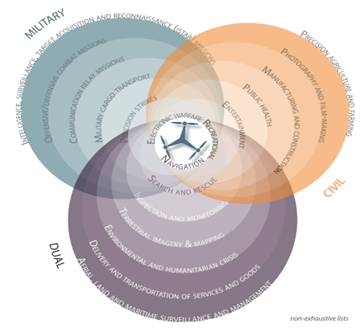
Source: EPRS briefing, 2019.
In military contexts, the term 'drone' has traditionally been used to refer to remotely controlled aircraft used for gunnery practice. However, the definition has expanded significantly in recent years to include a wide range of devices, from inexpensive, weaponised recreational multicopters to sophisticated, jet-sized uncrewed aircraft designed for intelligence, surveillance and reconnaissance (ISR), some of which cost millions.
The rapid proliferation of drones is particularly evident in the conflict in Ukraine, where both sides deploy thousands of drones of various sizes and types daily. While aerial drones (UAVs) are the most common, maritime drones have made a significant impact in the Black Sea, and land drones (uncrewed ground vehicles – UGVs) are increasingly appearing on the battlefield. Drones can be armed or unarmed, deployed for ISR or direct action, and either recoverable or designed as one-way-attack (OWA) drones that self-destruct upon impact. Some drones are remotely piloted using first-person view (FPV) goggles, while others are programmed as loitering munitions to autonomously seek out pre-designated targets. A growing trend in drone warfare is the treatment of certain OWA drones as expendable munitions, like artillery shells, while others function more like cruise missiles. Additionally, new and niche applications are emerging, including drone-based mine deployment, aerial combat through direct collision, and even UAVs equipped to breathe fire. The evolving roles of drones in modern warfare underscore the increasing complexity of their use and their expanding presence across various domains.
Drones vary significantly in size and design, ranging from insect-sized models to massive aircraft weighing several tonnes. Those weighing less than 2 kg are categorised as 'micro' or 'nano' drones, while those under 20 kg fall into the 'mini' category. Drones exceeding 20 kg are considered 'small' and are typically launched by hand or using a catapult. Medium-sized drones, weighing between 150 kg and 600 kg, are mainly used for military purposes, while large drones, exceeding 600 kg, are exclusively deployed in military operations. Military forces deploy drones of various sizes and weights, but most armed drones are significantly larger than standard commercial models, often exceeding 600 kg. Smaller drones can also be modified or designed to carry weapons or serve ISR roles, with nano and micro drones frequently used for intelligence gathering. Large drones typically operate beyond the visual line of sight, sometimes relying on radio transmission to relay imagery to operators. Medium-altitude long-endurance (MALE) and high-altitude long-endurance (HALE) drones are classified as large drones, capable of supporting tactical ISR missions as well as battlefield operations and targeted strikes. However, highly advanced military drones like the RQ-4 Global Hawk are primarily designed for ISR functions, and even drones commonly used for strikes often have unarmed ISR variants. Drones can be operated remotely or navigate autonomously using programmed instructions or artificial intelligence (AI). They come in different types, including single-rotor, multi-rotor, fixed-wing, and hybrid vertical take-off and landing (VTOL) models.
Drone swarms – defined as coordinated systems of multiple drones operating autonomously with minimal human oversight – are another ground-breaking technology. They leverage AI and machine learning to navigate challenges like GPS jamming and adverse conditions. Their cost-effectiveness and versatility offer significant advantages over traditional military deterrents, enabling synchronised operations across various domains. Globally, countries such as the US, China and several European countries are advancing drone swarm technologies, recognising their transformative impact on modern warfare strategies.
While fully autonomous military drones capable of selecting and engaging with targets without human input are not officially deployed at scale, there is growing evidence that such systems have been used in limited conflict scenarios. For instance, a United Nations report suggested that the Turkish-made Kargu-2 drone may have operated autonomously during a 2020 conflict in Libya, marking a possible first use of lethal autonomous weapons in combat. Drones like Israel's Harpy are also designed to autonomously detect and destroy radar emitters. Meanwhile, organisations like the International Committee of the Red Cross (ICRC) and Stop Killer Robots are pushing for global rules to ensure meaningful human control remains in place.
The EU and drones
In March 2022, at Versailles, EU leaders committed to substantially increasing defence expenditure. They also pledged to invest in critical and emerging technologies, such as drones, and in innovation for security and defence purposes. Additionally, they vowed to foster synergies between space, civilian and defence innovation and research. These commitments were later reiterated in the Strategic Compass.
The March 2024 European defence industrial strategy (EDIS) also calls for increasing defence innovation and the capacity to scale up production of affordable unmanned systems as a key requirement for EU defence preparedness in high-intensity conflicts. It notes that the European defence industry programme (EDIP) – which is currently pending negotiation and adoption by the European Parliament and the Council of the EU – could focus on enabling mass production, addressing supply chain vulnerabilities and removing critical dependencies. Joint procurement of drones or counter-drone systems may also be supported under the European Defence Industry Reinforcement through Common Procurement Act (EDIRPA). Furthermore, it suggests that Ukraine's urgent need for unmanned aircraft systems could be addressed through the European Peace Facility, in coordination with allied efforts through the Ukraine Defence Contact Group (a coalition of 57 nations, including all 32 NATO member states and the EU, supporting the defence of Ukraine). It also refers to the Commission's drone strategy 2.0 of November 2022. Key initiatives within it include coordinated EU-European Investment Bank (EIB) funding for a flagship drone technologies project, the creation of a strategic drone technology roadmap to guide research and reduce dependencies, and the establishment of a civil-defence drone testing network to foster collaboration across sectors. In addition, the EDIS notes that the Commission will put forward a policy proposal to support the production of drones within the EU or possibly jointly with Ukraine by mobilising relevant instruments.
Uncrewed systems across all domains, including the weaponisation of existing platforms, feature prominently in the EU capability development plan (CDP), which was approved by EU defence ministers in 2023. Notably, the CDP also advocates for the development of a European, NATO-interoperable standard for air defence systems, encompassing both kinetic and directed energy technologies designed to counter 'slow, small, and low-altitude threats' as well as drone swarms.
The ReArm Europe plan/Readiness 2030, launched by Commission President Ursula von der Leyen, aims to bolster EU defence capabilities by leveraging over €800 billion in funding. EU Member States are encouraged to increase national defence spending by activating the Stability and Growth Pact's escape clause, allowing temporary fiscal flexibility for up to four years, limited to defence expenditure and capped at 1.5 % of GDP annually. A new €150 billion instrument, SAFE (Security Action for Europe), should provide long-term EU-backed loans to support rapid and large-scale defence investments, mainly through joint procurement, with participation extended to Ukraine, EFTA/EEA countries, and EU partners. The plan also leverages the EIB Group and introduces a new savings and investments union strategy to attract private capital, ensuring the long-term viability of the EU's defence industrial base.
The white paper for European defence – Readiness 2030 identifies drones and counter-drone systems as one of seven priority areas critical for building robust EU defence. It emphasises that collaborative procurement is the most efficient means to acquire large numbers of drones. Additionally, the paper highlights Ukraine's significant expertise in drones and suggests that drones should be provided to Ukraine as a priority, as they are essential to address the asymmetry in military resources on the battlefield.
The Eurodrone
Eurodrone is a collaborative European initiative designed to meet future unmanned aerial system (UAS) requirements. Developed as a joint effort between Leonardo, Airbus Defence and Space, and Dassault Aviation, the programme is a partnership between industry and government, supported by France, Germany, Spain, and Italy. Under the management of the Organisation for Joint Armament Co-operation (OCCAR), Eurodrone will be deployed globally for intelligence, surveillance, target acquisition, and reconnaissance (ISTAR) missions, both in wide-area and in-theatre operations. In 2021, approximately €100 million was allocated to support the development of the Eurodrone, a long-endurance, remotely piloted aircraft system. As part of its 2024 call for proposals, the Commission allocated another €100 million to support the development of a fully European medium-altitude, long-endurance (MALE) remotely piloted aircraft system (RPAS). The aim is to reduce reliance on non-EU manufacturers for ISR missions.
The Eurodrone programme, launched in 2015, previously received €107 million in 2021 under the European defence industrial development programme. However, the Eurodrone programme has faced setbacks, including delays in a preliminary design review originally scheduled for September 2023, due to coordination issues between Airbus and Dassault. These delays could impact the critical design review planned for September 2024 and may push back the drone's first flight, currently scheduled for January 2027. The Eurodrone is also a PESCO project called 'European Medium Altitude Long Endurance Remotely Piloted Aircraft Systems - MALE RPAS'.
At the special European Council meeting on 6 March 2025, EU leaders reaffirmed their commitment to strengthening defence capabilities and autonomy in response to security threats, more specifically Russia's war against Ukraine. Recognising the urgency of the situation, they welcomed the Commission's plan to recommend activating the Stability and Growth Pact's escape clause to enable increased national defence spending. Additionally, they took note of the SAFE proposal for €150 billion in defence loans. Leaders also backed expanding the EIB's role in defence financing and called for private sector mobilisation. They urged simplification of legal and administrative frameworks and stressed the need to reduce strategic dependencies while boosting the EU's defence industry (a dedicated defence omnibus simplification proposal is expected by June 2025, according to the white paper). At the 20 March meeting, leaders emphasised the swift implementation of these initiatives, underlining the EU's complementary role to NATO in strengthening global and transatlantic security.
Initiatives to develop military drones
The European Defence Fund (EDF) allocates 4 % to 8 % of its annual budget to EDTs, which includes drones. The EU has been funding the research and development (R&D) of military uncrewed systems through the EDF and its predecessor programmes since 2015. As noted in the box above, in 2021 approximately €100 million was allocated to support development of the Eurodrone. Additionally, under the EDF's 2023 work programme, €68 million was allocated for counter-drone systems, while over €200 million was designated for 2024 to fund drones across various sizes and operational domains. In addition, the EU launched an EU Defence Innovation Scheme (EUDIS). With a financial envelope of €2 billion (€1.46 billion from the EDF, €90 million in co-funding from the Member States, and €400-500 million from other sources), the scheme supports innovation and entrepreneurship on essential technologies for EU defence.
In January 2024, the €175 million Defence Equity Facility (DEF) was launched under InvestEU. Managed by the European Investment Fund (EIF) on behalf of the Commission's Directorate-General for Defence Industry and Space (DEFIS), the facility supports venture capital and private equity funds investing in EU companies developing innovative defence technologies with dual-use potential. All investment must comply with the EIF's exclusion and restriction policies. The facility is financed by a €100 million contribution from the EDF and an additional €75 million from the EIF, with a four-year investment period running until 2027. Its goal is to attract up to €500 million in total investment, including private sector contributions.
European Defence Agency (EDA)
The EDA has been involved in defence innovation since its inception in 2004. EDTs – including drones – are one of its core research and technology activities. The agency's overarching strategic research agenda (OSRA) aligns Member States' defence research priorities with long-term capability needs by identifying technology building blocks (TBBs) and developing roadmaps to guide collaborative R&D efforts. In 2022, a European Defence Innovation Hub (HEDI) was launched within the EDA to enhance the agency's innovation activities and catalyse new activities jointly with Member States and stakeholders, and was one of the first concrete deliverables under the Strategic Compass. The first European Defence Innovation Day on 31 May 2022 sought to spur innovation in EU defence and foster synergies between defence and civilian innovation.
The EDA Defence Innovation Prize fosters the engagement of mainly non-traditional defence research and technology communities in generating innovative ideas. The 2020 winner was SWADAR, a drone-swarm tracking system designed for defence against swarm attacks that uses a team of defensive drones equipped with advanced sensors to track hostile swarms from multiple angles. The system integrates coordinated drone operations, real-time data fusion, and swarm behaviour learning to enhance adaptability. The EDA also advances UAS technology and currently manages 11 UAS-related projects, with seven more in preparation, involving 16 Member States and over 30 industry partners, and a budget exceeding €15 million. Key projects include standardising remote pilot stations, assessing risks for non-certified military UAS and integrating UAS into European airspace. Completed initiatives include validating MALE RPAS operations in non-segregated airspace, developing autonomous emergency functionalities and enhancing collision avoidance systems.
The EU is also fostering synergies between civilian and defence research and innovation. A Commission action plan from 2021 aims to enhance complementarity between EU programmes like Horizon Europe and the EDF, as well as between technologies at the crossroads of space, defence and civil applications. Additionally, a 2022 roadmap on critical technologies for security and defence sets out how the EU can boost research, technology development and innovation in key technologies while reducing strategic dependencies. This roadmap seeks to reinforce synergies between civilian and defence R&D, strengthening the competitiveness and resilience of the EU's security and defence sectors.
As drone warfare becomes increasingly central to the Russian-Ukraine conflict, commercial drones have served as the foundation for the models the Ukrainian army now uses to target tanks. Civilian drones have been extensively repurposed for military applications, serving both Ukrainian and Russian forces. These commercially available drones, primarily manufactured by Chinese companies like DJI, have been adapted for various battlefield roles, including reconnaissance, artillery targeting and direct attacks. The fact that these drones are easily available and affordable has facilitated their acquisition through crowdsourced funding, allowing military units to enhance their operational capabilities significantly. Significant amounts of EU research funding, channelled through sources such as Horizon Europe, have been invested in civilian drone projects, which – given the inherently dual-use nature of many drone technologies – could also potentially benefit certain defence applications. However, this excludes the specialised category of heavy military drones designed exclusively for combat or strategic missions. Importantly, Horizon Europe has always required a strict focus on civil applications. Meanwhile, it also allows for collaboration with EU-funded defence research to foster synergies, while at the same time recognising the presence of dual-use technology fields. In addition, the Commission established an Observatory on Critical Technologies in 2021 to identify key technologies in space, security, defence, and public order.
Permanent Structured Cooperation – a legal framework to deepen defence cooperation between its 26 Member States – is also being leveraged to coordinate drone and counter-drone systems. Under PESCO, the EU has launched several projects to strengthen defence through collaborative drone and counter-drone advancements. Key initiatives include the European Medium Altitude Long Endurance Remotely Piloted Aircraft Systems (EURODRONE), coordinated by Germany, to develop a European MALE RPAS for enhanced surveillance and reduced reliance on non-European systems, while the Counter Unmanned Aerial System (C-UAS) aims to detect and neutralise hostile drones. The Next Generation Small RPAS (NGSR), coordinated by Spain, focuses on developing tactical unmanned aerial systems for military and civilian use, with a prototype expected by 2027, and the Maritime Autonomous Systems for Mine Counter Measures (MAS MCM), coordinated by Belgium, integrates autonomous technologies for mine countermeasures.
To enhance the EU's defence capabilities in UAS, a range of experts have proposed complementary strategies across five interrelated domains: governance, procurement, innovation, counter-drone capabilities and strategic autonomy.
Recommendations in the area of governance and strategic coherence converge around the need for a clearer mandate for the EU Defence Commissioner and the creation of a comprehensive drone strategy that aligns procurement with long-term military planning. This includes ensuring coherence across Member States in drone development, deployment and regulation, as proposed by Andersson and Simon from the EU Institute for Security Studies. Enhancing coordination between EU institutions, national governments and international allies is also viewed as essential to fostering interoperability and streamlining defence efforts.
A second priority is procurement and industrial capacity. Pierre Haroche, Associate Research Fellow in Defence at the Jacques Delors Institute, argues for a large-scale EU initiative aimed at the mass production of drones, both to supply Ukraine in the short term and to reduce long-term dependency on external suppliers. He proposes creating an EU-funded procurement mechanism and using joint industrial policies to incentivise domestic drone production. Echoing this, Arana and Romero from Harvard's Belfer Center advocate for an EU-wide defence procurement programme to unify and scale investment across Member States.
In terms of technology and innovation, Arana and Romero emphasise the importance of investing in AI-driven drone research and propose expanding the European Research Council into a global innovation ecosystem. To finance this push, they suggest issuing defence eurobonds and launching collaborative development projects that also mobilise private capital through targeted incentives.
Counter-drone capabilities also feature prominently. Andersson and Simon recommend significantly increasing investment in technologies designed to neutralise or deter hostile drones, thereby protecting critical infrastructure and military assets. They highlight the need for sharing best practices and technologies both across the EU and with transatlantic partners to maintain a robust defensive posture.
Strategic autonomy is important, too. Haroche stresses that the EU must be able to produce independently next-generation drones to modernise its defence industrial base while reinforcing NATO's European pillar. Ulrike Franke from the European Council on Foreign Relations warns of the West's overreliance on Chinese-manufactured civilian drones, noting the operational and supply-chain risks this entails. Drawing lessons from the war in Ukraine, she underscores the strategic value of scalable drone production and the new dynamic of civilian involvement in drone warfare – through volunteer operators and crowdfunding – which presents novel opportunities and challenges for liberal democracies.
Armed drones in the EU Member States
As of 2023, the global commercial drone (UAS) market was valued at approximately USD$22.98 billion, with forecasts indicating robust growth to USD$57.16 billion by 2030. This surge is fuelled by rising demand across a range of sectors, including agriculture, logistics, media and healthcare. The market is currently dominated by Chinese manufacturers – most notably DJI, which commands an estimated 74 % share – followed by France's Parrot and other Chinese firms such as Yuneec, Autel Robotics, and Ehang. This concentration of production in China highlights not only its dominance in the sector but also potential security concerns, given the dual-use nature of many commercial drones, which can be adapted for sensitive or security-related purposes. The military UAS market, valued at USD$13.2 billion in 2022, is projected to reach USD$27.7 billion by 2032.
The EU is building on a solid foundation, and Europe is well-placed to take a leading role in the future of drone warfare. According to industry reports, as of 2022 over 40 % of all drone companies worldwide were based in Europe. Ukraine, alongside Turkey, has emerged as Europe's leading drone manufacturer. However, EUISS experts claim that, for Ukraine to fully realise the potential of its drone industry, it needs greater funding to scale up production and get better access to key components such as advanced radio transmitters and sensors.
The International Drone Coalition, initiated by Latvia and Ukraine, came into existence in February 2024. It consists of 17 countries – Australia, Canada, Czechia, Denmark, Estonia, France, Germany, Italy, Lithuania, Luxembourg, the Netherlands, New Zealand, Norway, Poland, Sweden, Latvia and the United Kingdom, with the latter two countries currently serving as its coordinators. The coalition has amassed €176 million in its Joint Fund over the past year, with total partner assistance exceeding €2 billion. These funds are allocated for purchasing drones and supporting innovative developments to enhance Ukrainian forces' battlefield capabilities. Two international tenders have been conducted: under the first, five suppliers were elected to deliver 30 000 FPV drones to Ukraine within six months; the second focused on advanced FPV and interceptor drones, with nearly 20 Ukrainian manufacturers participating for the first time. Additionally, the coalition has established a drone testing ground in Latvia. In March 2025, the Netherlands announced a €500 million investment in a large-scale drone project aimed at bolstering Ukraine's defence capabilities against the Russian aggression. This funding is part of a broader €2 billion aid package allocated by the Dutch government in support of Ukraine.
Currently, EU militaries do not have the extensive arsenals of armed drones that Russia and Ukraine possess. While some EU Member States operate a limited number of large, costly MALE drones – similar to those used in the 'War on Terrorism' – their effectiveness in a highly contested environment is restricted. Additionally, no EU military has a sufficient stockpile of expendable drones and loitering munitions to sustain high-intensity combat on the scale observed in Ukraine. In recent history, EU countries have concentrated on designing a high-end MALE UAV, despite having diverse operational needs. Meanwhile, technological advances have made smaller tactical UAVs increasingly capable, with payloads sufficient for strike missions in support of ground troops – a trend that has gained momentum over the past decade. However, EU countries appear slow to recognise or act on this shift. According to an analyst, their 'fixation' on the Eurodrone has come at the cost of expanding and modernising their tactical UAV fleets.
Considering Europe's shared operational needs and the expertise of its defence industry, investing in one or two common tactical UAV models might have been a more effective approach. Instead, large spenders have opted for domestic projects or off-the-shelf purchases, further fragmenting the market and increasing reliance on non-EU suppliers. However, there has been some considerable movement in this regard. Spain recently approved a close to €495 million investment in the SIRTAP tactical UAV, with funding spread over eight years from 2023 to 2031. Manufactured by Airbus, the drone is expected to have a 20-hour endurance, 6 000 km ceiling, 750 kg take-off weight and a 150 kg payload – features comparable to the Leonardo FALCO EVO, which is used in the Middle East but not by any European military. Partly in response to Turkish UAV advances, Greece has moved to strengthen its domestic capabilities while continuing to source systems abroad – particularly from Israel. In September 2022, Hellenic Aerospace Industries and three Greek universities unveiled Archytas, a multi-role, dual-use VTOL UAV with strong surveillance and reconnaissance functions. Then, in January 2023, Greece announced that it was launching the development of Grypas, a modular combat UAV with greater payload capacity. A prototype is expected by 2025, with Greece as the first customer – though other European buyers may follow suit. Meanwhile, budgetary constraints or urgent needs have led some EU countries to buy ready-made, non-EU UAVs. For example, Poland became the first EU customer of the Turkish Bayraktar TB2 in 2021 (also used a lot by Ukraine in the early phase of Russia's full-scale invasion), ordering four units, and later entered into a leasing deal with General Atomics for MQ-9A Reapers.
EU-NATO cooperation
The Strategic Compass and the 2022 NATO Strategic Concept both identify emerging and disruptive technologies (EDTs), which include drones, as strategic priorities for EU-NATO cooperation. This shared focus is further emphasised in the third EU-NATO Joint Declaration, which calls for deeper collaboration in defence innovation. NATO has launched the Defence Innovation Accelerator for the North Atlantic (DIANA), a dedicated body providing funding, mentoring, and access to test centres for dual-use technologies. DIANA is supported by the NATO Innovation Fund (NIF), a €1 billion venture capital initiative. In 2024, the European Investment Fund signed a Memorandum of Understanding with NIF to boost support for defence and security-focused start-ups across Europe. NATO also released an updated artificial intelligence strategy in 2024, prioritising responsible use, rapid adoption and protection of allied technologies from adversarial threats.
The EDA is closely collaborating with NATO's Joint Capability Group on Unmanned Aircraft Systems (JCGUAS) to boost the effectiveness and interoperability of UAS/RPAS for EU defence. During meetings held from 31 March to 3 April at a US military base in Garmisch, Germany, the EDA shared its approach to aligning European UAS capability development with NATO standards. The EU has also joined NATO-led drills like REPMUS, focusing on maritime autonomous systems. NATO has developed several key frameworks addressing the use and countering of UAS, including the Strategic Concept of Employment for UAS, the counter-UAS work programme, and operational initiatives like the alliance ground surveillance programme, which together guide NATO's approach to both exploiting and defending against drones.
A defence tech boom with a strong focus on drones and AI is currently taking place in Europe. For instance, Helsing, located in Munich, focuses on integrating AI with military applications. The company has developed the HX-2 drone, an intelligent strike UAV designed to enhance battlefield decision-making, and in July 2024 raised €450 million in funding. Helsing has secured a contract to supply the Ukrainian military with 6 000 HX-2 combat drones, following an earlier delivery of 4 000 HF-1 drones. The HX-2 is an AI-powered, X-Wing precision drone with a range of up to 100 km, designed to be resistant to electronic warfare and jamming, and capable of operating in swarms under human control. Quantum Systems, also based in Munich, specialises in small, dual-use UAS that feature electric vertical take-off and landing capabilities. In September 2024, the company secured €36.4 million in funding, supplementing the €63.6 million raised in October 2023, bringing their funding to over €100 million. Quantum's drones offer high-range capabilities, making them versatile for both military and civilian applications. It plans to double its production capacity in Ukraine in 2025, following the opening of its first facility there in April 2024. The company produces advanced Vector reconnaissance drones and has established an R&D centre and drone maintenance facility in Ukraine.
Drone regulation
The increasing use of drones in modern warfare – highlighted in conflicts such as the one in Ukraine, the Red Sea, and the Israel-Hamas war – has brought a host of legal and ethical challenges to the forefront. In the case of civilian drones, the Commission has been developing a comprehensive drone policy for over a decade. In 2014, it proposed a regulatory framework for various drone types and uses, with the European Aviation Safety Agency (EASA) taking the lead in setting common standards. The 2015 aviation strategy expanded this work, instructing EASA to draft detailed regulations and safety protocols. A 2018 regulation extended EU aviation rules to all unmanned aircraft, addressing safety, privacy, liability and environmental concerns. In 2019, drones were classified into open, specific and certified categories with distinct requirements. These rules, implemented in 2020, helped make the EU a leader in drone regulation. The 2021 U-space regulations, effective since 2023, aim to safely integrate drones into airspace through technical rules, coordination mechanisms and electronic visibility for aircraft. The 2022 drone strategy 2.0 seeks to expand drone usage and regulation across the EU by 2030. It focuses on building a strong drone ecosystem, with 19 flagship actions across nine areas, including innovative air mobility, public acceptance, training, investment, research, and system resilience.
The EU does not directly regulate military drone use in the same way as it regulates civilian drones. Military operations, including the use of drones for defence purposes, remain within the exclusive competence of the individual Member States. The regulatory framework governing armed drones spans three key areas of international law: international humanitarian law, international human rights law, and the law governing the use of force. Notably, the UN Convention on Certain Conventional Weapons, adopted in 1980, plays a significant role. The convention established the Group of Governmental Experts (GGE) to address emerging technologies, including LAWS, and to consider the ethical and moral issues surrounding their use in armed conflict. Discussions primarily focus on the human element involved in deploying such technologies and the responsibility in case of accidents. However, these forums have faced criticism for being too slow and unwieldy to handle effectively the rapid advancements and complex technological challenges involved.
In 2013, Christof Heyns, then the UN Special Rapporteur on extrajudicial, summary, or arbitrary executions, submitted a paper to the UN General Assembly detailing the international legal standards governing the use of armed drones. Essentially, it asserted that, for drone strikes to be considered lawful, they must comply with legal criteria in three main areas: the rules on the use of force, international humanitarian law, and international human rights law. The ICRC agreed that drones themselves do not inherently violate these principles, and that what matters is how they are used. In practice, however, applying these legal principles can be highly complex. Drones can theoretically enable more precise targeting, yet in many cases long-range drone attacks miss intended targets and result in civilian casualties. This raises questions about the obligation to distinguish between combatants and civilians and to avoid indiscriminate attacks. Energy infrastructure, for instance, has become a common target in Ukraine, prompting debate over whether such facilities are civilian objects or legitimate military objectives. Experts like Michael Schmitt argue that if disabling energy systems yields a clear military advantage – such as halting fuel supplies – they can be lawful targets, but only if the civilian harm is not excessive.
The principle of proportionality is central here. Civilian harm must not be disproportionate to the anticipated military gain. In cases where power outages caused by drone strikes lead to loss of life due to lack of medical care or heating, such attacks may be deemed unlawful. Legal scholars like Katharine Fortin stress that widespread civilian suffering, even if unintended, may still breach international legal standards. Moreover, the use of drones for what are referred to as 'personalised' strikes – targeting individuals – raises the issue of extrajudicial killings. Even when targeting combatants, drones must comply with legal safeguards. There must be an imminent threat and no viable alternative to lethal force. Concerns also persist around drone operators' reliance on visual data, which can be misinterpreted, especially in conflicts involving insurgents who may appear indistinguishable from civilians. Studies have shown that image-based targeting can introduce cognitive bias, further complicating legal compliance. There is also a moral and legal dilemma regarding surrender. ICRC guidance suggests that combatants must be allowed the opportunity to surrender where possible. Yet drones are often used to strike without warning, giving targets minimal chance to surrender. While footage of soldiers surrendering to drones occasionally circulates, the dominant narrative is one of lethal force being delivered remotely and instantaneously. Despite drones falling within the scope of existing legal regimes, enforcement has not kept pace with technological developments. Legal scholars and humanitarian organisations continue to raise concerns that the current use of drones – especially autonomous or semi-autonomous systems – may outstrip the ability of existing laws to regulate them effectively.
The UN's New Agenda for Peace has highlighted the critical need for strong governance frameworks to regulate emerging military technologies. The ICRC defines autonomous weapons as systems with 'critical function' autonomy, allowing them to independently select (i.e. search for, detect, identify, and track) and attack (i.e. intercept, neutralise, damage, or destroy) targets. These AI-powered systems, which may not be adequately vetted by decision-makers, raise serious concerns regarding accountability, proportionality and compliance with international humanitarian law. Since 2018, UN Secretary-General António Guterres has denounced LAWS as 'politically unacceptable and morally repugnant', calling for their prohibition under international law. The United Nations' Group of Governmental Experts on Lethal Autonomous Weapons Systems (GGE LAWS) continues to examine the ethical and security concerns surrounding these technologies. This forum, which brings together UN member states, NGOs, industry representatives and researchers, aims to establish common principles for the governance of autonomous weapon systems. In October 2023, the UN General Assembly adopted a resolution highlighting the potential threats posed by LAWS to global security and stressing the urgent need for a coordinated international response.
The EU, as a strong advocate for peace and human rights, plays an active role in these discussions. Several EU Member States have been instrumental in advancing the UNGA resolution, and the EU actively engages in the GGE on LAWS. Additionally, the Commission and the Parliament set up a working group on UAS prior to the publication of the drone strategy 2.0., outlining guidelines for the responsible use of drones in both civilian and military contexts. However, within the EU – and even more so on a global scale – there is no consensus on whether fully autonomous weapons should be regulated, particularly regarding the conditions under which they may be deployed and the responsibilities of their operators. Despite growing awareness of the ethical, legal, and security risks associated with autonomous drones in warfare, the EU has yet to develop a unified and coordinated international strategy to address these concerns.
European Parliament's position
Parliament has articulated a cautious stance on military drones, emphasising strict adherence to international law, particularly international humanitarian law and international human rights law. It has expressed grave concerns over the use of armed drones outside the international legal framework, especially regarding extrajudicial targeted killings, which it deems a violation of international law and a potential act of aggression when conducted without the consent of the targeted state's government. Parliament has called for the EU and its Member States to oppose and ban the practice of extrajudicial targeted killings, ensure that Member States do not perpetrate or facilitate unlawful targeted killings and include armed drones in relevant arms control and disarmament regimes. Additionally, Parliament advocates for transparency and accountability in drone operations, urging prompt, independent investigations into allegations of civilian casualties and public disclosure of the results. It also calls for strict controls over drone exports to prevent their use in human rights abuses. These positions reflect Parliament's commitment to ensuring that the use of military drones aligns with international legal standards and ethical norms.
Parliament has also taken an early and active role in the military AI debate, adopting key resolutions in 2018 and 2021. While generally open to military AI for its strategic value and potential to protect lives, Parliament stresses three core principles: human control, legal accountability and international governance via the UN. It strongly opposes LAWS without meaningful human oversight and calls for their global ban through UN negotiations. The 2021 resolution urges an EU-wide framework to regulate military AI in line with international law and fundamental rights, promoting ethics, transparency and accountability. Though the EU AI Act, adopted in 2024, excludes military uses, Parliament's Artificial Intelligence in the Digital Age (AIDA) Committee has nevertheless addressed dual-use concerns, highlighting the need for responsible AI governance in defence and cybersecurity, as well as cooperation with partners like NATO.
At the same time, Parliament actively supports defence innovation, particularly in the development and integration of UAS and emphasises the importance of fostering a competitive and innovative defence industrial base to enhance the EU's strategic autonomy. Parliament has called for the Commission to propose an EU drones package focusing on drone and anti-drone systems, including plans and funds to stimulate R&D. This initiative aims to learn from the Ukrainian experience and be open to the participation of Ukraine's highly innovative companies in R&D. It also aims to establish an industrial programme dedicated to the joint development, production and procurement of drones and anti-drone systems, as well as a regulation on the use of drones in civilian and military contexts. Additionally, Parliament has advocated for increased funding and support for emerging disruptive technologies in defence, recognising their potential to revolutionise military operations. Through these efforts, Parliament seeks to ensure that the EU remains at the forefront of defence technology and enhances its security and defence capabilities.
Main references
- Andersson, J. and Simon, S., 'Minding the drone gap: Drone warfare and the EU', European Union Institute for Security Studies, October 2024.
- Arana, G. and Romero, J., 'Drone Warfare in Today's World: 15 Policy Recommendations to improve the European Union's Defence Capabilities', Harvard Kennedy School Belfer Center, December 2024.
- Haroche, P., 'A rampart of drones to defend Europe: a plan for the new European Commission and High Representative', Jacques Delors Institute, September 2024.
Disclaimer
This document is prepared for, and addressed to, the Members and staff of the European Parliament as background material to assist them in their parliamentary work. The content of the document is the sole responsibility of its author(s) and any opinions expressed herein should not be taken to represent an official position of the Parliament.
Copyright
© European Union.
The reuse of this document is authorised under a Creative Commons Attribution 4.0 International (CC-BY 4.0) licence.

https://creativecommons.org/licenses/by/4.0/deed.en
To use or reproduce elements that are not owned by the European Union, permission may need to be sought directly from the respective rightsholders.