
Article page checkbox is not checked in page info.
The right to petition the European Parliament
The right to petition the European Parliament
Clément Franzoso, Members' Research Service
Summary
The right to petition the European Parliament was formally set out in the Maastricht Treaty as one of the rights of European Union citizenship. Parliament's predecessors, from the beginnings of the Communities in the 1950s, had already recognised the importance of receiving petitions from citizens, and this has become a major expression of Parliament's role as the direct representative of EU citizens. The European Parliament's practice is based on those of national parliaments, but is often more extensive in terms of scope.
The right of petition has developed substantially over time. In particular, petitions addressed to the European Parliament's Committee on Petitions (PETI committee) and then sent to the European Commission for information on the application of, or compliance with, Union law can potentially lead to infringement procedures against Member States. Some challenges remain regarding the treatment of petitions – particularly in finding more effective ways to involve national parliaments.
The committee attaches paramount importance to the examination and public discussion of petitions at its meetings, where petitioners can be invited to present their petitions. They frequently take the floor in the discussion, thereby actively contributing to the work of the committee. In this way, efficient communication takes place between Parliament, the Commission and citizens.
The PETI committee plays a key role in the election of the European Ombudsman, as it is responsible for organising the hearings of the nominees.
This briefing modifies and further develops a briefing published in 2015.
Background
The right to petition parliaments allows citizens close contact with an elected representative political institution and the possibility to participate indirectly in the democratic process and influence the political agenda. Like referenda and popular legislative initiatives, the right of petition is a crucial element of a participatory democracy.
In the EU context, the right of petition was provided in the rules of procedure of the European Parliament's predecessors – the European Coal and Steel Community's Common Assembly and the European Parliamentary Assembly – early in the 1950s. However, it was only in the late 1970s and early 1980s that specific detailed provisions for citizens to submit petitions to the European Parliament were introduced in Parliament's Rules of Procedure. This was followed by the creation of the dedicated Committee on Petitions (PETI) in 1987.1 Then, it was based on custom recognised through a 1989 interinstitutional agreement that secured, for the first time, the cooperation of the Commission and the Council, and not yet on a provision in the EU Treaties.
The right to petition the European Parliament – in any official EU language – as a right stemming from European Union citizenship was formally introduced at EU level in the Maastricht Treaty in 1992 (now Article 227 of the Treaty on the Functioning of the EU (TFEU)), along with the establishment of the position of the European Ombudsman (Article 228 TFEU) to deal with maladministration in the activities of the Union institutions, bodies, offices or agencies.
The right of petition and European Parliament procedure
The European Parliament has developed procedures for the receipt and handling of petitions, centred on the PETI committee. These are set out in Title IX of Parliament's Rules of Procedure.
The subject-matter of petitions
Petitions to the European Parliament represent complaints, requests, observations on the application of EU law, or appeals to Parliament to adopt a position on a specific matter covering the EU's areas of activity.2
Who can petition the European Parliament?
Under Articles 24(2) and 227 TFEU, 'any natural or legal person residing or having its registered office in a Member State shall have the right to address, individually or in association with other citizens or persons' 3 a petition of public and private interest to the European Parliament on issues concerning them directly and covering the EU's areas of activity. In addition, this right is enshrined in Article 44 of the Charter of Fundamental Rights of the European Union . Non-EU citizens can also petition the European Parliament, but only when legally resident in the European Union.
Procedure
Under Rule 232 of Parliament's Rules of Procedure, petitions addressed to Parliament in one of the official languages of the EU are first referred to the PETI committee, which then examines their admissibility. In cases where petitions are declared inadmissible (if, for example, the matter is not within the EU's fields of activity), where possible, other means of redress may be recommended, such as judicial remedies, contacting the national authorities or lodging a complaint with the European Ombudsman.
Possible outcomes
Once declared admissible, under Rule 233 of Parliament's Rules of Procedure, petitions are examined by the PETI committee and petitioners may be invited to participate in meetings of the committee if their petition is to be the subject of discussion. The committee can launch (in conjunction with Rule 52) an own-initiative report or submit a short motion for a resolution to the plenary. In addition, when investigating petitions and searching for a solution the PETI committee may organise fact-finding visits in Member States.
In addition, the committee may request Parliament's President to forward its opinion or recommendation to the Commission, the Council or the Member State authority concerned for action or a response (Rule 233.6).
Parliament also has the power, under Article 226 TFEU, to set up a committee of inquiry to investigate cases of maladministration in the implementation of EU law, except when the matter is subject to legal proceedings. Some petitions have indeed led to such a committee being set up, such as the 2005 Temporary Committee of Inquiry into the Crisis of the Equitable Life Assurance Society.
Parliament adopts annual reports on the PETI committee's activities. These concern the examination of individual petitions by the committee and discuss possible improvements to procedures and to relations with other institutions. The most recent report, covering the PETI committee's activity between 2019 and 2024, shows that the committee adopted 19 short motions for a resolution, 12 reports and 20 opinions on the files under the remit of other committees. It reported annually to Parliament on the outcome of its deliberations and has adopted five reports on the European Ombudsman reports on its activities from 2018 to 2022. The committee also conducted 11 fact-finding visits to seven Member States and one no-EU country, to establish facts and follow up on petitions received.
Judicial review
The right of petition has been subject to cases for annulment of a decision by the PETI committee brought before the Court of Justice of the EU (CJEU). In Case T-308/07 in 2011, the Court of First Instance (now the General Court) annulled the decision of the PETI committee to declare a petition from a German applicant inadmissible due to the lack of clearly stated reasons, while upholding the European Parliament's political right to take, or not take, further action on a petition.
In Case C‑261/13 P, the Court stated that 'a decision by which the Parliament considers that a petition addressed to it does not meet the conditions laid down in Article 227 TFEU must be amenable to judicial review, since it is liable to affect the right of petition of the person concerned. The same applies to a decision by which the Parliament, disregarding the very essence of the right of petition, refuses to consider, or refrains from considering, a petition addressed to it and, consequently, fails to verify whether it meets the conditions laid down in Article 227 TFEU.'
The EU's competence in the policy field, as a prerequisite, was also affirmed in Case T-496/21, paragraph 34: The notion of "a matter which comes within the Union's fields of activity" should be interpreted in light of Articles 2 to 6 TFEU, which define the competences attributed to the Union by the Treaties.
Scope of the right of petition in the European Parliament and in national parliaments
The right to petition is one way EU citizens can voice concerns, alongside the European Citizens' Initiative and complaints to the Ombudsman. At EU level, the right is adapted from national parliaments' practices in the area of petitions. However, compared to the broad access to the right to petition the European Parliament, provisions governing access to the right of petition at national level are more restricted in many cases. These include, firstly, the restriction placed by some parliaments (the Danish Folketing,4 the Greek parliament5) on the submission of a petition only through a Member. Other limits to addressing petitions involve restricting the right to address a collective petition to a national parliament to institutions (e.g. in Belgium).6 In one case – Slovakia – requirements include a minimum number of supporters of a petition,7 for example when concerning a proposal for a referendum.8
In 2023, the PETI committee held an inter-parliamentary committee meeting on the rules, procedures and practices concerning the right to petition, and on national parliaments' points of view on best practices and new approaches to the right to petition. A 2023 study commissioned by the committee and presented at the inter-parliamentary meeting shows that petition websites and new technologies have brought enormous potential, particularly for the promotion of the right to petition. However, according to the authors, to further enhance the performance of a petitions system it is essential to gather information that enables a precise assessment. Parliaments and petition committees should track key indicators, such as the time required to process petitions and identify the stages where delays are most likely to occur. Understanding the profile of petitioners by collecting data on their demographics, motivations, and interests and analysing this information can help devise strategies to broaden the range of petitioners and involve a wider audience in the process.
Impact of the Committee on Petitions
The PETI committee has examined a number of petitions that either have played a role in the preparation of infringement procedures by the Commission against Member States, or represent cases where infringement procedures under Articles 258 and 260 TFEU may be considered. The Commission decided to open two infringement procedures against Italy following several petitions during the last mandate: one on honorary magistrates and the other, together with Greece, on improving air passenger rights during the COVID-19 crisis.
Nevertheless, a recent study has questioned whether the Commission's follow-up to petitions is adequate. The study argues that petitions seem to have little impact on the Commission's actions regarding monitoring and ensuring the implementation of EU law. These findings suggest the need to increase the relevance of petitions and encourage the Commission to give greater consideration to petitions in its role as the guardian of Treaties. In response to the European Parliament's longstanding request, the Commission has linked related petitions with the information provided online on infringement proceedings and decisions. The Commission tool now allows citizen to search for cases linked to a petition. Several petitions have led to legislative or political action in various fields and especially on environmental issues. In 2022, the PETI committee held, together with the Committee on Legal Affairs (JURI), a public hearing on 'The EU Green Prosecutor' on the basis of petitions received to present new tools to fight environmental crime, including the possible creation of a European Green Prosecutor Office. It led to the Opinion on the proposal for a directive on the protection of the environment through criminal law (Environmental Crime Directive).
Also in 2022, the European Parliament adopted a resolution on illegal logging in the EU on the basis of a motion for a resolution by the PETI committee. In May 2023, the committee organised a fact-finding visit on management of the brown bear population and illegal logging in Romania. The Commission had opened an infringement procedure and the delegation visited the various stakeholders for a week to understand the situation better.
The European citizens' initiative (ECI)
The ECI is an EU mechanism aimed at increasing direct democracy by enabling 'EU citizens to participate directly in the development of EU policies'. The initiative enables one million EU citizens, who are nationals of at least seven Member States, to call directly on the European Commission to propose a legal act in an area where the Member States have conferred powers on the EU. If, at the end of the procedure, the ECI reaches the threshold, its organisers are invited to a hearing set up by the PETI committee to present their initiative; afterwards, Parliament may decide to debate further and adopt a resolution in plenary on the topic. Under Rule 236, the PETI committee may also decide to examine ECIs that cannot be submitted to the Commission because not all procedural requirements have been met.
Relations with the European Ombudsman
The PETI committee cooperates with the European Ombudsman, who investigates complaints about maladministration in EU institutions. Both share the goal of ensuring transparency, professionalism and integrity in the EU's operations, particularly in areas affecting citizens' daily lives, such as fundamental rights, environmental protection, consumer rights and workers' rights.
The committee plays a crucial role in the election of the Ombudsman, organising hearings of the candidates. In December 2019, the committee heard from five candidates before the election. In 2023, the procedure for the Ombudsman's election was revised, incorporating suggestions for improvements. New rules include standardised forms for supporting candidates, with signatures being valid only if they meet specific criteria, and a provision for publishing a full list of supporting Members.
The Ombudsman reports annually to the PETI committee, which also prepares its own reports on these activities. Furthermore, the committee is part of the European Network of Ombudsmen, a group that includes the European Ombudsman and national ombudsmen from EU Member States, candidate countries, and European Economic Area nations. The network aims to promote the exchange of information on EU law and policy, and to share best practices for improving governance and accountability.
In December 2024, after a public hearing of the candidates in the PETI committee, the European Parliament elected Teresa Anjinho as the European Ombudsman for the 10th parliamentary term. Teresa Anjinho succeeds Emily O'Reilly, who first assumed office in July 2013 (her mandate was renewed for a second term in December 2019). Prior to the plenary vote, on 3 December 2024, the PETI committee heard six candidates, each of whom underwent a hearing of around one hour, presenting their priorities for the Ombudsman's upcoming term. After a 10-minute opening statement, the political group coordinators asked a first round of questions (one minute per question, three minutes for answers) followed by questions from other MEPs. Each hearing concluded with the candidate making a three-minute final statement. The new Ombudsman will take office following an oath-taking ceremony on 27 February 2025 at the CJEU, for a five-year mandate.
Importance of the petitions network
The petitions network, which includes all Parliament's committees, was established by the PETI committee in 2016. It fosters cooperation and awareness on petition-related issues.
As outlined in the 2016 guidelines, if a petition falls under another committee's competence, the chair of the PETI committee may forward it to the relevant committee for an opinion or information. Members of the petitions network receive updates on petitions referred by the PETI committee and follow them up within the scope of their committee. They are also encouraged to inform coordinators and rapporteurs about petitions related to ongoing committee work, which may prompt discussions at committee meetings or during activities like hearings and workshops.
During the 2019-2024 term, the chair of the PETI committee forwarded 2 205 petitions to other committees for information and 317 for opinion to 23 different committees.
Quick look at success stories
Mutual recognition of parenthood and marriages
The PETI committee recognised the serious obstacles faced by same-sex couples and 'rainbow families' in their daily lives and called for the mutual recognition of parenthood and marriage. On 1 December 2022, a public hearing on 'Discrimination on the grounds of sexual orientation' was organised in association with the Committee on Civil Liberties, Justice and Home Affairs (LIBE) and the JURI committee. Later that month, the Commission presented its proposal for a regulation aimed at harmonising at EU level the rules of private international law relating to parenthood. The European Parliament's legislative resolution on this proposal refers to the various petitions submitted by EU citizens highlighting the need for a legal framework for cross-border recognition of parenthood between Member States.
The PETI committee also commissioned a study on the proposal in April 2023, which recommended to the Commission to issue guidelines on applying the new resolution and extend the geographical scope to children born in a third country.
Standardised dimensions for carry-on luggage
In October 2023, the European Parliament adopted a Resolution calling for standardised dimensions for carry-on luggage by single vote based on PETI's Short Motion for Resolution. The Resolution attracted a record media interest across the Members States. In November 2023, the European Commission adopted a legislative proposal calling for "a small number of common sizes and weights."
Data on petitions to the European Parliament
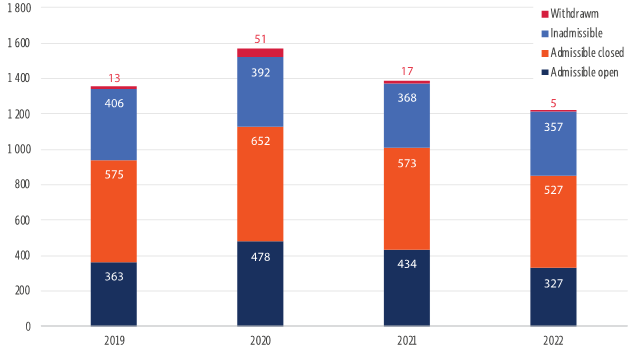
During the ninth legislative term (2019-2024), the PETI committee was in charge of 6 991 petitions: 1 357 petitions in 2019, 1 573 petitions in 2020, 1 392 petitions in 2021, 1 217 petitions in 2022 and 1 452 petitions in 2023. Petitions dealt with a wide spectrum of topics, mainly in the area of fundamental rights (i.e. disability, women's rights, children's rights, LGBTI equality, free movement, voting rights), environment, health, justice, employment and consumers' rights. A significant number of petitions led to legislative or political action, EU pilot cases, and sometimes even preliminary rulings or infringement proceedings.
Data source: European Parliament resolution on the outcomes of the Committee on Petitions' deliberations during 2022, 23 November 2023.
Figure 1 covers part of the 2019-2024 term and shows that a large majority of petitions were followed up and closed – between 500 and 650 petitions each year on average. The aim was to close an admissible petition, and provide a reason for closing it, mostly when the committee suggested a remedy or gave the necessary information, but also after a discussion in a committee meeting or after the petitioner who was asked to give a response or react to questions failed to do so.
Data source: European Parliament resolution on the outcomes of the Committee on Petitions' deliberations during 2022, 23 November 2023.
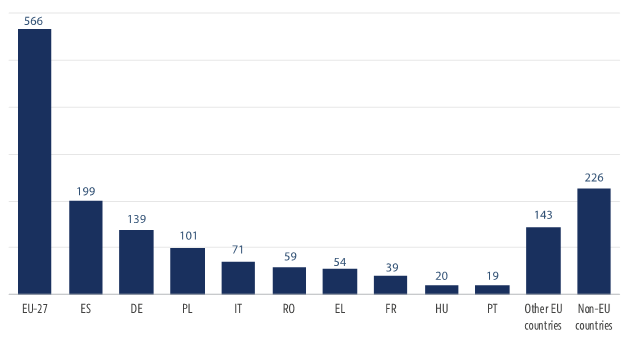
At the time of writing, the most recent annual report on the activities of the PETI committee covers the year 2022. This latter shows that 566 petitions concerned the EU as an entity and 226 concerned non-EU countries. Spain, Germany and Poland are among the Member States most often targeted by petitions.
Data source: European Parliament resolution on the outcomes of the Committee on Petitions' deliberations during 2022.
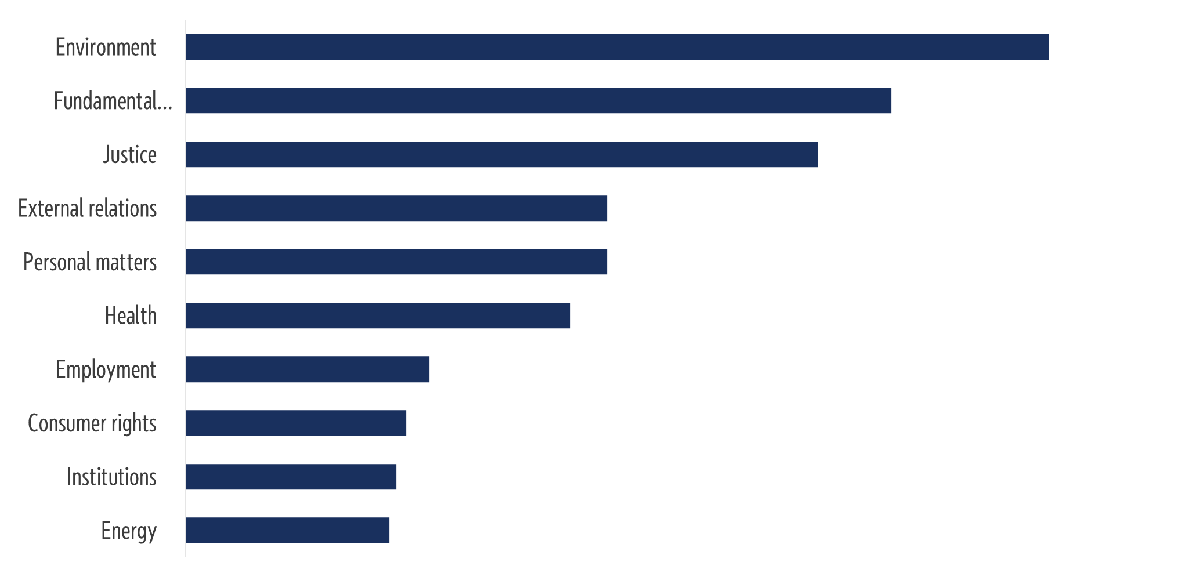
Figure 3 shows that Environment became the main subject of petitions to the European Parliament in 2022. In 2021, Fundamental Rights and Health were the main topics addressed in terms of the number of registrations, which can be explained by the COVID-19 crisis.
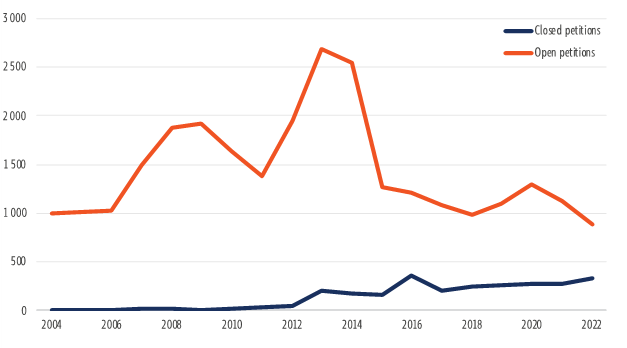
Data source: European Parliament resolution on the outcomes of the Committee on Petitions' deliberations during 2022, 23 November 2023.
The latest publication of statistics regarding the PETI committee covers the period of 2003-2022. Figure 4 shows some interesting elements, such as the increasing number of petitions lodged, partly as a result of the establishment of the Petitions Web Portal in 2014, to Brexit in 2016, and to the COVID-19 crisis in 2020 and 2021.
Main references
- Committee on Petitions (PETI), Activity Report 2019-2024, European Parliament, March 2024.
- Directorate-General for Internal Policies, Rules, procedures and practices of the right to petition parliaments, European Parliament, September 2023.
- Diaz Crego, M., Committees of inquiry in the European Parliament, EPRS, European Parliament, 2023.
- Directorate-General for Internal Policies, Inter-institutional relations in the treatment of petitions: the role of the Commission, European Parliament, 2021.
Endnotes
Classification
Policy areas: EU Democracy, Institutional and Parliamentary Law
Regions: European Union
Disclaimer
This document is prepared for, and addressed to, the Members and staff of the European Parliament as background material to assist them in their parliamentary work. The content of the document is the sole responsibility of its author(s) and any opinions expressed herein should not be taken to represent an official position of the Parliament.
Copyright
© European Union.
The reuse of this document is authorised under a Creative Commons Attribution 4.0 International (CC-BY 4.0) licence.

https://creativecommons.org/licenses/by/4.0/deed.en
To use or reproduce elements that are not owned by the European Union, permission may need to be sought directly from the respective rightsholders.