
Article page checkbox is not checked in page info.
Deepening the single market in the light of the Letta and Draghi reports
Deepening the single market in the light of the Letta and Draghi reports
Guillaume Ragonnaud, Members' Research Service
Summary
Often considered the 'cornerstone' of European integration, the single market now serves 449 million consumers and 31 million active companies, most of which are small and medium-sized enterprises (SMEs). It has delivered substantial economic benefits, ranging between 8 % and 9 % of European Union gross domestic product (GDP). Trade between Member States has risen steadily over the years, and today accounts for an estimated 56 million European jobs. The EU is among the largest trading blocs in the world, representing 15 % of world GDP, compared with the United States at 16 % and China at 19 %. The single market's attractiveness for foreign businesses also serves as an important geopolitical tool, enhancing the EU's influence amid geopolitical shifts.
Recent shocks, such as the COVID-19 pandemic and the war in Ukraine, have revealed not only the single market's vulnerability in crises, but also the extent to which the EU's competitiveness relies on a well-functioning single market, ensuring unhindered access to the goods, services, and strategic inputs EU supply chains need.
Although the single market has generally been a success, recent analyses, including those put forward by Enrico Letta and Mario Draghi in 2024, clearly demonstrate that it remains highly fragmented, limiting EU companies' ability to scale up and compete internationally, and preventing EU citizens from reaping the full benefits. For instance, 60 % of the barriers companies face today are of the same type as were already reported 20 years ago. The two reports converge on many points, not least on the need to take rapid action to deepen the single market.
Advancing the single market requires action in multiple policy fields, its digital dimension gaining increasing importance in recent years. Ultimately, a well-functioning single market, fit for the green and digital transitions, new technological developments and changing geopolitical realities can be seen as central to the EU's industrial policy.
Introduction
For more than 30 years, the single market has served as a cornerstone of European Union economic cooperation and growth. It remains an example of the wide-ranging benefits, both direct and indirect, brought about by European integration. Nevertheless, the architecture of the single market has never been completed and examples of market fragmentation abound. Furthermore, the fact that a deeper and correctly functioning internal market is crucial to EU competitiveness, places achievement of the single market high on the EU's political agenda.
In its 2023 communication on the EU's long-term competitiveness, the European Commission identifies 'a functioning single market' as one of the drivers of EU competitiveness, and stresses that broadening and deepening the single market is the most cost-effective measure to secure optimum EU productivity. In June 2023, the European Council requested an 'independent high-level report on the future of the single market', which was drafted by former Italian prime minister, Enrico Letta. Published in April 2024, the Letta report contains a wide range of policy recommendations to 'empower the single market to deliver a sustainable future and prosperity for all EU citizens'.
Commission President Ursula von der Leyen requested another former Italian prime minister, Mario Draghi, prepare a report on the future of European competitiveness, which was released in September 2024. The Draghi report, while building in particular on the Letta report's analyses of the single market, has a broader scope and seeks 'to lay out a new industrial strategy for Europe'. Both reports insist on the urgency to act: the Letta report calls for an immediate boost to the single market to adapt it to the new European and global contexts, and the Draghi report stresses that the EU has left its single market fragmented for too long, with cascading effects on competitiveness, pushing high-growth companies overseas, for instance. Growing and boosting EU productivity have consequently become an 'existential challenge' for Europe.
The next European Commission's political guidelines for 2024-2029 stress that while the single market is key to Europe's competitiveness, renewed impetus to complete it is needed urgently. In September 2024, 20 Member States welcomed the momentum to release the single market's full potential created by the Letta and Draghi reports, stressing that the single market should be at the centre of the EU's action to enhance its competitiveness. They underlined that the European Council and the Competitiveness Council asked the European Commission to publish a new single market strategy by June 2025.
The single market: A short history
In June 1985, the Commission published a white paper on the completion of the internal market, setting out a timetable for the completion of the single market. Signed in February 1986, the Single European Act (SEA) entered into force in July 1987, paving the way for the completion of the single market ('an area without internal frontiers in which the free movement of goods, persons, services and capital is ensured') by the end of 1992. On 1 January 1993, after the adoption of nearly 280 pieces of legislation, the single market came into force for 345 million people in 12 Member States. The single market covers a considerable range of policies. Moreover, competition policy, standards, public procurement policy, and intellectual property rights are key single-market enablers, helping to create a competitive business environment for EU companies.
Iceland, Liechtenstein and Norway belong to the single market under the European Economic Area (EEA) Agreement, and Switzerland also takes part by means of bilateral agreements. The United Kingdom left the EU single market on 1 January 2021.
The EU hosts the largest single market in the world. Home to 345 million people in 1993, it now numbers 447 million consumers and 31 million active companies. The Commission has stressed that trade within the single market accounts for 56 million European jobs, and the estimated economic benefits range between 8 % and 9 % of EU gross domestic product (GDP). Trade between Member States has risen steadily, with the share of intra-EU exports varying between Member States. For some countries, more than 80 % of their trade is with other Member States (Figure 1). In 2023, intra-EU exports in goods were worth €4 126 billion, intra-EU exports in services were worth €1 348 billion. Intra-EU investments were worth €8 163 billion (data for 2021). Furthermore, in the EU‑27, 3.7 % of employees hold the citizenship of an EU country other than the one in which they work, and 2.4 % of tertiary level students come from a different EU country than that in which they are studying. The economic importance of the single market, combined with EU regulatory leadership and its ability to shape international standards in line with EU values, interests and legislation gives rise to what is sometimes referred to as the 'Brussels effect', through which the EU is able to project its interests globally, as some third countries adopt 'EU-style regulations'.
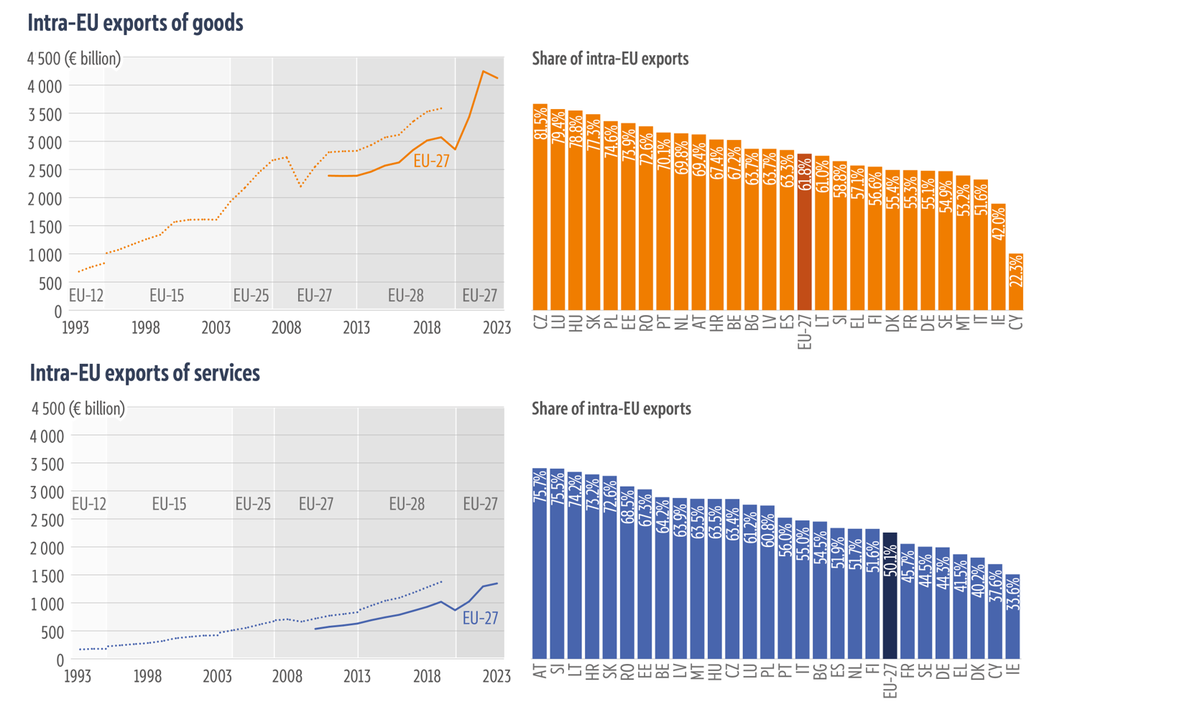
Source: Giulio Sabbati, EPRS, 2024.
Thirty years later, still to arrive at destination
Thirty years after it was launched, the single market is still evolving, with recent examples including the adoption of the Digital Markets Act, the Digital Services Act and the Internal Market Emergency and Resilience Act (IMERA) – a new 'safety net' for the single market to function in crises). Recent shocks, however, including the pandemic and Russia's illegal war on Ukraine, resulted in restrictions on free movement, shortages of goods and services, and rising energy prices. This has shown not only the single market's vulnerability to crises, but also the extent to which the EU economy relies on a fully functioning single market.
Although a success story, challenges remain. A 2023 EPRS study mapping the cost of non-Europe (2022-2032), finds that completing the single market by 2032 could yield €644 billion in collective benefits for EU citizens. In March 2020, the Commission identified the top 13 barriers to cross-border activity, as most commonly reported by consumers and businesses (such as burdensome and complex administrative procedures), and five main root causes for these barriers (such as inadequate enforcement of EU legislation). The Commission and the Member States are taking specific action and horizontal measures to remedy the situation, under a long-term action plan for better implementation and enforcement of the single market. The Commission has also set up a Single Market Enforcement Task Force (SMET) to improve the implementation and enforcement of single market freedoms. In 2021 and 2022, the SMET worked on cross-border restrictions for professionals, permitting procedures for wind and solar energy projects, administrative requirements for cross-border service providers, liability insurance problems for the provision of cross-border services, and barriers in the ecosystem of electric vehicle charging stations. The SMET supplements other enforcement instruments, such as infringement procedures, SOLVIT, and preventive mechanisms, such as the notifications procedure for technical regulations under the Single Market Transparency Directive (EU) 2015/1535.
In January 2023, Parliament adopted a resolution on the '30th anniversary of the single market: celebrating achievements and looking towards future developments'. The resolution notes the importance of the single market as the engine of European integration and backbone of the EU economy, as well as its role in bringing EU citizens together. The text also argues that none of the four freedoms should be left behind. It goes on to stress the Member States' key responsibility for implementing and enforcing existing single market legislation correctly, and urges the Commission to address unjustified barriers hampering realisation of the single market's full potential. In addition, the resolution calls for the renewal of the promise of the single market by updating it, supporting companies and consumers in the twin transitions, protecting consumers and the environment, and increasing funding for single market policies. Furthermore, while reaffirming Parliament's readiness to play its role in the process, the text demands renewed commitment from the Member States and the other EU institutions, as well as a specific agenda for action to 2030 and beyond, to strengthen and further develop the single market, particularly on services, energy, telecommunications and the digital single market.
The Commission published a communication on the single market at 30 in March 2023, discussing possible means to further integrate the single market. It proposes to address barriers in the most relevant economic sectors, such as services, capital, energy, digital and data markets. The Commission also highlights the need to improve enforcement in the sectors with the highest untapped potential, such as business services, retail, construction and tourism. Another area for action is improving the transposition and implementation of EU rules, cutting red tape and creating an 'enabling' business environment.
Letta and Draghi report proposals
The analyses presented in the two reports converge on many points, most notably in highlighting examples showing that the single market remains highly fragmented and insisting on the urgency for change. They both identify finance (progressing towards completing the capital markets union – CMU), energy, telecom, defence and space as key sectors where the single market needs to be deepened as a priority.
Capital markets union (CMU)
The CMU is an EU political project aimed at 'de-fragmenting' the markets for corporate financing. The first objective is to ensure that firms obtain comparable financing conditions regardless of the Member State in which they are located. Fragmented financial markets have adverse effects on euro monetary policy, as well as on fair competition between EU firms. The second major objective of the CMU is to expand the financial means and instruments available to EU corporations through wider, de-fragmented, EU capital markets offered to EU companies, as well as regulatory intervention. The incompletely integrated EU capital markets maintain economic discrepancies and divergence between EU Member States, while EU firms with significant innovation and growth potential continue to lack the financial investment they need from the private sector.
The EU's long-standing weaknesses in terms of innovation are thoroughly examined in both reports. Both reports express deep concern about shortages of workers and the skills needed to transform the EU economy. Both authors also agree that it is necessary to adjust the EU competition rules, ensuring better coordination of State aid while preserving the integrity of the single market. The two reports also point to the EU's massive investment needs over the coming years to support its strategic goals, to be met by both the public and private sectors. Common borrowing is also mentioned in both reports as a possible way to finance European public goods such as defence, energy, or digital infrastructure.
Both reports point to the need to reform EU governance and enhance EU decision-making, aiming to improve coordination between EU and Member State efforts, simplifying EU rules and reducing the administrative burden for companies, and improving assessment of the measures proposed by the legislators. Moreover, both reports put forward detailed roadmaps/action plans listing key actions that could be taken up to 2029. Finally, the importance of the external dimension of these issues are discussed in both reports, highlighting that the EU's economic interests should be protected, while also preserving openness to trade.
EU defence industry
Russia's war on Ukraine laid bare the challenges the European defence industry faces as it tries to meet increased demand and ramp up production in the wake of a fundamentally changed security environment in Europe. The European defence industry comprises a number of large multinational companies, mid-caps and over 2 000 small and medium-sized enterprises. It faces a multitude of challenges: decades of under-investment, fragmentation, lack of critical raw materials and semiconductors, and insufficient manufacturing capability. The EU and its Member States have taken several steps to reinforce the European defence industry, especially since the start of Russia's war on Ukraine.
The Letta report proposes to add a fifth freedom to the existing four, to enhance research, innovation and education. It also proposes to enhance financial integration within the single market to meet the EU's considerable investment needs to address its strategic goals, with proposals such as a savings and investments union, the creation of a new governance framework for State aid to promote a more European approach, or making more strategic use of public procurement. The report also proposes to further deepen the single market in sectors such as telecom, energy, defence industry, space, health and transport.
Letta emphasises that the benefits of single market integration should be shared equitably across the EU – between citizens and companies, including SMEs. To this end, he proposes enhanced support for cross-border cooperation projects between private and public actors, to set up an EU action plan for high-quality services of general interest, introduce a European degree to facilitate labour mobility, improve the economic environment for European SMEs, for instance by lifting remaining restrictions under the Services Directive, addressing tax fragmentation and improving consumer protection.
To foster greater dynamism in the single market, the Letta report also proposes reducing regulatory complexities by improving the design of EU law and its adoption process (through enhanced impact assessments of proposed measures and the introduction of a 'non-regression principle'). The report also proposes to better implement and enforce EU law and to simplify existing EU rules.
Finally, the report highlights the importance of addressing the external dimension of the single market, which has been increasingly affected by trade developments (such as export controls imposed by third countries or foreign direct investments). To safeguard the EU's economic resilience and interests, it proposes setting up a comprehensive approach to de-risk the EU's supplies of a broad range of key technologies or to better coordinate Member States' export control measures.
The Draghi report strongly advocates accelerating technological and scientific innovation to ensure that Europe's decarbonisation plans are matched by leadership on the required technologies, and to implement a genuine 'foreign economic policy' to increase security and reduce critical dependencies. Draghi proposes to launch a new EU industrial strategy, grounded primarily in full implementation of the single market, which will support the scaling up of young, innovative companies, creation of a true common energy market, an integrated multimodal transport market, increased demand for decarbonisation solutions, more resilient supply chains, and mobilisation of greater volumes of private finance.
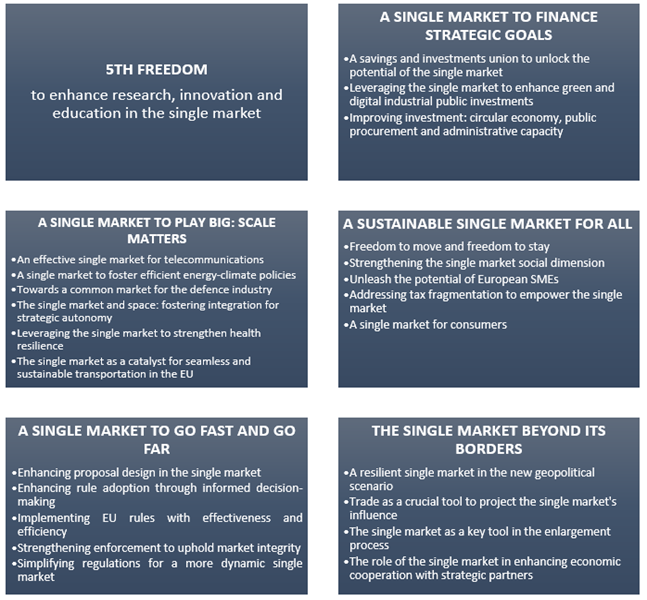
Source: EPRS, 2024.
The Draghi report also presents a series of proposals to complete the single market for different sectors, across chapters (see Figure 4 below), building upon the Letta report analyses.
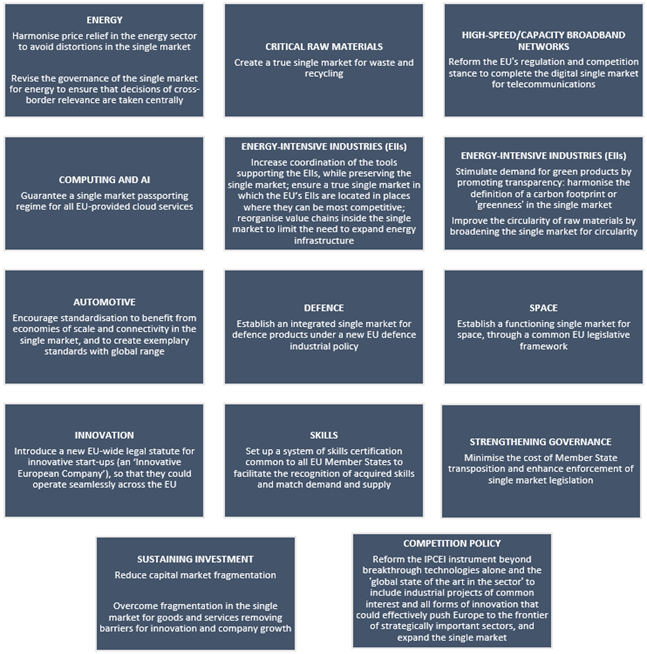
Source: EPRS, 2024.
Main references
- Letta, E., Much more than a market, April 2024.
- Draghi, M., The future of European competitiveness – A competitiveness strategy for Europe, September 2024.
Disclaimer
This document is prepared for, and addressed to, the Members and staff of the European Parliament as background material to assist them in their parliamentary work. The content of the document is the sole responsibility of its author(s) and any opinions expressed herein should not be taken to represent an official position of the Parliament.
Copyright
© European Union.
The reuse of this document is authorised under a Creative Commons Attribution 4.0 International (CC-BY 4.0) licence.

https://creativecommons.org/licenses/by/4.0/deed.en
To use or reproduce elements that are not owned by the European Union, permission may need to be sought directly from the respective rightsholders.