
Article page checkbox is not checked in page info.
Responsibility for search and rescue of migrants in the Mediterranean
Responsibility for search and rescue of migrants in the Mediterranean
Anita Orav, Members' Research Service
Summary
Governments and ship's masters are obliged, under international law, to assist people and vessels in distress at sea. They must provide this assistance regardless of the nationality, status, or the circumstances in which those in distress are found. They must apply these rules without prejudice to their obligations deriving from international humanitarian law and international human rights law, particularly the ban on refoulement. European Union (EU) Member States' search and rescue (SAR) and disembarkation activities are not currently covered by a common EU legal framework, except for activities carried out in the context of joint operations at sea led by the European Border and Coast Guard Agency (Frontex).
In recent years, EU naval operations, EU agencies and non-governmental organisations (NGOs) have rescued a significant proportion of migrants and asylum-seekers in distress in the Mediterranean Sea. Nevertheless, over the past couple of years, a large number of people have died or gone missing in the Mediterranean. The EU Fundamental Rights Agency (FRA) reports that the estimated number of people who died or went missing when trying to reach Europe by sea in 2023 increased by some 37 % compared with 2022.
In addition, a lack of coordination in SAR activities, individual countries acting alone, and criminalisation of NGOs active in SAR in the Mediterranean, have all led to migrants being forced to remain on boats. EU Member States and EU agencies (Frontex) have also been accused of pushbacks of asylum-seekers and other migrants towards Libya and Turkey and to the high seas. Individual actors dealing with migrant boats have been the subject of criticism and legal action. Their accountability is, however, not always clear, owing to varied application and interpretation of different bodies of international law.
This updates and expands on a 2022 EPRS briefing written by Anita Orav.
Introduction
Asylum-seekers and other migrants worldwide have long risked their lives aboard unseaworthy ships and other vessels, in search of international protection against persecution, conflict or other threats to their life, liberty or security; or to seek work, educational opportunities and better living conditions.
Governments and ships' masters complying with their obligations under international law to carry out rescue and disembarkation to a place of safety undertake complex operations involving different actors, who are subject to specific obligations under different bodies of international law. Even when a rescue is undertaken, problems can arise in securing agreement to disembark rescued people in a particular country.
The FRA regularly reports on criminal and administrative proceedings against NGOs and other private entities carrying out SAR operations. The most recent report from June 2024, states Germany, Spain, Italy, Malta and the Netherlands have initiated 81 proceedings since 2017. According to the FRA, 'the most common issues detected by port authorities concerned the excessive number of passengers, ship assets not working properly, having too many life jackets on board, having inadequate sewage systems for the number of potentially rescued people, as well as for causing environmental pollution'.
In the first half of 2023, civil society actors rescued only 4.2 % of migrants arriving in Italy by sea. This is due to a new Italian law1 dating from January 2024, whereby vessels must proceed to an assigned port after each rescue operation 'without delay'. Italian port authorities blocked the Sea‑Eye 4, which was fined three times in 2023 for conducting multiple rescue operations before disembarking.
Similar measures were applied to the Ocean Viking, Louise Michel, Open Arms and Humanity. Five NGOs have filed a complaint to the European Commission over this law, which they consider an obstacle to human rights work. Moreover, rescue vessels in the Mediterranean (see Figure 1) often experience long waits at sea for authorisation to enter a safe port, further endangering the safety and physical integrity of those rescued.
The FRA reports that practices of non-assistance at sea are also detected in the central Mediterranean, for example, Malta was reported for delaying assistance to a boat in distress for over 38 hours. This in spite of the United Nations High Commissioner for Refugees (UNHCR), together with other UN agencies, stressing the need to ensure that refugees and migrants rescued at sea are promptly disembarked in a 'place of safety' where migrants' 'lives, safety and other human rights – such as access to asylum and the prohibition of cruel, inhumane or degrading treatment or arbitrary detention' are ensured.
In May 2024, the Italian Civil Aviation Authority issued five decisions banning civil society-deployed aircraft from mounting search operations at sea from five airports in Sicily: Lampedusa, Palermo Bocca di Falco, Palermo Punta Raisi, Pantelleria, and Trapani. On 22 May 2024, the NGO Sea Watch was fined over €2 000 for continuing to fly the Seabird.
This change of policy has turned the Mediterranean into the deadliest sea for those who travel mainly from Africa and the Middle East. The increasingly securitised approach to SAR at sea is, according to the majority of academics and other stakeholders, in clear breach of international maritime, refugee, and humanitarian law. A 2021 report by the Office of the High Commissioner for Human Rights (OHCHR) pointed out that the measures taken by European countries to criminalise and halt the work of humanitarian actors in SAR operations, together with the reduction in European state-operated SAR vessels, had 'deadly consequences for adults and children seeking safety'.
Importantly, the report concluded that the evidence collected suggests the increase in casualties in the Mediterranean 'is not a tragic anomaly, but rather a consequence of concrete policy decisions and practices2 of the Libyan authorities, EU Member States and institutions, and other actors, who have combined to create an environment where the dignity and human rights of migrants are at risk.
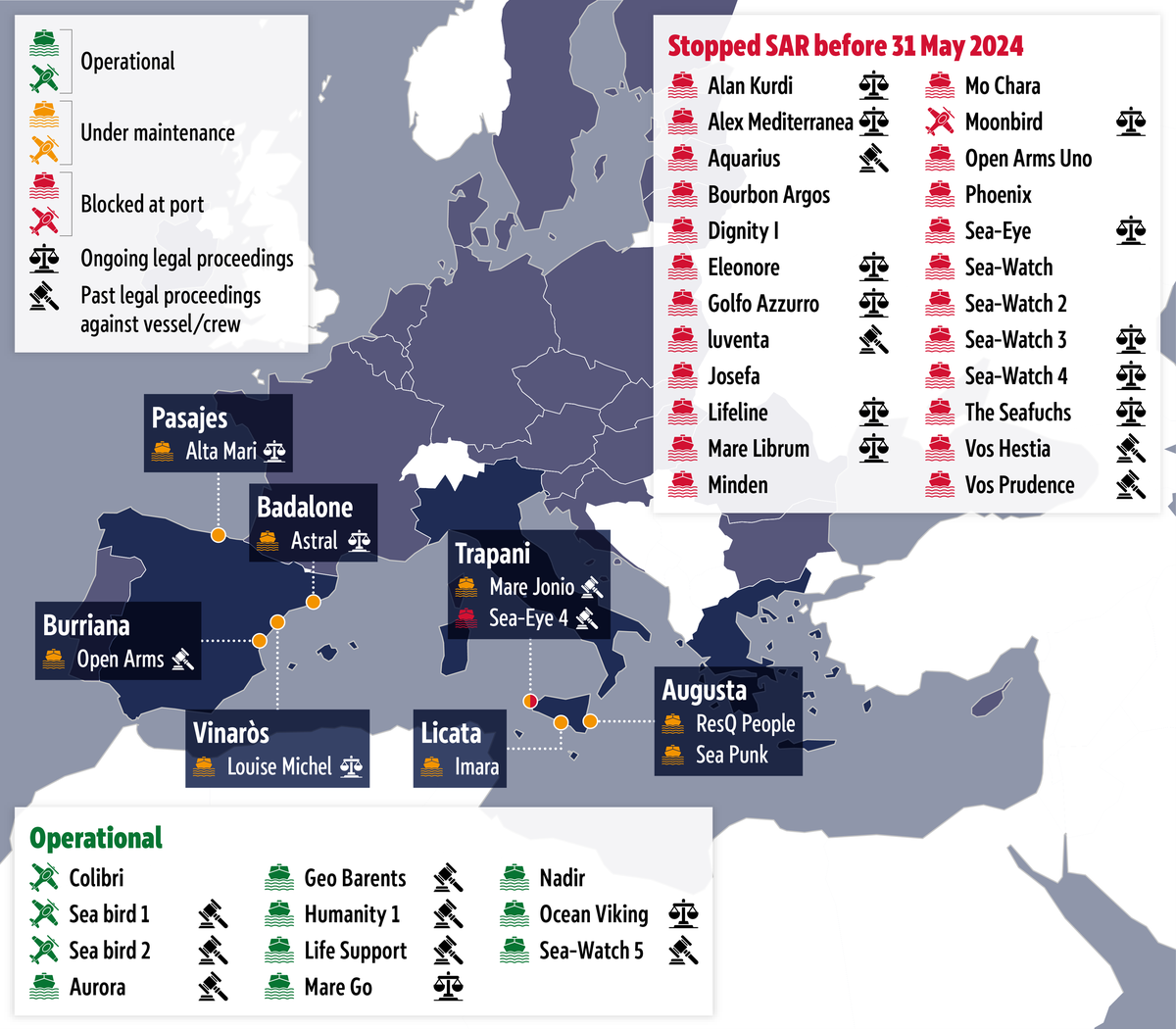
Source: EPRS, based on Search and rescue operations and fundamental rights – June 2024 update, European Union Agency for Fundamental Rights, July 2024; Graphic Samy Chahri, EPRS
Loss of life in the Mediterranean
From 2015 until April 2023, EU action at sea helped to save 615 087 lives in the Mediterranean. Over the past couple of years, however, the Mediterranean Sea has also been the scene of a huge number of casualties and missing people . While there were 3 155 deaths in 2023, the precise number of those who die in the Mediterranean Sea cannot be determined. Of the western, central, and eastern routes crossing the Mediterranean Sea, the central Mediterranean route was the deadliest. In 2024 alone (as of 30 June), 785 individuals have gone missing or lost their lives in the Mediterranean (Table 1).
| Years | Dead and missing |
|---|---|
| 2023 | 4 110 |
| 2022 | 3 017 |
| 2021 | 3 231 |
| 2020 | 1 881 |
| 2019 | 1 510 |
| 2018 | 2 277 |
| 2017 | 3 139 |
| 2016 | 5 096 |
| 2015 | 3 371 |
| 2014 | 3 538 |
Source: Mediterranean Situation, UNHCR Operational Data Portal, accessed 8 October 2024.
Between January 2024 and mid-August, the International Organization for Migration (IOM) estimates more than 1 000 people died or went missing in the central Mediterranean Sea. Europe's approach has meanwhile shifted to prioritising pushing back migrants at sea, cooperation with third countries to intercept and return smugglers and migrants, and criminalisation of NGOs that launch their own search and rescue (SAR) operations. Some EU Member States and EU agencies (Frontex) are suspected of pushbacks of asylum-seekers and other migrants to the high seas – towards Libya (considered unsafe) and Turkey (accused of not adhering to the non-refoulement principle).
Legal framework for search and rescue
International law
Obligations of ships' masters
Ships' masters are obliged to render assistance to those in distress at sea without regard to the nationality, status or the circumstances in which those affected are found. This obligation is based on the UN Convention on the Law of the Sea (UNCLOS, Article 98(1)) and the 1974 International Convention for the Safety of Life at Sea (SOLAS, Chapter V).
State parties' obligations under maritime conventions
State parties to several maritime conventions must ensure arrangements for communicating on and coordinating a rescue in their area of responsibility and for saving people in distress at sea around their coastline. This obligation is based on the SOLAS Convention (Chapter V), UNCLOS (Article 98(2)) and the International Convention on maritime search and rescue (SAR Convention, Chapters 2.1.10 and 1.3.2).
The SAR Convention envisages international cooperation for coordinating SAR operations, and stipulates the establishment of SAR zones independently of the delimitation of maritime zones , including in the Mediterranean.
The SAR obligations include transport to a safe place.3 An amendment to the SAR Convention to develop these rules entered into force in 2006, including the way to determine, a safe place in each case. The state responsible for the SAR zone should provide a safe place or make sure that such a place is found. However, there is no rule designating the state responsible for receiving the rescued passengers by default, such as, for example, the state of nationality or residence of those rescued, the flag state or the state from which the distressed vessel departed.
All the above-mentioned rules must be applied without prejudice to the obligations deriving from international humanitarian law and international human rights law, including the prohibition of refoulement .
The territorial scope of the principle of non-refoulement 4 is debated, both in literature and in practice. Some academics support its application wherever competent state authorities perform measures pertaining to border control, while for others, it applies to the actions of states, wherever undertaken, whether at the land border, or in maritime zones, including on the high seas. The practical consequences of its application at sea are detailed in a leaflet edited by the UNHCR and the International Maritime Organization (IMO).
Furthermore, as experts explain, states have human rights obligations towards only those individuals that find themselves within their jurisdiction. The legal systems do not recognise state duties towards migrants before they enter the relevant state's jurisdiction. As a rule, anyone within the territory (including the territorial sea) of a state is within that state's jurisdiction. On the high seas, states have been considered to exercise jurisdiction when state officials were physically present at a particular incident and thereby exercised effective control over the individuals seeking protection (see European Court of Human Rights (ECtHR) case of Hirsi Jamaa and others v Italy ).
The discussions on SAR at sea have focused mainly on refoulement and the illegality of pushbacks 5 of migrant boats to their point of departure, while the increasing prevalence of departure prevention or pullbacks by third countries has largely been ignored. These latter measures raise severe concerns with respect to the right to leave any country, including one's own.
The controversies surrounding the accountability of individual actors dealing with boat migrants at sea have also been observed in other parts of the world, on account of varied application and interpretation of different bodies of international law.
In 1993, in Sale v Haitian Centers Council , the United States Supreme Court concluded that both the international and US statutory prohibition against refoulement applied only with regard to actions taken on US territory. Accordingly, it ruled that the US policy to interdict refugees on the high seas and return them to Haiti without any screening or other processing did not violate international law.
EU law
The SAR and disembarkation activities of EU Member States are currently not covered by a common EU legal framework, except for those activities carried out in the context of Frontex-led joint operations at sea. The European Commission has consistently emphasised that SAR is not an EU competence, and has limited itself to underlining the humanitarian dimension of SAR operations.
Regulation (EU) No 656/2014 on the surveillance of the external sea borders applies to all Frontex-coordinated maritime border surveillance operations, and includes a set of SAR and disembarkation obligations for Member States' law-enforcement vessels. According to its Article 9, EU Member States are obliged to assist any vessel or person in distress at sea regardless of their nationality or status or the circumstances in which they are found, in accordance with international law and respect for fundamental rights. Moreover, during an SAR operation, while awaiting instructions from the rescue coordination centre, the operating units must take the appropriate measures to ensure the safety of the persons concerned (Article 9(2)(g)).
Article 4(1) of the regulation states that no person can be 'disembarked in, forced to enter, conducted to or otherwise handed over to' an unsafe country as defined in the regulation. Where rescue occurs in territorial waters or a contiguous zone, disembarkation should normally take place in the coastal Member State (i.e., the Member State in whose territorial or contiguous zone the operation takes place). However, if rescue or interception occurs on the high seas, the preferred place of disembarkation is 'in the third country from which the vessel is assumed to have departed'. If this is not possible, then the disembarkation 'shall' take place in the coastal Member State. Where disembarkation follows an SAR incident, the relevant rescue coordination centre (RCC) must identify an appropriate 'place of safety' (Article 10(1)(c)). If this is not possible, those rescued must be disembarked in the coastal Member State. The article further specifies that these 'modalities for disembarkation shall not have the effect of imposing obligations on Member States not participating in the sea operation unless they expressly provide authorisation for measures to be taken in their territorial sea or contiguous zone'.
The regulation requires that the Member States participating in Frontex-coordinated joint operations cooperate with the RCC responsible, to identify a place of safety and ensure speedy disembarkation of the rescued people. Article 2(12) provides a clear definition of 'place of safety', meaning 'location where rescue operations are considered to terminate and where the survivors' safety of life is not threatened, where their basic needs can be met and from which transportation arrangements can be made … taking into account the protection of their fundamental rights in compliance with the principle of non-refoulement'.
Furthermore, according to Article 4(3) of the regulation, before any rescued person is disembarked in, forced to enter, conducted to, or otherwise handed over to the authorities of a third country, the Frontex operation must conduct a case-by-case assessment of their personal circumstances and provide information on the destination of the rescued people. Those rescued also need to be given the possibility 'to express any reasons for believing that disembarkation in the proposed place would be in violation of the principle of non-refoulement'.
As for EU fundamental rights law, the EU Charter of Fundamental Rights becomes applicable as soon as a Member State acts within the scope of EU law. According to experts, this would be the case when patrolling the external sea borders in accordance with the Schengen Borders Code, regardless of whether this takes place within or outside the context of a Frontex operation. This raises the question of whether the Schengen Borders Code is applicable beyond the territory of EU Member States. In September 2012, in a case brought by the European Parliament, the Court of Justice of the EU annulled the 2010 Council Decision supplementing the Schengen Borders Code, on the basis that the Council had exceeded its implementing powers. The Court of Justice did not have to decide on the Parliament's other demands, including the territorial scope of the Schengen Borders Code.
Role of Frontex
Frontex's role in SAR operations is enshrined in Regulation (EU) 2019/1896. The regulation includes operations launched and carried out in accordance with the above-mentioned Regulation (EU) No 656/2014 and international law, taking place in situations that may arise during border surveillance operations at sea. In these circumstances, Frontex is obliged to provide technical and operational assistance to Member States and non-EU countries in support of SAR operations.
SAR is a specific objective of the operational plan of every Frontex joint maritime operation. For this reason, vessels deployed by Frontex to an operational area are also always ready to provide national authorities with support in SAR operations. SAR operations are always coordinated by the national RCC. The RCC orders vessels that are the closest to the incident, or the most capable to assist in the rescue. These may include national commercial or military vessels, vessels deployed by Frontex, private boats and others.
The EU and its agencies have no mandate to conduct SAR operations, as this remains a Member State competence. The regulation limits Frontex's accountability by establishing that 'In accordance with Union law and those instruments the Agency should assist Member States in conducting search and rescue operations in order to protect and save lives whenever and wherever so required'.6
Currently, Frontex runs three operations in the Mediterranean: (i) operation Themis (since 2018, replacing Triton), which supports Italian border control guards in SAR operations in the central Mediterranean; (ii) operation Poseidon, which supports Greece and covers the sea borders with Turkey and the Greek islands in the eastern Mediterranean, and (iii) operation Indalo (with operation Minerva), which covers the western Mediterranean route between Spain and Morocco. Moreover, in March 2020, the EU launched military operation Irini (replacing operation Sophia, which ran from 2015 until 2020), to help disrupt the business model of human smuggling and trafficking networks by information gathering and patrolling by planes. Frontex also has an obligation to monitor human rights compliance during all its operations, and to suspend or terminate any (funding of) activities when serious or persisting violations occur.
Following alleged involvement of Frontex staff in pushbacks of asylum-seekers by the Greek border force, Frontex came under the European Parliament's scrutiny. Parliament decided, inter alia, to set up a Frontex Scrutiny Working Group (FSWG), and postponed the granting of discharge to Frontex twice (in 2021 and 2022). The allegations prompted Frontex to launch an internal inquiry. Members of the European Parliament's Committee on Civil Liberties, Justice and Home Affairs (LIBE) demanded answers from Frontex's then Executive Director, Fabrice Leggeri, regarding the allegations. Leggeri resigned with immediate effect in April 2022. According to some experts, Frontex's set-up and working methods allow all actors involved to shift blame to others, while individuals face many practical as well as legal obstacles to bring Frontex to court. However, others insist that illegal pushbacks by Frontex units in the Mediterranean mean the EU incurs 'derivative responsibility' for a violation of the principle of non-refoulement and of the duty to assist those in distress at sea.
The European Ombudsman has received an increasing number of complaints against Frontex over its failures to comply with freedom of information requests. In July 2023, the Ombudsman concluded an inquiry into Frontex' role in the June 2023 Pylos shipwreck, one of the deadliest migration tragedies in the Mediterranean since 2015, with 82 fatalities and over 500 migrants missing at sea. The Ombudsman found that Frontex 'demonstrated shortcomings' in its response to maritime emergency situations. Following the inquiry, Frontex was forced to improve its freedom of information processes.
EU and Member State action in the Mediterranean
In early 2019, Member States decided to cease the EUNAVFOR MED Operation Sophia maritime patrols that had saved thousands of lives. One of the reasons stated was that SAR constitutes a 'pull factor' for migrants to the EU. The practice has been criticised by stakeholders and academics. Whether or not SAR operations represent a 'pull factor' of irregular migration at sea remains debatable. Indeed, the argument that SAR operations would incentivise migrant smuggling is not uncontested: in contrast to the argument of the Italian Senate in 2017 according to which SAR provides 'an incentive for human smugglers to arrange departures', others argue that there is no causal link between SAR operations and the number of migrants embarking on dangerous sea journeys towards the EU, that this argument is too simplistic, and that attention should be paid to the real economic, geopolitical, social, demographic, and environmental drivers of migration. A policy of forcing migrants to stay for several days and sometimes weeks on boats, together with legal action and administrative barriers preventing NGO ships from operating at sea, was the result of a stand-off between Member States.7
Most EU governments are reluctant to offer relocation spaces or to give access to protection to those who need it. Instead of providing for effective solidarity with frontline Member States and for fair responsibility-sharing, EU countries continue to secure external borders and focus on cooperating with third countries (in particular Libya , more recently with Tunisia, Egypt, and Mauritania) to curb migration flows, prompting heavy criticism from academics and civil society organisations .
Italy's very positive results with Mare Nostrum in 2014 fell dramatically just one year later and were neither matched by joint operation Triton nor by EUNAVFOR MED operation Sophia, deployed later and without an SAR mandate. In addition, the lower number of rescues in the Mediterranean was also due to a fall in the number of arrivals by sea from 2016 onwards.
Italy and Malta repeatedly prevented vessels conducting SAR activities in the Mediterranean from disembarking the people they had rescued at sea in their ports. Italy and Malta's stark resistance to disembarkations was, for some, deplorable from a humanitarian point of view, but not necessarily unlawful. Greece has consistently dismissed reports about pushbacks to Turkey, while Italy and Malta have also rejected the accusations by declaring themselves unsafe at the time due to the coronavirus pandemic, and by raising the issue of insufficient burden-sharing across the EU.
It prompted a group of Member States referred to as a 'coalition of the willing' to show 'ship-by-ship' solidarity with frontline Member States and stranded migrants, and make ad-hoc arrangements to take in those who had disembarked. These arrangements, although a positive shift from the previous stand-off, were nevertheless criticised for being conducted in a purely intergovernmental fashion, for being dependent on other EU countries agreeing to take responsibility for people rescued before their disembarkation, and for being unpredictable and incompatible with the common European asylum system (CEAS). Furthermore, according to experts, this partial solidarity failed to deliver a unified approach, failed to consider the interests of all EU countries, and was against the letter and spirit of Article 80 of the Treaty on the Functioning of the EU (TFEU), which requires EU policies on asylum, migration and border management to be based on the fair sharing of responsibilities.
A framework for a permanent solidarity mechanism was agreed on 20 December 2023, when the Parliament and the Council reached an agreement on the asylum and migration pact, including on the Regulation on Asylum and Migration Management. The agreed text was published in the Official Journal of the EU on 22 May 2024, and will start to apply on 1 July 2026. The new rules combine mandatory solidarity to support Member States who cannot cope with the number of irregular arrivals on their territory with flexibility for Member States as regards the choice of their contribution. The mechanism of solidarity for disembarked persons in a Member State applies to search and rescue operations as well as to vulnerable persons, regardless of how they crossed the EU external border. The mechanism is primarily based on voluntary contributions to be made at the Commission's request. The Commission explains that the pact will not affect Member States' competence in SAR under international law, but introduces a new legal framework for people entering an EU Member State in the context of a search and rescue operation.
More specifically, the new framework encompasses the following three main elements.
Rules on responsibility and solidarity for SAR
Disembarkation after SAR is not considered as equivalent to irregular entry, and will be included in the Eurodac database as a specific category. For SAR, the Member State that rescued a person remains responsible for 12 months, whereas in the case of irregular entry the responsibility lasts for 20 months. A permanent mandatory solidarity mechanism will allow part of the annual solidarity pool for Member States to be set aside under SAR pressure.
Improved information sharing and cooperation
In September 2020, the Commission adopted a recommendation on cooperation among Member States concerning operations carried out by private vessels for the purpose of SAR activities. The aim was to reduce fatalities at sea, maintain safe navigation, and ensure effective migration management in compliance with legal obligations. The recommendation called on the Commission to set up an Interdisciplinary European Contact Group on SAR, with the aim of strengthening cooperation between Member States and private vessels involved in SAR operations, exchanging information and best practice, and assisting and advising the Commission in SAR-related matters. The group began work in March 2021 and meets regularly. The objective is to gather practices applied by Member States to develop a common understanding of SAR. The group has now piloted near real-time and posterior analytical information sharing.
Guidance and common rules
In 2020, the European Commission presented a recommendation on enhanced cooperation on search and rescue. In parallel, the Commission also presented a proposal to revise the Facilitation Directive in an effort to clarify the non-criminalisation of humanitarian activity carried out in the course of search and rescue pursuant to international law. The negotiations are pending, and the 'facilitators' package' (Council Directive 2002/90 and Council Framework Decision 2002/946/JHA) was the subject of criticism. The European Parliament took the view that anyone who provides people in need with any form of humanitarian assistance should not be criminalised, and that EU law should reflect that principle. Parliament called for guidance and adequate monitoring systems on the application of the facilitators' package in its resolution of 5 July 2018 and at its hearing of 27 September 2018. As a response to the European Parliament, the Commission issued guidance on the implementation of EU rules on the facilitation of unauthorised entry, transit and residence.
Moreover, the European Union Agency for Asylum (EUAA) provides national authorities with support following disembarkations from SAR in Malta and Italy since 2019. This activity is coordinated by the European Commission in accordance with the Standard Operating Procedures agreed among participating Member States. The Agency also assists Greek authorities in the relocation of unaccompanied minors and other eligible beneficiaries to EU Member States.
Search and rescue case law
In 2012, the European Court of Human Rights delivered a first judgment on interception-at-sea. In Hirsi Jamaa and others v. Italy Somali and Eritrean migrants travelling from Libya had been intercepted at sea by the Italian authorities and sent back to Libya. The court found that returning them to Libya without examining their case exposed them to a risk of ill-treatment and amounted to a collective expulsion. Ultimately, the FRA emphasised that 'state responsibility may exceptionally arise when a state aids, assists, directs and controls or coerces another state to engage in a conduct that violates international obligations'. Even in the case where financial and/or technical 'aid or assistance' by an EU Member State or an EU agency to a third country may not qualify as 'exercising effective control' for the purposes of applying the Hirsi judgment benchmark, they could be still responsible in light of the EU Charter of Fundamental Rights.
On 8 May 2018, the Global Legal Action Network submitted a case ( S.S. and others v Italy ) to the ECtHR in relation to Libya's abuses against migrants during operations at sea and on return to the country in November 2017. The applicants claimed that Italy breached its obligations under the European Convention on Human Rights (ECHR) by cooperating with Libya to enable its coast guard to intercept people at sea and take them back to Libya. As explained by experts, the obvious goal of the applicants and their defenders was to have the court assert its jurisdiction by holding that a state party can retain effective control over people also when its officers 'only' equip, train, and possibly instruct vessels of a third state. In this case, according to academics, 'interveners launched a more principled understanding of jurisdiction which focused on the influence the state held in a given situation in ascertaining whether jurisdiction was exercised'.
This model is itself an evolution compared with previous practice (Hirsi Jamaa and Others v Italy). Confronted with the question of the extraterritorial application of the ECHR, the court asserted that the applicants had been 'under the continuous and exclusive de jure and de facto control of the Italian authorities'. The result was a breach not only of Article 3 ECHR owing to refoulement, but also of the prohibition of collective expulsions under Article 4 of Protocol 4 to the ECHR.
In June 2019, a complaint before the International Criminal Court (ICC) claimed EU Member States' migration policies in the Mediterranean are crimes against humanity, responsible for thousands of migrant deaths in the Mediterranean. Several EU actions to deter migration were argued to have violated human rights, including: the Triton operation's reduction in the number of sea rescues and creation of large zones off the Libyan coast without any rescue capacities; the persecution of NGO sea rescue groups by some Member States; the policy of returning some 40 000 migrants to militia-controlled camps in Libya; funding and training Libya's coast guard, and providing location data to ensure the Libyan force would pick up as many refugees as possible. On 23 November 2021, ICC Prosecutor Karim Khan presented his first report on the situation in Libya to the UN Security Council. He noted accounts of violent raids on Tripoli migrant camps, as well as arbitrary arrests and detentions of migrants, including women and children. On 25 April 2023, the ICC and the European Union Agency for Law Enforcement Cooperation (Europol) signed a working arrangement providing a legal framework for cooperative relations to allow a more effective joint response to core international crimes.
In 2021, the UN Human Rights Committee issued two interconnected decisions that some commentators have qualified as 'landmark in the legal attempts to hold European countries accountable for the violation of human rights occurring as a result of the mismanagement of migratory flows and their retreat from responsibility for saving lives at sea, as required by international law'. The two cases were brought against Malta and Italy following a 2013 shipwreck near Lampedusa, killing more than 200 people. The claimants alleged that Malta and Italy failed to assist those in distress at sea, thus violating their international obligations. Moreover, the claimants argued Malta and Italy failed to carry out an effective investigation into the causes of and responsibilities for the shipwreck. The UNHRC considered that Italy failed to show it met its due diligence obligations to protect the right to life pursuant to Article 6(1) of the International Covenant on Civil and Political Rights (ICCPR), and that it failed to meet its duty to conduct a prompt investigation of the allegations after the tragedy. The case against Malta was dismissed and declared inadmissible due to the applicants' failure to exhaust domestic remedies.
Moreover, in August 2022, the Court of Justice of the EU (CJEU) delivered its judgment on joined cases C-14/21 and C-15/21. The cases concerned two German ships, Sea Watch 3 and Sea Watch 4, which rescued and then disembarked those on board in two Sicilian ports (Palermo and Porto Empedocle). The port authorities subsequently detained the ships on the grounds that they were not certified to carry out SAR operations, and had exceeded the legally authorised number of persons on board. Sea Watch brought two actions for annulment of this decision to Sicily's Regional Administrative Court (TAR), which referred questions for a preliminary ruling (Article 267 TFEU) to the CJEU with a view to clarifying and receiving guidance on Directive 2009/16/EC on port state control. The CJEU clarified that Directive 2009/16/EC is applicable to any ship, including those operated by humanitarian organisations. However, the port state may adopt detention measures only in the event of a clear risk to safety, health or the environment, which it is for that state to demonstrate.
European Parliament position
Deeply regretting the recurrent loss of lives at sea, in its resolution on 'the need for EU action on search and rescue in the Mediterranean', the European Parliament called for political and financial support for national and Frontex initiatives. The Parliament advocated a comprehensive EU search and rescue mission implemented by authorities in Member States and Frontex. At the same time, the resolution asks the Commission to provide more information about all the support the EU and its Member States provide to border and coast guards in third countries, including Libya, Türkiye and Egypt. Members emphasised that deals with third countries should be more transparent and allegations of human rights violations need to be assessed.
On 14 December 2023, the Parliament also adopted a resolution on 'Frontex, building on the fact-finding investigation of the LIBE Working Group for Frontex Scrutiny'. This resolution reinforces both the agency's increased responsibility and budget (which grew from €114 million in 2015 to €750 million in 2022). It notes the needs for this be reflected in increased accountability and transparency, as well as increased scrutiny of the agency's respect for Union law. Members underline that Frontex could do more to increase the EU and Member States' capacity to carry out search and rescue operations by investing in appropriate assets for such operations.
Main references
- Citroni, G., No More Elusion of Responsibility for Rescue Operations at Sea: The Human Rights' Committee Views' on the Case A.S., D.I., O.I. and G.D. v. Italy and Malta , OpinioJuris, March 2021.
- Fink, M., Gombeer, K. and Rijpma, J., In search of a safe harbour for the Aquarius: the troubled waters of international and EU law, EU Immigration and Asylum Law and Policy blog, July 2018.
- Ghezelbach, D., Moreno-Lax, V., Klein, N. and Opeskin, B., 'Securitization of search and rescue at sea: The response to boat migration in the Mediterranean and offshore Australia', International and Comparative Law Quarterly, January 2018.
- Irrera, D., 'Non-governmental Search and Rescue Operations in the Mediterranean: Challenge or Opportunity for the EU?', European Foreign Affairs Review, Vol. 25(3), October 2019.
- Trevisanut, S., 'The Principle of Non-Refoulement And the De-Territorialization of Border Control at Sea', Leiden Journal of International Law, July 2014.
- Luyten, K. and Del Monte, M., European Parliament scrutiny of Frontex, EPRS, European Parliament, 2023.
Endnotes
Classification
Policy areas: Area of Freedom, Security and Justice | Public International Law
Regions: European Union, Non-EU Europe and the North
Disclaimer
This document is prepared for, and addressed to, the Members and staff of the European Parliament as background material to assist them in their parliamentary work. The content of the document is the sole responsibility of its author(s) and any opinions expressed herein should not be taken to represent an official position of the Parliament.
Copyright
© European Union.
The reuse of this document is authorised under a Creative Commons Attribution 4.0 International (CC-BY 4.0) licence.

https://creativecommons.org/licenses/by/4.0/deed.en
To use or reproduce elements that are not owned by the European Union, permission may need to be sought directly from the respective rightsholders.