
Article page checkbox is not checked in page info.
Annual EU budgetary procedure: Introduction to the steps in the European Parliament
Annual EU budgetary procedure Introduction to the steps in the European Parliament
Sidonia Mazur, Members' Research Service
Summary
The annual EU (European Union) budget funds policies and programmes that are in line with the Union's political priorities and legal obligations; it must also respect the ceilings set by the EU's multiannual financial framework. The EU's financial year starts on 1 January and ends on 31 December.
The European Parliament and the Council are the budgetary authority of the European Union. The two institutions, assisted by the European Commission, decide on the budget in the annual EU budgetary procedure.
The European Parliament amends the Council position through the work of its Committee on Budgets (BUDG) and the specialised parliamentary committees, and enables the Members of the European Parliament to modify the annual draft budget. Thereafter, Parliament adopts its position in plenary session.
The key actors in establishing Parliament's position are: the BUDG committee and the specialised parliamentary committees, in particular the BUDG chair, the annual budget rapporteurs and their shadows, and the BUDG coordinators and budget rapporteurs in specialised committees. The European Parliament and the Council negotiate an agreement on the annual budget through trilogue meetings and conciliation.
After presenting the life cycle of an amendment to the budget and possible scenarios set out in the EU Treaties for adoption or non‑adoption of the annual budget, this briefing goes on to explain differences between the Treaty calendar and the 'pragmatic calendar'.
Finally, the briefing explains what happens if there is no agreement on the EU annual budget.
What is the annual EU budget?
The annual budget funds the EU's policies and programmes in line with the Union's political priorities and legal obligations. It lays down all of the EU and European Atomic Energy Community (Euratom) expenditure and revenue for one financial year, which starts on 1 January and ends on 31 December.
The Treaty on the Functioning of the European Union (TFEU), and particularly Articles 312 to 324 thereof, establishes the legal basis for the EU budget. For Euratom, it is the Treaty establishing the European Atomic Energy Community, and particularly Articles 171, 174, 176 and 182 thereof. The main secondary sources for EU budget law include the Financial Regulation, the Multiannual Financial Framework (MFF) Regulation and an Interinstitutional Agreement.
The Financial Regulation lays down the principles of the budget and details the rules for its implementation. The MFF Regulation sets the EU multiannual financial plan for the years 2021 to 2027, including political priorities and annual budgetary ceilings. The Interinstitutional Agreement between the European Parliament, the Council and the Commission deals with budgetary discipline and the introduction of new own resources, and details the roles of the institutions as far as cooperation and sound financial management in budgetary matters are concerned. Within the European Parliament, the Rules of Procedure (Title II, Chapter 6) contain specific procedural rules for the adoption of the budget in Parliament.
The European Commission drafts the EU Union annual budget within the limits set in the MFF; all amounts are expressed in euros. Each expenditure and revenue item in the budget corresponds to one budget line.1
The budget is organised by institution or entity and has 10 separate sections. Parliament's section is the first and the European Commission's is the third (see Annex 1 for a complete list of the sections).The Commission's section is the only one that includes operational expenditure. All other sections are confined to administrative expenditure. The Commission's section accounts for 95 % of the EU budget, since most policies and programmes are executed by the Commission or through shared management.
The Commission's budget is organised under titles corresponding to the EU's policies. Each budget item mentions the appropriations provided for the financial year concerned (year n). For information, it also contains the amounts budgeted for the preceding financial year (year n‑1) and for the last financial year for which the accounts have been closed (year n‑2). Moreover, the budget includes references to legal bases or other explanations concerning the nature and purpose of the appropriations. Furthermore, the budget contains details of administrative expenditure such as staff and buildings.
Steps and timing of the annual budgetary procedure
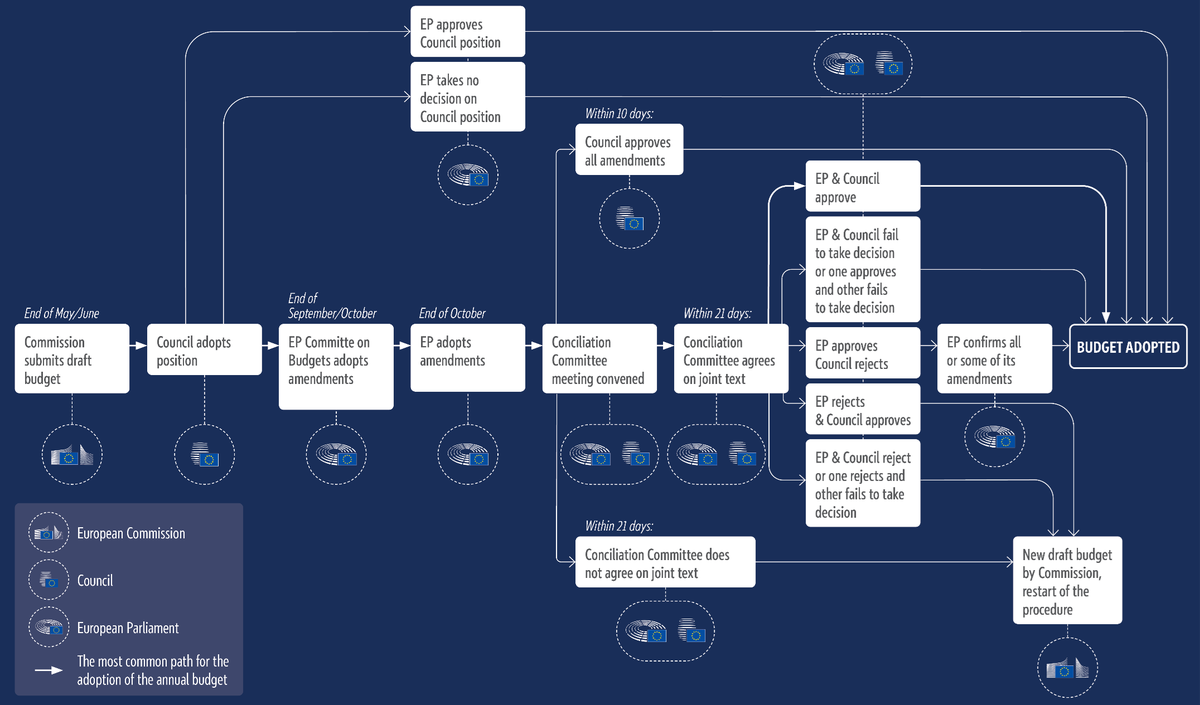
Each EU institution and body that has its own section in the EU budget starts the EU annual budgetary procedure by preparing its expenditure estimates for the forthcoming year. The Commission processes these estimates and produces a draft budget, including the revenue side. This draft budget is accompanied by a series of 'working documents' providing further information on specific topics (see Annex 2 for the complete list of working documents in the draft budget). The Council amends the Commission's draft budget and forwards its position to the European Parliament.
Parliament amends the Council's position through the work of its Committee on Budgets (BUDG) and the specialised parliamentary committees. Then, Parliament adopts its position in plenary. As there are generally differences between the Council's and Parliament's positions, a Conciliation Committee is convened to negotiate a joint text that reflects their agreement. If that fails, the Commission is obliged to present a new draft budget.
The annual EU budgetary procedure is described in detail in Articles 312 to 324 TFEU. The Treaty provides for several alternative scenarios for the adoption or the non‑adoption of the annual budget. Some of these scenarios are highly unlikely, as they would imply one of the arms of the budgetary authority abandoning its powers (see Annex 3 for the possible Treaty scenarios framed in the 'pragmatic calendar').
The Treaty sets the deadlines for the different steps. However the Treaty deadlines differ from the established practice set out in the pragmatic calendar. The pragmatic calendar is based on deadlines which are considerably earlier than the Treaty provisions. This gives the institutions more time to develop their positions and to reach an agreement (see Table 1 for a comparison between the Treaty calendar and the pragmatic calendar, using the 2025 budgetary procedure as an example).
| Step | Treaty calendar | Pragmatic calendar | Budget 2025 calendar |
|---|---|---|---|
| Estimates of expenditure | 1 July | March/April | |
| Draft budget | 1 September | End of April/ beginning of May (June in European Parliament election years) | 19 June 2024 |
| Council reading | 1 October | End of July | 17 July 2024 |
| Parliament reading | Not later than 42 days after Council reading | End of October | 21 to 24 October 2024 |
| Conciliation | 21 days from the day of its convocation | Following the Treaty calendar |
29 October to 18 November 2024 Planned adoption of joint text by the European Parliament: 25 to 28 November 2024 |
Source: EPRS.
Following the pragmatic calendar, the Council publishes its position in July, but waits for the formal adoption of its position until the end of August/beginning of September. This enables the European Parliament to meet the deadline of 42 days after the Council to adopt its position, and avoids the arrival of the Council's position in the middle of the summer recess.
Who does what in Parliament in the budgetary process?
The European Parliament and the Council are the budgetary authority. The two institutions, assisted by the European Commission, decide on the budget in the annual EU budgetary procedure. Parliament amends the Council's position, then negotiates with a view to reaching an agreement, and finally adopts the EU budget, signed off by Parliament's President.
The European Parliament's Committee on Budgets is responsible for preparing Parliament's position on the annual budget. This position, consisting of the budgetary amendments and the budget resolution, is then put to the vote and usually confirmed without amendments by Parliament in plenary.
Every year, the BUDG committee appoints two rapporteurs responsible for annual budget preparations. One of them is the general rapporteur, and the other the rapporteur for other sections. The general rapporteur deals with Section III (European Commission), while the rapporteur for other sections deals with the remaining EU budget, including the budget of the European Parliament.
Each specialised committee of the European Parliament chooses its own budget rapporteur. This rapporteur is responsible for the opinion and amendments decided by that specialised committee.
The chair of the BUDG committee presides over the votes in that committee and over the budgetary negotiations with the Council during trilogue meetings. Even though the President formally leads Parliament's delegation in conciliation, this role is usually delegated to the BUDG chair.
Life cycle of a budgetary amendment in the European Parliament
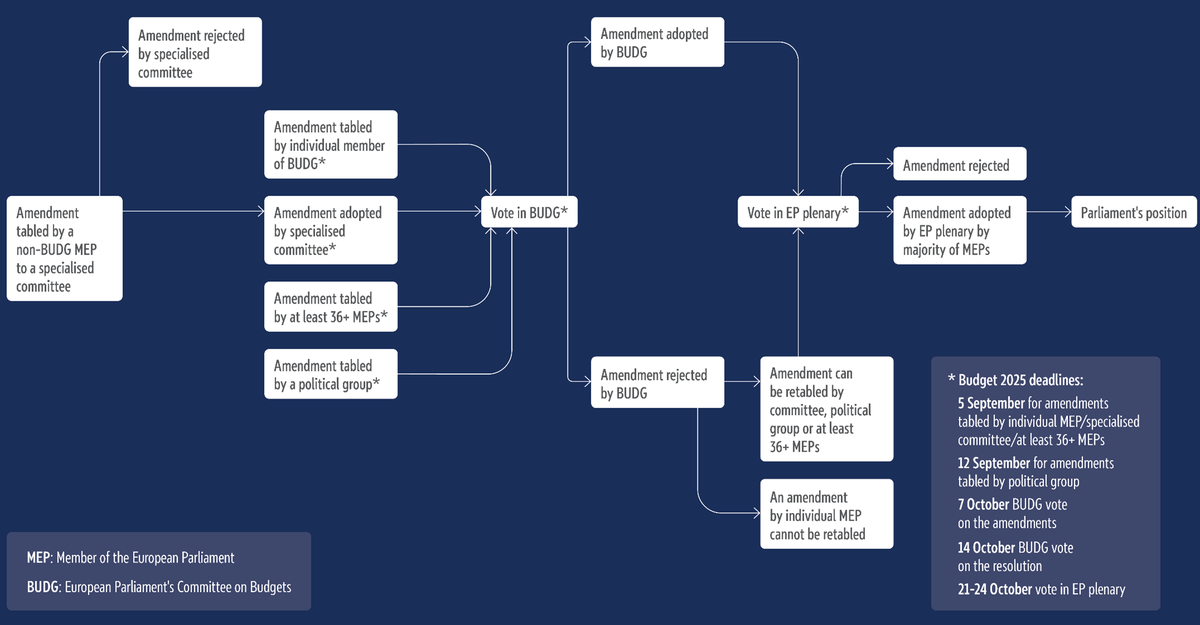
Members of the European Parliament can modify the draft annual budget through amendments to the Council's position. There are different entry points for such amendments, as outlined in Rule 96 of Parliament's Rules of Procedure. Individual Members may table amendments to the Council's position to the committee responsible (BUDG). Members can also table an amendment in their specialised committee. Alternatively, a political group or Members reaching at least the low threshold (one‑twentieth of Parliament's component Members, that is 36+ MEPs in this legislature) or a committee may table an amendment directly before the whole Parliament in plenary (see the visualisation of these possibilities in the graphic in Annex 4, 'Lifecycle of a budgetary amendment').
The deadlines for tabling amendments and the possibility of re‑tabling an amendment for a vote in plenary differ, depending on the author(s). An amendment by an individual Member cannot be re‑tabled in plenary once the amendment is rejected by the BUDG committee. However, amendments tabled by a group of at least one‑twentieth of Parliament's component Members, a specialised committee or a political group can be re‑tabled in plenary.
First, Parliament's specialised committees prepare their opinions on the forthcoming year's budget and budgetary amendments to the Council position. Then, the adopted amendments of the specialised committees are transmitted to the BUDG committee, which assesses them together with the amendments tabled to the BUDG committee.
The BUDG chair determines their eligibility and the rapporteurs propose a coherent set of amendments that respects the limits of the MFF. The rapporteurs call for the use of flexibility instruments when necessary.
The BUDG coordinators and shadow rapporteurs agree on the draft compromise amendments proposed by the rapporteurs. Moreover, the budget rapporteurs prepare for voting on amendments by aggregating them in 'compromise amendments'. Then, these are voted on collectively by the BUDG committee. Usually, compromise amendments are divided by MFF headings with a separate set for pilot projects and preparatory actions.2
The BUDG committee reflects its budgetary amendments in a resolution, where it clarifies its position and recalls its priorities. The budgetary resolution is adopted at a subsequent BUDG committee meeting.
Budgetary trilogues
During the year, the European Parliament, the Council and the European Commission meet several times in trilogues with the aim of presenting their positions. Usually these meetings take place in March, July and October.
The Council and Parliament both adopt a series of intermediate documents stating and explaining their respective positions. This process starts with the General Guidelines for the next year's budget, published in March ahead of the draft budget preparation.
The July trilogue is the opportunity for the Council to present its position, and for Parliament to present its preliminary position. Parliament's position for the July trilogue stems from a working document on the Commission's draft budget or the Council position, drawn up on the basis of Parliament's Guidelines, which are prepared by the rapporteur in coordination with the shadows.
A further trilogue takes place ahead of the adoption of Parliament's position in October. Throughout the budgetary procedure the budget rapporteurs publish working documents, which serve as an information source for Members of the BUDG committee.
The secretariat of the BUDG committee publishes a series of 'BUDG procedure documents (Docs)' (see Box 1). The 'Docs' present the budget lines with corresponding amendments following different stages in the processing of the draft budget. They are numbered, and Doc 4 is the basis of the voting list during the BUDG committee vote that takes place at the end of September/beginning of October.
Box 1 BUDG secretariat procedure documents
Doc 1 – Draft budget
Doc 2 – Council's position
Doc 3 – Amendments tabled with Plenary Sitting Service
Doc 4 – Amendments submitted to BUDG
Doc 5 – Amendments not adopted by BUDG
Doc 6 – Amendments adopted by BUDG
An important forum to build a compromise on Parliament's position is the BUDG coordinators' meeting. This body consists of the BUDG chair and deputy chairs, political groups' budget coordinators and budget rapporteurs, supported by the administration's staff members. Shadow budget rapporteurs also take part in the coordinators' meetings that deal with the budgetary procedure. The rapporteur presents and discusses his/her strategy with the coordinators, following which the details of the compromise package are mainly agreed among the 'budget team' composed of the budget rapporteurs and their shadows.
Conciliation
Parliament adopts its position in the second plenary of October. If this position amends the Council's position, Parliament's President, in agreement with the Council, convenes a meeting of the Conciliation Committee.
Parliament's President and the rotating Council presidency chair the Conciliation Committee. However, Parliament's President can delegate this task to a Vice‑President or the BUDG chair. Parliament's delegation is composed of 27 Members chosen by political groups, usually members of the BUDG committee. The BUDG chair and the budget rapporteurs lead the negotiations on behalf of Parliament. The Council delegation consists of representatives from the 27 Member States and is chaired by the rotating presidency.
The aim of the Conciliation Committee is to agree on a common position of the Council and Parliament, formulated in a 'Joint Text'. The Conciliation Committee has 21 days to complete the Joint Text. If this deadline expires, the Commission must submit a new draft budget and the annual budgetary procedure starts again.
What happens in the case of non‑agreement of the budget?
The two arms of the EU budgetary authority, the European Parliament and the Council, have to agree a common position on the forthcoming annual budget to be validated, at the latest at Parliament's last plenary session of the year preceding the year in question. Practically, this means an agreement has to be found at the December plenary session at the latest.
If conciliation fails to bring an agreement within 21 days, the Commission is obliged to present a new draft budget. Trilogues would continue informally, so that the Council and Parliament reach a compromise before carrying out their respective readings.
If there is still no agreement on the EU budget by 31 December, the system of 'provisional twelfths' comes into force automatically as envisaged by Article 315 TFEU. This means that each chapter of the budget will be funded monthly, up to a maximum of one twelfth of its appropriations of the previous year or of the draft budget, whichever is the lowest. This is a temporary default system, where there is no need for a decision by the EU budgetary authority to enter provisional monthly budgets. When an agreement is reached, the adopted budget applies retroactively to the full year.
Main references
- Council Regulation (EU, Euratom) No 2024/76513 of 29 February 2024 laying down the multiannual financial framework for the years 2021‑2027.
- European Union Public Finance, Directorate‑General for Budget, European Commission, 5th ed., Luxembourg, 2014.
- Guidelines for the 2025 Budget – Section III, European Parliament, 13 March 2024.
- Interinstitutional Agreement of 16 December 2020 between the European Parliament, the Council and the Commission on budgetary discipline, on cooperation in budgetary matters and on sound financial management, OJ LC 433, 20.12.2020.
- Regulation (EU, Euratom) 2018/1046 of the European Parliament and of the Council of 18 July 2018 on the financial rules applicable to the general budget of the Union, OJ L 193, 30.7.2018.
- Rules of Procedure of the European Parliament, July 2024.
- Treaty establishing the European Atomic Energy Community, OJ C 203, 7.6.2016.
- Treaty on the Functioning of the European Union, OJ C 202, 7.6.2016.
European Parliament supporting analysis
- 2025 Procedure, Committee on Budgets, European Parliament website.
- 2025 budgetary procedure: Key dates, Directorate for Budgetary Affairs, Secretariat of the Committee on Budgets, European Parliament, June 2024.
- Budgetary procedure, Directorate‑General for Internal Policies, European Parliament.
- James E., Fact Sheet on the Budgetary Procedure, European Parliament, April 2024.
- D'Alfonso A., Dobreva A., Sapała M., Kowald K., Mazur S., Mileusnic M., Pari M., Peters T. and Toft S., Budgetary Outlook for the European Union 2024, EPRS, European Parliament, April 2024.
Other sources
- Crombez C. and Hoyland B., The budgetary procedure in the European Union and the implications of the Treaty of Lisbon, European Union Politics, Vol. 16(1), pp. 67‑89, 2015.
- How is the EU budget prepared?, European Commission website, July 2024.
- The EU's annual budget, European Council website, July 2024.
- Statement of estimates 2025, Directorate‑General for Budget, European Commission, 19 June 2024.
- Working documents 2025, Directorate‑General for Budget, European Commission, 19 June 2024.
Endnotes
Annex 1 – Sections of the European Union budget
| Section | EU Institution |
|---|---|
| Section I | European Parliament |
| Section II | European Council and Council |
| Section III | Commission |
| Section IV | Court of Justice of the European Union |
| Section V | Court of Auditors |
| Section VI | European Economic and Social Committee |
| Section VII | European Committee of the Regions |
| Section VIII | European Ombudsman |
| Section IX | European Data Protection Supervisor |
| Section X | European External Action Service |
Data source: EPRS
Annex 2 – Commission draft budget working documents
| Number | Name |
|---|---|
| Working Document I | Programme statements of operational expenditure |
| Working Document II | Human resources of the EU institutions and executive agencies |
| Working Document III | Bodies set up by the EU having legal personality and public‑private partnerships |
| Working Document IV | Pilot projects and preparatory actions |
| Working Document V | Budget implementation and assigned revenue |
| Working Document VI | Commission expenditure under the administrative heading of the multiannual financial framework |
| Working Document VII | Commission buildings |
| Working Document VIII | Expenditure related to the external action of the European Union |
| Working Document IX | Funding for international organisations |
| Working Document X | Financial instruments |
| Working Document XI | EU trust funds |
| Working Document XII | Payment schedules |
Data source: EPRS
Annex 3 – Annual EU budgetary procedure: Possible Treaty scenarios and the pragmatic calendar
Data source: EPRS. Graphics by Lucille Killmayer, EPRS
Annex 4 – Life cycle of a budgetary amendment in the European Parliament
Data source: EPRS. Graphics by Lucille Killmayer, EPRS
Disclaimer
This document is prepared for, and addressed to, the Members and staff of the European Parliament as background material to assist them in their parliamentary work. The content of the document is the sole responsibility of its author(s) and any opinions expressed herein should not be taken to represent an official position of the Parliament.
Copyright
© European Union.
The reuse of this document is authorised under a Creative Commons Attribution 4.0 International (CC-BY 4.0) licence.

To use or reproduce elements that are not owned by the European Union, permission may need to be sought directly from the respective rightsholders.