
Article page checkbox is not checked in page info.
The policy priorities of the von der Leyen II Commission: State of play ahead of the 2026 State of the Union address
The policy priorities of the von der Leyen II Commission State of play ahead of the 2026 State of the Union address
Sarah Sheil, Members' Research Service
Summary
This EPRS paper analyses how the European Commission is delivering on the policy agenda set by its President, Ursula von der Leyen, and her College of Commissioners since taking office in December 2024. It provides an initial assessment of the delivery of the agenda's seven priorities in the run-up to the 2026 State of the Union address.
The von der Leyen II Commission has set seven priorities, under which it has so far announced over 400 initiatives. Almost half of these initiatives fall under the first priority, on prosperity and competitiveness; one in seven under the second, on defence and security; and one in 10 under the third, on social fairness. The remaining initiatives fall under the other four priorities.
Two figures provide summary information in infographic format: 1) charting the Commission's legislative and non-legislative delivery as of 31 August 2026; 2) an overview of progress on all the omnibus packages presented by the Commission in this mandate.
Introduction
In the run-up to the 2026 State of the Union address, the Members' Research Service of the European Parliamentary Research Service (EPRS) presents its twice-yearly monitoring of the Commission's delivery. This paper analyses in which areas the Commission has focused its efforts, how much it has achieved in relation to its commitments – as primarily set out in the previous State of the Union address and the 2026 Commission work programme. It also looks at how the Commission's priorities respond to an ever-changing geopolitical environment (from Ukraine to the Strait of Hormuz, from Canada to Mercosur, from China to Ceuta), evolving political and citizens' expectations – notably after a summer of record-high temperatures and wildfires – and the discussions on the proposals for the next multiannual budget to meet these challenges.
Since the beginning of its second mandate, the von der Leyen II Commission has made competitiveness its first priority. It comes first in terms of announcements, initiatives tabled, and texts adopted. This was reiterated by the presidents of the European Parliament and Council of the European Union, as well as of the Commission, in the 'One Europe, One Market' roadmap signed in April 2026. Starting its six-month mandate in July 2026, the Irish Presidency has taken on the baton, and has made competitiveness the first of its central themes.
The 'new era for European defence and security' comes next. The mainly non-legislative nature of the Commission's second priority translates differently, with initiatives far fewer in number but of high political prominence. This policy area is at the forefront in the interinstitutional joint declaration on the EU's legislative priorities for 2026.
The use of 'omnibuses', going beyond the first priority, has been extended from 10 to 12, with taxation (omnibus XI) and energy and tyre labelling (omnibus XII). A 13th omnibus on citizens is due in the fourth quarter of 2026. Figure 2 monitors progress from the tabling of the legislative proposals through negotiation to adoption by the co-legislators and publication in the Official Journal.
On deliveries, 423 initiatives have been announced, the large majority under this Commission but a significant minority (126) were inherited from the von der Leyen I Commission, and a further 33 from earlier mandates. Initiatives under 'A new plan for Europe's sustainable prosperity and competitiveness' – the first priority – account for half (211) of the Commission's announcements; among these initiatives, three in four (156) have been tabled, of which more than a quarter have already been adopted (47). Over half (84) are proceeding normally, and 14 are close to adoption. The defence and security priority comes next, with one in eight of all the proposals announced. Under this priority, more than two thirds have been tabled. Of these, one third have been adopted, while half are proceeding normally. Social fairness is next, with one in 10 of all the initiatives announced. Under this priority, two thirds have been tabled. Of these, only two in five have been adopted, while half are proceeding normally. As usual, this paper reports on achievements as well as delays.
By way of comparison, at the same stage in von der Leyen's first mandate, i.e. on the eve of its second State of the Union address, the Commission had announced almost as many proposals (406 in 2021, 423 in 2026).
Our data show that in an unstable environment and uncertain times, the European institutions are delivering. The Commission has been steady in tabling initiatives, and the co-legislators in negotiating and adopting legislative proposals. Compared with six months ago, the number of legislative proposals adopted has almost doubled, jumping from 57 to 105.
This does not mean that all expectations have been met. A quarter of the initiatives announced are still to be delivered, including a third of initiatives under Priority 5. The seven chapters in this paper indicate, among other things, which initiatives have not been delivered as announced and scheduled. They also assess how the proposals for a multiannual financial framework (MFF) reflects the Commission's political priorities. The upcoming MFF negotiations will be crucial.
As in previous editions, this analysis covers all seven of the Commission's priorities. The infographic (see Figure 1) illustrates the degree of progress numerically, both overall and by priority, while the two-page commentary in the chapter on each priority focuses on the major themes and developments in that area. The first priority is covered in six pages, given its breadth and importance. This publication also presents a panorama of Commission omnibus packages and progress in adopting them (see Figure 2).
The next issue in this series will be published in spring 2027.
For more information on how the von der Leyen II Commission's agenda is progressing, readers are invited to consult the proposal-by-proposal assessment on the European Parliament's Legislative Train Schedule website, developed and regularly updated by EPRS.
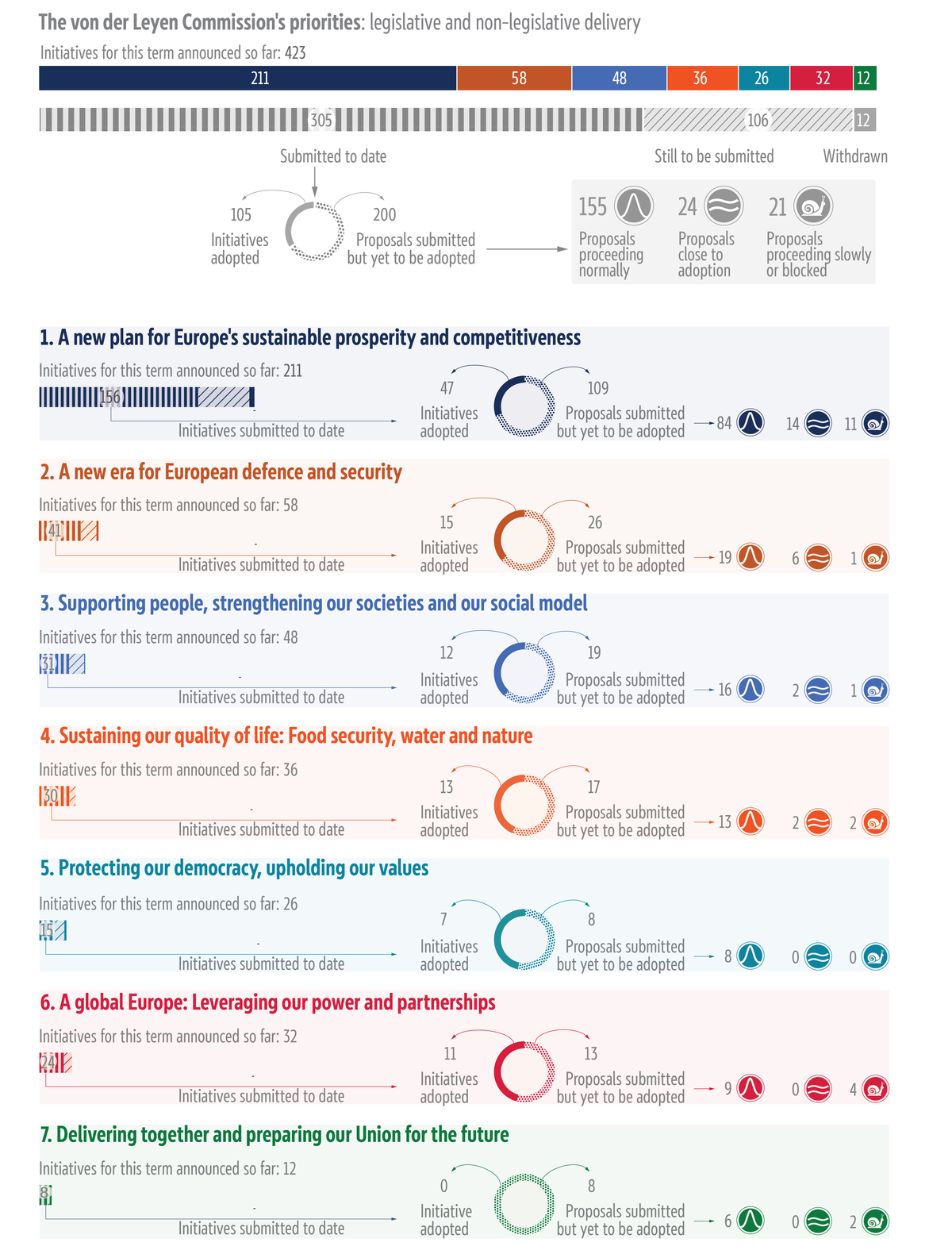
Data source: EPRS. Graphic by Giulio Sabbati.
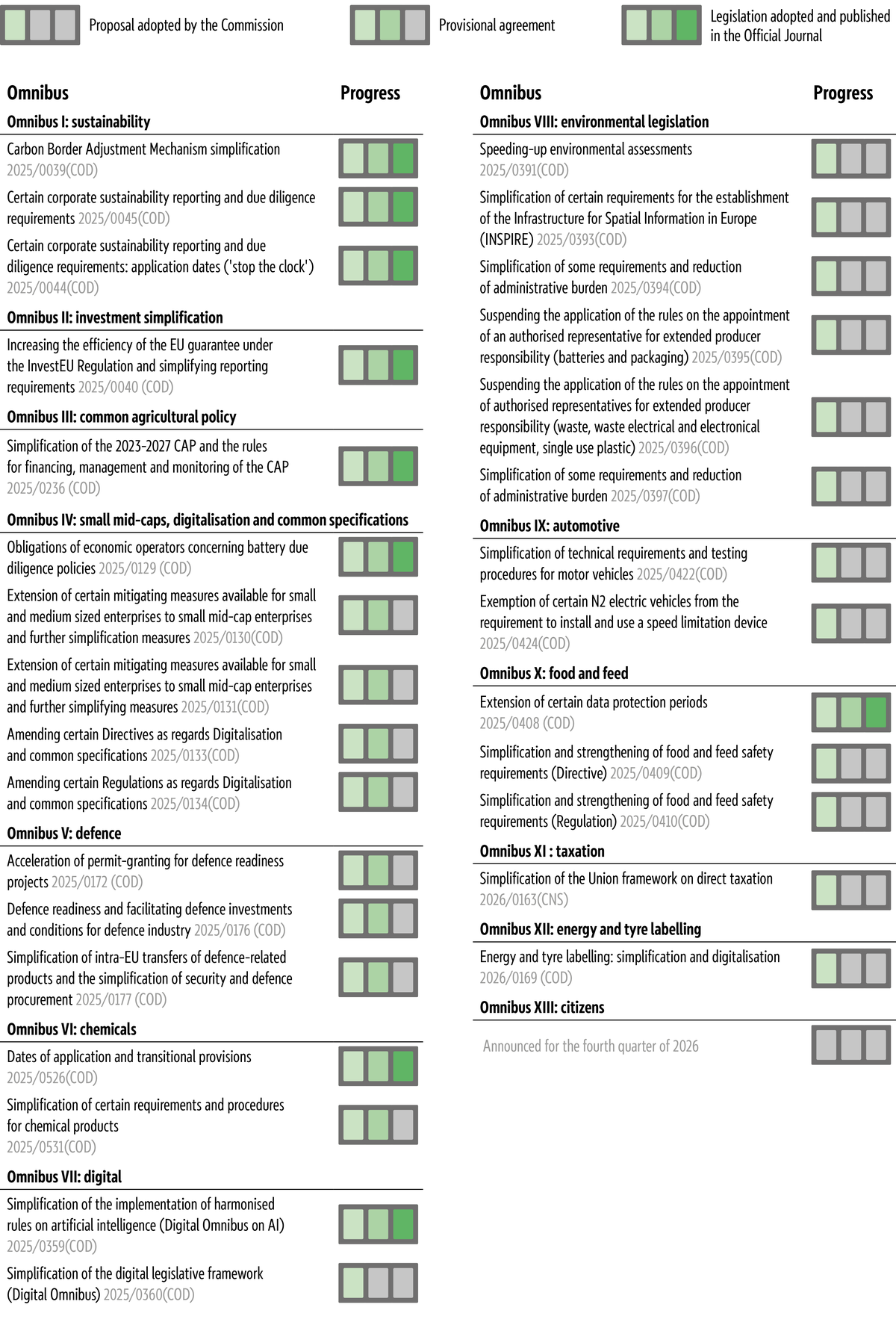
Data source: EPRS. Graphic by Samy Chahri.
1. A new plan for Europe's sustainable prosperity and competitiveness
The von der Leyen II Commission has placed competitiveness at the core of its agenda. Competitiveness is seen as essential for enabling European businesses to adapt, remain resilient, and sustain prosperity in an increasingly divided global economy. The Commission's approach to strengthening Europe's competitiveness has been shaped by the 2024 Draghi and Letta reports. In May 2026, Mario Draghi emphasised that Europe's strategic investment needs an average of nearly €1.2 trillion per year, including recent defence commitments. The vulnerabilities identified in his report remain largely unresolved.
According to his analysis, Europe's competitiveness is undermined by persistent structural weaknesses, including an incomplete single market, fragmented energy markets, segmented capital markets, and a defence industry divided along national lines. Growth is further constrained by an innovation gap, regulatory complexity, and strategic dependencies; and rising investment needs in defence, decarbonisation, and digital infrastructure are straining already tight public finances.
In the competitiveness compass, from 2025, the Commission set out a five‑year roadmap with priority actions to foster growth, encompassing a broad spectrum of extremely diverse initiatives.
The joint declaration of the Parliament, Council and Commission on EU legislative priorities for 2026 identifies competitiveness, including simplification, as an overarching principle guiding the work of the institutions. The 'One Europe, One Market' roadmap was signed by the Presidents of Parliament, the Commission and the Council on 24 April 2026. It sets out a series of legislative files that are to be treated as priorities by the three institutions, with dates for the delivery of the Commission proposal and target dates for the conclusion of legislative negotiations. The roadmap divides the files under the following headings: i) simplifying rules, ii) a more integrated single market (including by removal of the 'terrible ten' barriers identified in the single market strategy), iii) championing strong trade, iv) reducing energy prices and decarbonising, and v) driving the digital and artificial intelligence (AI) transformation.
Where the roadmap overlaps with the 2026 Commission work programme, the dates for the Commission proposals broadly correspond to the commitments already made in the work programme.
A progress review of implementation of the joint declaration and the 'One Europe, One Market' roadmap for the period March to June 2026 was published in June 2026, at the time of the European Council meeting. Progress is expected to be reviewed quarterly by the three institutions (Parliament, Council and Commission).
The sections below follow the structure of the Commission's competitiveness agenda.
Simplifying the business environment
A cornerstone of the von der Leyen II Commission is regulatory simplification, pursued, principally, through 12 omnibus (see Figure 2) packages aimed at reducing the regulatory burden and thus administrative costs. As explained in its communication on implementation and simplification of February 2025, by the end of its mandate, the Commission intends to reduce recurring administrative costs by at least 25 % for all companies (equivalent to savings of €37.5 billion) – and by 35 % for small and medium-sized enterprises (SMEs).
In April 2026, the Commission adopted a communication on a simpler, clearer and better enforced EU rulebook, which emphasises that new EU initiatives should be 'simple by design'. The Commission also calls on Parliament, the Council and the Member States to adhere to it when exercising their prerogatives. By modernising the way EU laws are designed, implemented and enforced, the Commission aims to support the achievement of the 'One Europe, one market' roadmap (see below). The communication is accompanied by a regulatory deep cleaning action plan, aimed at decreasing burdens, modernising and simplifying 12 policy areas, while also contributing to strengthening competitiveness and innovation. Those policy areas are: free movement of goods and services, financial services and banking, customs, taxation, health and food safety, agriculture, transport, energy, climate, environment, digital, and housing and permitting. According to the Commission, they will be examined as a matter of priority in 2026 and 2027. According to the Commission, the 'deep cleaning' may result in legislative or other regulatory proposals, support measures, repeals, withdrawals or other actions to address outdated provisions, overlaps, inconsistencies or redundant requirements that generate unnecessary burdens, and foster consolidation.
On 24 June 2026, the Commission presented a tax simplification package. It includes two legislative proposals: one for a taxation omnibus (see Figure 2) aimed at simplifying five directives in the field of direct taxation, and the other for a recast of the directive on administrative cooperation in the field of taxation. The taxation omnibus would, for example, abolish withholding taxes on cross-border payments of dividends, interest and royalties between EU companies. According to the Commission, the package is estimated to generate savings and reduce compliance costs for business by €7.9 billion.
On the same day, the Commission presented its 12th omnibus (see Figure 2), aimed at simplifying the rules on labelling for energy-related products and tyres. The proposal seeks to streamline these rules, which are designed to provide customers and end-users with harmonised and comparable information on energy use and other characteristics of the products prior to purchase. The proposal would, for instance, introduce more flexibility in the format for energy labels accompanying products and align the process for reviewing tyre labels with the procedure for updating energy labels. The Commission claims that this package would save companies and market surveillance authorities up to €125 million annually over the next decade.
Reducing energy prices and decarbonising
On 10 March 2026, the Commission adopted the citizens energy package, following up on an announcement in Commissioner Dan Jørgensen's mission letter. The package sets out non-binding measures to lower household energy bills by reducing electricity taxes and levies, optimising network tariffs, expanding access to clean and efficient technologies (such as heat pumps), and improving market transparency through 24-hour supplier switching and best-tariff advice.
Also in March 2026, the Commission put forward a clean energy investment strategy as a follow‑up to the affordable energy action plan. The strategy seeks to mobilise private capital for the energy transition by de‑risking clean-energy investments, improving access to finance for energy infrastructure and establishing structured cooperation with the financial community, to be backed by €75 billion in European Investment Bank Group financing over three years.
In response to the spike in fossil fuel costs triggered by the closure of the Strait of Hormuz in February 2026, the AccelerateEU communication was adopted in April 2026 with the aim of proposing measures to mitigate rising energy prices and reduce the EU's fossil fuel exposure, combining short-term relief measures with a faster structural shift towards electrification and clean-energy production. Building on the citizens energy package and AccelerateEU, the Commission published a further set of recommendations on 30 April 2026. These focus on protecting vulnerable customers from disconnections, supplier risk management, key contractual terms of energy supply contracts, and energy communities and self-consumption.
One of the key elements of AccelerateEU was the announcement that the Commission would come forward with a proposal to revise network charges and thereby reduce electricity bills for consumers. The proposal targets network charges that businesses and households pay to cover the cost of transporting energy to where they consume it. This makes up between a quarter and a third of electricity prices and is key to energy affordability. The Commission proposal on future-proofing electricity bills in the Union was adopted on 17 July 2026. It would particularly reduce network charges for certain consumer groups and taxes for energy-intensive businesses.
On the same day, the Commission published its electrification action plan. Currently, the electrification rate of Europe's economy, in terms of final energy consumption, stands at 23 %. The clean industrial deal introduced a 32 % target as a 2030 key performance indicator. The electrification action plan will serve as a strategic roadmap to accelerate the adoption of electricity across the sectors of the economy that still heavily rely on fossil fuels, namely transport, heating and some industrial processes. The Commission proposes an indicative target of 46 % as the share of electricity in final energy consumption by 2040.
Lastly, on 24 March 2026 the Commission postponed the dedicated legislative proposal on the full phasing-out of Russian oil imports due to the spike in fossil fuel prices following the closure of the Strait of Hormuz. It had originally committed to that proposal following a trilogue agreement on the phase-out of Russian natural gas imports in December 2025, which led to the adoption of Regulation (EU) 2026/261 (see Priority 6). Prior to the full-scale invasion of Ukraine by Russia in February 2022, 27 % of the oil consumed in the EU was imported from Russia; that figure currently stands at 2 % (only two Member States still import oil from Russia). Furthermore, the legislative proposal on phasing out the import of nuclear material from Russia, announced in the Commission roadmap towards ending Russian energy imports in May 2025, has also been postponed due to the intense complexity of global nuclear material supply chains.
Advancing the EU ETS reform
The update of the EU emissions trading systems for stationary installations, aviation and maritime (ETS1), and the relevant market stability reserve (MSR1) was part of the Commission 2026 work programme. On 17 July 2026, the Commission adopted a proposal on driving competitiveness and cost-effective decarbonisation, addressing different issues including the expansion of greenhouse gas (GHG) emissions coverage to international aviation and non-CO2 aviation effects, municipal waste incineration, and how to account for negative emissions resulting from GHG emissions removed from the atmosphere and safely and permanently stored. The Commission also proposed to include GHG emissions from medium-sized offshore and cargo ships in the EU ETS and extending existing derogations until 2035.
In line with Regulation (EU) 2026/667 setting a Union climate target for 2040, the Commission also proposed revising the current ETS trajectory to take into account the agreed 2040 target in a manner that would allow for limited GHG emissions after 2039, and a slower phase-out pathway for free allocation of allowances extended until 2038.
The Commission complemented the ETS1 and MSR1 updates with two additional initiatives, including a targeted proposal to cancel the automatic invalidation of allowances above 400 million from the MSR1, and a separate proposal introducing sector-specific fallback benchmarks (heat and fuel) for free allocation. The overall package is expected to define the EU ETS framework post 2030.
Deepening the single market
Building on previous political signals given by the European Council, the Council and Parliament, as well as the Letta and Draghi reports, the Commission adopted the single market strategy in May 2025. The strategy focuses on five areas: i) removing the most harmful barriers, the so-called 'terrible ten'; ii) a new approach to European services markets; iii) supporting SMEs and mid-caps; iv) digitalisation of procedures; and v) enforcement, with emphasis on the ownership of the single market by Member States.
Three of the flagship initiatives outlined by the single market strategy were specified in the 2026 Commission work programme, as follows: a review of the EU public procurement legislation, a review of the new legislative framework of product rules, and a review of the standardisation regulation.
The public procurement review would aim to modernise and simplify procurement rules, while making public procurement a tool for strategic investment. The envisaged date for adoption of the proposal in the work programme was the second quarter of 2026, but this has since slipped to 9 September 2026.
The latter two initiatives, together with an update of the market surveillance regulation, were grouped within a future European product act scheduled for adoption on 30 September 2026. This act is expected to consist of a package of initiatives designed to overhaul EU product legislation to equip it for a digitalised world and the opportunities presented by the circular economy, as well as to combat the influx of low-value consumer deliveries from outside the EU. In connection with the product act, on 9 June 2026 a political deal was struck on legislation amending the existing EU product legislation acquis to allow for the Commission to adopt common specifications instead of standards in certain situations and for greater use of digital technology by economic operators and public authorities. These files were part of the omnibus IV package on single market simplification (see Figure 2).
Scaling up investment
On 18 March 2026, the Commission adopted a proposal for a regulation on the 28th regime corporate legal framework (EU Inc.), which would establish a new business form aimed at facilitating operations and financing of startups and scaleups. The framework would allow for quick, fully digital registration that is automatically valid across the EU, thereby benefiting the operations of EU Inc. businesses and facilitating their expansion. In addition, the proposal would provide for a single tax treatment of employee remuneration through stocks, as well as employee participation schemes. Finally, the proposal would establish fast termination frameworks, but for startups only.
On 29 May, the Commission published the first European startup and scaleup scoreboard, providing an overview of startup and scaleup performance based on key indicators.
On 17 July 2026, the Commission adopted a communication announcing a series of measures and initiatives for the EU banking sector, aimed at strengthening its integration, efficiency, and competitiveness. The ultimate goal is to consolidate the EU economy by financing growth, innovation, and strategic priorities. This communication is part of the strategy for the savings and investments union (SIU) and announces measures and proposals to be presented in 2027. These will address the cross-border fragmentation of the EU banking sector, the implementation of international standards that consider the specificities of the EU, and the excessive complexity of the regulatory framework.
On 18 May 2026, the Commission announced that it had selected the EQT group (established in Sweden) to be the fund manager for the Scaleup Europe Fund. The fund is expected to direct up to €5 billion in late-stage financing to the most promising EU companies in strategic technology areas, such as AI, quantum technologies, semiconductor technologies, robotics and autonomous systems, energy technologies, space technologies, biotechnologies, medical technologies, advanced materials, and agritech.
Boosting productivity with digital tech diffusion
On 3 June 2026, the Commission presented a technological sovereignty package, addressing a critical weakness of the EU, namely that over 80 % of its digital products, services, infrastructure, and intellectual property rely on non‑EU providers. The package aims to strengthen the EU's position in digital technologies by boosting innovation, industrial capacity, and autonomy across supply chains. It seeks to secure the supply of key digital technologies, gain and maintain control over data infrastructures and critical data, and ensure that the EU leads the standard-setting process for strategic digital technologies. It includes two legislative proposals: firstly, a chips act 2.0, building on the existing Chips Act Regulation. The proposal aims to support the EU's capacity for industrial innovation and stimulate demand for semiconductors produced in the EU, increase the EU's resilience and security of supply in semiconductor technologies, and improve monitoring of the chips market to enable a swift response to supply disruptions. Secondly, a proposal for a cloud and AI development act (CADA). This would particularly support 'cloud and AI leadership initiatives', to drive research, innovation, and large-scale capacity across the EU's cloud and AI ecosystem. It would also streamline permitting through the designation of 'data centre acceleration zones' by Member States, enabling faster and large-scale infrastructure deployment under a clear regulatory framework. Finally, it would support the development of trusted cloud computing services. Additionally, the package includes an EU open source strategy and a strategic roadmap for digitalisation and AI in energy.
On 7 April 2026, the Commission adopted a proposal for a regulation on the EU Space Services Agency. The proposal aims to ensure continuity of the agency's operations beyond the current (2021-2027) MFF.
The Commission's 2026 work programme includes a legislative initiative on a Quantum Act. Originally announced for the second quarter of 2026, but not yet published, the initiative aims to deliver on the European declaration on quantum technologies and the Quantum Europe strategy.
The Commission presented an action plan on cybersecurity and artificial intelligence on 7 July 2026. The plan aims to support the safe and responsible use of advanced AI while strengthening Europe's cyber-resilience in a context where frontier AI can both bolster and undermine critical systems.
Supporting health, research and innovation
On 12 May 2026, a provisional agreement was reached on the proposal for a critical medicines act, which aims to address shortages of medicines and reduce dependencies relating to critical medicines and ingredients, as well as to ensure the supply of affordable medicines.
The proposal for a regulation on a European innovation act has been postponed until September 2026.
On 27 May 2026, the Commission adopted a proposal for a regulation establishing an EU‑level selection and authorisation procedure for systems providing mobile satellite services (MSS) in the harmonised 2 GHz band, replacing the 2008 MSS Decision ahead of the expiry of current licences in May 2027. It covers a key spectrum for the deployment of innovative satellite services. The proposal seeks to ensure a uniform EU framework by dividing the band equally for governmental use, EU commercial operators and all operators subject to security and data‑protection conditions. Under a new EU‑wide selection procedure, the Commission would set common authorisation conditions, run calls for applications and grant 20‑year rights of use based on admissibility, eligibility and comparative criteria where demand exceeds available spectrum.
Simplifying chemicals rules
On 27 April 2026, despite years of commitments, Commissioner Jessika Roswall informed the Environment, Climate and Food Safety Committee that the Commission had come to the conclusion that it would not revise the REACH Regulation on the risk management of chemicals at this point, on the grounds that major legislative changes would undermine the certainty and predictability that industry requires. The decision ends six years of preparatory work initiated under the European Green Deal and follows the Regulatory Scrutiny Board's rejection of the impact assessment in autumn 2025. The Commission has indicated that it will instead pursue targeted simplifications and updates to the annexes to the REACH Regulation through implementing and delegated acts.
On 16 June 2026, Parliament and the Council reached a political agreement on the chemicals omnibus (see Figure 2), aiming to simplify and align rules on classification, labelling and packaging (CLP), cosmetics and fertilising products. The deal preserves the simplification and digitalisation objectives of the Commission proposal but tightens a number of safeguards compared with the initial deregulation draft, notably on the treatment of carcinogenic, mutagenic or reprotoxic (CMR) substances in cosmetics, the legibility of labels and the handling of hazardous substances in fertilisers.
On 30 June 2026, Parliament and the Council reached a provisional agreement on a proposal for a basic regulation on the European Chemicals Agency, aiming to provide it with an autonomous legal framework and the resources needed to fulfil its duties under its growing mandate.
2. A new era for European defence and security
In the past six months, the EU has continued to develop its security agenda by advancing defence readiness, strengthening internal security, and implementing key reforms in migration, asylum and border management.
Bringing the defence union to life and creating a preparedness union
EU Member States are raising defence expenditure at a faster pace than previously anticipated. Since 2024, spending has increased by 20 %, reaching €418 billion in 2025, equivalent to 2.2 % of EU GDP. It is expected to rise further to €454 billion in 2026, representing 2.4 % of GDP. Combined with bilateral military assistance from EU Member States, total EU support for Ukraine's armed forces is estimated at €77 billion, of which €6.4 billion has been channelled through the European Peace Facility. On 23 April 2026, the Council approved a €90 billion loan for Ukraine to finance urgent budgetary and defence needs in 2026 and 2027. Around €60 billion is earmarked for defence industrial investment and procurement from the Ukrainian and EU defence industries, while a further €4.9 billion was disbursed in mid-2026 to support the procurement of drones.
The Security Action for Europe (SAFE) instrument has entered its implementation phase. Between February and April 2026, the Council approved defence investment plans for 18 Member States, unlocking up to €150 billion in EU backed loans, with the first disbursements beginning in May 2026.
On 30 March 2026, the Commission adopted the €1.5 billion work programme of the European defence industry programme (EDIP) for 2026 to 2027 and, on 3 July 2026, proposed five European Defence Projects of Common Interest (EDPCIs) in areas including air and missile defence, drones, maritime security, space and Eastern Flank surveillance, allocating €325 million to support their implementation as flagship multinational capability projects.
On 10 June 2026, the Council and the European Parliament reached a provisional agreement on the defence readiness omnibus (see Figure 2), a package designed to streamline the legal and administrative framework governing the defence sector. On 15 July 2026, the Council and Parliament reached a provisional agreement on the programme for agile and rapid defence innovation (AGILE), a new €115 million EU programme to provide rapid, targeted support for SMEs, start-ups and scale-ups developing emerging and disruptive defence technologies, with the aim of strengthening defence innovation across the Union.
On military mobility, the European Council conclusions of 18 and 19 June 2026 called on the co-legislators to agree on its legislative proposal by the end of 2026.
Despite progress on these files, major challenges remain, notably accelerating capability delivery, scaling up defence industrial production, reducing fragmentation in procurement, and ensuring sustained implementation of commitments by Member States.
A safer and more secure Europe
The EU internal security strategy, ProtectEU, announced new legislation to strengthen Europol and Frontex, modernise rules on organised crime and drug precursors, and revise the regulation on explosives precursors. On 24 June 2026, the European Commission published a proposal for a new Europol Regulation. Regarding drug precursors, work has begun in Parliament and the Council on the December 2025 proposal. The Commission is expected to adopt a proposal for the revision of the current rules to combat organised crime in the third quarter of 2026.
Alongside these new legislative efforts, progress has also been made on several long-standing files. The Directive on combating corruption was published in the Official Journal on 11 May 2026. Work has begun in Parliament and the Council on the February 2026 Commission proposal for a directive on common criminal law standards on illicit firearms trafficking. Parliament continues its work on the July 2025 proposal for a regulation establishing EU funding for internal security for the 2028‑2034 period: the Committee on Budgets adopted its opinion on 15 July 2026, while the Council adopted its partial negotiating position on the same day.
Initiated under the previous mandate, the 2022 proposal for permanent rules to combat child sexual abuse online remains under interinstitutional negotiation. Interim measures have been set up in the meantime as a temporary derogation from certain provisions of the e-Privacy Directive. They expired on 3 April 2026 and were reinstated on 23 July 2026 to last until 3 April 2028. Meanwhile, political agreement was reached on 22 June 2026 on the February 2024 proposal to recast the 2011 Directive on combating child sexual abuse.
Migration and stronger common borders
In June 2026, the pact on migration and asylum became fully applicable. It reforms border management, asylum procedures, responsibility-sharing among Member States, and cooperation with third countries. Two key elements of its implementation are the establishment of the solidarity cycle ‒ with the Commission presenting a European annual asylum and migration report ‒ and the development of a strategic, forward-looking framework for continued work under the pact over the next five years, set out in a European asylum and migration management strategy.
On 30 July 2026, an unprecedented mass irregular border crossing into Ceuta prompted an extraordinary meeting of EU home affairs ministers on 4 August. Ministers agreed to strengthen external border management, combat migrant smuggling, reinforce returns, deepen cooperation with third countries, and improve early warning and crisis coordination.
The EU has also continued work on Schengen governance through an EU visa policy strategy and on upgrading border and security information systems. A proposal to strengthen rules against the facilitation of unauthorised entry, transit and stay is awaiting committee decision. In July 2026, the Commission announced a new sanctions regime targeting criminal networks involved in migrant smuggling, human trafficking and other forms of organised crime.
The Commission also announced a further revision of the mandate of the European Border and Coast Guard Agency (Frontex) to address geopolitical, security and migration challenges, including implementation of the pact, hybrid threats and faster returns of individuals without a right to remain. The EU is finalising a return regulation introducing, notably, provisions on return hubs in third countries. In February 2026, two related regulations entered into force, covering the safe third country concept and a common list of safe countries of origin.
3. Supporting people, strengthening our societies and our social model
To sustain and improve European quality of life, Ursula von der Leyen promised in her political guidelines, presented ahead of her re-election in 2024, to promote social fairness, strengthen social and regional cohesion, and ensure equal opportunities for all. Stemming from this promise, the main objectives for the Commission's term are to deliver opportunities, stability and well-being for everyone, to strengthen our social market model to ensure a just transition for all, and to tackle inequality, regional disparities and discrimination. Given the limited competence in social policy provided to the EU by the Treaties, many of the initiatives envisaged so far are non-legislative.
Promoting social fairness in the modern economy
In December 2025, the Commission adopted a quality jobs roadmap, outlining its approach to competitiveness through quality jobs and its support to changing industries and economies. It followed with consultations on the next legislative step, announced for 2026: the quality jobs act, which is expected to focus on algorithmic management and AI at work; health and safety at work; subcontracting; just transitions; and enforcement and the role of social partners. Since the 2025 union of skills, as further steps towards ensuring fair mobility, the Commission has announced a fair labour mobility package, containing legislative initiatives on skills portability, a European social security pass and strengthening the European Labour Authority, all for the third quarter of 2026. These initiatives aim to further strengthen the labour mobility acquis, following recent successes such as the provisional agreements on social security coordination and the e-declaration portal for the posting of workers.
To address the worsening housing situation in a coordinated way, the Commission adopted a European affordable housing plan in December 2025, outlining how it wants to boost housing supply, mobilise investment, enable immediate support while driving reforms, and protect the most affected. In May 2026, it followed up on the plan by proposing a Council recommendation on fighting housing exclusion. Its 2026 work programme also announced legislative initiatives on short-term rentals and construction services for the second and fourth quarter of 2026, respectively. The forthcoming pan-European investment platform for affordable and sustainable housing, the roll-out of the Social Climate Fund and the adapted cohesion policy rules, which give Member States greater flexibility to invest, aim to move investment in housing into higher gear.
To give new impetus to the implementation of the 2017 European Pillar of Social Rights and achieve the 2030 social headline targets, von der Leyen originally announced a new action plan by the end of 2025, with stronger links to the European Semester. Having evaluated the 2021 action plan's implementation, in its communication of 22 July 2026 the Commission affirmed the plan's continued relevance and, instead of presenting a new one, it outlined three further areas of action to strengthen the plan's implementation: tackling the cost of living, AI's potentially harmful effects on the labour market and, more generally, inequalities.
The links with the European Semester have been strengthened through the social convergence framework, which has been embedded in the revised economic governance framework and become part of the European Semester cycle. The 2026 European Semester spring package reflects a change of focus towards ensuring a skilled workforce, linking economic performance with the human capital needed to achieve it, which has also newly translated into the country-specific recommendations.
Von der Leyen has pledged to step up EU action against poverty with a first-ever EU anti‑poverty strategy, which was adopted on 6 May 2026 and addresses the root causes of poverty across the life course. The Commission also sought to strengthen the 2021 Council recommendation on the European child guarantee – which aims to prevent and fight social exclusion through education, healthcare and other essential public services – with its communication on Breaking the cycle of child poverty. Von der Leyen has also pledged to tackle the root causes of demographic change and to reduce regional disparities, with a June 2026 strategy focusing on islands, outermost regions and cities.
The delivery of the update of the European Pillar of Social Rights action plan and of the strengthened European child guarantee reflect the challenge of matching the initial political intentions – declared amidst expectations from voters and political parties alike – with tangible outcomes in a policy area with limited EU competences. All the more so, as a corresponding priority strengthening has not translated into the proposed 2028-2034 long-term budget, which is currently being negotiated (see Priority 7). There, in the proposed European Social Fund 2028-2034, the logic of ringfencing funding levels to specific social priorities has been discontinued, which would hold also for the future support to the Just Transition Fund. Targeted EU support, for which Parliament has repeatedly pushed, would be left for Member States to interpret.
In November 2025, the Commission presented a new consumer agenda (2025-2030) with a new action plan on consumers in the single market.
Reuniting our societies and supporting young people
To address the growing divisions in society and increase solidarity among citizens, von der Leyen made intergenerational fairness a distinct part of a Commissioner's portfolio. A strategy on intergenerational fairness was adopted on 5 March 2026; a dedicated platform accompanies the process.
The political guidelines, with a strong focus on young people, aim to strengthen Erasmus+, including vocational education and training (VET), and the Commission aims to make the programme more inclusive and accessible for all, paying special attention to people with fewer opportunities. Further non-legislative initiatives promoting education are expected in the third quarter of 2026, focusing on European schools alliances, basic skills, and the future of digital education and skills.
Considering the protection of children's and young people's mental health to be a major challenge, von der Leyen launched an EU-wide enquiry into the broader impacts of social media on well-being. She has pledged to confront the unethical techniques used by online platforms and take action on the addictive design of online services. The February 2026 action plan against cyberbullying raises the prospect of potential EU-wide rules on social media age thresholds. On 13 July 2026, a special panel on child safety online published a report giving advice to the Commission, and the Commission announced that it would follow up by making a proposal after the summer.
Strengthening the union of equality
Building on its long-standing efforts to combat discrimination,the Commission has been implementing a new gender equality strategy 2026-2030. It had previously adopted an EU anti‑racism strategy 2026‑2030 in January 2026, an LGBTIQ+ equality strategy in October 2025 and a roadmap for women's rights in March 2025.
4. Sustaining our quality of life: Food security, water and nature
Ensuring food security and food sovereignty is a key priority in von der Leyen's political guidelines, which call for resilient agriculture and fisheries, in terms not only of competitiveness but also of preparedness for future shocks and protection of water and nature. This comes at a time when both the agri-food sector and the environment face growing challenges, especially from climate change.
Building a competitive and resilient agriculture and food system and safeguarding biodiversity
Discussions on the proposals that are part of the 2028-2034 MFF continue to dominate the Priority 4 agenda (see Priority 7). Specifically, this includes the proposal for a new regulation on common agricultural policy (CAP) rules for the 2028-2034 period, the targeted review of the Regulation on Common Market Organisation (CMO) for agricultural markets and a proposal for a new regulation on the EU support to the common fisheries policy for the 2028‑2034 period. The Commission has also been delivering on some, but not all, of its promises announced in the vision for agriculture and food, an overarching strategy that sets out the Commission's plans for the future of farming and food in the EU to 2040 and guides the Commission's work for this mandate.
Agriculture
The main tool to ensure food security, encourage sustainable farming and support farmers and rural areas remains the CAP. In June 2026, the Commission proposed temporary CAP support and payment of advances for farmers affected by the increased fertiliser prices due to the Middle East crisis. To ensure that farmers can afford fertilisers before the planting season for the next year, Parliament and the Council adopted the new regulation in record time, under five weeks.
In the meantime, work continues on the next CAP, with Parliament's committee rapporteurs rejecting significant parts of the Commission's proposals in their draft reports on the NRP regulation and on the CAP regulation. Together, the draft reports suggest ringfencing the overall CAP budget and maintaining the two CAP pillars, while 10 % of the total CAP would be ringfenced for young farmers, 35 % of rural development funds for agri-environment and climate actions, 5 % of rural development funds for the LEADER programme, and 5 % of rural development funds for crisis payments. The cap for direct payments would be set at €500 000 per natural person, while the agri‑environment and climate actions would be able to provide real incentives for farmers, as they would be allowed to exceed the amount of actual cost and income foregone. Parliament aims to agree its position on these files this year.
To ensure the viability of farms and strengthen farmers' position in the supply chain, two new regulations were adopted by the co-legislators in the first half of 2026. First, in March, on cross-border enforcement of the Unfair Trading Practices (UTP) Directive aiming to better protect farmers when selling to big buyers, such as large retailers or food processors, in other Member States. Then, in June, targeted amendments to the CMO Regulation were agreed with the aim of improving the bargaining position of producer organisations and making the mandatory use of written contracts more widespread in the agricultural sector. By the end of 2026, the Commission plans a review of the UTP Directive itself, notably to protect farmers from being pressured to sell their products below the cost of production.
To develop a long-term policy for a sustainable livestock sector, on 7 July 2026 the Commission adopted an EU livestock strategy and an EU protein action plan, which together aim to 'reduce strategic dependencies, reinforce European food security and contribute to a stronger, more resilient and more strategic European agri-food system'. In parallel, the Commission published a report on the evaluation of the animal health law. In addition, by the end of the year, the Commission aims to review the animal welfare legislation, including phasing out cages, which was requested by a European citizens' initiative. However, it is behind on some other initiatives announced in its 2026 work programme, such as the evaluation of the Biocidal Products Regulation, which was originally planned by the end of 2026, but has been postponed to the third quarter of 2027 (though some amendments were adopted in part 1 of the food and feed package in May 2026). The co-legislators are working on the second part of that package (Omnibus X – see Figure 2), which, among other measures, aims to accelerate market access for biopesticides, and ease the renewal procedures for pesticides, biocides and feed additive authorisations. An evaluation of the performance of the European Food Safety Authority (EFSA), planned for the first quarter of 2026, has not yet been delivered.
Fisheries
In line with the European Ocean Pact, adopted on 5 June 2025, the Commission has put forward initiatives that aim to protect ocean health, boost the EU's blue economy, and support coastal communities. In March 2026, it adopted the EU ports strategy and the EU industrial maritime strategy (the latter originally announced for 2025). In April 2026, it published the results of an evaluation of the Common Fisheries Policy Regulation, and in June it put forward the first-ever EU strategies for islands and coastal communities and a European ocean observation initiative. An ocean act, centred on a revision of the Maritime Spatial Planning Directive, is planned for the end of 2026. Its preparation will take into account the revision of the Marine Strategy Framework Directive to ensure coherent ocean governance.
Water and nature
With water supply increasingly at risk, the Commission announced a targeted revision of the Water Framework Directive for the third quarter of 2026. It is also working on helping farmers transition to more nature-friendly practices and has adopted a roadmap towards nature credits, as well as a revision of the Organic Regulation and a roadmap to reduce the burden on organic operators. In May 2026, it put forward a fertiliser action plan, laying out the steps to support domestic fertiliser production, promote the circular economy and decarbonisation.
Boosting climate adaptation, preparedness and solidarity
A binding 2040 climate target of net 90 % emissions reduction, compared to 1990, was adopted by the co-legislators in March 2026, amending the European Climate Law. Considering impacts from climate change among the biggest risks to our way of life and food security, the announced European integrated framework for climate resilience will aim to strengthen preparedness, with the proposal due in the second half of 2026. The Commission has also proposed to increase the budget (see Priority 7) for the EU civil protection mechanism.
5. Protecting our democracy, upholding our values
This priority strengthens the focus on protecting democracy through the European democracy shield, building on long-standing initiatives already established under the von der Leyen I Commission to counter foreign information manipulation and interference (FIMI), put citizens at the heart of European democracy, and strengthen the rule of law. The Irish Presidency, running from July to December 2026, intends to focus on this priority.
Protecting our democracy
Against the backdrop of aggravating threats from foreign state and non-state actors against European democracy and values, paired with growing internal pressure, the Commisssion included in the 2024 political guidelines a commitmenet to a European democracy shield (EDS). On 12 November 2025, the Commission and the High Representative/Vice-President of the Commission (HR/VP) adopted a joint communication on the European democracy shield: Empowering strong and resilient democracies, aimed at protecting against FIMI, boosting societal resilience and preparedness, building a European network of fact-checkers, stepping up digital enforcement, addressing deepfakes, and preserving and promoting freedom of expression. The EDS initiative comes amid intensifying pushback from the US government and industry actors against EU digital regulation.
Main responsibility for the EDS lies with the European Commissioner for Democracy, Justice, the Rule of Law and Consumer Protection, Michael McGrath. The EDS aims to protect democracy against multifaceted threats, including 'interference and distortions in the information space' as well as hybrid threats aimed at impacting elections and eroding trust in democratic processes. Actions due up to 2027 under the EDS fall under four key pillars: 1) a European Centre for Democratic Resilience; 2) safeguarding the integrity of the information space; 3) strengthening institutions, fair and free elections, and free and independent media; and 4) boosting societal resilience and citizens' engagement.
The new European Centre for Democratic Resilience is the most visible innovation in the EDS. Launched at the General Affairs Council meeting on 24 February 2026, the centre is to serve as a framework for exchange, operational cooperation and coordination among participating Member States, EU candidate countries and potential candidates, as well as EU institutions. Priority areas for the first year include: developing tools to support resilient elections; an EU blueprint to counter FIMI and disinformation; a stakeholder platform for civil society organisations, think tanks, researchers, academia, fact-checkers and media organisations; fostering capacity building and mutual learning; identifying modalities of cooperation with EU candidate countries and potential candidates; and involving citizens, including through citizens' panels.
On 18 December 2024, Parliament voted to set up a special committee on the European Democracy Shield (EUDS), which was constituted on 3 February 2025. The extended mandate of the EUDS committee is set to expire in February 2027.
On 23 June 2026, the Special Committee adopted an own-initiative report to improve the EDS.The report calls for the new Centre to be set up by a legal act, with operational parameters and a dedicated budget. Moreover, MEPs call for reduced reliance on foreign-controlled technology in critical sectors as well as stronger preparedness and enhanced protection of independent media and civil society. The plenary vote is scheduled for September 2026. In addition, on 7 July 2026, Parliament adopted a resolution drafted by the Committee on Culture and Education, calling for strengthened media literacy and digital learning.
A decade of work to defend the information space
The EDS builds on previous EU efforts to counter FIMI, not least the work of the European External Action Service (EEAS). The evolving regulatory framework includes the Digital Services Act (DSA) and the Artificial Intelligence (AI) Act. The 2023 defence of democracy package, the regulation on transparency and targeting of political advertising (TTPA), the European Media Freedom Act (EMFA) and the Audiovisual Media Services Directive (AVMSD) are other core pieces of legislation.
Putting citizens at the heart of our democracies
In parallel with the publication of the EDS, the Commission published a civil society strategy. It focused on three main pillars: 1) strengthening effective engagement with civil society organisations (CSOs) as partners in governance; 2) supporting and protecting CSOs; and 3) ensuring long-term, predictable and sufficient financing. The strategy also includes ideas to support civil society in EU external action. The Commission has continued to engage European citizens through the European Citizens' Panels, a deliberative format initiated under von der Leyen's first mandate. Several youth policy dialogues have been held. Further confirming the need for action, the Civic Space Report 2026 pointed to the deteriorating environment under which CSOs operate in the EU. The Democracy, Rule of Law, and Fundamental Rights Monitoring Group (DRFMG), a working group created by the Civil Liberties, Justice and Home Affairs Committee, discussed in March 2026 the challenges for, as well as protection and empowerment of, CSOs.
Strengthening the rule of law
In its seventh rule of law report published on 17 July 2026, the Commission found marked improvements and important reforms completed or underway in all areas monitored, even if it remains uneven across Member States and policy areas, with some challenges persisting.The Commission also suggested that the report should play a more important role under the next long-term EU budget. Parliament adopted its position on the sixth rule of law report on 29 April 2026 considering that the Commission's recommendations were not sufficiently addressed by the Member States and asked for a follow-up mechanism for non-implemented recommendation.
The procedure against Hungary over Article 7 TEU breach of values, launched in 2018, is still ongoing. Changes announced by the new government formed after the April 2026 elections have to translate into reforms and restoration of rule of law, along the lines called for by Parliament in November 2025. In addition, in April 2026, the Court of Justice found for the very first time a self-standing infringement of Article 2 in the infringement case against Hungary.
6. A global Europe: Leveraging our power and partnerships
Against a geopolitical and economic backdrop that is increasingly challenging, the EU's foreign affairs focus in particular on economic foreign policy, enlargement, and the wider neighbourhood.
Economic foreign policy: Fostering the EU's sovereignty and diversifying partnerships
The EU continues to establish an economic foreign policy that links geopolitics and geo-economics and pursues economic security, trade and investment in global partnerships. An example of this concept is the update of the rules on the screening of foreign investments that the European Parliament approved on 19 May 2026 and which will fully enter into force in January 2028.
Another example is the invitation by von der Leyen to the Prime Minister of Canada, Mark Carney, to attend the 2026 State of the European Union address, underlining the partnership approach. Carney will then address Parliament the following day. Against the background of escalating trade tensions with the US, Canada and the EU – which, amongst other agreements, already have a Comprehensive Economic and Trade Agreement (CETA) in place –are willing to further strengthen ties. In March 2026, Parliament had called for deeper EU-Canada cooperation to tackle security threats and boost trade.
In June 2026, Parliament and the Council approved the implementation of the tariff commitments under the EU-US Joint Statement of 21 August 2025. Since 1 May 2026, the EU provisionally applies the EU-Mercosur Interim Trade Agreement (ITA) creating one of the world's biggest trade zones. In addition, following the EU-Mexico Summit on 22 May 2026, Parliament approved the modernised EU-Mexico Global Agreement and the interim trade agreement on 8 July 2026. Two other envisaged trade agreements are approaching the finishing line: the EU and Australia concluded negotiations on 24 March 2026, while negotiations with India – the EU's ninth largest trading partner – concluded on 27 January 2026. Both agreements are currently undergoing legal scrubbing and translation before moving to formal ratification.
In response to increasing global instability and multiplied crises, on 27 May 2026 the Commission and HR/VP adopted the new joint communication on humanitarian aid, outlining a strategic overhaul of EU aid delivery.
A geopolitical imperative: Enlarging the EU
The target for possible accession of new candidate countries by 2030 was confirmed by both the HR/VP, Kaja Kallas, and the Enlargement Commissioner, Marta Kos, as being 'realistic' for leading candidate countries of the Western Balkans. The von der Leyen II Commission has considered enlargement a 'geopolitical imperative' since its 2024 political guidelines. In November 2025, the Commission adopted its 2025 enlargement package. The EU‑Western Balkans Summit of 5 June 2026 'welcomed progress in implementing the growth plan for the Western Balkans, including €673.6 million disbursed since 2024 to support reforms and investments'. The most advanced candidate country, Montenegro, has opened all negotiation chapters and wishes to close them by the end of 2026. Albania has also opened all chapters, and closed three of them (science and research, education and culture, and external relations) on 14 July 2026. Ukraine and Moldova opened Cluster 1 (fundamentals) on 15 June 2026, while Cluster 6 (external relations) was opened on 14 July 2026.
On 8 June 2026, the Commission disbursed a seventh regular payment of €2.8 billion as part of the Ukraine Facility, which brings the total EU support to Ukraine under all pillars of the facility to approximately €42 billion (with a total budget of €50 billion for 2024-2027). Concerning the Ukraine Support Loan – a new financial support package of €90 billion for 2026‑2027 using the enhanced cooperation procedure, the first disbursements took place in June 2026 and were worth €3.2 billion in macro-financial assistance and €3.9 billion for drones procurement.
The wider neighbourhood: Weakening Russia's economic base and strengthening ties with the Mediterranean and the Middle East
In 2026, Russia's war of aggression against Ukraine has entered its fifth year. Over the first half of 2026, the Council adopted the 20th and 21st packages of sanctions, the largest and most powerful so far, targeting energy, financial services, including third-country banks and crypto platforms enabling circumvention, as well as expanded trade bans. The 21st package also introduced the basis for a comprehensive visa ban for combatants and ex-combatants of the Russian armed forces, on which the Council may act in the future. Furthermore, on 26 January 2026, EU countries formally adopted the Regulation (EU) 2026/26 on phasing out Russian imports of both pipeline gas and LNG, which also lays the groundwork for further weakening Russia by preparing the phase-out of oil imports (see Priority 1).
The EU has sought to strengthen its strategic partnerships in the Mediterranean and the Middle East despite the ongoing conflicts. In April 2026, the Commission presented its first action plan under the 2025 pact for the Mediterranean, which will serve as a framework for partnerships with 10 Mediterranean countries.
The EU continues to support a two-state solution for Israel and Palestine. A €1.6 billion multiannual programme for 2025-2027 is under implementation, which includes direct financial assistance to the Palestinian Authority (PA), support for its reform agenda, and support for Palestinian socio-economic recovery. The EU is coordinating international support to a reformed PA through the Palestine donor group. In July 2026, the donor group launched the 'Team Gaza initiative' with initial pledges of €883.6 million to support early recovery, including €257 million from the Commission and the European Investment Bank (EIB). Regarding humanitarian aid, the EU has provided over €670 million since 2023, including a €124 million package in 2026.
In January 2026, the EU announced a new chapter in EU-Syria relations, including the resumption of the 1978 EU-Syria cooperation agreement and a financial assistance package of approximately €620 million for 2026 and 2027. Lebanon has received €110 million in humanitarian funding in 2026, along with another €45 million for vulnerable families. Following the first-ever EU-Jordan summit and the adoption of a new €500 million macro-financial assistance (MFA) programme in January 2026, the EU granted €15.5 million for humanitarian aid in March, and €135 million for education, security and migration management in May. The first-ever EU-Egypt summit was held in October 2025, and a multi-billion euro MFA package is being implemented. The EU started negotiations on strategic partnership agreements with the United Arab Emirates and Qatar in December 2025, and with Bahrain in July 2026. Following the start of the 2026 US-Iran war and the resulting security challenges, the EU seeks closer ties with the Gulf. Iran had been subject to restrictive measures before the current conflict, including the Council's decision on 29 January 2026 to list the Islamic Revolutionary Guard Corps (IRGC) as a terrorist organisation. The EU has since expanded this framework to target those impeding freedom of navigation.
7. Delivering together and preparing our Union for the future
In April 2026, the European Parliament adopted its position on the EU's long-term budget (MFF) for 2028-2034. Parliament stands ready to start negotiations with the Council. Also part of this priority, the framework agreement with the Commission, aimed at reinforcing the Commission's political accountability and improving relations between the two institutions, is now in place. In addition, Parliament continues discussions on the reforms it deems necessary in view of EU enlargement.
European Parliament's position on the proposed MFF
Parliament claims a reinforced and more ambitious budget for the European Union, a budget that matches the Union's political ambitions and citizens' expectations. It proposes that the EU's long term budget is set at 1.27 % of the EU's gross national income (GNI) plus an additional 0.11 % of EU GNI, set over and above the MFF ceilings, to repay the debt related to NextGenerationEU (NGEU). That would mean a budget of €1.788 trillion for the EU's programmes and an additional €149.3 billion for NGEU debt repayment, totalling €1.938 trillion overall, i.e. a 10 % increase (+€175.1 billion) – including NGEU – compared with the Commission proposal.
In its report, Parliament underlines its key budgetary principles. It demands enhanced transparency, accountability and funding predictability, and the strict application of the Rule of Law Conditionality Regulation. It defends a more detailed budgetary nomenclature with distinct budget lines for individual programmes, such as the CAP, the common fisheries policy, cohesion policy, the European Social Fund and home affairs, refusing the 'one plan per Member State' approach proposed by the Commission. It further advocates preserving as separate programmes EU4Health and LIFE, and having separate budget lines under external action for the different pillars, countries and instruments. Parliament's committees are continuing their work on the individual programmes related to the 2028-2034 MFF, with the aim of reaching a position in November 2026.
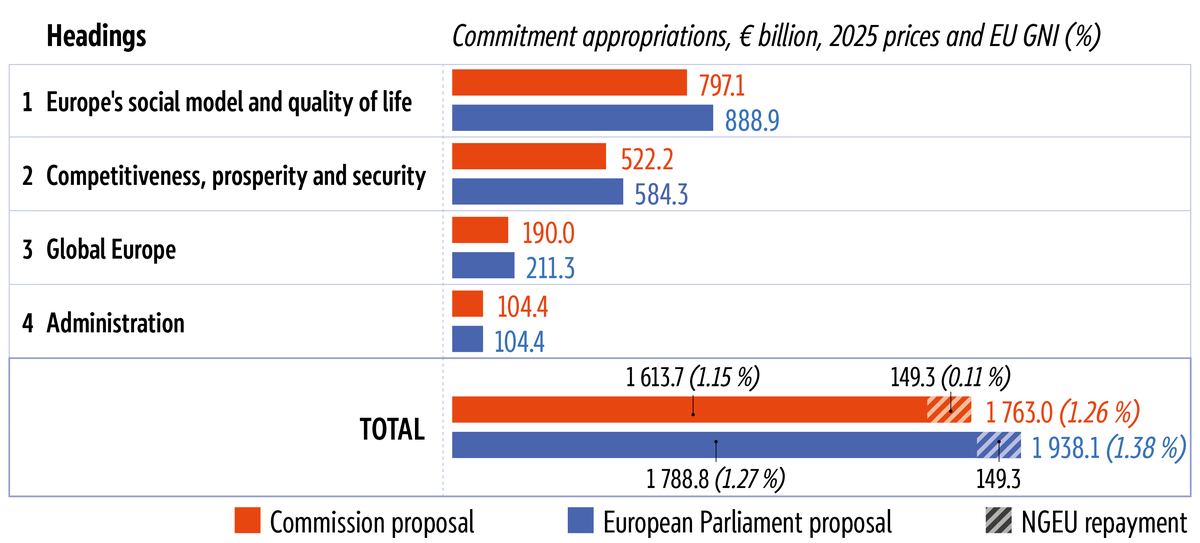
Data source: EPRS, compiled by the author based on the European Parliament interim report, April 2026.
On the Council's side, discussions are ongoing. The Irish Presidency intends to present a new negotiating box by the October European Council meeting, but there are issues dividing Member States. The size of the budget, the allocations to different policies and the introduction of new own resources are expected to be key to the discussions, made all the more difficult as this file requires unanimous agreement in the Council. The Council aims to have an agreement on the next MFF before the end of 2026; a final agreement requires Parliament's consent.
A new framework agreement between Parliament and the European Commission
Roberta Metsola and Ursula von der Leyen signed a revised framework agreement (FA 2026) between their two institutions on 28 April 2026. Von der Leyen's commitment to revise the 2010 FA was announced as she was running for reappointment. Ahead of her re-election as President of the Commission, she pledged to collaborate more closely with Parliament. Her promise was reaffirmed in the 2024 political guidelines.
The 2026 FA reflects post-Lisbon institutional developments, parliamentary reforms and increasing demands for transparency, accountability, and parliamentary scrutiny of the Commission. It highlights the principle of equal treatment between Parliament and the Council, as well as the role of the Commission as honest broker aiming to strengthen interinstitutional cooperation, especially by ensuring the flow of comprehensive, timely and detailed information to Parliament. It aspires to reinforce the Commission's political accountability, including the regular attendance of Commissioners in Parliament. Next, it underscores the exceptional character of the emergency procedure under Article 122 TFEU available to the Commission, as well as a commitment to a predictable mechanism for fast-track decision-making. It also reaffirms Parliament's right of initiative under Article 225 TFEU, and the right to be transparently informed by the Commission regarding the negotiation of international agreements.
Reforming the European Union
Although Parliament has, in November 2023, triggered the process to reform the Treaties according to Article 48 TEU, by submitting to the Council a comprehensive blueprint inspired by the outcome of the Conference on the Future of Europe, this initiative has not been followed up by the European Council. While the process is somewhat stalled, the discussion on the need to reform the EU has not ceased, particularly in view of EU enlargement. In February 2024, Parliament highlighted the importance of preparing enlargement with institutional and financial reforms. In October 2025, Parliament reiterated this view by underlining that enlargement is a powerful 'geopolitical tool' and a long 'geo-strategic investment' needing to be preceded by reforms to enhance its efficiency.
This reform should tackle several institutional aspects such as the composition of Parliament, keeping it at a workable size, the composition of the Commission, safeguarding geographic and demographic balance, and the functioning of the Council's decision-making process through the adaptation of qualified majority voting to reflect new Member States but also to preserve the balance between larger and smaller countries. Parliament reiterated the need to reform MFF governance, moving to full co-legislative powers on the expenditure side and on the adoption of the MFF. Parliament observed also that the objectives of an institutional pre-enlargement reform can be achieved by activating the flexibility mechanisms already offered by the Treaties. In its resolution of November 2025 on the Draghi report, Parliament stressed the need to undertake Treaty reforms following the recommendations of the Conference on the Future of Europe.
Interinstitutional reference documents
- Framework Agreement on relations between the European Parliament and the European Commission, 12 May 2026.
- Joint declaration of the European Parliament, the Council of the European Union and the European Commission on the EU legislative priorities for 2026, 23 December 2025.
European Commission reference documents
- Commission work programmes: 2026, 2025.
- State of the Union address 2025.
- Political guidelines for the next European Commission 2024-2029, by candidate for President of the European Commission Ursula von der Leyen, European Commission, 18 July 2024.
A selection of European Parliamentary Research Service publications
- Anglmayer, I., Dalli, H. and Ioannides, I., 2026 Commission work programme, EPRS, European Parliament, November 2025.
- Ashton, D., European product act, EPRS, European Parliament, June 2026.
- Ashton, D. et Karamfilova, E., EU public procurement legislation: Implementation and upcoming review, EPRS, European Parliament, March 2026.
- Bąkowski, P., Understanding drug precursor control in the European Union, EPRS, European Parliament, June 2025.
- Baranik, K., 2026 Framework Agreement: Framework Agreement on relations between the European Parliament and the European Commission, EPRS, European Parliament, June 2026.
- Baranik, K., The 2026 State of the Union address, EPRS, European Parliament, September 2026.
- Bentzen, N., European democracy shield: An overview, EPRS, European Parliament, June 2025.
- Bentzen, N., European democracy shield, EPRS, European Parliament, June 2025.
- Caprile, A. and Cîrlig, C., EU sanctions against Russia 2025: State of play, perspectives and challenges, EPRS, European Parliament, February 2025.
- Clapp, S., Reinforcing the EU's defence industry, EPRS, European Parliament, March 2026.
- Clapp, S., European defence industry, EPRS, European Parliament, February 2026.
- Clapp, S., European defence readiness roadmap, EPRS, European Parliament, January 2026.
- De Luca, S., Digital networks act, EPRS, European Parliament, May 2025.
- Dobreva, A., Kowald, K., Mazur, S., Pari, M. and Peters, T., Budgetary Outlook for the European Union 2026, EPRS, European Parliament, July 2026.
- Dumbrava, C., State of the Schengen area, EPRS, European Parliament, May 2025.
- Immenkamp, B., Strengthening Europol's mandate, EPRS, European Parliament, May 2025.
- Hallak, I., European competitiveness fund, EPRS, European Parliament, November 2025.
- Jensen, L., Amending the European Climate Law, EPRS, European Parliament, September 2025.
- Jütten, M., Clean trade and investment partnerships – A new instrument in the EU's trade policy toolbox, EPRS, European Parliament, April 2025.
- Kowald, K. and Pari, M., 2028-2034 EU budget: Parliament's position, EPRS, European Parliament, April 2026.
- Mańko, R., Legal bases in Article 122 TFEU: Tackling emergencies through executive acts, EPRS, European Parliament, April 2025.
- Mańko, R., The Commission's annual rule of law reports: Five years on (2020-2025), EPRS, European Parliament, December 2025.
- Pape, M., Towards a quality jobs act, EPRS, European Parliament, July 2026.
- Pape, M., A coordinated EU approach to housing, EPRS, European Parliament, May 2025.
- Pari, M. and Cuyvers, T., 2028-2034 EU budget: Comparing Parliament's position with the Commission proposal, EPRS, European Parliament, April 2026
- Radjenovic, A., A common system for the return of third-country nationals staying illegally in the European Union, EPRS, European Parliament, March 2025.
- Ragonnaud, G., Deepening the single market in the light of the Letta and Draghi reports, EPRS, European Parliament, October 2024.
- Šajn, N., Regulation on the common agricultural policy for the period 2028 to 2034, EPRS, European Parliament, December 2025.
- Šajn, N., CAP simplification package: Omnibus on agriculture, EPRS, European Parliament, July 2025.
- Scholaert, F., Conditions for EU support to the CFP (2028-2034 programming period), EPRS, European Parliament, October 2025.
- Sheil, S., The policy priorities of the von der Leyen II Commission: State of play in March 2026, EPRS, European Parliament, March 2026.
- Sheil, S., The policy priorities of the von der Leyen II Commission: State of play ahead of the 2025 State of the Union address, EPRS, European Parliament, September 2025.
- Szczepański, M., New EU economic security doctrine, EPRS, European Parliament, June 2025.
- Widuto, A., Phasing out Russian fossil fuel imports, EPRS, European Parliament, November 2025.
- Yougova, D., Union Civil Protection Mechanism: 2028-2034 programming period, EPRS, European Parliament, January 2026.
Classification
Policy areas: Agriculture and Rural Development | Budget | Democracy | Economics and Monetary Issues | Environment | EU Democracy, Institutional and Parliamentary Law | Food Safety | Security and Defence | Social Policy
Committees: Budgets (BUDG), Economic and Monetary Affairs (ECON), Employment and Social Affairs (EMPL), Environment, Climate and Food Safety (ENVI), Agriculture and Rural Development (AGRI), Legal Affairs (JURI), Security and Defence (SEDE), Public Health (SANT), European Democracy Shield (EUDS)
Statement on the use of AI
Any AI-generated content in this text has been reviewed by its author(s).
Disclaimer
This document is prepared for, and addressed to, the Members and staff of the European Parliament as background material to assist them in their parliamentary work. The content of the document is the sole responsibility of its author(s) and any opinions expressed herein should not be taken to represent an official position of the Parliament.
Copyright
© European Union.
The reuse of this document is authorised under a Creative Commons Attribution 4.0 International (CC-BY 4.0) licence.

https://creativecommons.org/licenses/by/4.0/deed.en
To use or reproduce elements that are not owned by the European Union, permission may need to be sought directly from the respective rightsholders.