
Recasting the Directive regarding the European Investigation Order

Context
By recasting the Directive regarding the European Investigation Order (EIO), the European Commission is seeking to improve the cross‑border gathering of evidence in criminal matters. Key elements of the reform are clearer rules on cross‑border surveillance, including in situations of urgency; clearer regulation of the use of technical recording devices; more precise rules on the (re)use of evidence; and an updated EIO form.
Moreover, the Commission is proposing to introduce an entirely new European Union (EU) instrument of mutual recognition, a European Remote Participation Order (ERPO). The ERPO would provide a common framework for the remote participation of suspects, accused persons and victims who are parties to criminal proceedings in court hearings from another Member State.
The proposal is part of a set of new measures to strengthen the EU's response to an increasingly complex criminal landscape, which the Commission published on 24 June 2026. The Commission seeks to enhance the EU's capacity to prevent, investigate and prosecute serious cross‑border crime, by modernising the legal frameworks that govern cooperation between law enforcement, judicial and other relevant authorities.
The package includes two revised regulations, to strengthen the mandates of the EU Agency for Criminal Justice Cooperation (Eurojust) and the EU Agency for Law Enforcement Cooperation (Europol); amendments to the Data Protection Regulation for Union institutions and bodies; and the recast of the Directive regarding the EIO. The new measures are designed to ensure that police, customs, prosecutors and courts can work together more effectively across EU and external borders, to address the growing threat to European security.
Legislative proposal
2026/0172 (COD) – Proposal for a directive of the European Parliament and of the Council regarding the European Investigation Order in criminal matters and the European Remote Participation Order (recast) – COM(2026) 313, 23.6.2026.
Issue
The European Investigation Order (EIO) is a judicial cooperation instrument used to obtain evidence in criminal matters across European Union (EU) Member States (except Denmark and Ireland). Available data indicate a steady rise in the use of the EIO since it was introduced by Directive 2014/41/EU on the European Investigation Order in criminal matters (the EIO Directive), which has applied since 22 May 2017 and has generally been found to work well. Nevertheless, recent reports from Member States, the European Union Agency for Criminal Justice Cooperation (Eurojust), the European Judicial Network, as well as case law of the Court of Justice of the European Union (CJEU) have drawn attention to differences in national practice and areas requiring clarification.
The European Commission proposes to recast the EIO Directive, to clarify the rules on cross‑border surveillance, the use and onward transfer of evidence, and the issuing of an EIO. The proposal would also establish a new mutual recognition instrument, a European Remote Participation Order (ERPO), to provide a common framework for the remote participation of suspects, accused persons and victims who are parties to criminal proceedings in court hearings from another Member State.
Stakeholders have drawn attention to the importance of ensuring the protection of fundamental rights and personal data, as well as fair trial guarantees in the proposed directive.
Main points of the proposal
European Remote Participation Order
The creation of the ERPO is the most significant change introduced by the proposed directive, since it would create a new legal basis for the remote participation of a party in a criminal court hearing in cross‑border situations.
Obtaining evidence through a remote hearing
The EIO Directive currently provides for a specific investigative measure to obtain evidence that involves hearings by videoconference or other audiovisual transmission (Article 24) as well as by telephone (Article 25). If the competent authority of a Member State wants to hear a witness, an expert, a suspect or an accused present in another Member State, the competent authority may issue an EIO to hear that person by videoconference or other audiovisual transmission. Witnesses and experts can also be heard by telephone.
The final report on the 10th round of mutual evaluation ('final report', see also below) found that the hearing of witnesses, experts, suspects and accused persons via videoconference, as regulated by Article 24 of the EIO Directive, is an investigative measure that is frequently requested and executed during both the investigative and trial phases. The report describes hearings by videoconference in criminal proceedings as an innovative approach that has revolutionised how evidence is obtained and presented, enhancing the efficiency of judicial systems and accelerating justice.1
However, the EIO Directive does not make provisions for the remote participation of a party in a criminal court hearing. Article 1(1) of the EIO Directive states that an EIO ... is issued to have one or several specific investigative measure(s) carried out in another Member State to obtain evidence. The EIO was not conceived to facilitate the remote participation of suspects, accused persons and victims of crime in the main trial by videoconference from another Member State.
Nevertheless, the final report found that several Member States issue EIOs for that purpose. However, other Member States take the view that an EIO may never be issued and executed for the hearing of an accused person by videoconference to ensure their participation in the main trial from another Member State, even if the accused person consents. Some Member States also never allow the issuing and execution of EIOs for the hearing of an accused person at the trial phase for evidentiary purposes, irrespective of their consent.
Remote participation in court proceedings
The proposed directive would introduce a new instrument of mutual recognition – an ERPO – to enable a suspect, an accused person, or a victim of crime who has the status of party to criminal proceedings to participate in one or more court hearing(s) in criminal proceedings remotely by means of videoconferencing or other distance communication technology from another Member State (Article 36). The proposal sets out the conditions for issuing and transmitting an ERPO (Article 37); the procedure for seeking the consent of the person concerned (Article 38); requirements and practical arrangements for the execution of an ERPO (Article 42); the grounds for non‑recognition and non‑execution (Article 43); procedural rights and safeguards (Article 49); and legal remedies (Article 50).2
Collection of evidence versus remote participation in proceedings
The proposed directive includes amendments to emphasise the distinction between the two types of situation in which videoconferencing can be used. The EIO remains the appropriate instrument for hearings by videoconference involving a suspect or an accused person for the purposes of gathering evidence (Article 24(1)), such as to establish the relevant facts with regard to the existence of a criminal offence, the circumstances in which the offence was committed, or the identity of the perpetrator.
By contrast, an ERPO is to be issued from now on to organise remote participation for the full participation in all types of criminal court hearings at both the pre‑trial and trial stage from another Member State, as appropriate, depending on whether the person concerned is a suspect, an accused person or a victim of crime. The distinction between an EIO and an ERPO has significant consequences in terms of rules, safeguards and procedures.
Figure 1 below illustrates the possibilities set out by law for various actors to use distance communication technology (such as videoconferencing) for court and court‑related procedure in criminal cases in all EU Member States. Most Member States consider evidence filled in digital format only to be admissible, and allow remote hearings for experts, parties, defendants, victims and witnesses. However, fully remote oral proceedings are generally not possible (partly possible only in Bulgaria and Poland). The data do not indicate whether the rules also apply to cross‑border cases.

Consent to use information as evidence
Law enforcement or judicial authorities often share information that has not yet been designated as formal evidence in court proceedings.
The exchange of information between Member States' law enforcement authorities is regulated by Directive (EU) 2023/977, which established harmonised rules for the adequate and rapid exchange of information between the competent law enforcement authorities for the purpose of preventing, detecting or investigating criminal offences. By contrast, the spontaneous exchange of information between judicial authorities takes place under the Convention on Mutual Assistance in Criminal Matters between the Member States of the European Union (the Convention). Article 7 of the Convention provides that the competent authorities of the Member States may exchange information, without a request to that effect, relating to criminal offences and the infringements of rules of law.
The EIO Directive currently lacks a provision that allows authorities to request the use of information previously shared between the authorities of different Member States as evidence in criminal proceedings. The proposed directive includes a new article, Article 35, that establishes a procedure for requesting such consent.
Subsequent use and onward transfer of information/evidence
The speciality principle plays a crucial role in international cooperation in criminal matters, including in the context of mutual legal assistance, which is aimed at the cross‑border collection and use of information and evidence. The speciality principle is a purpose‑limitation rule according to which:
the requesting Party shall not forward or use information or evidence obtained from the requested Party for investigations, prosecutions or proceedings other than those referred to in its request without the prior consent of the requested Party.3
The EIO Directive currently does not expressly regulate the rule of speciality, and Member States' views have diverged on whether it applies in the context of the EIO Directive. Some Member States consider that, when executing an EIO, evidence may only be used for the purpose of that specific investigation ; others make no mention, but assume the evidence will not be used for another purpose. Some Member States consider permission must always be sought from the executing Member State before evidence is used in a different case; others consider this step unnecessary.4
The proposed directive introduces clear rules on the circumstances under which information or evidence obtained through an EIO may either be used for another purpose or transferred to another Member State, a non‑EU country or an international organisation (Article 21). If the domestic law of the Member State that provides the information or evidence imposes conditions limiting the use of the information or evidence for purposes other than those for which it was gathered, that Member State has to inform the receiving Member State. That Member State, before using the information or evidence for another purpose, has to obtain the consent of the Member State that provided the information. Consent has to be sought always before the information is passed on to another Member State, a non‑EU country or an international organisation.
Cross‑border surveillance
Clear legal basis for cross‑border surveillance for evidentiary purposes
The EU Treaties have established an area of Freedom, Security and Justice (AFSJ) in which national police and judicial authorities retain full responsibility for law enforcement and criminal justice in their respective Member State. At the same time, the Treaties established the legal basis for 'measures for coordination and cooperation between police and judicial authorities and other competent authorities, as well as through the mutual recognition of judgments in criminal matters and, if necessary, through the approximation of criminal laws'. The Schengen framework has removed internal border controls, while providing police and judicial authorities with special powers and procedures for cross‑border cooperation, including information exchange, cross‑border surveillance and pursuit, and assistance in criminal investigations and proceedings.
Article 40 of the Convention implementing the Schengen Agreement (CISA) regulates cross‑border surveillance as a measure of police cooperation. The final report of the 10th round of mutual evaluations revealed that the relationship between the EIO Directive and the CISA is 'quite problematic' in the area of cross‑border surveillance, and that Member States follow different approaches and practice. The evaluation found that some Member States consider cross‑border surveillance to be a measure of police cooperation under Article 40 of the CISA (rather than the EIO Directive), while others treat it as a judicial investigative measure and as a means of gathering evidence, to which the EIO Directive applies. The 59th plenary meeting of the European Judicial Network, held in Prague on 9‑11 November 2022, identified cross‑border surveillance of persons and items as 'one of the biggest problems in international cooperation'.
Article 30 of the proposed directive addresses the above inconsistencies by introducing a new framework for surveillance carried out in person by law enforcement officers operating technical means for the purpose of gathering evidence that continues across national borders. Moreover, Article 30(1) defines the conditions for such evidentiary surveillance, which has to 'consist of the observation of a person or object by law enforcement officers and involves the creation of audio, visual, or other records by technical means operated by law enforcement officers for the purpose of obtaining evidence'.
The duration and practical arrangements for the cross‑border surveillance, including the use of technical means and the modalities governing the conduct of the officers involved, are to be agreed between the competent authorities of the issuing state and the executing state. Law enforcement officers of the issuing state conducting the cross‑border surveillance must act solely for the purpose of observation and documentation of the cross‑border surveillance, must not exercise coercive powers, and must not enter private premises in the territory of the executing state (Article 30(4)).
The executing authority – i.e. the competent authority of the Member State in which the surveillance takes place – may make its consent subject to any conditions that would apply in a similar domestic case, and may refuse it altogether where the investigative measure would not have been authorised in a similar domestic case.
Cross‑border surveillance in situations of urgency
Cross‑border law enforcement cooperation can not function properly if officers have to invariably stop at the national border, even in situations of urgency. The CISA sets out baseline rules on the conduct of cross‑border hot pursuit by law enforcement officers of an individual caught in the act of committing or participating in a relevant offence (Article 41).
The proposed directive complements the CISA by introducing the possibility of continuing surveillance for the purpose of obtaining evidence in urgency situations, while the competent authority in the Member State on whose territory the surveillance takes place considers the application for an EIO.
Article 30(6) provides that:
where, on the grounds of duly justified urgency, it is not possible to issue and transmit an EIO before the person or object under surveillance enters the territory of the executing State, the law enforcement officers of the issuing State may continue cross‑border surveillance on the territory of the executing State.
Strict conditions apply, including notifying the authority competent for the receipt of urgent notifications immediately after the law enforcement officers of the issuing state have crossed the border. Urgent cross‑border surveillance must be carried out in compliance with any instructions issued by the competent authorities of the executing state. Moreover, an EIO must still be issued and transmitted to the executing authority no later than 48 hours after the crossing of the border, stating the reasons why its prior transmission was not possible. The cross‑border surveillance has to cease as soon as the executing authority so requests, or where the recognition or execution of the EIO is refused. Where the recognition or execution of the EIO is refused or the provisional execution of cross‑border surveillance is otherwise not permitted, any material obtained from the cross‑border surveillance may be used only where strictly necessary to prevent an immediate and serious threat to public security, and the executing authority must be notified of any such use and of the reasons thereof.
This measure would reduce procedural interruptions that can undermine the practical utility of an EIO in urgent cases.
Interception of telecommunications
The 10th round of evaluations found that the main issue concerning the interception of telecommunications as an investigative measure in cross‑border situations is the lack of a uniform definition of the concept of 'interception of telecommunications'. The EIO Directive does not define the term, nor does any other piece of EU legislation. In the absence of a uniform understanding of the term, practitioners disagree on whether certain investigative measures, such as GPS tracking, 'bugging' vehicles, installing spyware on a device to intercept conversations at source, or audio/video surveillance, fall within the concept of 'interception of telecommunications'. This uncertainty has caused difficulties in the past, especially as regards the notification requirements under Articles 30 and 31 of the EIO Directive, since Member States have adopted different approaches and interpretations.
The proposed directive introduces a definition of 'telecommunications' (Article 2(1)(g)) as meaning 'any communications, including both the content of the communication and associated data, transmitted through electronic communications networks, as defined in Article 2, point (1), of Directive (EU) 2018/1972 of 11 December 2018 establishing the European Electronic Communications Code,5 or 'electronic communications services' as defined in Article 2, point (4), of that Directive'.6
However, the proposed directive does not include in its operative provisions a separate definition of the concept of 'interception of telecommunications'. Guidance on the interpretation and scope of this investigative measure can be found in recital 46 of the proposed directive, which notes that the term 'interception of telecommunications' applies only to measures 'specifically directed at acquiring communications in transmission through electronic communication networks or services'. According to recital 46, this is to be treated as distinct from the installation of a technical recording device (see below).
Moreover, the proposed directive clarifies the rules on the interception of telecommunications in cross‑border situations. A distinction is drawn between situations in which the technical assistance of the executing Member State or States is needed (Article 31), and situations where it is not (Article 33). In the latter case, the investigating Member State nevertheless has to notify the Member State in which the interception takes place. If the interception of telecommunications that has been requested would not be authorised in the Member State in which the interception takes place, that Member State can inform the investigating state within 96 hours that the interception may not be carried out or that it has to be terminated. Moreover, the notified Member State may impose restrictions or conditions on the use of material that has already been intercepted, or require it to be deleted (Article 33(4)).
The proposed directive clarifies also that interception of telecommunications cannot continue beyond certain time limits indicated in the original EIO. If interception has to continue, a new EIO has to be issued (Article 31(7)).
Use of technical recording devices in cross‑border surveillance
The proposed directive introduces new provisions governing the use of a 'technical device7 enabling the collection of location, audio or visual data' in cross‑border surveillance situations (Article 28(1)(d)), as an investigative measure implying the gathering of evidence in real time, continuously and over a certain period of time (Article 28).
Recital 46 states clearly that the interception of telecommunications and the use of technical recording devices are two separate investigative measures:
The transmission of data collected by technical recording devices through electronic communications networks or services for the purpose of storing such data should not, in itself, qualify the measure as the interception of telecommunications.
The proposed directive explicitly regulates the situation where the competent authority of one Member State authorises use of a technical recording device, and that technical recording device enters the territory of another Member State from which no technical assistance is needed to continue its use (Article 34).
The proposed directive envisages that the Member State that did not authorise the use of the technical recording device but on whose territory it is being used can refuse the use of a technical recording device if this would not be authorised in a similar domestic case. Moreover, if the competent authority of the Member State authorising the use of a technical recording device knows that the device will be used in another Member State, it needs to notify the other Member State at the time of ordering the use of the technical recording device. Alternatively, notification has to take place as soon as it becomes known that the technical recording device is, or will be, on the territory of the other Member State.
Definition of an 'issuing authority'
Article 2 of the EIO Directive defines an 'issuing authority' for the purposes of an EIO. It provides that the issuing authority can be a judge, a court, an investigating judge or a public prosecutor (Article 2(1)(c)(i)), or 'any other competent authority as defined by the issuing State, which is acting in its capacity as an investigating authority in criminal proceedings with competence to order the gathering of evidence in accordance with national law' (Article 2(1)(c)(ii)), for example, the police or an administrative authority.
In situations in which the national law of a Member State requires an investigative measure to be issued by a judicial authority, this has led to problems with the execution of an EIO when the issuing authority (of the other Member State) was a public prosecutor, a law enforcement authority or any other authority, and the EIO had not been validated by a judicial authority.
In several cases brought before the CJEU, the Court provided clarification of the concept of 'issuing authority' and related procedural requirements.8 However, the final report on the 10th round of mutual evaluations found that some Member States have not fully amended their national legislation to comply with the CJEU's judgments. This has led to different procedural requirements in different Member States.
The Commission proposed to amend Article 2 by introducing uniform rules in situations in which the issuing authority is a public prosecutor or 'any other competent authority'.
Proposed amendments to Article 2(1)(c)(ii) clarify the rules that apply if the issuing authority for an EIO is the public prosecutor, noting that 'where national law requires prior authorisation by a judge, court or investigating judge for the investigative measure concerned and no such authorisation has been obtained in accordance with national procedures, before it is transmitted to the executing authority the EIO shall be validated by a judge, court or investigating judge'.
Article 2(1)(c)(iii) clarifies the rules that apply where the issuing authority is 'any other competent authority', adding safeguards that require validation by a judge, court or investigating judge.
Moreover, Article 2 introduces new rules to cover the issuing of an ERPO.
Improving the EIO form
The proposed directive includes amendments to the EIO form, which is used by the issuing authority to request the assistance of the executing authority. Among other changes, in relation to certain investigative measures, the issuing authority would need to provide reasons why the requested measures are relevant for the purposes of the criminal proceedings. The issuing authority has to provide information on whether a connection exists between the EIO and EIOs (or other judicial cooperation requests) issued in relation to other investigations or proceedings. The form would also show more clearly whether a judge or another judicial authority authorised the measure, the stage of the investigation or proceedings, why the matter is urgent, and what legal remedies are available.
Decentralised information technology (IT) system
The Commission proposes that all official communication relating to EIOs and ERPOs between authorities, including the transmission of EIO and ERPO forms, 'should, as a rule, be carried out through the decentralised IT system' established by Regulation (EU) 2023/2844, to ensure a swift, direct, interoperable, reliable and secure exchange of data.9 A decentralised IT system is a network of IT systems and interoperable access points, operating under the individual responsibility and management of each Member State, Union body or agency, that enables the secure and reliable cross‑border exchange of information.
Access to the decentralised IT system is to be ensured through e‑CODEX, the e‑justice Communication via Online Data Exchange system. e‑CODEX is a computerised system for the cross‑border electronic exchange of data in the area of judicial cooperation in civil and criminal matters. Established by a dedicated regulation, Regulation (EU) 2022/850 of 30 May 2022, the e-CODEX system, is considered the 'flagship' project of EU e‑justice: a decentralised system that provides an interoperable solution for cross‑border exchanges of judiciary data, thus allowing all Member States, including citizens, businesses and legal professionals, to communicate with each other using their existing national systems.
The general reliance on the decentralised IT system is subject to the exceptions and alternative means of communication provided by Article 51(2), particularly relevant in urgent operational contexts.
Parliament's prior position
In its capacity as co‑legislator, the European Parliament supported the adoption of the EIO Directive in 2014, voting in favour of the creation of a single instrument on gathering cross‑border evidence. Parliament wanted to see a broad scope for the instrument, covering almost all investigative measures, including hearings, searches and surveillance. Parliament was explicitly in favour of using the EIO to obtain information on banking and other financial operations, on the content of telecommunications as well as traffic and location data associated with such telecommunications, and for covert investigations. At the same time, Parliament insisted on strong safeguards and limits, including the protection of fundamental rights, clear grounds for refusal of the execution of an EIO, proportionality and legality checks, and the availability of legal remedies. Parliament has adopted no stand‑alone resolutions specifically dedicated to the EIO since the adoption of the EIO Directive.
Prior positions of other EU institutions
Council
The Presidency of the Council, assisted by the General Secretariat of the Council, coordinates mutual evaluations of the application and implementation at national level of EU instruments and international legal acts and instruments in criminal matters. This is done on the basis of 97/827/JHA: Joint Action of 5 December 1997 adopted by the Council establishing a mechanism for evaluating the application and implementation at national level of international undertakings in the fight against organised crime. Experts carry out the peer evaluations.10
The 10th round of mutual evaluations,which took place between 2023 and 2024, focused on the implementation of the EIO Directive. The final report was published on 10 December 2024 and has fed directly into the proposed directive.
The Council Working Party on Judicial Cooperation in Criminal Matters deliberated on the proposal on 8 and 22 July and on 2, 28 and 29 September 2026.
Preparation of the proposal
In the European internal security strategy (ProtectEU), published on 1 April 2025, the Commission announced it would 'assess the need to further strengthen the European Investigation Order', as part of efforts to equip the EU criminal justice system with effective tools to address emerging threats. On 6 January 2026, the Commission launched a call for evidence for an initiative to revise the EIO Directive. The call was aimed at stakeholders, including national authorities, legal practitioners, non‑governmental organisations (NGOs), and researchers. Stakeholders sent in 15 replies, and the feedback period ended on 3 February 2026.
The Commission did not publish an impact assessment of the proposed directive. However, on 2 October 2026, the Commission published a staff working document 'to explain the problem, the objectives of the proposal, the chosen policy approach and the consultation activities carried out'. The staff working document also analyses the proposed solution in the light of its impacts on effectiveness, efficiency, fundamental rights and coherence with other EU instruments for cross‑border judicial cooperation.
In 2023, the Commission launched the High‑Level Group (HLG) on Access to Data for effective law enforcement. Co‑chaired by the Commission and the Presidency of the Council, the HLG explored challenges that law enforcement practitioners in the Union face in their daily work in connection to access to data. The final report, published on 15 November 2024, included a recommendation to enhance the role of the EIO in requests for cross‑border lawful interception of data.
Points of view
European Data Protection Supervisor
On 10 August 2026, the European Data Protection Supervisor (EDPS) issued an opinion on the proposed directive.
The EDPS notes that evidence collected by way of an EIO will typically contain personal data such as information on bank and other financial accounts, banking and other financial operations, real‑time geolocation, audio or visual data and telecommunications data. The EDPS stresses that, for these reasons, the proposed directive has a 'significant impact on the lives of the individuals concerned and their rights to privacy and to the protection of personal data'.
The EDPS made several recommendations, including:
-
clarifying the roles of the actors who may be involved in processing personal data under the proposed directive, taking into account Regulation (EU) 2023/2844 on the digitalisation of judicial cooperation and access to justice in cross‑border civil, commercial and criminal matters;
-
specifying that personal data obtained prior to the decision refusing the recognition or execution of an EIO should be deleted immediately, unless it is strictly necessary to prevent an immediate and serious threat to public security;
-
clarifying that any means of transmission need to ensure an adequate level of security of the communicated personal data.
Fair Trials NGO
Fair Trials NGO has welcomed the Commission's proposal to revise the EIO, and expressed satisfaction that the Commission took into consideration several of its earlier recommendations.11
Fair Trials welcomes several aspects of the proposal, including the creation of a dedicated framework for cross‑border remote participation in criminal proceedings and the inclusion of important safeguards and remedies aimed at protecting the rights of suspects and accused persons, such as confidential communication with lawyers and measures to support effective participation in remote hearings.
At the same time, Fair Trials notes that the proposal raises questions regarding safeguards in the context of cross‑border evidence gathering, including in relation to consent and the expanded use of investigative powers. Fair Trials considers that there remains scope to strengthen the protection of fundamental rights and fair trial guarantees in the proposed directive.
On 1 October 2026, Fair Trials launched a new project – 'Absent Rights' – on the right to be present at trial.
Background information
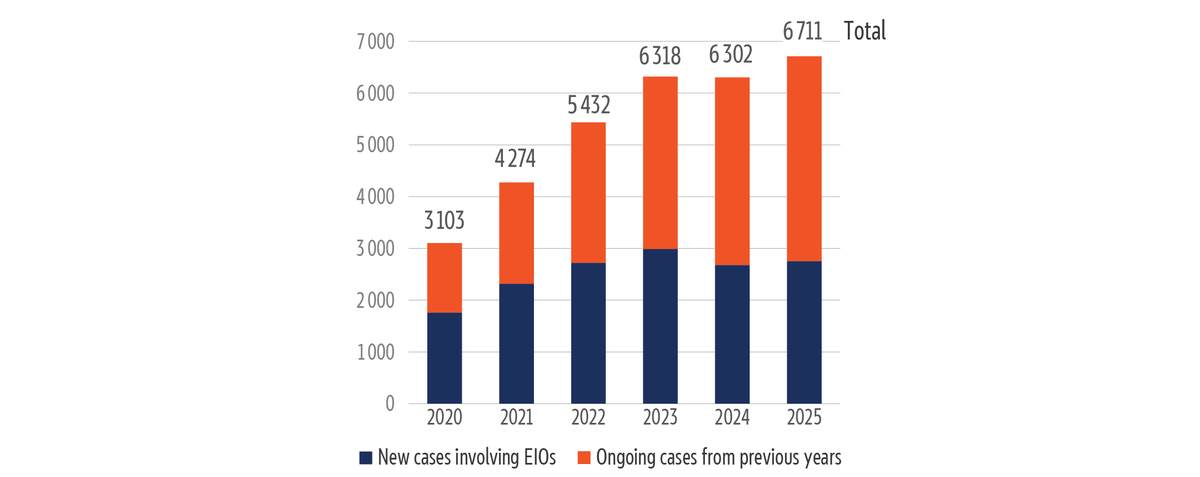
Little statistical data on the implementation of EIOs exist, as most Member States do not provide comprehensive statistics. The only such information available concerns EIOs in which Eurojust has been involved. The number of EIOs involving Eurojust has overall increased. Eurojust's annual reports from 2020 to 2025 provide an overview of new Eurojust cases and ongoing Eurojust cases from previous years involving EIOs. The number of new cases each year involving EIOs has risen from 1 757 in 2020 to 2 751 in 2025. The number of ongoing cases involving EIOs carried over from previous years has also substantially increased, from 1 346 in 2020 to 3 960 in 2024. The total number of Eurojust cases involving EIOs has more than doubled in six years (see Figure 2).
However, Eurojust is not involved in all EIOs, and there is no provision, under the EIO Directive, requiring Member States to provide statistical information to the Commission on the number of EIOs issued and/or executed. The proposed directive would require Member States to collect comprehensive statistics to allow the Commission to monitor the application of the proposed directive, including (i) the number of EIOs – and urgent notifications under Article 30(6), point (a), in the context of cross‑border surveillance – transmitted by the issuing state; and (ii) the number of EIOs executed by the executing state (Article 55(2) points (a) and (b)). The proposed directive would also introduce reporting requirements for the ERPO, including the number of ERPOs transmitted by the issuing state, the number of ERPOs recognised, executed or refused (Article 55(2) points (g) to (j)).
European Parliament supporting analysis
- Immenkamp, B., European Investigation Order, pre‑legislative briefing, EPRS, European Parliament, May 2026.
Endnotes
Classification
Policy areas: Area of Freedom, Security and Justice
Committees: Civil Liberties, Justice and Home Affairs (LIBE)
Statement on the use of AI
Any AI‑generated content in this text has been reviewed by the author. ChatGPT was used to research and summarise background information and improve readability.
Disclaimer
This document is prepared for, and addressed to, the Members and staff of the European Parliament as background material to assist them in their parliamentary work. The content of the document is the sole responsibility of its author(s) and any opinions expressed herein should not be taken to represent an official position of the Parliament.
Copyright
© European Union.
The reuse of this document is authorised under a Creative Commons Attribution 4.0 International (CC-BY 4.0) licence.

To use or reproduce elements that are not owned by the European Union, permission may need to be sought directly from the respective rightsholders.